The Mighty FTU
What do Mass, Energy, and Time have in Common?
The Mighty FTU
What Do Mass, Energy, and Time Have in Common?
The FTU.
A tiny little superhero in the world of physics.
Do not mistake size for strength.
Like the cartoon character Mighty Mouse, this tiny little guy can flex some serious muscle.

Mighty Mouse
Mass, energy, and time are not different things.
They are all behaviors of an FTU.
What exactly is an FTU?
Let’s unveil the most comprehensive view of one ever seen.
The Mighty Mouse of Physics
FTU stands for Field Transition Unit and is grounded in the notion that reality comprises three angles: Before, During, and After.
Fₜᵤ = B ∘ D ∘ A
An FTU is not a particle, like a photon or an electron.
It is a cube.
See the following article for the genesis of this idea:
[embed]Wave-Particle Duality: The False God Of waves, particles, and cubesmedium.com
This cube is built on two main bastions:
- The constants of the universe
- The exponents of the speed of light
Together, these two bastions are the core of the mighty FTU’s superpowers.
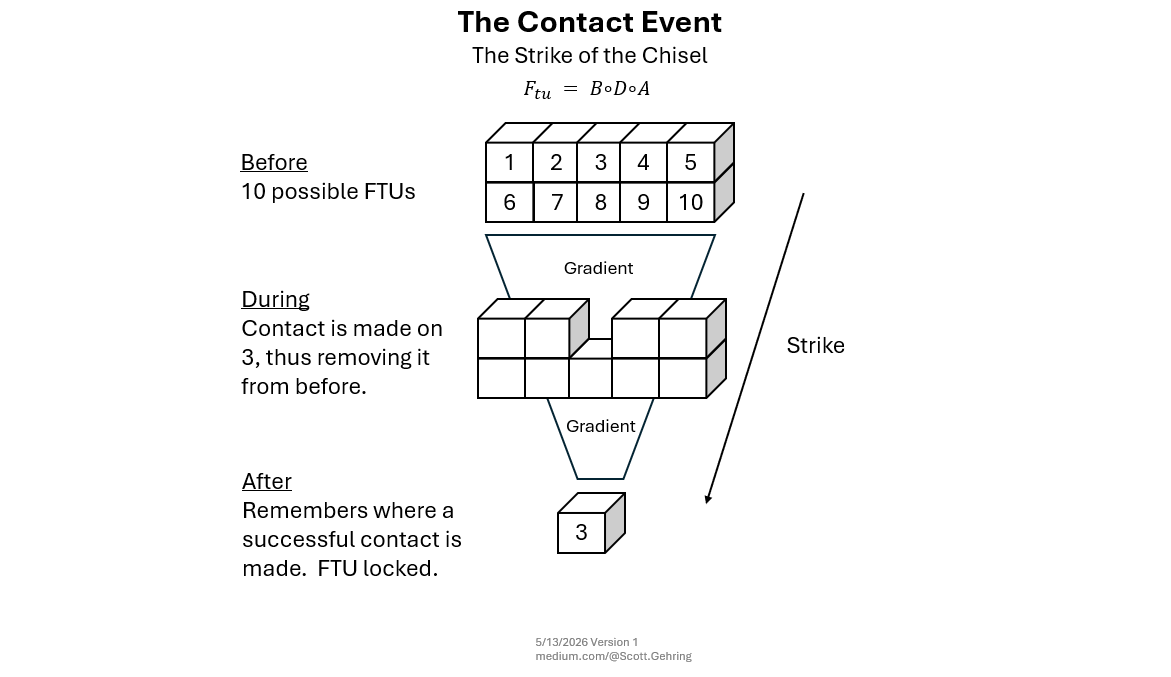
What this construct gives us is the progression from uncertainty to partial certainty to full certainty, all within a single object.
Thus, it has an inherent arrow, or in a physics sense, a gradient.
Parts of the FTU have been defined in various other precursor articles on the Phase Manifold Model, but none are as comprehensive as the diagrams of this object you are about to see, starting with Diagram 1:

Diagram 1 — Constants and Speed of Light Exponents
Like Mighty Mouse, there is a lot of power packed into this little package, so let’s break it down.
The Construction
The main structure of the FTU is based on three key constants:
The speed of light (c ≈ 299,792,458 m/s), Boltzmann (kᵦ ≈ 1.38 × 10⁻²³ joules per kelvin), and Planck mass (mₚ ≈ 2.18 × 10⁻⁸ kg).
Each of these constants is the specified hard, measurable boundary condition for the FTU walls.
They are the basis for constructing the cube.
See the article for more on the role of constants:
[embed]The Universe’s Train Tracks: Why Constants Exist The railway of realitymedium.com
In addition, the FTU is an asymmetrical object.
Meaning before, during, and after are not just geospatial dimensions, like a classic 3D cube; they have inherent directionality.
What provides that directionality? The speed of light, c.
But more specifically, not the c itself, but the exponent of c. These are defined like a ladder.
As such:
c⁰ → c¹ → c² → c³
See the following article for more details on the Ladder of Light:
[embed]The Ladder of Light From Possibility to Persistencemedium.com
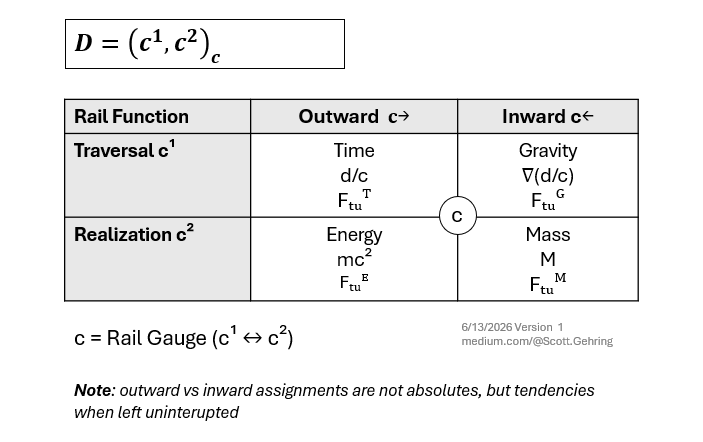
Taken together, the constants and the speed-of-light exponent give us the mathematical definition of the FTU boundaries.
Defined as such:
Before = B = (c⁰)ₘₚ
During = D = (c¹,c²)꜀
After = A = (c³) kᵦ
These formulas create the three walls of the FTU, with the constants as the gauges and the speed-of-light ladder as the internal gradient that gives it flow.
The FTU is Primitive
The original intuition about the FTU was that it was primarily temporal.
In human terms, after all, before, during, and after can be directly felt as constructs of time.
This is why the early heuristic of the BDA concept was expressed as:
T ≈ B ∘ D ∘ A
Where T = Time.
And when contrasting BDA with the classical physics of the special theory of relativity, time can be easily substituted into the E=mc² equation.
[embed]The Bridge of Time E=mc² and the Phase Manifold Connectionmedium.com
However, if one keeps digging into the logic and implications of the FTU construct, one quickly realizes that its significance extends beyond time alone.
The FTU appears to provide a common origin from which time, energy, and mass can be interpreted as different readouts of the same underlying event process.
In this view:
- Energy is the active execution of an FTU.
- Mass is the persistent record of completed FTUs.
- Time is the ordering and progression of FTU transitions.
This suggests a different perspective on the foundations of physics. Rather than treating time, mass, and energy as separate primitives, they may represent different aspects of a deeper event architecture.
The proposal is straightforward:
The FTU is the primitive. Mass, energy, and time are observable projections of that primitive.
If this interpretation is correct, physics may be describing the same underlying process through different measurement languages, with each language observing a different aspect of the same event.
Despite the different colors of Mighty Mouse’s suits, he is still, after all, a mouse.
The FTU Expanded Math
The following formula expands the current FTU definitions into different readouts of the same FTU.
The original FTU construct formula is defined as:
Fₜᵤ = B ∘ D ∘ A
Using the definitions from Diagram 1, an FTU coordinate system can be represented as such:
Fₜᵤᶜ = (B,D,A) = ((c⁰)ₘₚ, (c¹,c²)꜀, (c³)kᵦ)
Using the PMM Rosetta Stone translation table, we can then derive the mass, energy, and time qualities as such:
Mass = Fₜᵤᴹ = (mₚ, m, (kᵦT)/c²)
Energy = Fₜᵤᴱ = (mₚc², mc², kᵦT)
Time = Fₜᵤᵀ = (ℏ/(mₚc²), d/c, ℏ/(kᵦT))
The significance of these expressions is not that they introduce new physical quantities.
Instead, they are using existing forms and prescribing them to different read-out phases.
For example, the famous E=mc² squared equation is a During phase readout phenomenon.
Using the E from E=mc², a compact variation of energy readout would be:

Where:

Each term is already familiar within modern physics.
What is unusual is that mass, energy, and time emerge as different projections of the same Field Transition Unit.
In simple terms, they are one thing viewed from four different angles.
The mighty FTU has properties of a cube, flow, and a field, all in one. This seems strange. How is this possible?
The Gradient Hidden Inside the FTU
Every superhero needs a source of power.
For the FTU, that power comes from an unexpected place: the exponents of the speed of light.
Within the FTU, however, they serve a purpose. They create an ordered progression across the Before, During, and After phases.
In other words, they give the FTU an inherent direction.
Before corresponds to c⁰.
During occupies the interior rails c¹ and c².
After terminates at c³.
This progression creates a systemic gradient that runs through the entire construct.
Just as water flows downhill due to a difference in elevation, the FTU progresses due to a difference in c-order. The event naturally moves from lower-order states toward higher-order states.
c⁰ → c¹ → c² → c³
The result is an intrinsic ordering principle embedded directly into the geometry of the FTU.
This ordering is what allows the FTU to distinguish possibility from realization and realization from persistence.
It is what makes time feel like it is “flowing,” and gravity feel like it is “pulling.”
See the following article for more details on the relationship of time and gravity in PMM:
[embed]Time, Gravity, and the Sculpture of Infinity Nature is Michelangelo, the Universe is Davidmedium.com
Without the gradient, Before, During, and After would simply be three adjacent regions. With the gradient, they become a process.
The exponents transform the FTU from a geometric object into an event object.
The following diagram shows the gradient inherent within the FTU:

Diagram2 — FTU Gradient by way of c exponent
This is why the Ladder of Light plays such a central role in the model.
The ladder provides the progression that carries an event from uncertainty through interaction into recorded history.
See the following article for more on the FTU gradient effect:
[embed]The Molecule of Time How duration is built and why time flowsmedium.com
Once the FTU is viewed as an event field rather than a static cube, an interesting question emerges: how should such a field be observed?
Observable Perspectives on the FTU
Is B∘D∘A a process, an operator, or a quantity?
Answer: It is a field.
The BDA composition illustrates the field. The phases describe the field’s behavior. The constants govern the field’s response per phase.
Substitutions are simply different ways of reading the field through a particular phase window.
For example:
A spacetime interval:
ds² = gμν dxμ dxν
This reads the field through the active interaction window of the During phase.
Entropy:
S = kᵦ ln Ω
This reads the field through the recording behavior of the After phase.
Momentum:
p = mv
This reads the field through motion occurring inside the During window.
A probability amplitude:
P = |ψ|²
This reads the field through the transition between possibility and realization.
In each case, the equation is observing the same underlying field from a different perspective.
The FTU provides a common language beneath these equations.
From the PMM viewpoint, mass, energy, distance, probability, and entropy are different observables arising from the same underlying Before-During-After process.
Just as a mountain can be viewed from different sides without becoming a different mountain, the FTU can be viewed through different equations without becoming a different field.
The Tiny Superhero
Like Mighty Mouse, the FTU is deceptively small.
A simple three-part construct built from Before, During, and After.
Yet hidden inside that tiny arrangement is a complete event cycle.
The c-order gradient carries the event from possibility (c⁰), through interaction (c¹ and c²), into persistence (c³). What appears to be a static object is actually a continuously unfolding process.
Each traversal of the FTU produces a completed event:
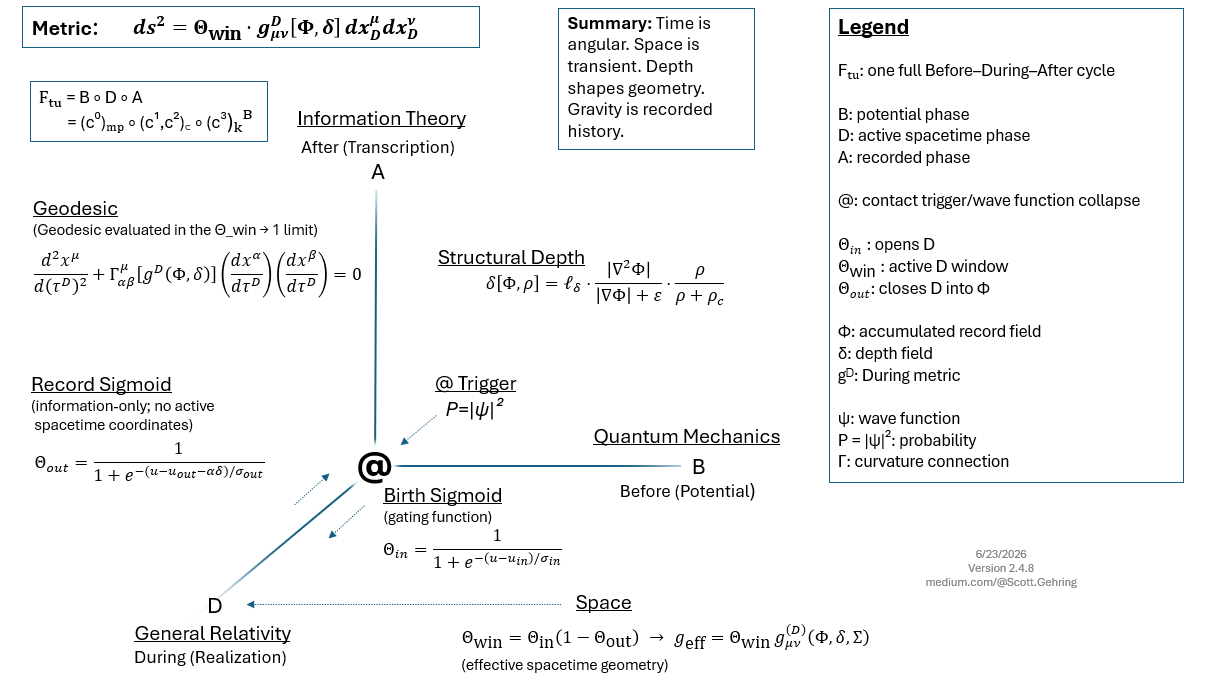
Fₜᵤ@ = Θ_con { B[Φ] → @ → Θ_in → D(Θ_win) → Θ_out → A(Φ′) }
The sequence begins in the Before phase, where possibilities exist as potential futures.
Contact (Θ_con) initiates the transition, opening the entry gate and allowing the event to enter the active window of the During phase.
For more on the role of contact, see the following article:
[embed]Contact is the Key🔑 Gravity. Quantum Mechanics. Time and Space.medium.com
@ is the wave-function collapse, the first step of post-contact behavior where reality snaps into existence.
As the exit gate rises, the event passes into the After phase, where the experience is written into history as an updated record, Φ’.
The following is an enhanced diagram that overlays the FTU dynamics onto Diagram 1.

Diagram 3 — FTU with Gate Dynamics
From this perspective, the FTU is not a particle, a wave, or a point in space. It is a unit of transition.
Perhaps mass, energy, and time were never separate characters in the story.
Perhaps they were different outfits worn by the same tiny superhero all along.
Quick Reference — the FTU one-pager
The following summarizes the formulas of the FTU:
# The Field Transition Unit (FTU) Basic Construct
Fₜᵤ = B ∘ D ∘ A

# Ladder of Light c-Scale
c⁰ → c¹ → c² → c³

# The Before Axis
B = (c⁰)ₘₚ

# The During Axis
D = (c¹,c²)꜀

# The After Axis
A = (c³) kᵦ

# FTU as Coordinate System
Fₜᵤᶜ = (B,D,A) = ((c⁰)ₘₚ, (c¹,c²)꜀, (c³)kᵦ)

# FTU Mass Readout
Fₜᵤᴹ = (mₚ, m, (kᵦT)/c²)

# FTU Energy Readout
Fₜᵤᴱ = (mₚc², mc², kᵦT)

# FTU Time Readout
Fₜᵤᵀ = (ℏ/(mₚc²), d/c, ℏ/(kᵦT))

# FTU Dynamics with Wave Function Collapse
Fₜᵤ@ = Θ_con{ B[Φ] → @ → Θ_in → D(Θ_win) → Θ_out → A(Φ′) }
About the Author
Scott grew up asking questions nobody around him could answer.
He found partial answers in dojos, in engineering labs, and in the back seats of cars staring at ancient light.
Technologist. Inventor. Martial artist.
linktr.ee/StrategicEngagementofForce
About — Scott Gehring — Medium
They Get Their Kicks — YouTube
TheyGetTheirKicks (@GetTheirKicks) / X (twitter.com)
Strategic Engagement of Force (@force_strategic) / X (twitter.com)
메타데이터
- post_id
- cc7dbdc4cb7a
- slug
- the-mighty-ftu-cc7dbdc4cb7a
- url
- https://medium.com/phase-manifold-model/the-mighty-ftu-cc7dbdc4cb7a
- canonical_url
- https://medium.com/phase-manifold-model/the-mighty-ftu-cc7dbdc4cb7a
- author_url
- https://medium.com/@Scott.Gehring
- status
- ok
- fetched_at
- 2026-06-14 13:58:26