Understanding Domain Adaptation in Sentence Transformers for Enhanced NLP Performance
Introduction
Understanding Domain Adaptation in Sentence Transformers for Enhanced NLP Performance
Introduction
In today’s rapidly evolving era of AI and Machine Learning, strong base models offer extraordinary capabilities across a wide range of tasks, most notably in Natural Languange Processing (NLP). However, to truly exploit their potential in specific real-world applications, we must acknowledge a critical challenge:
The inherent mismatch between the general knowledge embedded in these base models and the fine-grained, often highly specific characteristics of real-world target domains.
For Instance, In highly technical domains like Aviation, general models encounter difficulties which involving the analysis of flight reports, maintenance logs, or air traffic control communications, require an understanding of very specific protocols, jargon, and safety-critical language. This issues was highlighted by by Wang, Chou, Rouck, Tien, and Baumgartner, which demonstrates the necessity of specialized adaptation for optimal performance in such niche areas (Adapting Sentence Transformers For The Aviation Domain, 2023).
In the domain of healthcare, specifically when extracting information from patient notes or electronic health records (EHRs), general model could misinterpret highly specific medical terminology. A study on inflammatory bowel disease (IBD) demonstrates the need for novel domain-specific pre-training and entity-aware masking strategies with contrastive learning to adapt general language models for robust biomedical entity extraction from unstructured clinical text (as highlighted in research “Clinical entity-aware domain adaptation in low resource setting for inflammatory bowel disease” by Frontiers in Artificial Intelligence, 2024).
Furthermore, in HR recruitment, when processing resumes or job descriptions, a general model might struggle to accurately identify transferable skills, evaluate candidate suitability, or parse complex career paths. It may not grasp the subtle distinctions between similar-sounding roles (e.g., “Software Engineer” vs. “DevOps Engineer”), the importance of specific certifications (e.g., PMP, CFA), or the industry-specific jargon used to describe responsibilities and achievements (e.g., “managed Agile sprints,” “implemented CI/CD pipelines”). The informal, often bullet-pointed structure of resumes and the persuasive, keyword-rich language of job ads differ significantly from the structured prose a general model is accustomed to, potentially leading to missed qualified candidates or irrelevant matches. My ongoing work in this domain specifically investigates domain adaptation approach to achieve more robust job-resume matching. Further details will follow shortly.
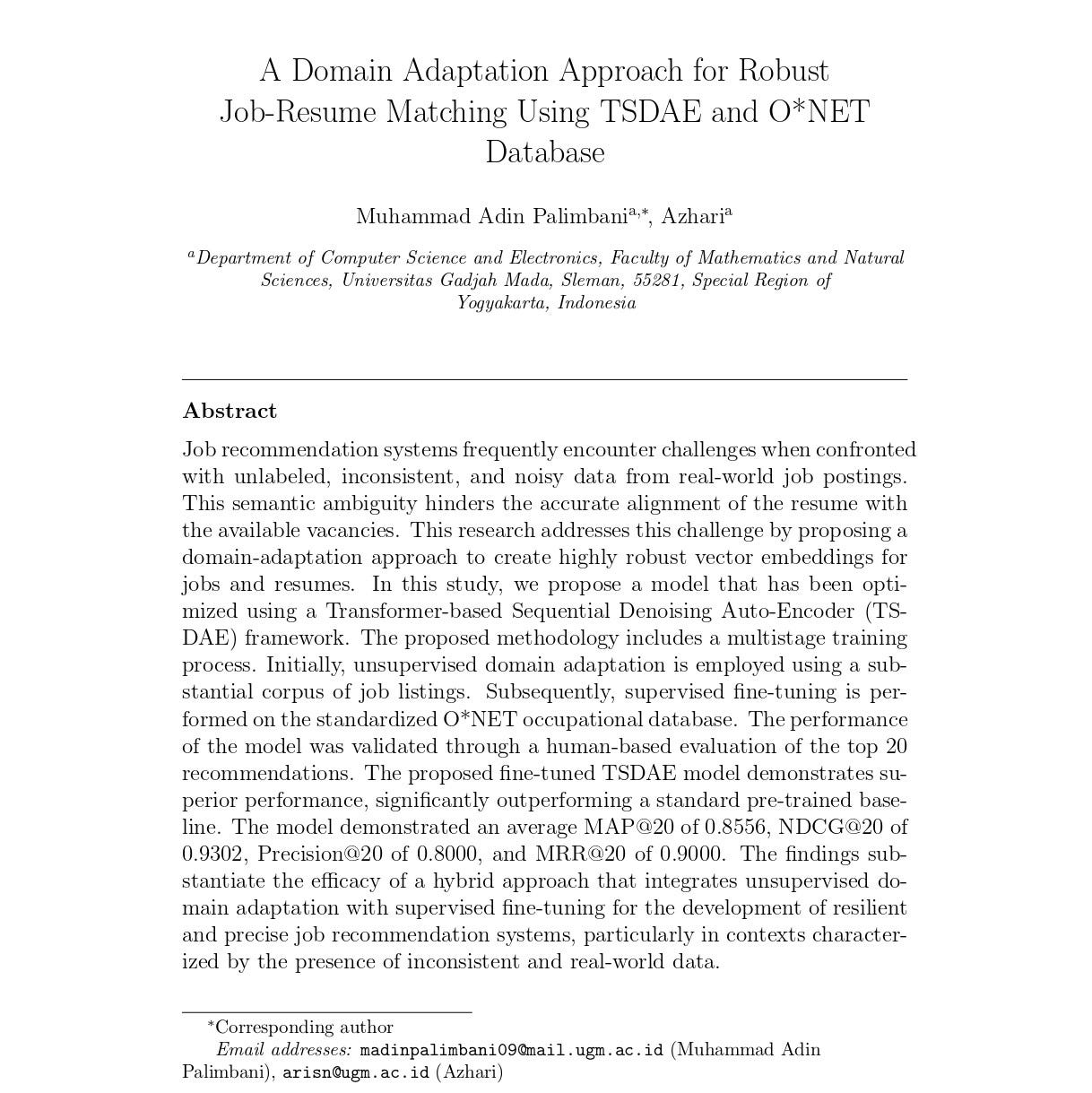
Exploring This Approaches For Robust Job-Resume Matching. I will elaborate on this soon!
This mismatch often leads to poor performance when these models are applied directly to tasks with unique vocabularies, style conventions, or different data distributions. Therefore, there is an urgent need for domain adaptation techniques in NLP tasks to bridge this gap, enabling base models to learn and generalize effectively from limited domain-specific data, and unlock their full potential in diverse and specific real-world scenarios.
What Exactly is Domain Adaptation?
Domain Adaptation is a powerful technique designed to fine-tune text embedding models for your specific text domain. The best part? It often achieves this without needing new, labeled training data from that domain. Think of it as teaching a generally smart student to become an expert in a niche field, leveraging their existing knowledge and guiding them with relevant, but unstructured, information from the new area. With domain adaptation, you leverage two key resources: an unlabeled corpus directly from your target domain, combined with an existing labeled corpus from a more general domain. This synergy allows the model to bridge the gap between general knowledge and domain-specific understanding. You can find many suitable labeled training datasets to kickstart this process in collections like the Embedding Model Datasets Collection.
How Does It Work & What’s the Performance Outlook?
Domain adaptation strategies are all about harmonizing the embedding spaces between your general (source) and specialized (target) domains.
- Adaptive Pre-Training: This involves an initial training phase on your target domain’s vast unlabeled corpus using methods like Masked Language Modeling (MLM) or TSDAE. Following this, the model is fine-tuned with an existing labeled dataset. This two-stage process typically yields substantial performance breakthroughs for your target domain.
- Generative Pseudo-Labeling (GPL): A remarkably agile and effective method, GPL can be seamlessly integrated on top of an already fine-tuned model. It unfolds in three clever phases: 1) Query Generation: Artfully crafting queries from a given text. 2) Negative Mining: Skillfully identifying passages that are similar but not truly relevant to the query. 3) Pseudo-Labeling: Employing a Cross-Encoder to intelligently score query-passage pairs, thereby generating robust triplets for training the model using MarginMSELoss. Even better, GPL can be dynamically combined with adaptive pre-training for even more significant performance enhancements!
Domain adaptation is your strategic key to unlocking the true, specialized potential of your text embedding models across diverse, complex data landscapes. It empowers your AI solutions to genuinely comprehend and flawlessly process specialized language with unparalleled accuracy.
Discover more about these transformative techniques and practical examples: Domain Adaptation in Sentence Transformers
메타데이터
- post_id
- cc7f8a669c95
- slug
- understanding-domain-adaptation-in-sentence-transformers-for-enhanced-nlp-performance-cc7f8a669c95
- url
- https://medium.com/@madinpalimbani09/understanding-domain-adaptation-in-sentence-transformers-for-enhanced-nlp-performance-cc7f8a669c95
- canonical_url
- https://medium.com/@madinpalimbani09/understanding-domain-adaptation-in-sentence-transformers-for-enhanced-nlp-performance-cc7f8a669c95
- author_url
- https://medium.com/@madinpalimbani09
- status
- ok
- fetched_at
- 2026-06-27 18:20:27