Cardinality in ER Models vs SQL Implementation: Bridging the Gap
When designing a database, understanding cardinality is crucial — yet many developers face confusion when translating Entity-Relationship…
Cardinality in ER Models vs SQL Implementation: Bridging the Gap
When designing a database, understanding cardinality is crucial — yet many developers face confusion when translating Entity-Relationship (ER) models into actual SQL implementations. This post explores the concept of cardinality in both contexts, highlights key differences, and walks through real-world use cases that help “bridge the gap.”
What is Cardinality?
At its core, cardinality refers to the number of occurrences in one entity that can be associated with the number of occurrences in another.
In simpler terms:
Cardinality defines how many of one item are linked to how many of another.
Cardinality Types in ER Models:
- One-to-One (1:1)
- One-to-Many (1:N)
- Many-to-Many (M:N)
These types are fundamental when modeling relationships between entities like User and Order, Student and Course, etc.
Cardinality in ER Models
1. One-to-One (1:1)
Example: Each person has one passport.
ER Representation:
- Two entities (Person, Passport) connected with a line labeled 1:1.
2. One-to-Many (1:N)
Example: One department has many employees.
ER Representation:
Department(1) →Employee(Many)
3. Many-to-Many (M:N)
Example: Students enroll in many courses, and each course has many students.
ER Representation:
- A direct line between
StudentandCourse, both sides marked with "many."
Cardinality in SQL Implementation
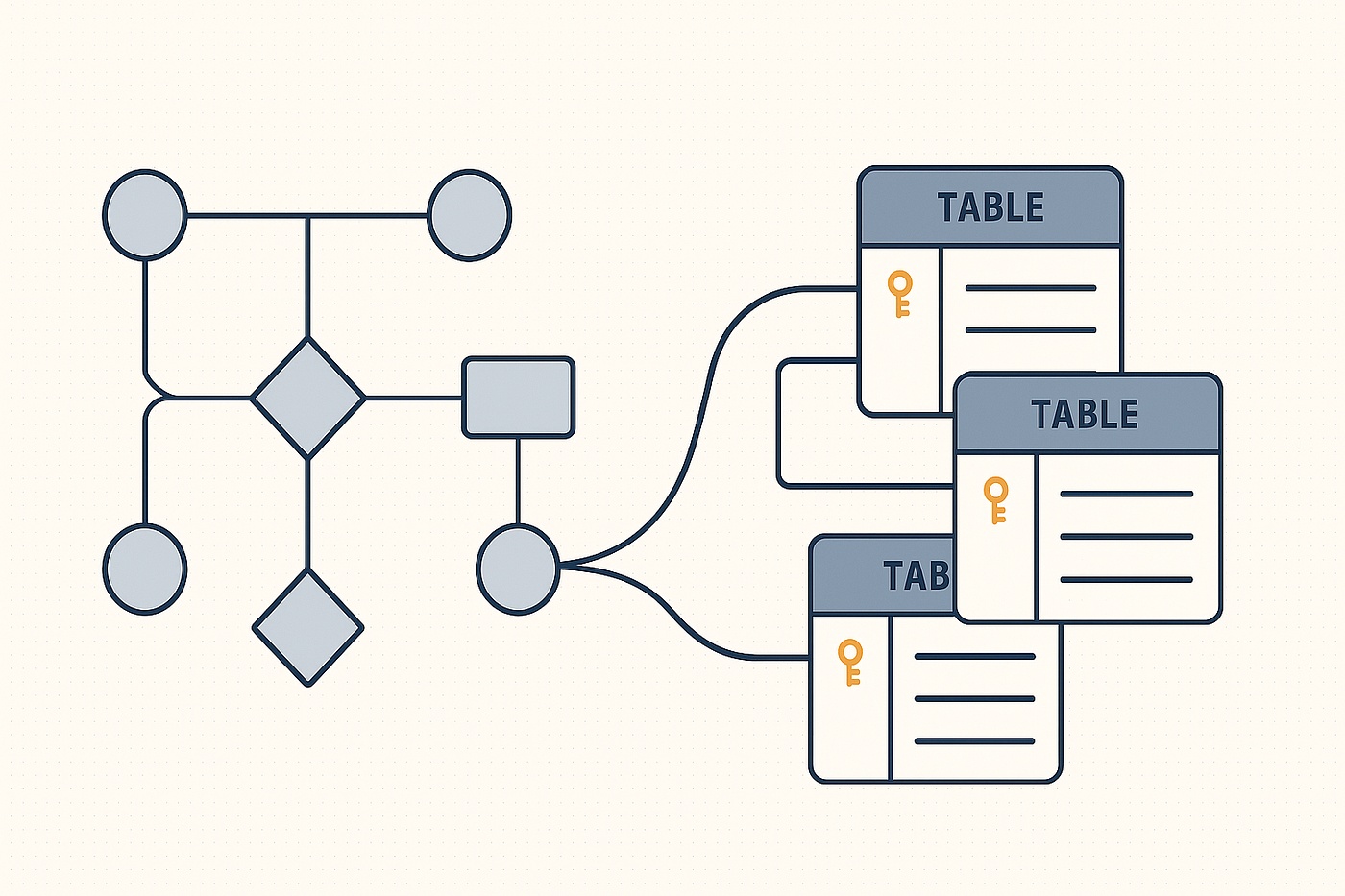
When implementing an ER design in SQL, cardinality impacts how tables are structured and how foreign keys and junction tables are used.
1. One-to-One (1:1)
Implementation:
- Two tables, one has a unique foreign key to the other.
CREATE TABLE Person (
    id INT PRIMARY KEY,
    name VARCHAR(100)
);
CREATE TABLE Passport (
    id INT PRIMARY KEY,
    person_id INT UNIQUE,
    FOREIGN KEY (person_id) REFERENCES Person(id)
);
Use Case: Storing sensitive data (like medical records) separately for privacy and modularity.
2. One-to-Many (1:N)
Implementation:
- The “many” side holds a foreign key referencing the “one” side.
CREATE TABLE Department (
    id INT PRIMARY KEY,
    name VARCHAR(100)
);
CREATE TABLE Employee (
    id INT PRIMARY KEY,
    name VARCHAR(100),
    department_id INT,
    FOREIGN KEY (department_id) REFERENCES Department(id)
);
Use Case: Organizing employees by department in an HR system.
3. Many-to-Many (M:N)
Implementation:
- A junction (associative) table is created to link the two entities.
CREATE TABLE Student (
    id INT PRIMARY KEY,
    name VARCHAR(100)
);
CREATE TABLE Course (
    id INT PRIMARY KEY,
    title VARCHAR(100)
);
CREATE TABLE Enrollment (
    student_id INT,
    course_id INT,
    PRIMARY KEY (student_id, course_id),
    FOREIGN KEY (student_id) REFERENCES Student(id),
    FOREIGN KEY (course_id) REFERENCES Course(id)
);
Use Case: Enrollments in an education platform, where students take multiple courses and vice versa.
Bridging the Gap: Key Considerations
1. ER Diagrams Are Conceptual; SQL Is Physical
ERDs show intent and logic; SQL defines storage and constraints.
2. Many-to-Many Needs Breaking Down
- In ER diagrams, you might directly connect two entities.
- In SQL, you must create a join table to represent it properly.
3. Optional vs Mandatory Relationships
- ER diagrams often specify *(0..1), (1..1), (0..)** types.
- In SQL, this is implemented using
NOT NULL,UNIQUE, or optional foreign keys.
4. Performance and Indexing
SQL allows tuning cardinality relationships using indexes, foreign key constraints, and cascading rules — all of which have performance implications.
Real-World Scenarios
1. Hospital Management System
- Doctors (1:N) → Patients
- Patients (M:N) → Treatments (via
PatientTreatmenttable) - Each patient has one unique record (1:1)
2. E-Commerce Platform
- Customers (1:N) → Orders
- Products (M:N) ↔ Orders (via
OrderDetailsjunction table) - Each order belongs to one customer
3. Online Learning Platform
- Users (1:1) → Profile
- Users (1:N) → Course Completions
- Users (M:N) ↔ Courses (via
UserCoursetable)
Summary
One-to-One (1:1) Relationships
- Represented in SQL using a foreign key with a
UNIQUEconstraint. - Ensures each record in one table maps to exactly one in another.
One-to-Many (1:N) Relationships
- Implemented by placing a foreign key on the “many” side.
- Most common relationship type in relational databases.
Many-to-Many (M:N) Relationships
- Requires a junction (bridge) table with foreign keys from both entities
- The junction table typically uses a composite primary key.
ER Diagrams Are Conceptual, SQL Is Physical
- ER models define intent and logic; SQL translates it into schema and constraints.
Optional vs Mandatory Relationships
- Enforced in SQL using
NOT NULL,DEFAULT, and referential integrity constraints.
Cardinality Affects Performance
- SQL implementations involve indexing, join operations, and constraint enforcement — all of which impact query performance.
Final Thoughts
Understanding cardinality in both ER modeling and SQL implementation is critical for designing scalable, accurate databases. While ER diagrams offer a high-level view, SQL requires you to get into the specifics — from foreign keys to indexing and join tables.
Bridging the gap between ER models and SQL isn’t just about structure — it’s about thinking relationally and designing intelligently.
Thanks for reading!
SQL #DatabaseDesign #ERModel #Cardinality #DataModeling #BackendDevelopment #RelationalDatabases #TechBlog #WebDev #DBMS #Programming #SQLTutorial
메타데이터
- post_id
- cc8a6d005edb
- slug
- cardinality-in-er-models-vs-sql-implementation-bridging-the-gap-cc8a6d005edb
- url
- https://medium.com/@sqlmentor/cardinality-in-er-models-vs-sql-implementation-bridging-the-gap-cc8a6d005edb
- canonical_url
- https://medium.com/@sqlmentor/cardinality-in-er-models-vs-sql-implementation-bridging-the-gap-cc8a6d005edb
- author_url
- https://medium.com/@sqlmentor
- status
- ok
- fetched_at
- 2026-07-13 15:35:31