The New American Renaissance
How we solved climate change by turning back the clock
Enhanced Freedom Warmth
The New American Renaissance
How we solved climate change by turning back the clock
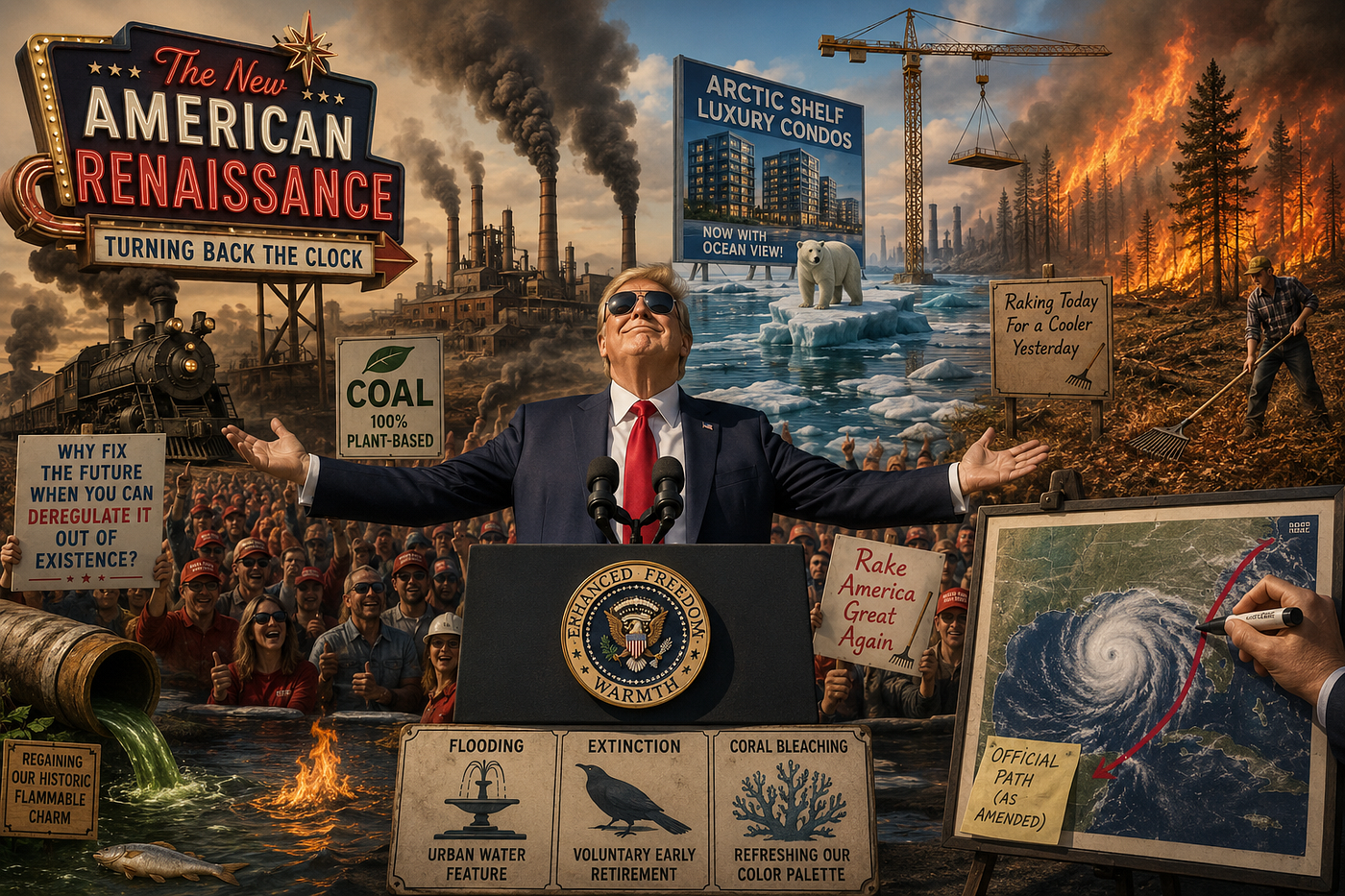
ChatGPT presents America’s bold new climate plan: deny it, deregulate it, and call the smoke freedom.
The United States has solved climate change.
The solution, arrived at after years of careful deliberation, was to stop believing in it, a move so elegant in its simplicity that scientists are still struggling to explain why they didn’t think of it first.
While the rest of the world frantically rearranges its energy grids, America has taken the more dignified path: aggressive nostalgia, legally enforced.
The new governing philosophy fits on a bumper sticker, which is appropriate, because bumper stickers run on gasoline.
Why fix the future when you can deregulate it out of existence?
The retro makeover begins with atmospheric time travel.
By dismantling the Clean Power Plan and lifting restrictions on greenhouse gas emissions, federal policy is methodically restoring the soot-choked ambiance of the early Industrial Revolution, a period Americans remember fondly, despite not having been alive for it.
Even the nation’s waterways are being restored to their former glory.
Rivers are rapidly regaining their historic, flammable charm thanks to the rollback of Clean Water Act protections, which had long burdened corporations with the inconvenience of not poisoning things.
To complete the heritage look, coal has been officially designated an organic, plant-based artisanal rock, the sourdough starter of the energy sector.
Of course, changing the landscape requires changing the vocabulary.
The term “global warming” has been permanently scrubbed from government websites and replaced with the legally approved phrase:
Enhanced Freedom Warmth.
This is not spin.
This is meteorological liberty.
The resulting policy, which officials described as absolutely perfect and frankly better than anything Europe has ever done, was promptly branded, trademarked, and licensed to the federal government at a rate to be determined.
Many people are saying it’s the most beautiful deregulation in history, perhaps ever.
At packed arenas across the country, thousands gathered to celebrate the new climate policy, many of them in counties that no longer have a coastline.
Here is where most administrations would have stopped. This one kept going.
When glaciers began disappearing ahead of schedule, officials recognized the opportunity hidden inside the catastrophe: prime, newly ice-free real estate.
The Arctic shelf, previously buried under centuries of ecological obstruction, was fast-tracked for luxury development.
Prospective buyers were reminded that an Arctic shelf luxury condo is technically closer to Ohio than it used to be.
When wildfires threatened the West Coast, the administration bypassed the entire field of forestry science in favor of a labor-intensive raking mandate, a policy that devastated the forestry science field and single-handedly saved the artisanal rake industry, which had previously been doing fine.
But the true genius emerged in storm season.
Rather than spending billions on climate resiliency infrastructure, officials discovered that hurricanes can be legally rerouted by redrawing their paths on official documents with a permanent marker.
The meteorological community raised objections.
These objections were themselves reclassified as a weather event, specifically, a “Regulatory Opinion Storm,” and redirected into the Gulf of Mexico using the same technique.
By this point, the policy had become self-sustaining.
Flooding was reframed as spontaneous urban water features.
Species extinction was reclassified as voluntary early retirement.
When the last coral reef bleached white, the official statement noted that the ocean had simply refreshed its color palette and would be pivoting to a cleaner aesthetic, effective immediately.
Which is how the United States arrived, in the end, not at collapse.
But at a press release.
Nature, it turns out, was never angry.
It was merely undergoing an unscheduled restructuring, and it failed to notify the relevant agencies in advance. The forms have since been submitted. The planet is currently under review.
Expect a response within six to eight business decades, or whenever the inbox is no longer underwater.
This piece was written for June 5: World Environment Day, in response to Mary Acton’s prompt:
The Earth is already speaking to us — through record-breaking temperatures, more intense wildfires, extreme storms and glaciers disappearing before our eyes. What has changed in your country?
This is, of course, a fictional response.
Or is it?
You decide.
Thanks to Mary Acton for the prompt, to Adrienne Beaumont for keeping the June prompts coming, and to the tC editors for giving this one a home.
[embed]June is Bustin’ Out all Over Writing prompts coming out the yin-yangmedium.com
메타데이터
- post_id
- ccb71c83715f
- slug
- the-new-american-renaissance-ccb71c83715f
- url
- https://medium.com/the-challenged/the-new-american-renaissance-ccb71c83715f
- canonical_url
- https://medium.com/the-challenged/the-new-american-renaissance-ccb71c83715f
- author_url
- https://medium.com/@milwaukeemasala
- status
- ok
- fetched_at
- 2026-06-09 15:37:30