Why Western Elites Fear China’s Data More Than Its Rise
A strange, unspoken problem is haunting global statistical bodies. It has nothing to do with trade wars, military tensions, or diplomatic…
Why Western Elites Fear China’s Data More Than Its Rise
A strange, unspoken problem is haunting global statistical bodies. It has nothing to do with trade wars, military tensions, or diplomatic friction. It is a data problem, one that breaks nearly every existing framework the West has used to measure the world for two centuries.
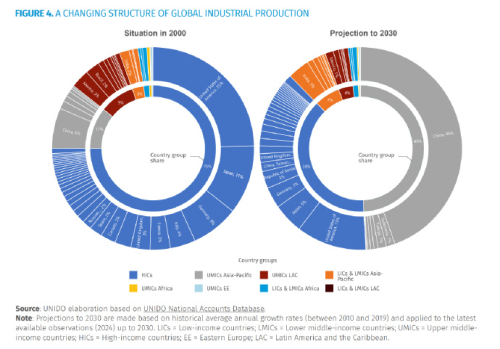
The latest forecasts from the United Nations Industrial Development Organization paint a jarring picture. By 2030, Chinese manufacturing will make up forty-five percent of global manufacturing output. On the surface, it is just another large economic figure. In practice, it collapses global comparison entirely.
Standard global datasets are no longer functional with Chinese figures included. Plug China’s numbers into regional and global tables, and every other nation’s industrial output shrinks to marginal, almost irrelevant values. Old ranking systems, growth benchmarks, and economic comparison tools stop working altogether.
International analysts now face a constant, no-win dilemma. Leave China’s data out, and global economic reports feel hollow and unrepresentative of real global trends. Keep it in, and every baseline average, growth rate, and regional metric becomes distorted beyond useful interpretation. This persistent statistical disruption is what industry practitioners casually refer to as the “China effect.”
Most public commentary fixates on China’s rising global standing and expanding economic influence. But Western institutional insiders hold a quieter, more sober view. They are not threatened by China’s rise in the abstract. They are threatened by its data — massive, verifiable, and standardized datasets that cannot be copied, controlled, or spun to fit Western narratives.
These numbers undermine the world order the West has long curated. They expose inconsistencies in long-held global narratives and poke holes in the layered rule sets that have guided international policy for generations.
Consumer lifestyle statistics offer some of the clearest evidence of systemic Western statistical double standards. Food consumption data, in particular, lays bare how flexible many Western nations are with their own benchmarking, while China adheres to rigid, consistent counting rules.
The Food and Agriculture Organization now separates China’s dietary consumption data from global peer comparisons as standard practice. Blending Chinese figures into general global groups skews final averages so severely that the resulting data loses all practical meaning.
The core issue is differing counting standards. China’s meat consumption statistics measure only pure, edible meat weight. Many other countries count side dishes, fillers, and carbohydrate-heavy meal components toward official meat consumption totals. The practice artificially inflates domestic lifestyle metrics, creating a misleading picture of household living standards.
This statistical gap has fueled public misunderstanding for years. Casual online discourse in several advanced economies has periodically questioned Chinese living standards and meat consumption levels. Hard official data has consistently debunked these casual assumptions.
Paper-thin per capita consumption similarities vanish under closer inspection. Chinese consumption stats reflect actual meat intake. Many competing national statistics simply document meals with small meat portions mixed with heavy carbohydrate bases.
The sheer scale of China’s meat market also carries overlooked global implications. Its total meat output is large enough to provide consistent, reliable meat access for impoverished communities across Africa if redistributed globally on an equitable basis.
Domestic consumption growth tells a clear story of national development. In 1978, the average Chinese person consumed just nine kilograms of meat per year. By 2022, that number had climbed to sixty-seven kilograms, nearly an eight-fold increase across forty-four years of sustained growth.
For global statisticians, the most intractable issue is structural, not numerical. China’s population exceeds the combined population of all developed nations. Its per capita lifestyle metrics now sit above the developed-world average. Yet it still qualifies as a developing economy by core developmental benchmarks.
No preexisting global category fits this profile. Grouping China with developed nations skews high-income economy benchmarks. Grouping it with developing nations inflates emerging-market averages. The only viable solution for global bodies is to list China’s data independently.
If meat consumption illustrates broad livelihood progress, watermelon consumption highlights the unique scale of China’s mass consumer economy. The global watermelon market is effectively single-handedly shaped by Chinese demand.
China holds roughly eighteen percent of the global population yet consumes seventy percent of the world’s watermelon supply. Its citizens eat an average of fifty kilograms of watermelon per person annually. In comparison, neighboring advanced economies record under five kilograms per capita, with their official counts often including inedible rind portions.
A single Chinese province’s watermelon consumption easily outpaces the entire national consumption of most small-to-medium-sized countries. In North America, Europe, Japan, and South Korea, watermelon remains a premium seasonal fruit, commonly sold by the slice at prices too high for everyday household use. In China, it is an affordable summer staple, accessible to nearly all income brackets.
This gap is not merely a side effect of population size. It reflects broad, nationwide improvement in household disposable income and quality of life across a massive population base. It rewrites how analysts understand baseline global food consumption patterns.
Consumption data undermines Western social development narratives. Ecological and reforestation data further exposes the hypocrisy of dominant Western environmental discourse.
Western media and environmental groups have long framed Western nations as global climate leaders while questioning China’s ecological governance record. Objective satellite tracking and UN forestry data contradict this popular narrative entirely.
Global greening trends only register positive because of China’s contribution. Global forest coverage metrics show net positive growth with Chinese data included. Remove those figures, and the world shows clear, widespread forest loss and ecological decline.
While many Western and overseas regions continue systematic deforestation and native ecosystem degradation, China has sustained decades of consistent desert restoration, hillside reforestation, and nationwide ecological improvement projects.
NASA satellite analysis confirms that one quarter of all new global green space created in the past two decades comes from China. The country maintains the world’s largest man-made forest area by a significant margin.
The contrast in approach is stark. Western environmental policy often centers on conference negotiations, theoretical frameworks, and public pledges. China focuses on ground-level, long-term ecological restoration with measurable, trackable outcomes.
Still, consumer and ecological data only hint at the larger shift. Industrial and energy data form the true backbone of the “China effect,” creating structural challenges Western industrial economies cannot overcome.
Electric power underpins all modern industrial activity, and China now dominates global energy output. In 2025, China’s power generation accounted for thirty-three-point-two percent of the world’s total. Roughly one of every three kilowatt-hours produced globally originates within its borders.
Its national power output surpasses the combined generation of the United States and Europe. Individual Chinese provinces produce more electricity than entire medium-sized countries. Inner Mongolia’s power capacity alone can sustain daily energy use across multiple Nordic nations.
Through the first half of 2026, domestic thermal power capacity expanded steadily. Solar and wind power growth moderated slightly, though China’s installed renewable base remains far larger than any other country’s.
While European nations face persistent energy instability and debate whether to restart idle coal facilities, China has already scaled up energy storage and grid infrastructure, laying stable groundwork for future industrial expansion.
Dominance in foundational industrial materials reinforces this structural gap. China’s crude steel output consistently tops fifty percent of global production, exceeding the combined steel output of the United States, Japan, and Germany.
Cement production hovers near fifty percent of the global total, supporting nearly half of all major infrastructure projects worldwide. As of July 2026, Tangshan’s blast furnace operating rate held steady at ninety-five-point-six percent for three consecutive months. A single regional industrial hub in China now sways global steel supply dynamics.
By contrast, traditional Western industrial powers rely heavily on government subsidies to keep domestic steel mills operational. The competitive disparity is no longer marginal; it is structural and widening annually.
China’s industrial lead extends beyond heavy industry to modern infrastructure and digital logistics. Its high-speed rail network covers more than seventy percent of the world’s total high-speed mileage. All other countries’ high-speed rail lines combined do not match its scale.
Domestic parcel logistics exceed one trillion units annually, outpacing the total logistics volume of every other nation combined. China also leads globally in manufacturing value addition, smartphone production, and renewable energy installation. Remove its data from global industry reports, and nearly every modern industrial metric collapses sharply.
Most observers fixate on these eye-catching scale numbers. The deeper shift lies in structural uniqueness. No existing global model accounts for a 1.4 billion-person economy operating at full industrial speed simultaneously.
Western global statistics were built for a 19th-century colonial order, one where wealthy industrial nations sat at the top of global value chains and developing states remained in subordinate, follower positions. The system’s designers never anticipated a large, rapidly industrializing nation that defies all preset tiers and classifications.
China outperforms traditional industrial powers in manufacturing scale, consumer volume, and infrastructure density, yet retains core developing-economy characteristics in per capita income and ongoing structural growth. It fits no predefined Western category.
This unclassifiable status creates inconsistent Western policy and media attitudes. Western institutions label China a developing country in human rights discourse to discredit its governance model. In climate negotiations, they rebrand it as a developed economy to demand heavier emission-reduction burdens.
In trade disputes, Western governments refuse to acknowledge China’s market economy status while rejecting the policy exemptions typically granted to developing nations. The shifting classifications are not evidence of rigorous analysis. They are flexible framing to uphold Western advantage.
Phrases like the “China effect” or “China shock” serve a clear rhetorical purpose. They disguise systemic Western institutional failure as an external disruption. Rather than admit outdated global rules cannot explain new global realities, Western elites frame China’s growth as a disruptive anomaly.
Scale inevitably rewrites global rules.
Outdated global metrics will never capture the shape of a new global economy.
메타데이터
- post_id
- ccbbb48e49ee
- slug
- why-western-elites-fear-chinas-data-more-than-its-rise-ccbbb48e49ee
- url
- https://medium.com/@nanmoon/why-western-elites-fear-chinas-data-more-than-its-rise-ccbbb48e49ee
- canonical_url
- https://medium.com/@nanmoon/why-western-elites-fear-chinas-data-more-than-its-rise-ccbbb48e49ee
- author_url
- https://medium.com/@nanmoon
- status
- ok
- fetched_at
- 2026-07-28 12:19:09