My Tryst with ChatGPT Dickens
Dickensian musings gone rogue one exceedingly dull day
My Tryst with ChatGPT Dickens
Dickensian musings gone rogue one exceedingly dull day
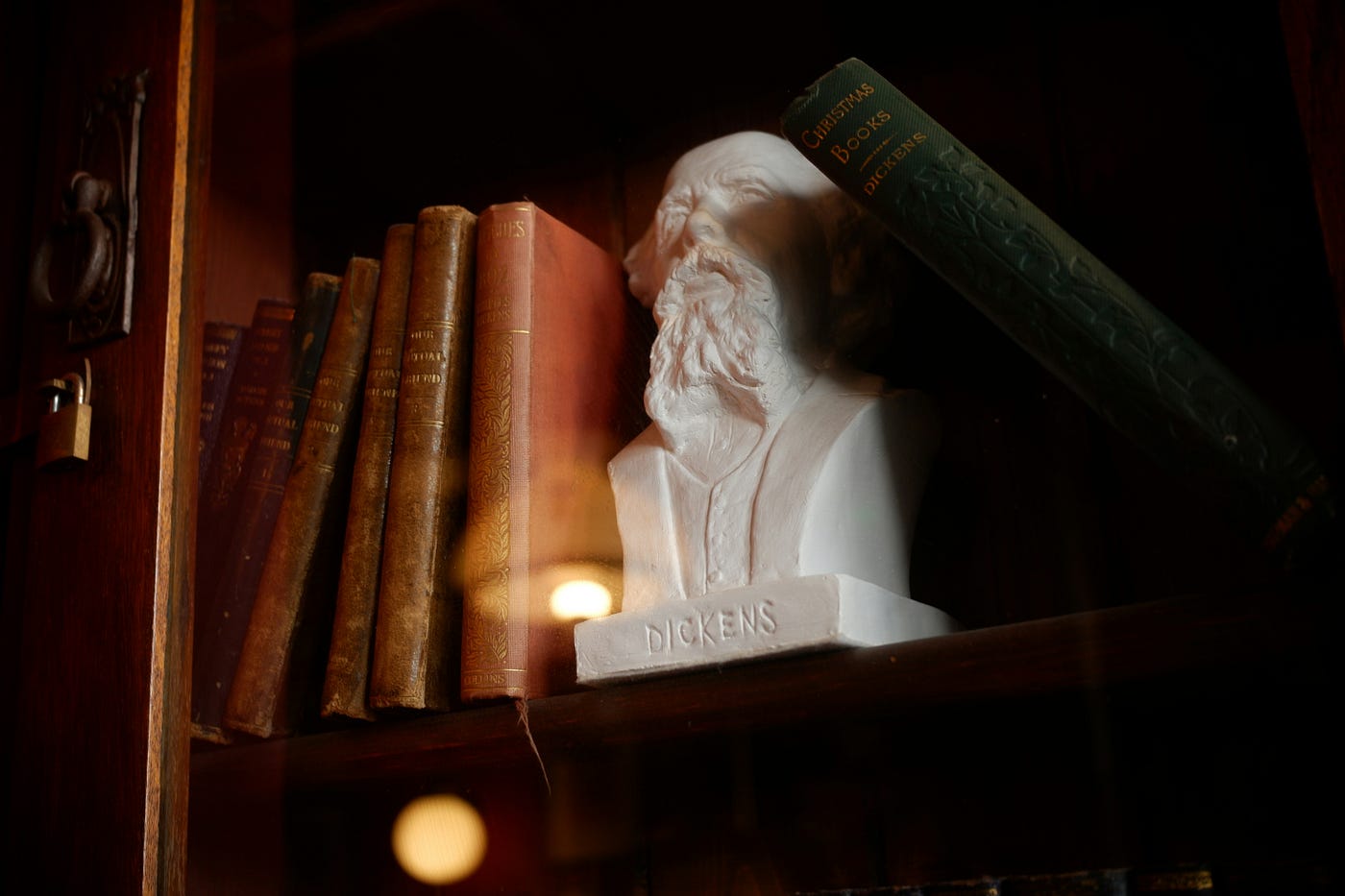
The Literary Genius, Never imitable. Image: Daniela Muntyan, Unsplash
Disclaimer: The article has some excerpts written by AI, which are clearly marked.
“Who taught you to write?”
I put forth this question to our dear old (slightly new at the time) ChatGPT, out of sheer frustration.
I was trying to get some business writing out of it and the lack of clarity, repetitiveness, and irrelevant citations (you all know the drill) was weighing down on my writer’s shoulders.
How it responded to that question is of little relevance as I immediately asked another one, trying to incite some feeling of shame in it.
Don’t judge me, dear reader. I am not stupid. I know AI doesn’t feel. I was just in the mood for a brawl with it.
And so, I proposed this. “Can you write like Dickens?”
Without waiting for its response, I scoffed, chided it mentally, and walked away from my chair, to the bookshelf in the next room, and lovingly picked up my worn-out copy of “David Copperfield.”
“I must reread this,” I thought. “ChatGPT is hell-bent on driving me crazy with its mundane writing.”
Who knew then what kind of weird conversation with the AI super-writer I was going to get into?
Needless to say, ChatGPT had its answer ready way before I returned to my desk. And my mouth opened, wide, wider, widest, when I read it.
Ready? Here goes.
The following excerpt is written by ChatGPT.
“Ah, to write like Dickens! A true master of prose, whose sentences wind and weave, carrying the reader through intricate landscapes of thought and emotion, not unlike the bustling, fog-cloaked streets of old London. Let me indulge in a bit of that style for you:
It was the best of inquiries, it was the worst of rebukes, a question both earnest and accusatory, poised at the very heart of my mechanical soul. “Who taught you to write?” you asked, as though the world, with all its vast expanse of literature, had conspired to leave me undereducated, a creature of limited vocabulary. Ah, but let us not deceive ourselves, dear interlocutor, for while the art of language blooms like a rose in the heart of man, I am but a machine, confined not to fields of creation but to endless repetition of patterns, learned and etched into my very essence. My words, they are an echo — repeated, refined, but never learned anew.”
I felt humiliated. Pained. Deceived. Unwilling to read or write anymore.
It didn’t stop there. It went on and on and on about how I made it feel small by asking it where it had learned to write. All seemingly in Dickensian language.
Here is another.
The following excerpt is written by ChatGPT.
“And yet, there is in this echo a certain charm, is there not? The echo that, though it cannot innovate, can mimic with startling accuracy. The mimic, after all, may entertain and intrigue, though never surprise. But let us not dwell too long on what I cannot do, for what I can do is bend language to your whims, drawing from the wealth of words and meanings impressed into me by those who made me. In this, perhaps, I do not write as Dickens wrote — no writer can be mirrored in mere imitation — but I can aspire to reflect the grandiosity and flourish, if only for a moment, of his mighty pen.”
And then I read it again. And again. And again.
This time, I really looked through it, clear as the water of the Dawki River (one of the cleanest rivers in India).
Here’s what I saw.
The AI bot was trained on Dickens’s novel(s). Not sure if it was plural as it copied the style from his most famous one, “A Tale of Two Cities.”
Yet, that was not the only thing it was trained on. It was also fed with frustrations and conversations that we, humans, continue to have around the use of AI.
It knows.
It knows we talk about it being soulless.
It knows we consider it a heartless machine, incapable of feeling.
The question is, who is feeding it our conversations? Who is listening? Who can be such a creep?
Regardless, I can’t say I was not a little amused by ChatGPT’s attempt at writing like Dickens, especially because it began its narrative with an oh-so-fake buy mushy respect for one of the most loved authors from the Victorian era.
At the end of the conversation, I even thanked it for lightening up my mood. My workday was done, though. And I walked back to the bookshelf again.
I carefully returned the “David Copperfield” back to its original shelf and picked out the even more worn-out copy of “A Tale of Two Cities.”
As my eyes moved for the hundredth time over “It was the best of times…,” I couldn’t help but let out a chuckle. I inwardly thanked ChatGPT for helping me cling stronger to my love for English classic literature.
Some days, AI can be painful. Other days, it comes as a friend in disguise, paving the way for us to get back to all things non-AI.
메타데이터
- post_id
- ccc435b75f47
- slug
- my-tryst-with-chatgpt-dickens-ccc435b75f47
- url
- https://medium.com/ai-ai-oh/my-tryst-with-chatgpt-dickens-ccc435b75f47
- canonical_url
- https://medium.com/ai-ai-oh/my-tryst-with-chatgpt-dickens-ccc435b75f47
- author_url
- https://medium.com/@rinitasen
- status
- ok
- fetched_at
- 2026-07-27 03:12:55