Understanding the “Chinese Idea of Life and Death” From Yi Jing (易经, I Ching, Book of Changes)
“Do Chinese people have religious beliefs?”
Understanding the “Chinese Idea of Life and Death” From Yi Jing (易经, I Ching, Book of Changes)
“Do Chinese people have religious beliefs?”
My friends often ask me this question. I said first, that religion and belief cannot be equated in the Chinese context. China has diverse religions, with Buddhism, Daoism, Christianity, and Islam Islam all having numerous followers. When it comes to belief, the variety is even more diverse. Some believe in ancestors, some in shamans, some in the Jade Emperor, the Earth God, the Money God, and some also believe in nothing but ‘heaven’s vigour, with the Jun Zi (person with the highest virtue) striving tirelessly’. Believing in oneself, isn’t that a form of belief too?
Calling it ‘belief’ isn’t entirely accurate either. From the perspective of Yi Jing, it is not a matter of belief when facing visible and invisible parts of the universe. Like sunrise and sunset, the waxing and waning of the moon, these objective existences and phenomena have nothing to do with ‘belief’. That is why Chinese philosophy rarely dwells on and explores questions like ‘Who created humans’ or ‘Who is the creator’, but rather focuses more on the interaction between humans and the external world. Looking back through history, except for certain dynasties, mainstream Chinese society rarely saw widespread promotion of religion. Did Confucius brush aside the issue of religion with his phrase ‘Respect ghosts and gods, but keep a distance from them’? It is not that simple. Regarding the ultimate questions of ‘Who am I? Where do I come from? Where am I going?’, although Chinese philosophy may not be keen on repetitively questioning and confirming them, it does not mean there are no answers to these questions. Perhaps we can catch a glimpse of Chinese-style belief from the Chapter of Xi Ci in the Yi Jing, written by Confucius.
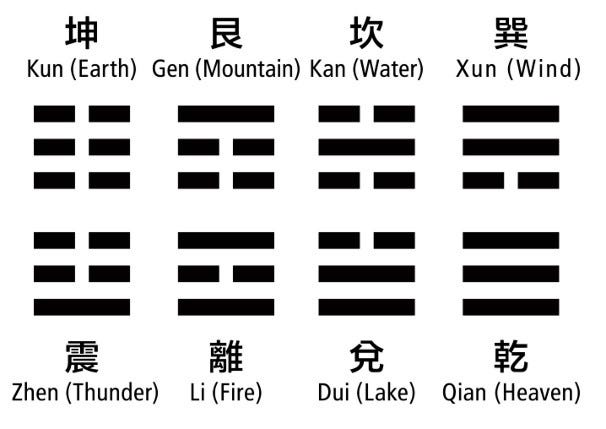
Ba Gua | Credit: Internet
A brief introduction of Yi Jing. Wikipedia describes Yi Jing as ‘an ancient Chinese divination text used by wizards to predict the future and determine fortune and misfortune.’ Baidu Baike says Yi Jing ‘covers all things and all changes in the universe; It can used to well govern the country; It is broad and profound; It is the source of Chinese civilization.’ The difference between these two definitions also reflects the duality of Yi Jing. It is the supreme study of ancient emperors, kings, sages, and Jun Zi, and it can also be a tool book found in the hands of every street fortune teller. It can be said that all the traditional Chinese Philosophy and culture, whether Daoism or Confucian thought, whether military strategy or metaphysics, all grow up in the fertile soil of Yi Jing. Yi Jing consists of two parts: the ‘Classic’ and the ‘Commentary’. The ‘Classic’ consists of the 64 hexagrams and their interpretations while ‘Commentary’ is written by Confucius and his disciples to explain Yi Jing. Among them, the Chapter of Xi Ci is the most brilliant. Xi Ci states that “the Yi accords with the norm of heaven and earth, hence they can supplement the Dao of heaven and earth”. In other words, Yi represents the principles of heaven and earth. The 64 hexagrams are like a massive net, outlining all the laws of change in the universe. Whether it’s changes in the objective world or changes in human affairs, they all cannot escape these 64 hexagrams.

Sequence of Fu Xi Ba Gua (Xian Tian Ba Gua)| Credit: Internet

Orientation Map of Fu Xi Ba Gua (Xian Tian Ba Gua)| Credit: Internet
Since Yi Jing is a study that encompasses all things, how does it view the issues of life and death in religion? A line in Xi Ci answers this question — “the primal reverts to the ultimate, so as life and death”. Life is the beginning, death is the end. The beginning entails an end, and the end entails a beginning. The beginning is not truly the beginning, and the end is not truly the end. The end doesn’t necessarily come after the beginning, nor does it come before the beginning. Confucius believed that if one could understand this truth, one would understand what life and death are all about. This concept is largely similar in meaning to the Buddhist concept of ‘reincarnation’. In Eastern culture, death is not called death, but ‘head to life’. However, Chinese culture doesn’t regard life and death as heavily as Buddhism does, because in the eyes of Confucianism and Daoism, life and death are objective laws, devoid of mystique or emotional colour. Whether one rejoices in life or mourns in death is entirely a subjective choice. Death can also be a cause for celebration, as seen in the folk traditions in many parts of China of holding ‘joyous funerals’ to celebrate elderly people who have passed away at an old age. Also, in traditional Chinese numerology, the Twelve Life Circle — Birth, Bathing, Youth, Officer, Prosperous, Weakening, Sickness, Death, Grave, Termination, Embryo, and Nurture — also describe the ‘primal reverts to the ultimate’. From this, we can see an interesting aspect of Chinese culture — ‘death’, ‘grave’, and ‘termination’ are not the end of the circle, but ‘embryo’ and ‘nurture’. The end of life is the stage where new life is being gestated. From the moment a baby cries at birth, it’s the beginning of another life cycle. This is what a Chinese Chengyu says ‘Sheng Sheng Bu Xi’, meaning ‘life continues with life with no stop’.

Twelve Life Circles in Traditional Chinese Numerology and Astrology | Credit: Internet
Confucius also didn’t spend much effort advocating posthumous karma and retribution concepts. Confucius believed, on the one hand, that a true Jun Zi would not change his actions in virtue and cultivation based on whether there would be good or bad consequences after death. On the other hand, it must be admitted that educating the public requires a belief in ghosts and gods, so Confucius also said ‘The benevolent have long lives’. This ‘long life’ transcends the length of human life, the life of a great benevolent person has already surpassed physical time, and this is the true ‘being in harmony with heaven and earth’. Religion depicts the world after death for us while Yi Jing tells us how to live, and tells us to look at ‘death’ from standing from the ‘life’. If we stand at sunrise and watch the sunset, there is no need to feel pessimistic about the sunset. Because the sun will rise again after 12 hours.
Yi Jing explains the issues of life and death from a perspective devoid of superstition and divine authority, and provides the Chinese answer to the questions of “Who am I? Where do I come from? Where am I going?”. Nan Huaijin said, “Strip away all the religious trappings, and the highest religious philosophy in the East is ‘god without form’. God has no position, no image, whether it’s our own life, our spirit, the life of the universe, the spirit of the universe, God has no position, is omnipresent, and nowhere.”

易经系传别讲 by Nan Huai Jin 南怀瑾(Author) | Credit: Internet
When I was in school, my teacher said that traditional Chinese thought was simple materialism. After reading Yi Jing, I feel more agree with this statement. But rather than saying it’s materialism or idealism, Yi Jing is realism. All the mysteries in the universe, visible and invisible, perceptible and imperceptible, are seen as absolute material, absolute objective existence by Yi Jing. It does not doesn’t clothe the supreme Dao in the garb of ‘god’. It only tells us ‘Dao is the interaction of yin and yang’ and ‘the unexpectedness and unknownness of yin and yang are called god’. This is the reason why it is difficult to explain the question of whether Chinese people have religious beliefs because it has shed the trappings of religion. The traditional Western definition of religion does not hold true for Confucianism and Daoism. The various schools of thought in Chinese culture are all rooted in the same recognition of ‘heaven and man united’. It is a recognition rooted and developed from Yi Jing to Chinese people’s mindset that transcends simple idol worship and prophet prophecy.
메타데이터
- post_id
- cccd82c0cb30
- slug
- understanding-the-chinese-idea-of-life-and-death-from-yi-jing-易经-i-ching-book-of-changes-cccd82c0cb30
- url
- https://medium.com/@az0301/understanding-the-chinese-idea-of-life-and-death-from-yi-jing-%E6%98%93%E7%BB%8F-i-ching-book-of-changes-cccd82c0cb30
- canonical_url
- https://medium.com/@az0301/understanding-the-chinese-idea-of-life-and-death-from-yi-jing-%E6%98%93%E7%BB%8F-i-ching-book-of-changes-cccd82c0cb30
- author_url
- https://medium.com/@az0301
- status
- ok
- fetched_at
- 2026-07-24 09:03:45