Fine-Tuning vs Pre-Training vs Re-Training: The Only Guide a PM Will Ever Need
Why You Shouldn’t Be Building a University When You Just Need to Hire an Intern
Fine-Tuning vs Pre-Training vs Re-Training: The Only Guide a PM Will Ever Need
Why You Shouldn’t Be Building a University When You Just Need to Hire an Intern
The Problem with AI Jargon
Every time someone says “we should fine-tune the model” in an engineering meeting, do you nod confidently while internally Googling “fine-tune vs retrain difference” under the table?
No shame. This post is for you.
These three terms get thrown around constantly in AI product discussions. Confusing them leads to wildly wrong decisions: overspending, underdelivering, or shipping an AI feature that ages like milk in the sun.
Let’s fix that with one analogy you’ll never forget.
Meet Chef Marco (Our AI Model)
You’re opening a restaurant and you need a world-class chef. You have three options. Your choice determines cost, timeline, and outcome.
Option 1: Pre-Training — Send Marco to Chef School. All of It.
You enroll Marco in a 10-year culinary school covering every cuisine that has ever existed — French, Japanese, Indian, Peruvian, molecular gastronomy, ancient Roman recipes, all of it. He reads every cookbook and trains under every Michelin-star chef alive.
When he graduates, Marco knows everything.
The catch? This cost you $10 million and 10 years. And he still doesn’t know your restaurant’s style.
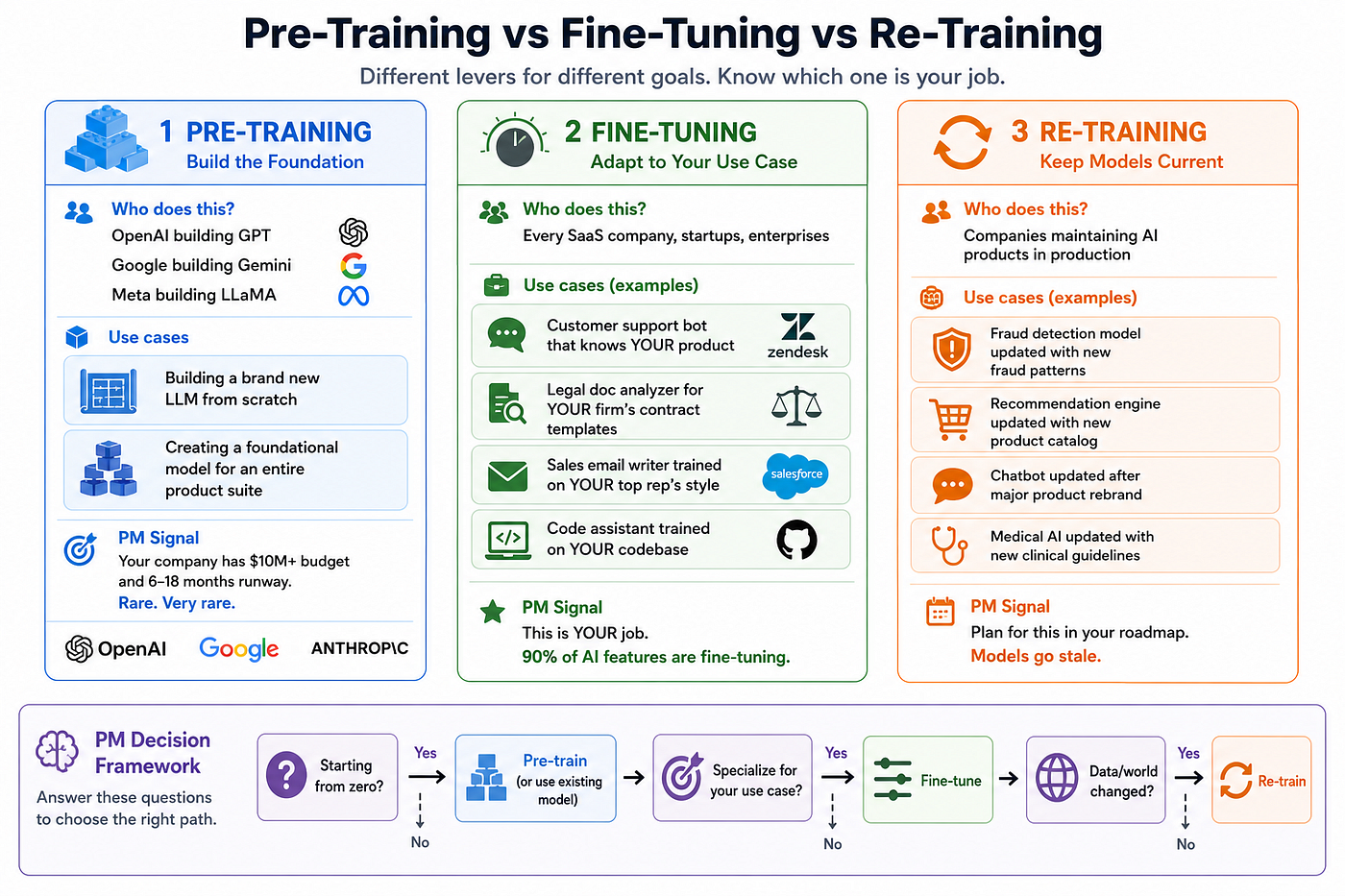
In AI terms: Pre-training is building a foundational model from scratch. Think OpenAI training GPT-4, Google training Gemini, Meta training LLaMA. Billions of parameters. Trillions of tokens. Hundreds of millions of dollars.
PM Takeaway: Unless your company is OpenAI or Google, you are not pre-training a model. This is not your job. Move on.
Option 2: Fine-Tuning — Teach Marco Your Menu
Marco (the pre-trained genius) just joined your restaurant. He already knows how to cook. You don’t teach him to hold a knife. Instead, you spend two weeks showing him your signature sauce recipes, your exact plating style, and the 47 dietary restrictions your loyal customers have.
Within two weeks, Marco isn’t a generalist anymore. He’s your chef.
In AI terms: Fine-tuning takes an existing foundation model (GPT-4, Claude, Llama) and trains it further on your specific data for your specific task.
A customer support bot that knows your product’s exact tone and pricing. A legal document analyzer trained on your firm’s contract templates. A sales email writer modeled after your top rep’s style. A code assistant that knows your internal codebase.
Cost: days to weeks. Thousands to low hundreds of thousands of dollars — not hundreds of millions.
PM Takeaway: This is your bread and butter. 90% of AI features you’ll ever ship are fine-tuning problems. When your team says “we need an AI feature,” your first question should be: “What existing model are we fine-tuning, and on what data?”
Option 3: Re-Training — Marco Needs a Refresher
Two years in, your restaurant expanded. You added 50 new dishes. You rebranded. Customers now care about sustainable sourcing and Marco has no idea what oat butter is. His knowledge is stale — not because he was bad, but because the world moved on.
You don’t fire him. You bring him back for a targeted refresher on the new stuff.
In AI terms: Re-training updates a model with new or corrected data. Common triggers: your product changed significantly, the world shifted (new regulations, new events), model drift crept in as real-world patterns evolved, or you discovered the model was consistently wrong about something.
PM Takeaway: Re-training is a maintenance activity that belongs on your roadmap. Models are not “ship and forget.” If you don’t plan for re-training cycles, you’ll be explaining to your CEO why the AI chatbot is still quoting old pricing three months after a rebrand.

The Cheat Sheet
Pre-Training → Building the model from zero.
Who does it: OpenAI, Google, Anthropic.
Cost: $$$$$. Time: months to years.
PM relevance: almost none — let someone else do this.
Fine-Tuning → Specializing an existing model for your domain.
Who does it: you, every PM shipping AI features.
Cost: $$.
Time: days to weeks. PM relevance: this is your core job.
Re-Training → Updating a model when data or the world changes.
Who does it: you, ongoing.
Cost: $$–$$$.
Time: days to months.
PM relevance: plan for this in every AI roadmap.
The PM Decision Framework (3 Questions)
-
Are we building a brand-new foundational model from scratch? Yes → Pre-training. Also call your CFO. You need serious money. No → Use an existing model (GPT, Claude, Gemini, Llama) and keep going.
-
Does the model need to learn our specific domain, style, or use case? Yes → Fine-tune it on your data. Almost always the right call. No → Good prompting and RAG might be enough. Start there.
-
Is our model’s knowledge outdated or its performance degrading? Yes → Re-train on updated data. Put this on the roadmap now. No → You’re good. Keep monitoring metrics.
Real-World Scenarios Every PM Faces
“We want an AI customer support bot” You’re not building GPT. You’re fine-tuning an existing LLM on your help docs and support transcripts. Fine-tuning.
“Our AI recommendations are getting worse” User behavior shifted. Products changed. The model needs new patterns. Re-training.
“We need the AI to sound like our brand” Fine-tune a base model on your brand’s past content and style guide. Done within days.
“Our medical AI keeps citing outdated treatment guidelines” Re-train on updated clinical guidelines. Also a compliance issue, so move fast.
“We want to compete with OpenAI” Pre-training. Budget: $500M+. Timeline: 3 years. Are you sure? ;)
The One Line to Remember
Pre-training is building the university. Fine-tuning is hiring a grad and training them for your specific job. Re-training is sending your employee to an annual refresher course.
As a PM, your job is almost never to build the university. Hire smart, train specifically, refresh regularly.
Now walk into your next engineering meeting and drop: “Should we fine-tune on our domain data, or is this better addressed through RAG and prompt engineering?”
They’ll think you’ve been doing this for years.
Have thoughts on this? Building an AI product and wondering which approach fits your use case? Drop a comment — I read every single one.
Tags: #Product Management · #Artificial Intelligence · #Machine Learning · #AI Product · #LLMs · #Fine-Tuning · #ML for PMs
메타데이터
- post_id
- ccce1de1dfc0
- slug
- fine-tuning-vs-pre-training-vs-re-training-the-only-guide-a-pm-will-ever-need-ccce1de1dfc0
- url
- https://medium.com/@srivatsan_innov/fine-tuning-vs-pre-training-vs-re-training-the-only-guide-a-pm-will-ever-need-ccce1de1dfc0
- canonical_url
- https://medium.com/@srivatsan_innov/fine-tuning-vs-pre-training-vs-re-training-the-only-guide-a-pm-will-ever-need-ccce1de1dfc0
- author_url
- https://medium.com/@srivatsan_innov
- status
- ok
- fetched_at
- 2026-06-16 19:09:56