Israel Elections: Complete Guide (1949–2026)
PART 1: The 2026 Election — Quick Facts
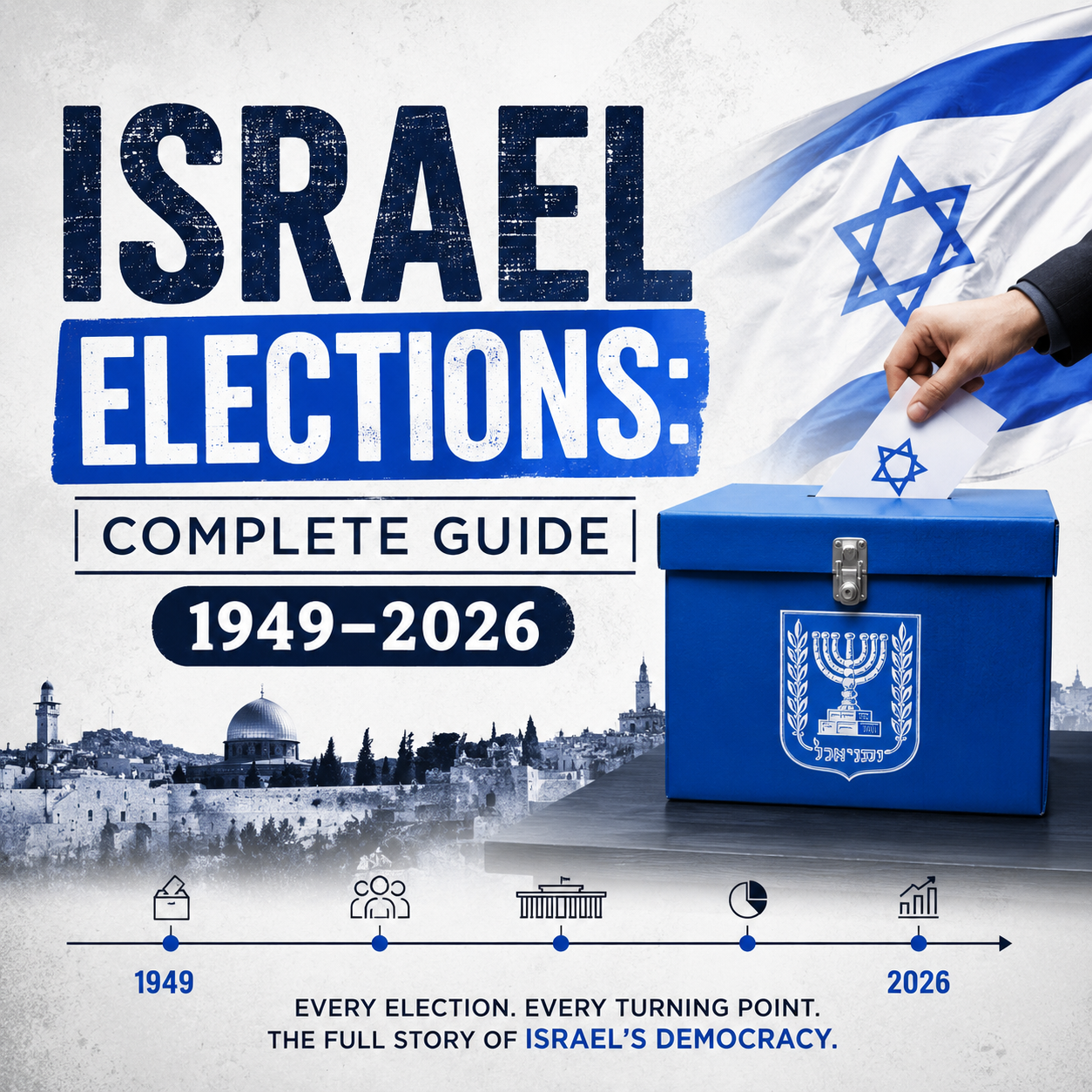
Israel Elections: Complete Guide (1949–2026)
PART 1: The 2026 Election — Quick Facts
Election for 26th Knesset (120 seats) Scheduled date No later than 27 October 2026 (possible snap date between 8 Sept–20 Oct if dissolution bill moves faster) Why it matters First election since the 7 October 2023 Hamas attack, the Gaza War, the Hezbollah war, and the 2026 Iran war Threshold to enter Knesset 3.25% of national vote Seats needed to govern 61 of 120
Why this election is happening now
- Israel’s 25th Knesset (elected Nov 2022) was expected to serve its full 4-year term.
- In May 2026, MKs voted unanimously to dissolve the Knesset after Netanyahu’s coalition failed to pass a bill exempting ultra-Orthodox (Haredi) yeshiva students from military conscription — the “Haredi draft crisis.”
- Likud itself submitted the dissolution bill to keep some control over timing rather than lose it to a coalition revolt.
PART 2: The Two Blocs & Key Players
Netanyahu Bloc (governing coalition)
Party Leader Position Likud Benjamin Netanyahu Right-wing, nationalist; PM since Dec 2022 (6th term), also facing an ongoing corruption trial Religious Zionist Party Bezalel Smotrich Far-right, pro-settlement expansion Otzma Yehudit Itamar Ben-Gvir Far-right, hardline on security/Palestinians United Torah Judaism (UTJ) — Ultra-Orthodox (Ashkenazi), defends draft exemptions Shas — Ultra-Orthodox (Sephardi), defends draft exemptions
Note: Gideon Sa’ar’s New Hope merged into Likud in 2025. UTJ’s two factions briefly quit the government in mid-2025 over the draft bill dispute, leaving Netanyahu with a razor-thin 60-seat majority.
Opposition Bloc
Party/Alliance Leader Position Together (BeYachad) Naftali Bennett (Lapid folded his Yesh Atid list into it, April 2026) Center-right to center; Bennett leads polls for much of 2026; backs PM term limits Yashar (Straight Ahead) Gadi Eisenkot New party (founded Sept 2025) led by former IDF chief of staff; campaign centers on an independent inquiry into Oct 7 failures The Democrats Yair Golan Merger of Labor + Meretz (2024); center-left/social-democratic National Unity Benny Gantz Centrist, security-focused Yisrael Beiteinu Avigdor Lieberman Secular-right, coordinating with Yashar Joint List (revived) Ra’am, Hadash, Ta’al, Balad Arab-Israeli parties, agreed to reunite for 2026
Where polls stand (mid-2026)
- Opposition bloc (Bennett-led): ~58–60 seats
- Netanyahu coalition: ~50–52 seats
- Neither side has a clear 61-seat path → likely deadlock, another election, or an awkward unity government.
- Both major blocs publicly refuse to rely on Arab parties to form government, despite their pivotal seat count.
- Likud alone is polling around 22–24 seats (down from 32 in 2022).
PART 3: The Issues Defining the Campaign
- October 7 accountability — Opposition demands a formal state commission of inquiry into the Hamas attack’s intelligence/security failures; Netanyahu prefers narrower internal reviews. This is the single biggest issue.
- Haredi draft exemptions — The war exposed the burden gap between secular/religious-Zionist Israelis (who serve and were hit hardest by casualties) and ultra-Orthodox communities (largely exempt). This directly triggered the Knesset’s dissolution.
- Judicial reform / Supreme Court independence — Unfinished business from the mass 2023 protests, still a core dividing line.
- Netanyahu’s corruption trial — Ongoing, feeds distrust narratives on both sides.
- Iran, Hezbollah, and Gaza’s future governance — Most Jewish Israelis backed military action against Iran (broadly hawkish consensus), but there’s growing public debate over the sustainability of open-ended conflict on multiple fronts.
- Economic strain — War-driven costs, reservist call-ups, and budget pressure.
How the war has reshaped politics
- Public trust in Netanyahu fell sharply after Oct 7; polls have shown a majority of Israelis at times favoring his resignation.
- Two former IDF chiefs of staff who served in Netanyahu’s wartime cabinet — Gantz and Eisenkot — quit in June 2024 citing lack of a war “exit strategy,” and both are now running against him.
- There’s cross-bloc consensus on countering Iran/Hamas/Hezbollah as existential threats, but real disagreement is emerging over strategy sustainability — this is a subtler, evolving fault line rather than a settled one.
- The war effectively froze the election clock (a full-term Knesset was expected) until the draft-law collapse forced dissolution.
PART 4: Full Election History, Independence to Today
Israel uses nationwide proportional representation — no district voting, no party has ever won 61+ seats outright, so every government has been a coalition. The Knesset has been dissolved early almost every time (only rarely serving a full term).
Here’s the same table, cleaned up and grouped by era so the pattern sticks better:
ISRAEL ELECTIONS: 1949–2026
═══════════════════════════ ERA 1: Labor/Mapai Dominance (1949–1977) ═══════════════════════════
1949 — Mapai — 46 seats — PM: Ben-Gurion
1951 — Mapai — 45 seats — PM: Ben-Gurion
1955 — Mapai — 40 seats — PM: Ben-Gurion / Sharett
1959 — Mapai — 47 seats — PM: Ben-Gurion
1961 — Mapai — 42 seats — PM: Ben-Gurion / Eshkol
1965 — Alignment — 45 seats — PM: Eshkol
1969 — Alignment — 56 seats ⭐ (record, still unbeaten) — PM: Golda Meir
1973 — Alignment — 51 seats — PM: Meir → Rabin
💡 Remember: 29 straight years of Labor rule.
═══════════════════════════ ERA 2: The “Mahapakh” & Right-Left Split (1977–1992) ═══════════════════════════
1977 — Likud — 43 seats — PM: Begin — “The Revolution” — ends 29 yrs of Labor rule
1981 — Likud — 48 seats — PM: Begin
1984 — Alignment 44 / Likud 41 (tie) — PM: Peres → Shamir (rotation deal)
1988 — Likud 40 / Alignment 39 (tie) — PM: Shamir (unity govt)
1992 — Labor — 44 seats — PM: Rabin
💡 Remember: 1984 & 1988 = dead heats → forced power-sharing, just like 2026 might be.
═══════════════════════════ ERA 3: Direct PM Experiment (1996–2001) ═══════════════════════════
1996 — Likud-Gesher-Tzomet — 32 seats — PM: Netanyahu
1999 — One Israel — 26 seats — PM: Barak
2001 — (PM vote only, no Knesset election) — PM: Sharon
💡 Remember: Israel briefly voted for PM and Knesset separately — scrapped after 2001, made coalitions less stable.
═══════════════════════════ ERA 4: Kadima & Netanyahu’s Long Reign (2003–2015) ═══════════════════════════
2003 — Likud — 38 seats — PM: Sharon
2006 — Kadima — 29 seats — PM: Olmert
2009 — Kadima 28 / Likud 27 — PM: Netanyahu (Kadima won more seats, Netanyahu still became PM)
2013 — Likud Beiteinu — 31 seats — PM: Netanyahu
2015 — Likud — 30 seats — PM: Netanyahu
💡 Remember: seats ≠ power — 2009 proves it.
═══════════════════════════ ERA 5: The Gridlock Years (2019–2022) ═══════════════════════════
Apr 2019 — Likud 35 = Blue & White 35 (tie) — PM: Netanyahu (caretaker)
Sep 2019 — Blue & White 33 / Likud 32 — PM: Netanyahu (caretaker)
Mar 2020 — Likud — 36 seats — PM: Netanyahu (unity w/ Gantz)
Mar 2021 — Likud — 30 seats — PM: Bennett → Lapid (rotation)
Nov 2022 — Likud — 32 seats — PM: Netanyahu
💡 Remember: 5 elections in under 4 years, all really asking one question — “Is Netanyahu fit to govern?”
═══════════════════════════ ERA 6: Now ═══════════════════════════
2026 — TBD (election Oct 27) — PM: TBD — first vote since Oct 7, 2023
💡 Remember: Polling looks like a 1984/1988 rerun — near-even blocs, no clear majority.
═══════════════════════════
The whole 77 years in one line: Labor built the state → Likud broke Labor’s grip (1977) → direct PM elections tried and abandoned (1996–2001) → Kadima and Netanyahu traded power (2003–2015) → five straight deadlocked elections (2019–2022) → now a sixth deadlock, shaped by the Oct 7 war (2026).
Patterns worth remembering
- 1948–1977 (29 years): Uninterrupted Labor/Mapai dominance.
- 1977 “Mahapakh”: Likud’s first-ever win, permanently broke Labor’s monopoly.
- 1984 & 1988: Elections so close neither bloc could govern alone → forced power-sharing/rotation governments (a preview of 2026’s likely deadlock).
- 1996–2001: Brief experiment with directly electing the PM separately from the Knesset — scrapped for producing less stable governments, not more.
- 2019–2022 (5 elections in under 4 years): Longest period of political paralysis in Israeli history, all centered on “is Netanyahu fit to govern.”
- Highest seat count ever for one list: Alignment’s 56 in 1969 — no party has ever crossed the 61-seat majority threshold alone.
- Netanyahu is Israel’s longest-serving PM (three separate stints, largely continuous since 2009).
PART 5: One-Paragraph Summary
Israel’s 2026 election is a referendum on Netanyahu’s wartime leadership after Oct 7, playing out through two flashpoints — who’s accountable for the security failure, and whether ultra-Orthodox citizens must serve in the military — layered on top of unresolved judicial reform battles and Netanyahu’s corruption trial. Two roughly even blocs (Netanyahu’s religious-right coalition vs. a Bennett-led opposition featuring new entrants Eisenkot and a merged Bennett-Lapid list) are neck-and-neck in polling, echoing the deadlocked elections of the 1980s more than any recent contest — meaning another coalition crisis, rather than a decisive verdict, is a real possibility.
메타데이터
- post_id
- ccce814deebc
- slug
- israel-elections-complete-guide-1949-2026-ccce814deebc
- url
- https://medium.com/@imran.haidree/israel-elections-complete-guide-1949-2026-ccce814deebc
- canonical_url
- https://medium.com/@imran.haidree/israel-elections-complete-guide-1949-2026-ccce814deebc
- author_url
- https://medium.com/@imran.haidree
- status
- ok
- fetched_at
- 2026-08-08 02:08:21