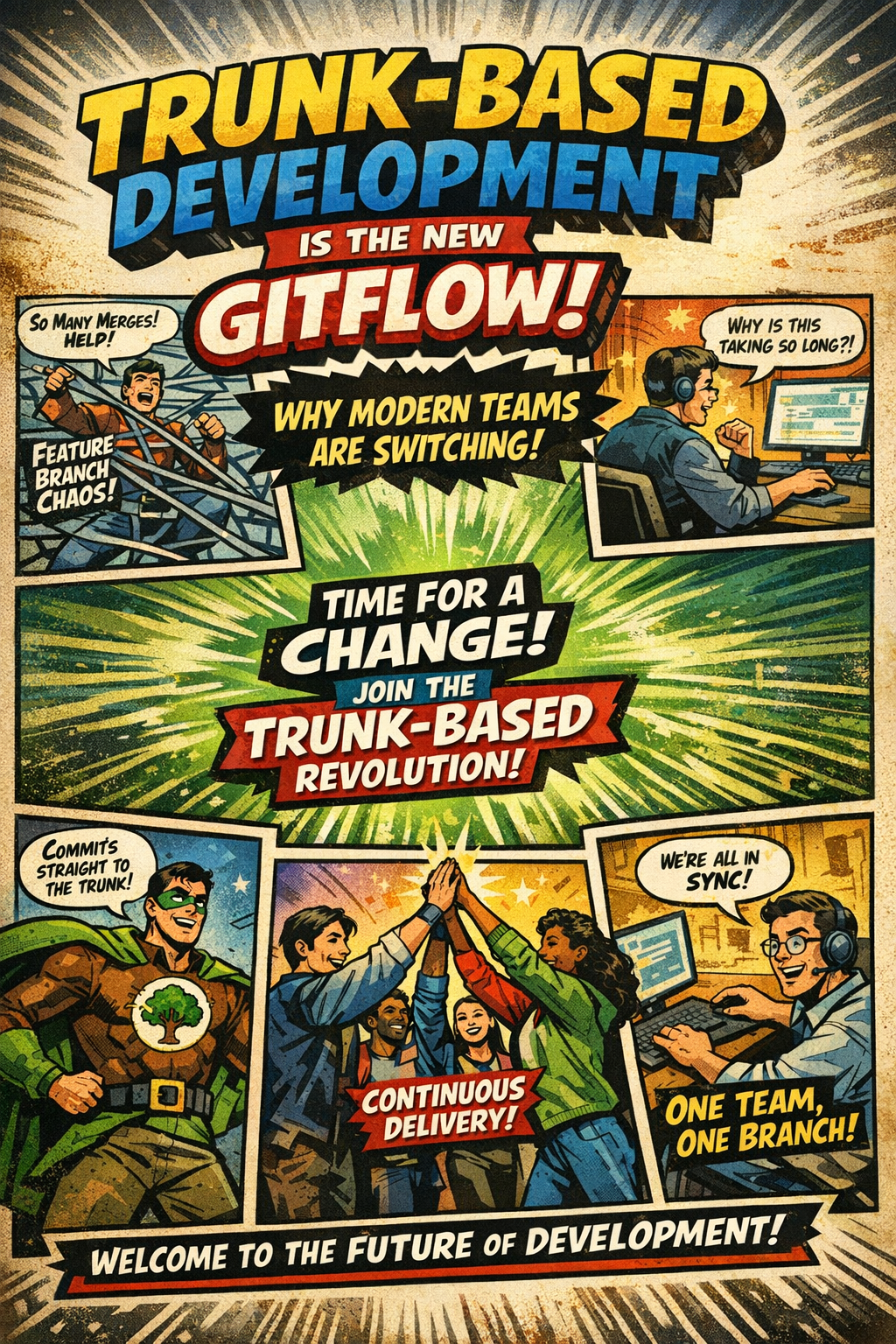
Trunk-Based Development is the New GitFlow: Why Modern Teams are Switching
Trunk-Based Development is the New GitFlow: Why Modern Teams are Switching
Merge Early. Release Safely. Ship Continuously.
A Practical Guide to Feature Flags and Branching Strategy for Continuous Delivery
Modern engineering teams are under constant pressure to ship faster. Customers expect rapid iteration. Competitors move quickly. Product teams want experiments. Leadership wants predictability.
But speed without control creates outages, rollbacks, and burned-out engineers.
The solution isn’t “work harder.” It’s adopting the right feature flag and branching strategy that enables continuous delivery — safely.
This guide explains what to implement, why it matters, and how to do it correctly.
Why Continuous Shipping Fails Without Strategy
Many teams say they want continuous delivery. Few build the foundation for it.
Common failure patterns:
- Long-lived feature branches that diverge for weeks
- Massive pull requests that are hard to review
- Big-bang releases
- Fear of merging incomplete work
- Production deploys that feel risky
The result?
- Merge conflicts
- Delayed releases
- High deployment anxiety
- Slower innovation
High-performing companies like Amazon, Netflix, and Google don’t ship faster because their engineers are superhuman.
They ship faster because they reduce risk through:
- Trunk-based development
- Feature flags
- Progressive delivery
- Small batch sizes
Speed is a byproduct of safety.
The Core Idea: Decouple Deployment from Release
This is the most important concept.
Deployment = Code is in production. Release = Users can access the feature.
Feature flags separate the two.
That separation changes everything.
You can:
- Merge unfinished work
- Deploy multiple times per day
- Test in production safely
- Roll back instantly without redeploying
This dramatically lowers the cost of change.
The Branching Strategy: Trunk-Based Development
If you want continuous delivery, start here.
What It Is
- One main branch (
mainortrunk) - Short-lived feature branches (1–3 days max)
- Frequent merges to main
- Always deploy from main
No long-lived branches.
Why It Works
Long branches create:
- Drift from main
- Painful merges
- Hidden integration problems
- Delayed feedback
Short branches:
- Reduce merge conflicts
- Improve code review quality
- Surface issues early
- Encourage smaller, safer changes
If a feature takes three weeks, that does not mean the branch should live for three weeks.
Instead, merge incomplete work behind a feature flag.
The Feature Flag Strategy
Feature flags make trunk-based development safe.
1. Release Flags (Most Common)
Used to hide incomplete features.
Example:
- New checkout flow
- Refactored dashboard
- New API response format
These flags are temporary and must be removed after full rollout.
2. Experiment Flags
Used for:
- A/B testing
- Conversion optimization
- UX experiments
These often integrate with analytics tools.
3. Operational Flags (Kill Switches)
Used to:
- Disable a failing feature instantly
- Reduce load during incidents
- Turn off expensive logic
These are critical for production safety.
4. Permission or Beta Flags
Used to:
- Enable features for internal teams
- Roll out to beta customers
- Gate by user role
The Recommended Workflow
Here’s what modern continuous delivery looks like:
- Create short-lived branch
- Add feature flag immediately
- Merge early — even if incomplete
- CI runs automatically
- Deploy to production
- Enable feature gradually
- Remove flag after full release
This allows safe, incremental progress instead of risky big releases.
Progressive Rollout Strategy
Never release to 100% of users instantly.
Instead:
- 0% (internal only)
- 5%
- 25%
- 50%
- 100%
Monitor:
- Errors
- Performance
- Business metrics
If something breaks, turn off the flag.
No redeploy required.
That’s real operational safety.
Environment Defaults (Practical Setup)
A common pattern:

Feature Flag Setup
This ensures features are tested early but released intentionally.
Governance: Prevent Feature Flag Debt
Feature flags are powerful — but dangerous if unmanaged.
Every flag should have:
- An owner
- A documented purpose
- A target removal date
- Tracking in your project system
Release flags should typically be removed within 2–4 weeks.
Stale flags:
- Increase cognitive load
- Create testing complexity
- Hide dead code paths
Treat flag cleanup as part of “definition of done.”
When Not to Use Feature Flags
Avoid flags for:
- Simple one-line changes
- Pure backend refactors with no user impact
- Database migrations (use backward-compatible migrations instead)
Flags are for controlling risk — not avoiding discipline.
The Business Impact
When implemented correctly, this strategy leads to:
🚀 Faster Time to Market
Smaller changes move through the system quickly.
🔐 Lower Deployment Risk
Releases are controlled and reversible.
📊 Better Experimentation
Product teams can test ideas safely.
😌 Reduced Engineer Stress
Deployments stop feeling like high-stakes events.
🔁 Continuous Feedback Loops
Production becomes a safe testing ground.
What This Looks Like at Scale
For teams of 10–100+ engineers:
- Trunk-based development
- Mandatory PR reviews
- Automated CI/CD
- Feature flags for incomplete work
- Gradual rollouts
- Strict flag cleanup policy
This model scales because it reduces coordination overhead.
The larger the team, the more critical small batch sizes become.
Final Takeaway
Continuous delivery is not about deploying more often.
It’s about reducing the risk of each deployment.
Feature flags and trunk-based development work together to:
- Minimize integration pain
- Enable safe experimentation
- Decouple release from deployment
- Increase engineering velocity
Merge early. Release safely. Ship continuously
메타데이터
- post_id
- ccd1e6766cb1
- slug
- trunk-based-development-is-the-new-gitflow-why-modern-teams-are-switching-ccd1e6766cb1
- url
- https://medium.com/@samueldeveloper/trunk-based-development-is-the-new-gitflow-why-modern-teams-are-switching-ccd1e6766cb1
- canonical_url
- https://medium.com/@samueldeveloper/trunk-based-development-is-the-new-gitflow-why-modern-teams-are-switching-ccd1e6766cb1
- author_url
- https://medium.com/@samueldeveloper
- status
- ok
- fetched_at
- 2026-07-31 01:28:13