“This is America” Black Indigenous Photo Album
The presence of Black indigenous in the Americas was documented and acknowledged until the turn of the 20th Century, which brought…
“This is America” Black Indigenous Photo Album
The presence of Black indigenous in the Americas was documented and acknowledged until the turn of the 20th Century (the 1900s), which brought eugenics, scientific racism, and Jim Crow apartheid to scholarship and record-keeping.
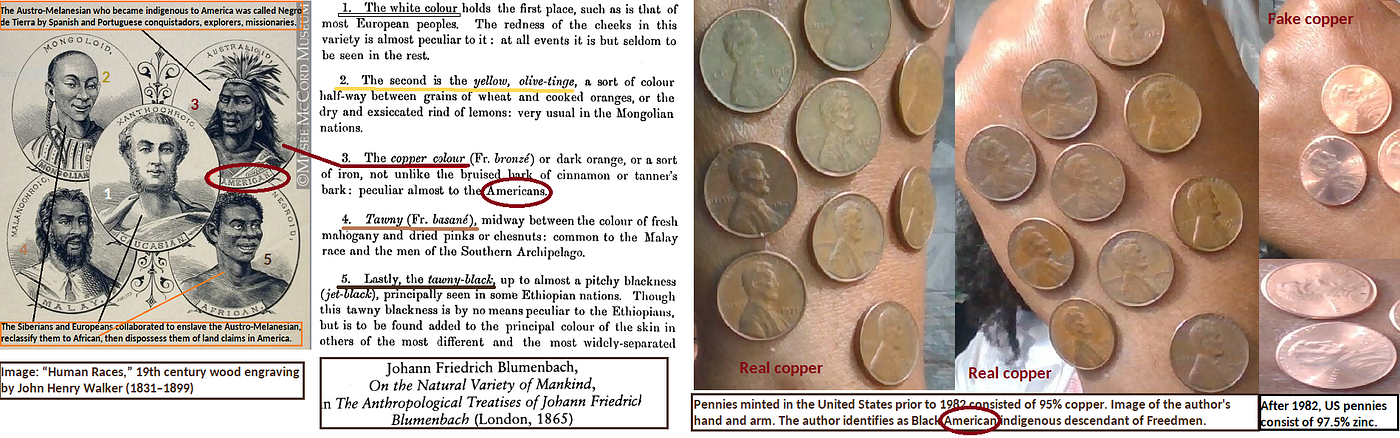
LEFT: “Human Races.” Note that the only figure labeled “American” is dark-brown and wearing headdress. 19th Century wood engraving by John Henry Walker (1831–1909). LEFT MIDDLE: “The copper color (Fr bronze) or dark orange, a sort of iron not unlike the bruised bark of cinnamon or tanner’s bark peculiar almost to the Americans.” Johan Friedrich Blumenbach, “On the Natural Variety of Mankind in the Anthropological Treaties of Johan Fredrich Blumenbach” (London, 1865). RIGHT MIDDLE: Pennies minted in the United States prior to 1982 consisted of 95% copper, which are dark brown in color. Image of the author’s hand and arm. The author identifies as Black American indigenous descendant of Freedmen. RIGHT: “Fake Copper.” After 1982, US pennies consist of 97.5% zinc covered by a coating of 2.5% copper, which are a pinkish-orange.
The arrival of Walter Plecker (son of a slaveholder, 1861–1947) to Virginia’s Vital Statistics, Aleš Hrdlička (immigrant, 1869–1943) to the Smithsonian Institution, Melville Herskovits (son of immigrants, 1895–1963) to Anthropology at Northwestern University, and Flinders Petrie (eugenicist,1853–1942) to Egyptology initiated an intense effort to conceal, diminish, or destroy evidence of the presence and contributions of the Black indigenous in the Americas. These destructive efforts by White supremacists and eugenicists against Black indigeneity within the Americas have faced increased scrutiny and backlash.
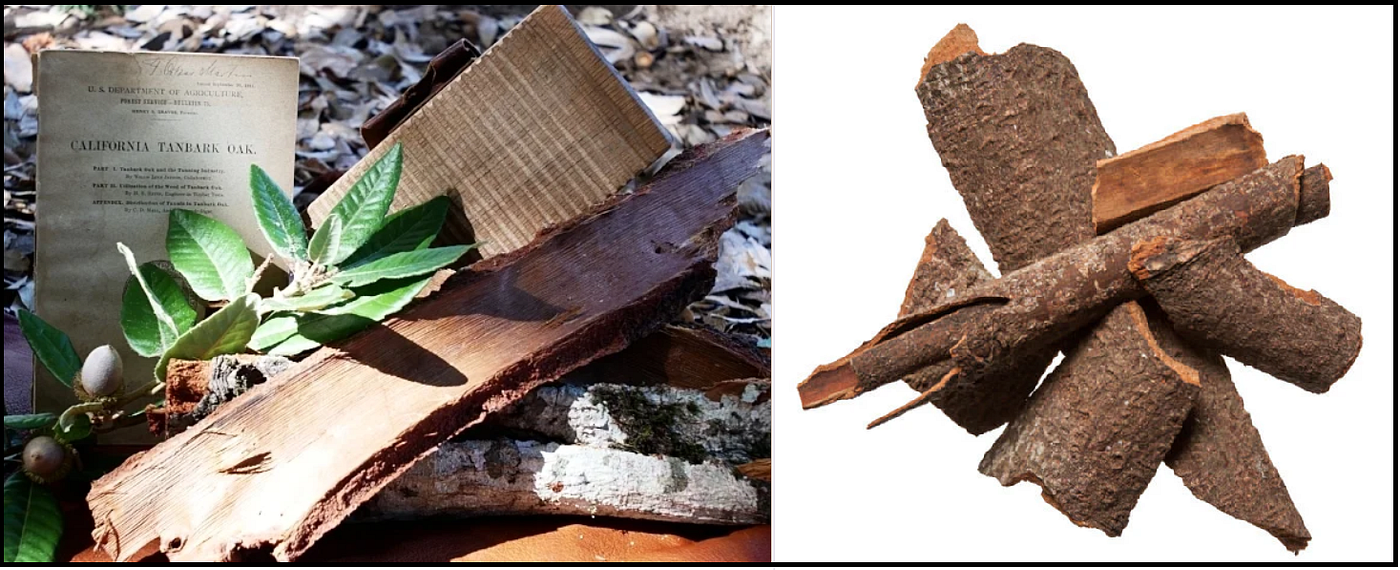
In “On the Natural Variety of Mankind in the Anthropological Treaties of Johan Fredrich Blumenbach,” Johan Friedrich Blumenbach compared Americans to tanner’s bark and bruised cinnamon bark, as well as copper, all of which are dark brown in color. Not olive, not tan, not tawny, not even red… DARK BROWN. LEFT: Tanner’s bark used for leather from https://skillcult.com/blog/tanningmaterials. RIGHT: Cinnamon bark from https://plumdragonherbs.com/products/rou-gui.
Common misconception is that 12,000-year-old Luzia’s skeletal remains found in Brazil yielded DNA that proved that she was “Amerindian,” or “Paleoindian,” or Siberian descent, or that she arrived to Brazil via Beringia. 100% false. No DNA has ever been successfully extracted or analyzed from Luzia. Her skeleton burned (or was burned) prior to extraction. The burning of Luzia and the attempt to steal her valor, is only one example of concealment.
![LEFT: 12,000-year-old skull of woman known as “Luzia” RIGHT: Realistic sculpture of Luzia. The museum’s most popular exhibit, the 12,000-year-old remains of a woman simply known as “Luzia,” is one of the millions of irreplaceable artifacts lost in the fire. Using her skull, [Walter Neves] created a realistic sculpture of the woman. It too was destroyed. Will Adams. RelicRecord.com](https://miro.medium.com/v2/resize:fit:800/1*7aInWv96Wj-yXrdywA7ihw.jpeg)
LEFT: 12,000-year-old skull of woman known as “Luzia” RIGHT: Realistic sculpture of Luzia. The museum’s most popular exhibit, the 12,000-year-old remains of a woman simply known as “Luzia,” is one of the millions of irreplaceable artifacts lost in the fire. Using her skull, [Walter Neves] created a realistic sculpture of the woman. It too was destroyed. Will Adams. RelicRecord.com
The map below is the clearest indication of Luzia’s origin. A boat drifting unpowered from Sierra Leone or Liberia would immediately enter the Equatorial current and reach the shores of northeast Brazil in as little as 30 to 45 days.

Key “Negroid” (non-Siberian) artifacts and remains on the eastern shores of the Americas. Perry DNA, South Carolina, United States. 1800s AD. Landing zone of the North Equatorial Current. Topper Site, South Carolina, United States. 50,000 years ago. Discovered in the landing zone of the North Equatorial Current. Olmec Civilization, San Lorenzo Tenochtitlan, Veracruz, Mexico. Flourished 1400 BC. Discovered in the landing zone of the North Equatorial Current. “Naia,” Yucatán Peninsula, Mexico. Lived 12,000 years ago. Found in the landing zone of the North Equatorial Current from West Africa. “Luzia,” Minas Gerais, Brazil. Lived 11,500 years ago. Found in the landing zone of the South Equatorial Current from West Africa. Pedra Furada, Piaui, Brazil. Developed 60,000 years ago. Landing zone of the South Equatorial Current from West Africa. Map of the Earth’s major ocean currents. US govt public domain. U. S. Government. Public Domain.
Nearly every war fought on North American soil concerned indigenous slavery:
Pequot War, 1636–1638, (slave acquisition)
Tuscaroa War, 1711–1715, (slave acquisition)
Yamasee War, 1715–1717, (slave acquisition)
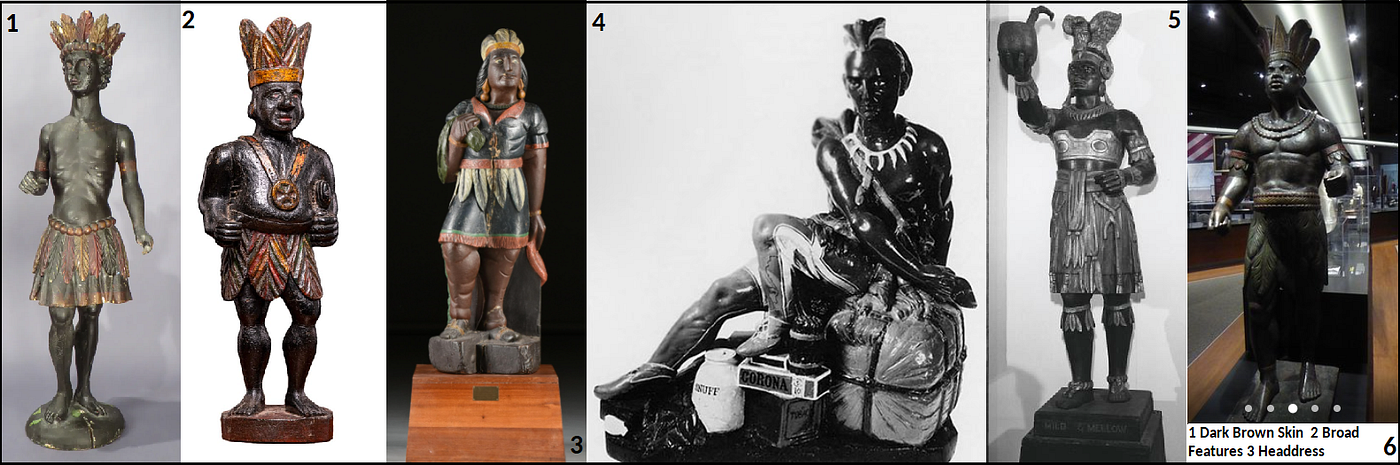
Cigar Store Indians with dark brown skin, broad features, and headdress. See also, Artists in Wood: American Carvers of Cigar-Store Indians, Show Figures, and Circus Wagons,” by Frederick Fried, Publisher Clarkson N. Potter, New York, 1970. 1) “Cigar Store Indian c.1790" and “… manufactured for tobacco companies in Scotland as a display item for their products. This particular form is commonly referred to as the “Virginia” or “Black Boy” style…” 19th Century, Wood, Dutch School, Unknown artist. “…carved “Virginie men,” as Europeans called native Americans, were used for advertising the sale of tobacco, an American crop.” Caption and Image from 1stdibs.com. 2) “19th C Oakwood Counter Top Cigar Store Indian Statue, Netherlands.” Caption and image from 1stdibs.com. 3) “An American painted and carved wood cigar store Indian, probably Maryland or Delaware, late 19th Century.” Caption and image from SimpsonGalleries.com. 4) “Pewter Indian.” Caption from Penn Museum. 5) “Cigar Store Indian.” Image and caption from National Museum of American History. 6) “Cigar Store Indian.” Virginia Museum of History & Culture, Richmond. Image and caption from TripAdvisor.
Revolutionary War, 1775–1783, (Britain emancipated slaves)
Red Stick Creek War, 1813 — 1814 (slave acquisition)
War of 1812, 1812–1815, (Britain emancipated slaves)
Seminole War, 1816–1818, 1835–1842, 1855–1858 (slave acquisition)
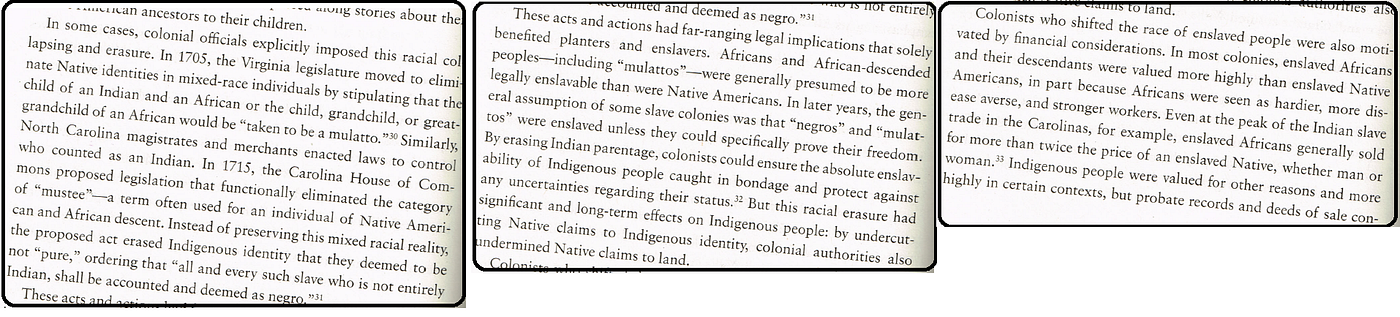
Image excerpted from: Fisher, Linford D. Stealing America: The Hidden Story of Indigenous Slavery in U.S. History. New York: Liveright Publishing Corporation, 2026.
Texas Revolution, 1835–1836, (Mexico emancipated slaves)
Bleeding Kansas, 1854–1861, (slavery expansion)
Civil War, 1861–1865, (the Union emancipated slaves)
The Indian Wars were wars of captive-taking, enslavement, slave trading, slave trafficking, land stealing, and forced labor to clear and develop the vacated land for cash crops. The Indians did not disappear. They were chained. Southeastern plantation owners took advantage of President Andrew Jackson’s forced-removal policies to gather up Indian captives and traffick them west to Texas cotton plantations.
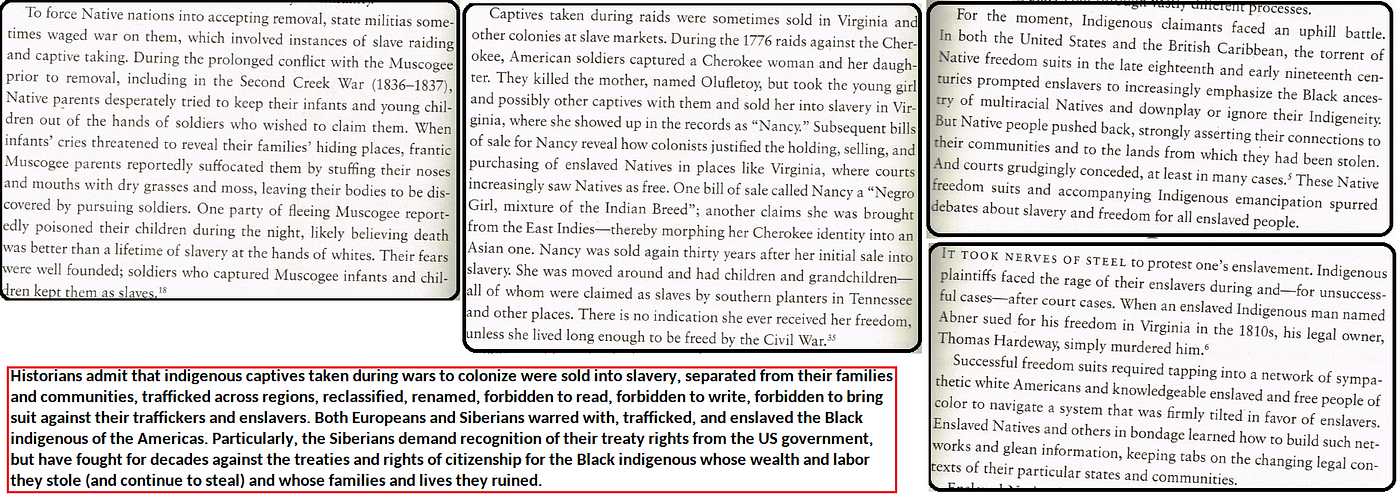
Image excerpted from: Fisher, Linford D. Stealing America: The Hidden Story of Indigenous Slavery in U.S. History. New York: Liveright Publishing Corporation, 2026.
Stealing America: The Hidden Story of Indigenous Slavery in US History reveals in great detail, the reclassification of indigenous tribal members to “mulatto, colored, negro, Black” in North American slave records.
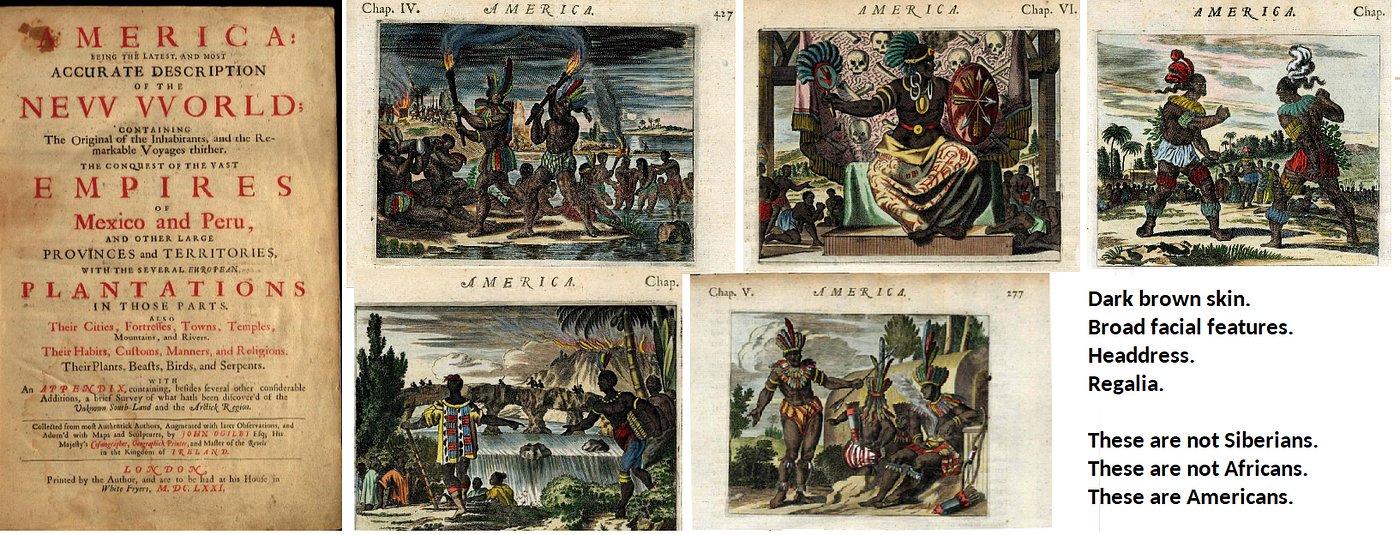
Clockwise from LEFT: Title page of “AMERICA.” Then, “Native Peruvians.” Then, “Aztec Chief Wall of Skulls.” Then, “Inca Chiefs Ritual Prophecy.” Then, “Aztec Warriors Making Healing Ointments.” Then, “Quito, Ecuador Waterfall.” Screenshot images from Ogilby, John. America: Being the Latest, and Most Accurate Description of the New World. London: Printed by the Author, 1671. Public domain.
Colonizers trafficked the enslaved as the “spoils of war” throughout the North American colonies, to the Caribbean, Europe, and Africa.
![Europeans used Black indigenous in headdress as emblems [avatars] of America. LEFT: “An Emblem of America.” Published by Haines & Son [London]. 1798. Allegorical figure, shown full-length standing to left, holding a standard showing the stars and stripes and an eagle, looking at two black boys wearing feathered head-dresses who stand on the left…” Caption by Wikipedia. Public domain. LEFT MIDDLE: “An Emblem of America.” Allegorical figure print by Haines & Son from the British Museum. 1798–1801 Hand-coloured mezzotint with etching. Public domain. RIGHT MIDDLE: “Amerique” A vintage postcard illustration advertising Lefevre-Utile biscuits and featuring representations of the Americas, including a Black woman in headdress. Published in Paris, France, circa 1910. Public domain. RIGHT: “Moctezuma: Last King of Mexico.” This famous portrait of the Aztec potentate Montezuma II (1466–1520) was included in John Ogilby’s publication America: Being the Latest and Most Accurate Description of the New World, and in the work of Van Meur of the same year. 1671. Public domain.](https://miro.medium.com/v2/resize:fit:1400/1*8JNN9UxfZJDzJGtzSc6VgA.png)
Europeans used Black indigenous in headdress as emblems [avatars] of America. LEFT: “An Emblem of America.” Published by Haines & Son [London]. 1798. Allegorical figure, shown full-length standing to left, holding a standard showing the stars and stripes and an eagle, looking at two black boys wearing feathered head-dresses who stand on the left…” Caption by Wikipedia. Public domain. LEFT MIDDLE: “An Emblem of America.” Allegorical figure print by Haines & Son from the British Museum. 1798–1801 Hand-coloured mezzotint with etching. Public domain. RIGHT MIDDLE: “Amerique” A vintage postcard illustration advertising Lefevre-Utile biscuits and featuring representations of the Americas, including a Black woman in headdress. Published in Paris, France, circa 1910. Public domain. RIGHT: “Moctezuma: Last King of Mexico.” This famous portrait of the Aztec potentate Montezuma II (1466–1520) was included in John Ogilby’s publication America: Being the Latest and Most Accurate Description of the New World, and in the work of Van Meur of the same year. 1671. Public domain.
![LEFT: Crispus Attucks (c. 1723 — March 5, 1770) was a Black Wampanoag “whaler, sailor, and stevedore regarded as the first person killed in the Boston Massacre, and as a result the first American killed in the American Revolution. Town histories of Framingham written in 1847 and 1887 describe him as a slave of Deacon William Brown. In 1750, Brown advertised for the return of a runaway slave named Crispas,” and described him as “Molatto.” Photo and captions from Wikipedia. Public domain. CENTER: “Illustration of Tituba by John W. Ehninger, 1902.” Tituba (c. 1692–1693) was an enslaved Arawak from Barbados, brought to Massachusetts. Her spouse was John Indian, a Wampanoag. She was accused of witchcraft during the Salem Witch Trials of 1692–1693. Held for one year, but never convicted. “Tituba, illustration by John W. Ehninger.” Published in “Giles Corey of the Salem Farms” (1868) (Houghton, Mifflin & Co.), in The Complete Poetical Works of Henry Wadsworth Longfellow, Boston, 1902. From Wikipedia. Public domain. RIGHT: “Shoshone Indian and his Squaw.” Hodder, Edwin, Robert Brown, and Moses Foster Sweetser. The World: Its Cities and Peoples. London, Paris, New York, Melbourne: Cassell & Company, Ltd., [c. 1882–1890]. Colonizers of this time had difficulty sorting the ethnicities of Black indigenous, Siberian, and African enslaved.](https://miro.medium.com/v2/resize:fit:1399/1*Q2ysebcW4sm4y_h23RX2fg.png)
LEFT: Crispus Attucks (c. 1723 — March 5, 1770) was a Black Wampanoag “whaler, sailor, and stevedore regarded as the first person killed in the Boston Massacre, and as a result the first American killed in the American Revolution. Town histories of Framingham written in 1847 and 1887 describe him as a slave of Deacon William Brown. In 1750, Brown advertised for the return of a runaway slave named Crispas,” and described him as “Molatto.” Photo and captions from Wikipedia. Public domain. CENTER: “Illustration of Tituba by John W. Ehninger, 1902.” Tituba (c. 1692–1693) was an enslaved Arawak from Barbados, brought to Massachusetts. Her spouse was John Indian, a Wampanoag. She was accused of witchcraft during the Salem Witch Trials of 1692–1693. Held for one year, but never convicted. “Tituba, illustration by John W. Ehninger.” Published in “Giles Corey of the Salem Farms” (1868) (Houghton, Mifflin & Co.), in The Complete Poetical Works of Henry Wadsworth Longfellow, Boston, 1902. From Wikipedia. Public domain. RIGHT: “Shoshone Indian and his Squaw.” Hodder, Edwin, Robert Brown, and Moses Foster Sweetser. The World: Its Cities and Peoples. London, Paris, New York, Melbourne: Cassell & Company, Ltd., [c. 1882–1890]. Colonizers of this time had difficulty sorting the ethnicities of Black indigenous, Siberian, and African enslaved.

Americans also used Black indigenous in headdress as symbols. Woodcut tobacco labels. English School, circa 1700s. Virginia Historical Society.
Enslavement of indigenous was eventually outlawed because it provoked coordinated retaliation by tribal nations against the enslavers. However, though it was outlawed, enslavement of the indigenous did not stop.
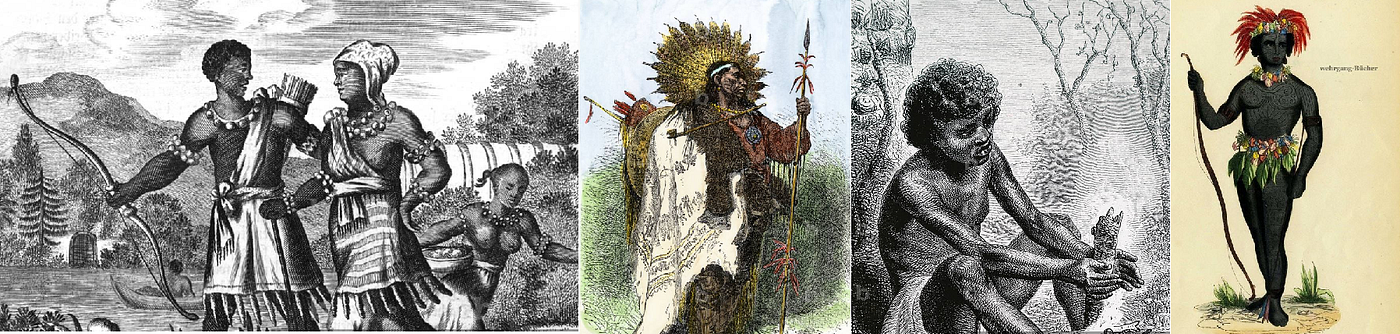
LEFT: “Native Americans as described by travellers (engraving).” Engraving by Theodor de Bry (Flemish, 1528–1598). Public domain. LEFT MIDDLE: “History of Indigenous Peoples: Wampanoag Warrior in Costume, Massachusetts. 19th century engraving. Public domain. RIGHT MIDDLE: Engraving of a North American Indian using a fire drill. Public domain. RIGHT: “Eingeborner Der Massacre-Insel United-States, Dauphin Island. Alabama, 1843.” Born on Massacre Island United-States, Dauphin Island. Alabama, 1843.
Instead, reclassification of the indigenous increased.
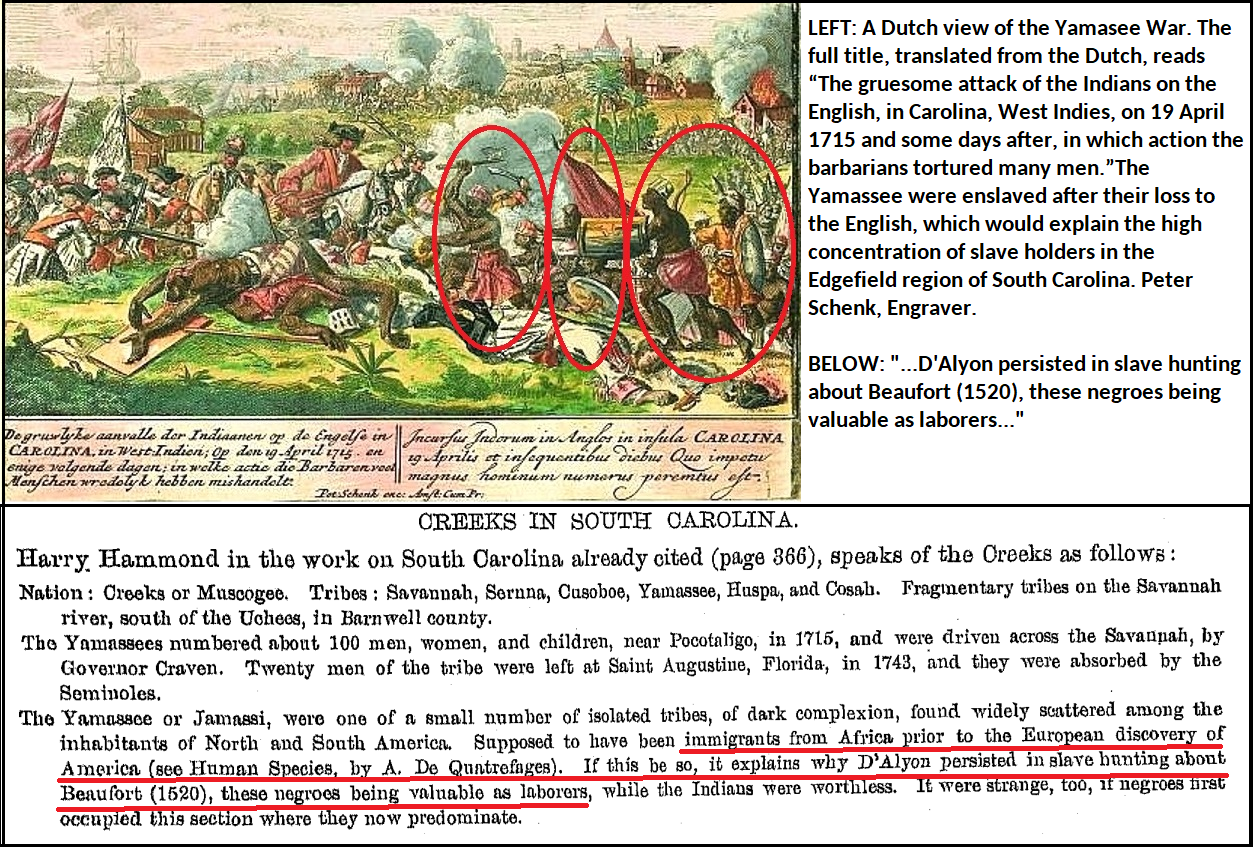
LEFT: A Dutch view of the Yamasee War. The full title, translated from the Dutch, reads “The gruesome attack of the Indians on the English, in Carolina, West Indies, on 19 April 1715 and some days after, in which action the barbarians tortured many men.” Peter Schenk, Engraver. The Yamassee were enslaved after their loss to the English, which would explain the high concentration of slave holders in the Edgefield region of South Carolina. BOTTOM: “The Yamassee or Jamassi, were one of a small number of isolated tribes, of dark complexion, found widely scattered among the inhabitants of North and South America. Supposed to have been immigrants FROM AFRICA PRIOR TO THE EUROPEAN DISCOVERY OF AMERICA (see Human Species, by A. De Quatrefages). If this be so, it explains why D’Alyon PERSISTED IN SLAVE HUNTING ABOUT BEAUFORT (1520), THESE NEGROES BEING VALUABLE AS LABORERS, while the Indians were worthless. It were strange, too, if negroes first occupied this section where they now predominate.” Extra Census Bulletin: The Five Civilized Tribes in Indian Territory. US Census Office. Department of the Interior. 1894. In 1521, an expedition Lucas Vázquez de Ayllón sponsored under Francisco Gordillo landed near Cape Fear/the Lowcountry, where they kidnapped roughly 70 Native Americans to sell into slavery in Hispaniola. From the pictured excerpt, we see the Spanish were actively hunting for dark-complexioned indigenous populations to enslave in the southeastern region of North America as far back as the 1520s. In 1894, Hammond speculates that the “negroes” of South Carolina were indigenous because of D’Alyon’s 1520s slave-hunting.
Slavers who illegally trafficked indigenous slaves hid them in plain sight via paper work and reclassification.
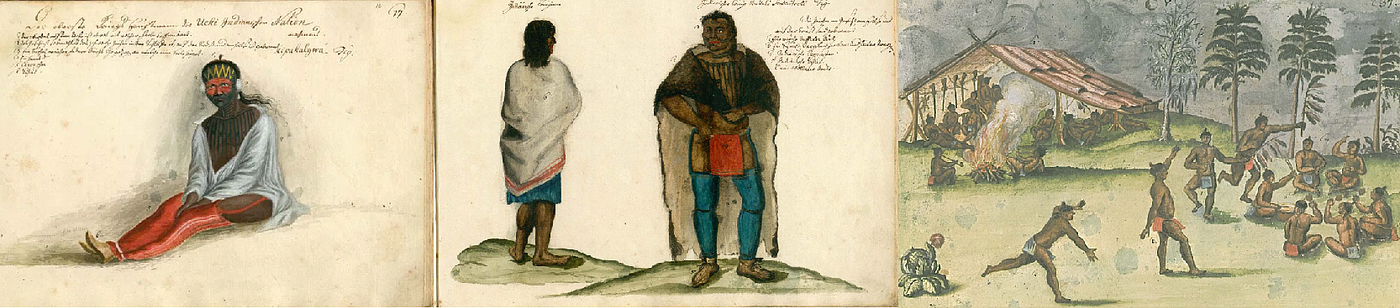
LEFT: Yuchi Tribe Chief Kipahalgwa. “This watercolor portrait of “General” Kipahalgwa of the Yuchi Indians was painted by the German artist Philip Georg Friedrich von Reck around 1734. . Kipahalgwa is depicted wearing an English-style shirt, leggings, and shoes. He is seated, and he also wears a green and gold hat.” Caption by New Georgia Encyclopedia. Painted by Philip Georg Friedrich von Reck circa 1736 in Georgia. CENTER: “Painter Philip Georg Friedrich von Reck identified this couple as Senkaitschi, a Yuchi king and his queen. The queen’s blanket, which the artist describes as “a British blanket from Charles Town,” offers evidence of trade with Europeans.” Caption by New Georgia Encyclopedia. 1730s. RIGHT: “Georgia’s Yuchi Indians of Georgia were one of many refugee tribes in the area during the eighteenth century. They eventually joined with the Lower Creek Indians. Here the Yuchi Indians are depicted in a war dance. Six Yuchis sit in a circle on the right, and four others stand near them, dancing. A group of Yuchi Indians sits under an open-sided wooden structure in the background. A fire burns just outside the building.“ Caption by New Georgia Encyclopedia. “Yuchi Indians of Georgia. “ Watercolor illustration by the German, Philip Georg Friedrich von Reck, circa 1730s.
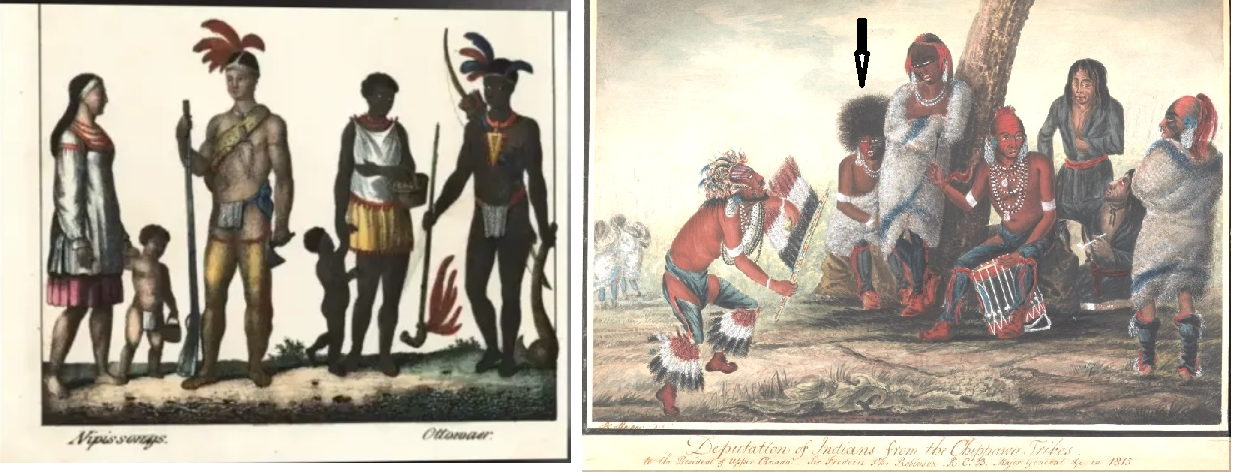
LEFT: “Costumes of Canadian natives: Nipissing and Ottowa people.” Hand-colored lithograph from Friedrich Wilhelm Goedsches’s Complete Gallery of Peoples in True Pictures, Meissen, circa 1835–1840. RIGHT: Deputation of Indians from the Chippewa Tribes to the President of Upper Canada, Sir Frederic Ph Robinson, KCB, Major General, etc., in 1815. By Rudolf Steiger (1815). National Gallery of Canada
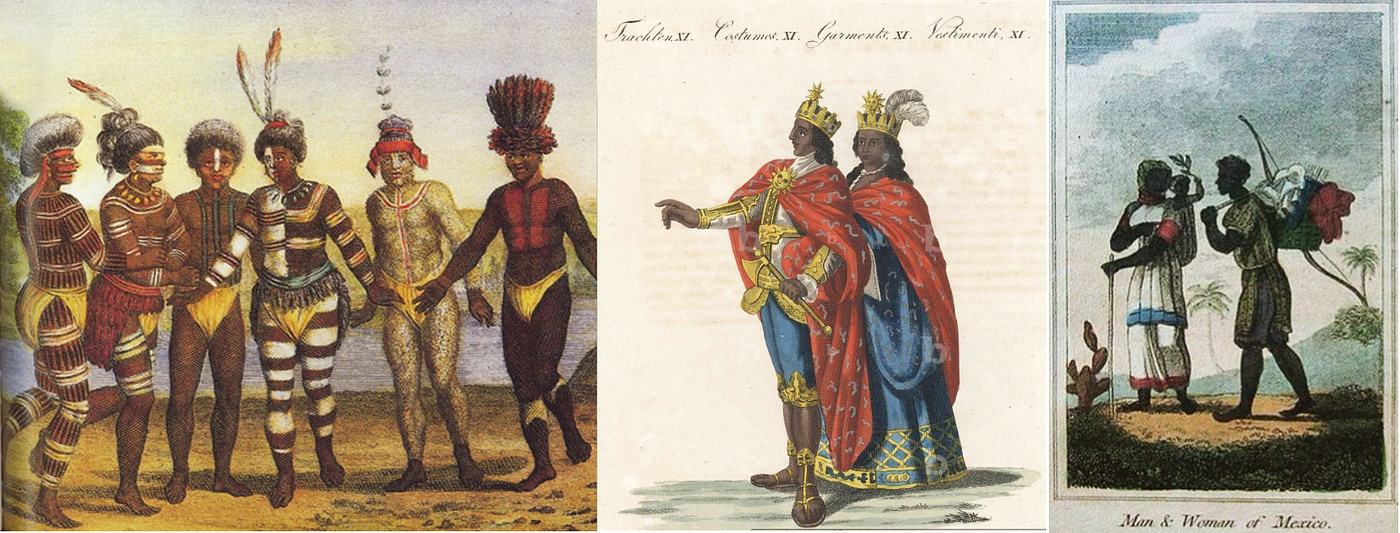
LEFT: “The Ohlone people performing a ceremonial dance at Mission San Jose,” by Louis Choris. 1816. Choris, a Russian artist and naturalist visited Alta California in 1816 as part of the Russian scientific expedition aboard the Rurik. His sketches and colorized engravings, including scenes of dancers at Mission Dolores, are among the earliest visual records of Ohlone culture. Public domain. CENTER: Lithograph of Peruvian Incas, 18th century allegorical representation of Inca king and queen in modern western clothes with gold crown with sun emblem, embroidered cloak, gold axe and sandals with lion. Taken from Richard Phillips’ “Present State of Peru.” Handcoloured copperplate engraving from Bertuch’s “” Bilderbuch fur Kinder”” (Picture Book for Children), Weimar, 1807. Friedrich Johann Bertuch (1747–1822) was a German publisher and man of arts most famous for his 12-volume encyclopedia for children illustrated with 1,200 engraved plates on natural history, science, costume, mythology, etc., published from 1790–1830. RIGHT: Handcoloured copperplate engraving from Mary Anne Vennings A Geographical Present being Descriptions of the Principal Countries of the World, Darton, Harvey and Darton, London, 1818. Public domain.
![Tierra del Fuego is the southern tip of Chile. Patagonia covers the southern regions of Chile and Argentina, across the Andes Mountain range. LEFT: “A Female [Savage] of Tierra del Fuego.” CENTER: “A Male [Savage] of Tierra del Fuego.” 1795. These hand-colored copperplate engravings were produced by J. Chapman, J. Pass, and Barlow. They based the engravings on drawings by Johann Ihle. Ihle’s original artwork was published in Ebenezer Sibly’s “Universal System of Natural History” (1794–1796). Public domain. Photos and captions from https://realhistoryww.com/world_history/ancient/Misc/Americas/Black_Indians.htm. Accessed 03/21/2026 RIGHT: “A Patagonian, 1848.” An engraving from the Natural History of Man by James Cowles Prichard, published by Hippolyte Bailliere, (London, 3rd ed, 1848). Public domain.](https://miro.medium.com/v2/resize:fit:1400/1*3FEomgvCW-a5wueZki80Gw.png)
Tierra del Fuego is the southern tip of Chile. Patagonia covers the southern regions of Chile and Argentina, across the Andes Mountain range. LEFT: “A Female [Savage] of Tierra del Fuego.” CENTER: “A Male [Savage] of Tierra del Fuego.” 1795. These hand-colored copperplate engravings were produced by J. Chapman, J. Pass, and Barlow. They based the engravings on drawings by Johann Ihle. Ihle’s original artwork was published in Ebenezer Sibly’s “Universal System of Natural History” (1794–1796). Public domain. Photos and captions from https://realhistoryww.com/world_history/ancient/Misc/Americas/Black_Indians.htm. Accessed 03/21/2026 RIGHT: “A Patagonian, 1848.” An engraving from the Natural History of Man by James Cowles Prichard, published by Hippolyte Bailliere, (London, 3rd ed, 1848). Public domain.
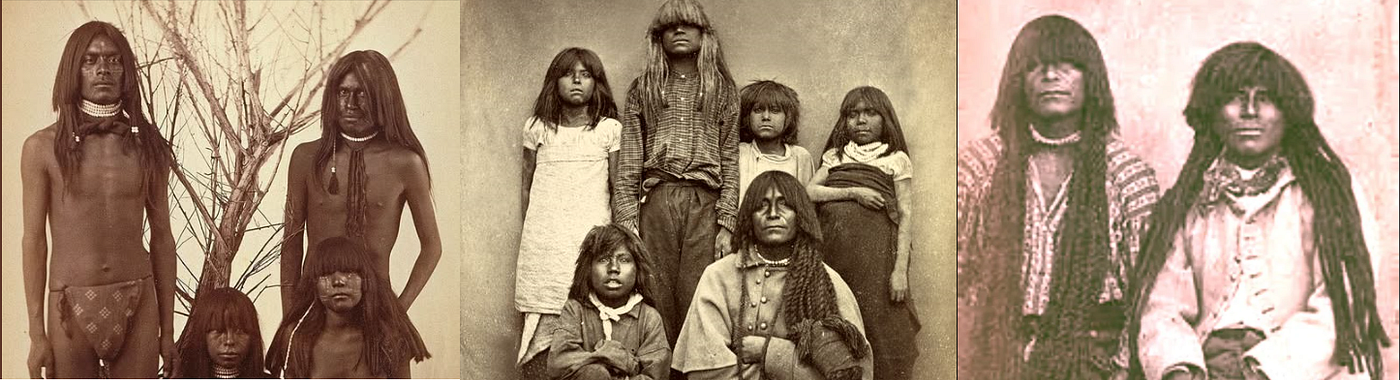
Pima Indians of Arizona, mid-to-late 1800s. Public domain.
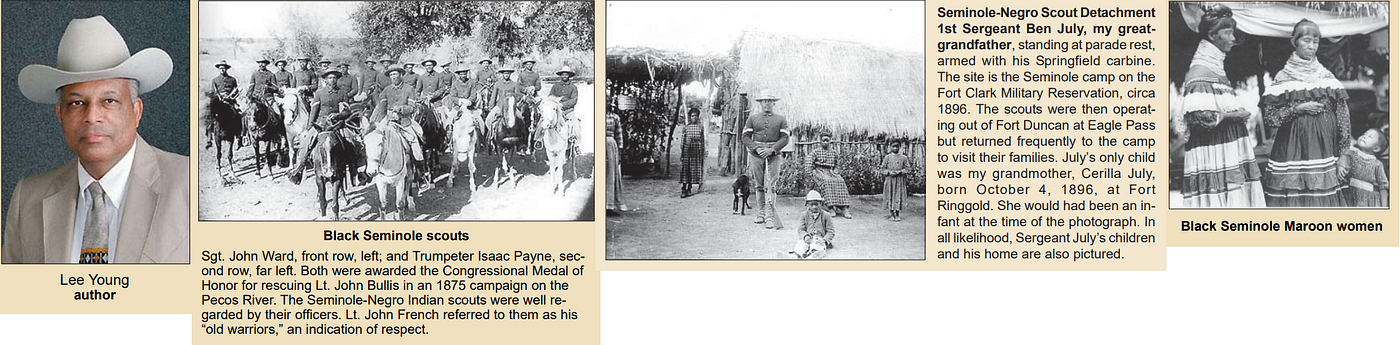
LEFT: “Lee Young, author.” CENTER LEFT: “Black Seminole Scouts.” CENTER RIGHT: “Seminole-Negro Scout Detachment. 1st Sergeant Ben July, my grandfather, standing at parade rest.” RIGHT: “Black Seminole Maroon women.” Captions by Lee Young. Photos from Texas Ranger Hall of Fame and Museum.
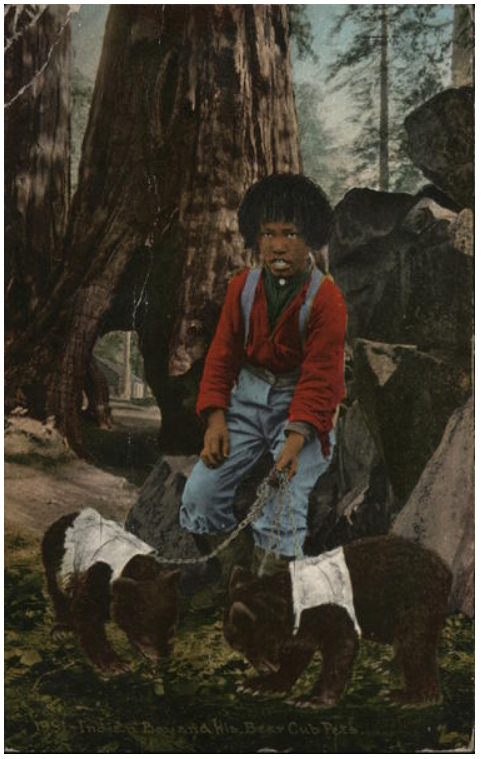
“1901 Indian Boy and his bear cub pets.” Note the hair style of this young man. Post card published by Edw. H. Mitchell, a prolific San Francisco-based publisher.
![LEFT: “Indian Pibesha’s girls. Photograph shows portrait of two Native American girls in traditional dress.” [Warm Springs Reservation, Oregon] CENTER: “Indian Jim and three sons. Photograph shows portrait of Native American man and boys in traditional dress.” [Warm Springs Reservation, Oregon] Young, F. A. (Fred Andrew), photographer. 1902. Public domain. Captions and descriptions by Library of Congress Prints and Photographs Division. http://hdl.loc.gov/loc.pnp/pp.print. Accessed 02/15/2026 RIGHT: “Digger Indians [Native Americans]. Yosemite Valley, California. 1870. Public domain.](https://miro.medium.com/v2/resize:fit:1400/1*C1ZalZPpP1L4B3Bn7qTJdQ.png)
LEFT: “Indian Pibesha’s girls. Photograph shows portrait of two Native American girls in traditional dress.” [Warm Springs Reservation, Oregon] CENTER: “Indian Jim and three sons. Photograph shows portrait of Native American man and boys in traditional dress.” [Warm Springs Reservation, Oregon] Young, F. A. (Fred Andrew), photographer. 1902. Public domain. Captions and descriptions by Library of Congress Prints and Photographs Division. http://hdl.loc.gov/loc.pnp/pp.print. Accessed 02/15/2026 RIGHT: “Digger Indians [Native Americans]. Yosemite Valley, California. 1870. Public domain.
Even after removal to Oklahoma Territory, even after “The Trail of Tears,” the Asiatic Siberians continued to capture, traffick, enslave, and disenfranchise the dark-skinned amongst them.
![[1] FAR LEFT: “Chickasaw Freedmen filing on allotments at Tishomingo (3759, W. P. Campbell Collection, OHS).” [2] MIDDLE LEFT: “Caesar Bowlegs, a Seminole Freedman” (21504.AL.1.l4.r.2, Roy J. Morgan Collection, OHS). [3] NEAR LEFT: “Adam Grayson, a Muscogee (Creek) Freedman” (20473.16, Sigmund Sameth Collection, OHS) [4] NEAR RIGHT: “Carrie William Hall, a Chickasaw Freedwoman, c. 1915” (20699.80.44.3, State Museum/Rubye M. Hall Collection, OHS) [5] MIDDLE RIGHT: “Morris Sheppard, a Freedman, with his family,” c. 1930s (18532, WPA Slave Narratives Collection, OHS) [6] FAR RIGHT: “Dolly Stidham, a Freedwoman” (20382.759, Jennie Elrod Collection, OHS). Photos and captions from Oklahoma Historical Society. Public domain. https://www.okhistory.org/learn/freedmen](https://miro.medium.com/v2/resize:fit:1400/1*8XOQK2q_nD5zMaIykpXvtw.png)
[1] FAR LEFT: “Chickasaw Freedmen filing on allotments at Tishomingo (3759, W. P. Campbell Collection, OHS).” [2] MIDDLE LEFT: “Caesar Bowlegs, a Seminole Freedman” (21504.AL.1.l4.r.2, Roy J. Morgan Collection, OHS). [3] NEAR LEFT: “Adam Grayson, a Muscogee (Creek) Freedman” (20473.16, Sigmund Sameth Collection, OHS) [4] NEAR RIGHT: “Carrie William Hall, a Chickasaw Freedwoman, c. 1915” (20699.80.44.3, State Museum/Rubye M. Hall Collection, OHS) [5] MIDDLE RIGHT: “Morris Sheppard, a Freedman, with his family,” c. 1930s (18532, WPA Slave Narratives Collection, OHS) [6] FAR RIGHT: “Dolly Stidham, a Freedwoman” (20382.759, Jennie Elrod Collection, OHS). Photos and captions from Oklahoma Historical Society. Public domain. https://www.okhistory.org/learn/freedmen
European and Asiatic Siberian-derived tribal nations demand their reparations from the US government, but refuse to acknowledge what they owe to the people they enslaved, whose lives they ruined, and whose families they destroyed.
![LEFT: [Head-and-shoulders portrait of an unidentified man, possibly American Indian, possibly Choctaw]. Caption and photo from Library of Congress. Public domain. RIGHT: Ida Daniel Lawson, daughter; Malinda Tom Lawson (1853–1934), mother, was born in Clinton, Louisiana to two full-blood Choctaw parents; Emma Britt, daughter.](https://miro.medium.com/v2/resize:fit:1007/1*xOO8u_3fT7jP-GaF-MSu4Q.png)
LEFT: [Head-and-shoulders portrait of an unidentified man, possibly American Indian, possibly Choctaw]. Caption and photo from Library of Congress. Public domain. RIGHT: Ida Daniel Lawson, daughter; Malinda Tom Lawson (1853–1934), mother, was born in Clinton, Louisiana to two full-blood Choctaw parents; Emma Britt, daughter.
![Mississippi [Louisiana] Choctaw group wearing traditional garb, c. 1908. Yowani Choctaw Tribe. Wikimedia Commons. Public domain.](https://miro.medium.com/v2/resize:fit:1000/1*4CSE_2QTj0gAcDilvc4qRA.png)
Mississippi [Louisiana] Choctaw group wearing traditional garb, c. 1908. Yowani Choctaw Tribe. Wikimedia Commons. Public domain.
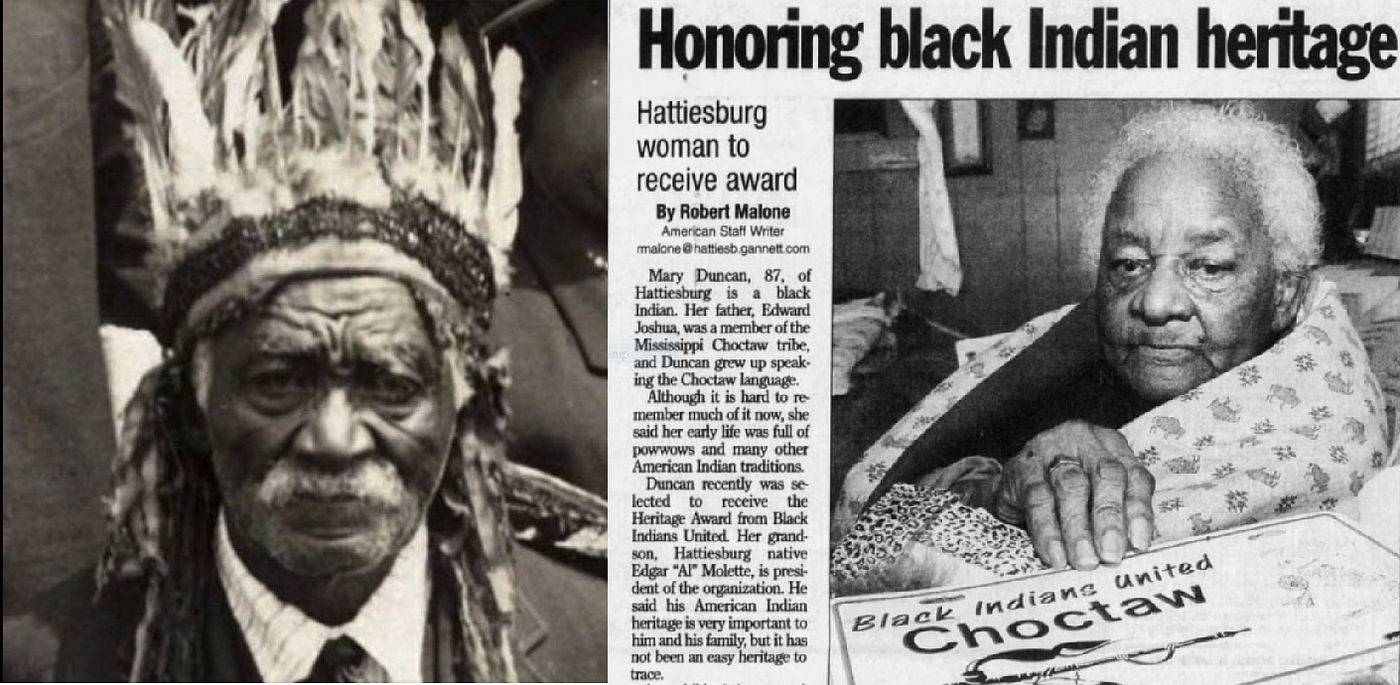
LEFT: Chief James Lemuel Cisco was born in Grafton, Massachusetts in 1846 as the son of Samuel Cisco and Sarah Maria Arnold. He was Chief of the Nipmuc tribe and lived to 1931. RIGHT: “Mary Duncan, Choctaw.” Image from Malone, Robert. “ Honoring Black Indian Heritage: Hattiesburg Woman to Receive Award.” Hattiesburg American, December 7, 2004. https://www.newspapers.com/article/hattiesburg-american-black-indian-herita/16303281/ Accessed 03/31/2026
![Formerly-enslaved Indians. LEFT: James Green. “His father, an American Indian, managed to get his son declared a “free boy.” But at age twelve, James was kidnapped and sold at a Virginia slave market to a Texas ranchman named James Pinchback.” CENTER: Tillie R. Powers. “Her mother was kidnapped by a band of Native Americans and she was fathered by an Indian. Not wanting Tillie to grow up in the tribe, her mother wrapped the baby in a blanket and set her beside the river. She was found by Confederate army officer, Joseph Powers, who raised her on a plantation in Edgecombe County, NC. “ RIGHT: Josie Brown lived in Woodvile, Texas (1859-unkown). “Her mother was a Choctaw Indian who was kidnapped and sold into slavery. Hundreds of thousands of American Indians were enslaved by Europeans starting in the Colonial Period — and Indians later enslaved [B]lacks.” Captions and photos from Cahan, Richard, and Michael Williams. 2020. River of Blood: American Slavery from the People Who Lived It. Chicago: CityFiles Press.](https://miro.medium.com/v2/resize:fit:1400/1*w6ekNcQqm59iQSyICy_Vig.png)
Formerly-enslaved Indians. LEFT: James Green. “His father, an American Indian, managed to get his son declared a “free boy.” But at age twelve, James was kidnapped and sold at a Virginia slave market to a Texas ranchman named James Pinchback.” CENTER: Tillie R. Powers. “Her mother was kidnapped by a band of Native Americans and she was fathered by an Indian. Not wanting Tillie to grow up in the tribe, her mother wrapped the baby in a blanket and set her beside the river. She was found by Confederate army officer, Joseph Powers, who raised her on a plantation in Edgecombe County, NC. “ RIGHT: Josie Brown lived in Woodvile, Texas (1859-unkown). “Her mother was a Choctaw Indian who was kidnapped and sold into slavery. Hundreds of thousands of American Indians were enslaved by Europeans starting in the Colonial Period — and Indians later enslaved [B]lacks.” Captions and photos from Cahan, Richard, and Michael Williams. 2020. River of Blood: American Slavery from the People Who Lived It. Chicago: CityFiles Press.
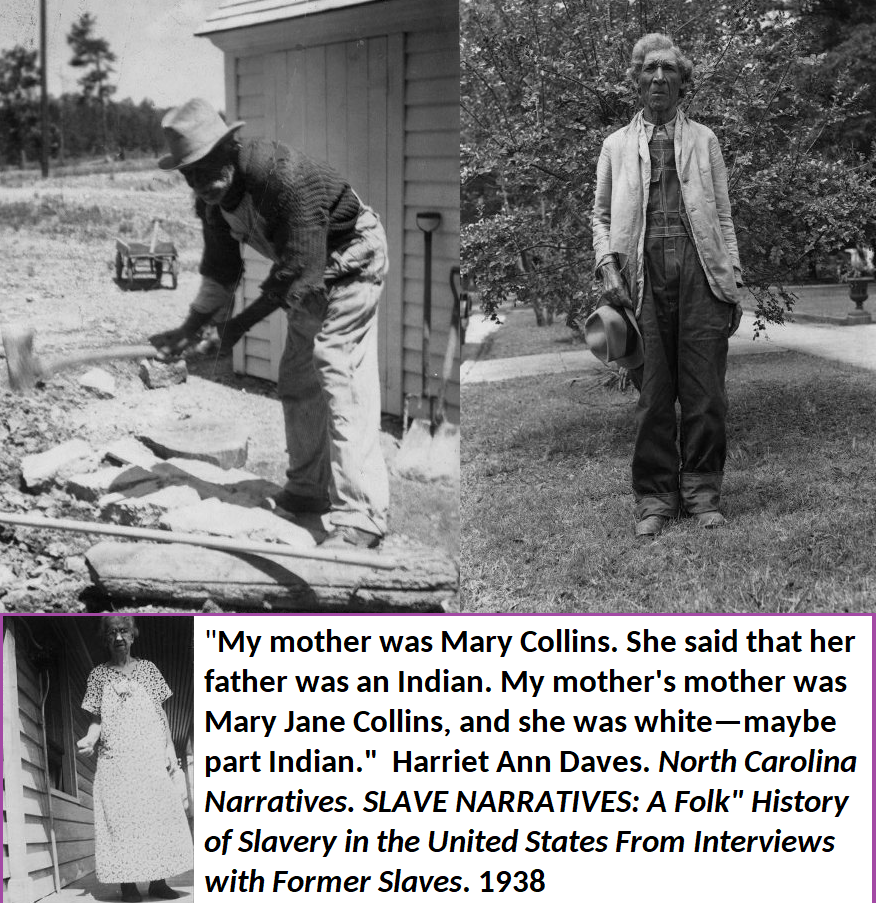
Formerly-enslaved Indians. TOP LEFT: Abraham Jones lived in Alabama (circa 1843–1947). “My grandpappy was a full-blooded Indian but I don’t know what kind.” TOP RIGHT: Nathan Beauchamp lived in Alabama (1858–1948). “So one day pappy came to de massa and tell him dat dere wuz an Injun gal on de St. Francis Indian Village dat he wanted fo’ a wife, an’ de boss say all right so pappy married de Indian gal. Her name wuz Mimi. So I is half n — — r an half Injun. My mammy died ‘bout five year after freedom, but I can remembers dat she had long black hair, and I remembers de way de sun sparkle on her teeth when she smile.” BOTTOM: Harriet Ann Daves (1856–1937) was born in Virginia and lived North Carolina. “My mother was Mary Collins. She said that her father was an Indian. My mother’s mother was Mary Jane Collins, and she was white — maybe part Indian.” See: SLAVE NARRATIVES: A Folk History of Slavery in the United States From Interviews with Former Slaves. 1938.
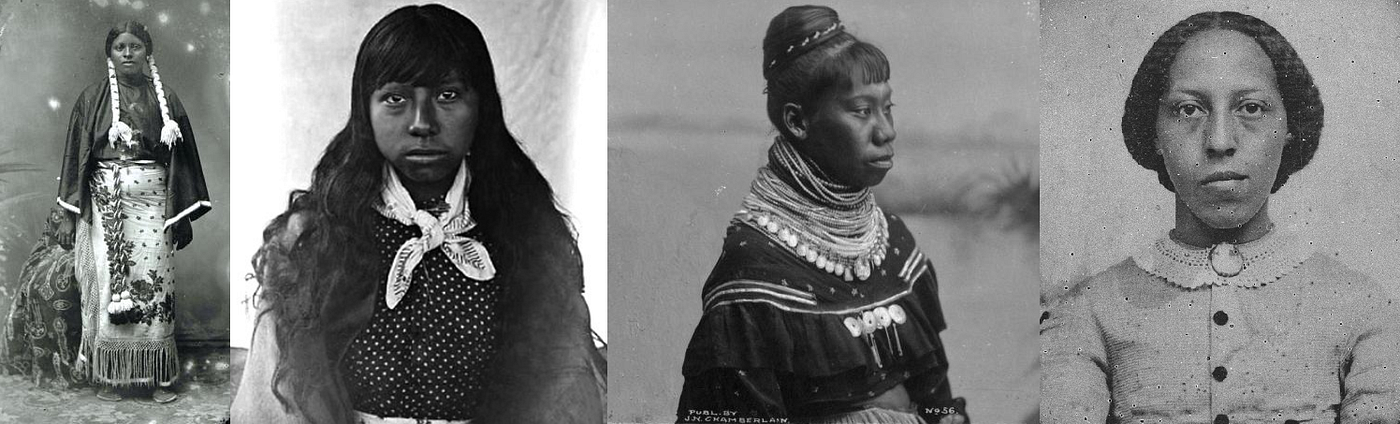
LEFT: “Diana Fletcher (Black Seminole, b. 1838), adopted into the Kiowa tribe. Her father was African American, and her mother was Seminole. Her stepfamily was Kiowa.” Wikimedia Commons. Public Domain. LEFT MIDDLE: “Cherokee girl. “ Photo titled: “Ayasta’s Daughter,” 1888. National Anthropological Archives, Smithsonian Institution. Public domain. RIGHT MIDDLE: “Waist-up portrait of a Seminole Native American woman wearing a native outfit featuring many necklaces around her neck, and with her hair in a bun.” Caption by Wisconsin Historical Society. Photo caption: “Seminole Squaw, Miami, Fla.” by J.N. Chamberlain, circa 1880s. RIGHT: “Portrait of Zerviah Gould Mitchell (Black Wampanoag circa 1850–1860. Smithsonian Institution. Public domain. Mitchell, along with Ebenezer W. Pierce, wrote Indian History, Biography, and Genealogy, about the life of Wampanoag leader Massasoit and his descendants.
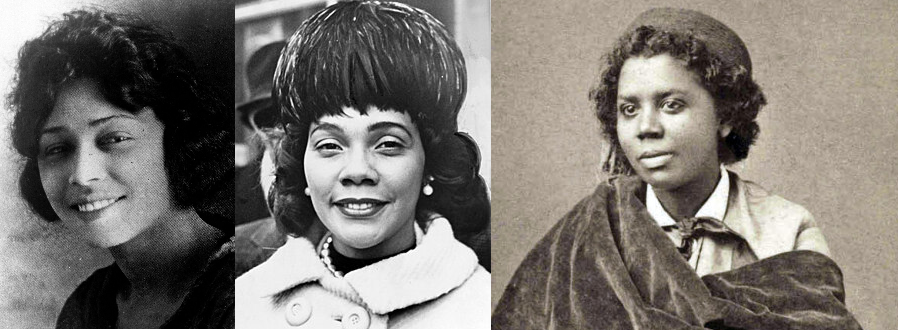
LEFT: Aviator Bessie Coleman’s mother was Black, her father was Cherokee. She was born into a family of sharecroppers on January 26, 1892 in Atlanta, Texas. “Bessie Coleman, circa 1920s.” Wikimedia Commons. Public domain. CENTER: Portrait of Coretta Scott King, 1964. “Coretta’s maternal grandfather, Martin, was born to a slave of Black Native ancestry…” Herman Hiller / New York World-Telegram & Sun. Donated to the Library of Congress. Public domain. RIGHT: Edmonia Lewis (c. 1844–1907) of Black and Ojibwa descent. “Edmonia Lewis achieved international recognition as a sculptor during the second half of the nineteenth century.” Photo circa 1870. Photo and caption from National Portrait Gallery. Wikipedia. Public domain.
The Cherokee heritage of Bill Pickett (Williamson County, Texas ), Bessie Coleman (Atlanta, Texas) and likely that of Johnny Mathis (Gilmer, Texas), may have resulted during the migration of Cherokee to northeast Texas following Indian Removal from the southeastern states to avoid settlement in Oklahoma Territory.
![LEFT: “George Bonga. (August 20, 1802–1874) was a fur trader, entrepreneur and interpreter for the U.S. government, who was of Ojibwe and [Black] descent, fluent in French, Ojibwemowin and English.” Image from Wikimedia Commons. Public domain. Caption from Wikipedia. CENTER: James Beckwourth (1798–1866) was a mountain man, fur trader, explorer, scout, rancher, and businessman. Of Black, Native, and White descent, he was born into slavery in Virginia, freed by his father, and apprenticed to a blacksmith. Later, he moved to the American West. He lived with Crow Nation and married into other tribal nations. Wikimedia Commons. Public domain. RIGHT: “Bill Picket. c.1902.” Born 1870, in Jenks Branch, Williamson County, Texas, his family’s ancestry was Black and Cherokee. North Fort Worth Historical Society. Image and caption from Wikipedia. Public domain.](https://miro.medium.com/v2/resize:fit:865/1*a20fZV6LN6UUkkvm3wSp1g.png)
LEFT: “George Bonga. (August 20, 1802–1874) was a fur trader, entrepreneur and interpreter for the U.S. government, who was of Ojibwe and [Black] descent, fluent in French, Ojibwemowin and English.” Image from Wikimedia Commons. Public domain. Caption from Wikipedia. CENTER: James Beckwourth (1798–1866) was a mountain man, fur trader, explorer, scout, rancher, and businessman. Of Black, Native, and White descent, he was born into slavery in Virginia, freed by his father, and apprenticed to a blacksmith. Later, he moved to the American West. He lived with Crow Nation and married into other tribal nations. Wikimedia Commons. Public domain. RIGHT: “Bill Picket. c.1902.” Born 1870, in Jenks Branch, Williamson County, Texas, his family’s ancestry was Black and Cherokee. North Fort Worth Historical Society. Image and caption from Wikipedia. Public domain.
The Cherokee brought their slaves with them to develop the land in Texas. The first President of Texas Sam Houston was a Cherokee ally, however, the tribe’s efforts to negotiate land titles failed and the next Texas President Mirabeau B. Lamar feared Cherokee collusion with Mexico.
![LEFT: Photograph of Chief Oshkosh of the Menomee in Wisconsin. Accessed from Weird History Stories from historian Chrissy Senecal. 12/25/2025 CENTER: “Native Kish- Kah- Nah- Cut (Stump), Chief of the Chippewa Tribe,” c. 1863. [Chief of Mille Lac Chippewas.] Whitney’s Gallery, Saint Paul. RIGHT: Shuriap, Yampa Band Ute leader, 1868. Public domain.](https://miro.medium.com/v2/resize:fit:1283/1*K1UJLR1LR37kBUtilU4TcA.png)
LEFT: Photograph of Chief Oshkosh of the Menomee in Wisconsin. Accessed from Weird History Stories from historian Chrissy Senecal. 12/25/2025 CENTER: “Native Kish- Kah- Nah- Cut (Stump), Chief of the Chippewa Tribe,” c. 1863. [Chief of Mille Lac Chippewas.] Whitney’s Gallery, Saint Paul. RIGHT: Shuriap, Yampa Band Ute leader, 1868. Public domain.
The Battle of the Neches, the main engagement of the Cherokee War of 1838–1839 (part of the Texas–Indian Wars), took place July 1839 (in Van Zandt County, between Tyler and Ben Wheeler) and ended with expulsion of the tribe.
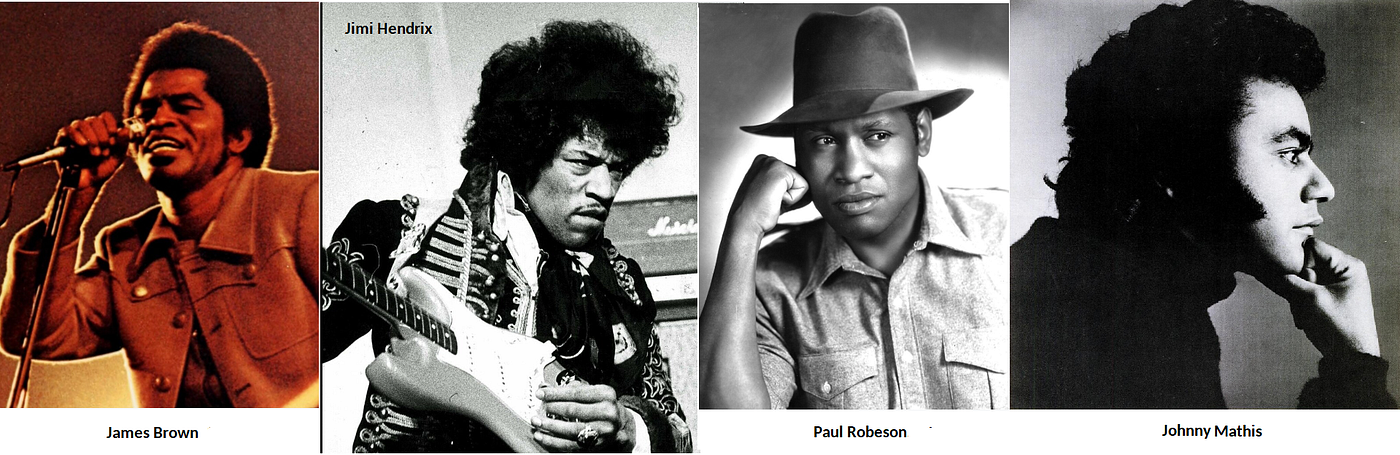
Examples of Black American indigeneity: FAR LEFT: James Brown of South Carolina, 1970. “James Brown performing at Tulane Stadium, New Orleans, 24 October 1970. from “Jambalaya” Tulane University yearbook 1971.” archive.org/details/jambalayayearboo76edit/page/n155/mode/2up/. Wikimedia Commons. Public domain. CENTER LEFT: Jimi Hendrix of Seattle (WA), 1967. “Jimi Hendrix at the amusement park Gröna Lund in Stockholm, Sweden, May 24, 1967.” Wikimedia Commons. Public domain. CENTER RIGHT: Paul Robeson of New Jersey, 1930s. “Publicity photo of Paul Robeson.” 1930s. Wikimedia Commons. Public domain. FAR RIGHT: Johnny Mathis of Texas, 1977. “Photo of Johnny Mathis from a Columbia Records ad.” Wikimedia Commons. Public domain.
The Cherokee attempted to relocate to Mexico, but were unable, and so joined the Cherokee who had already relocated to Oklahoma Territory.
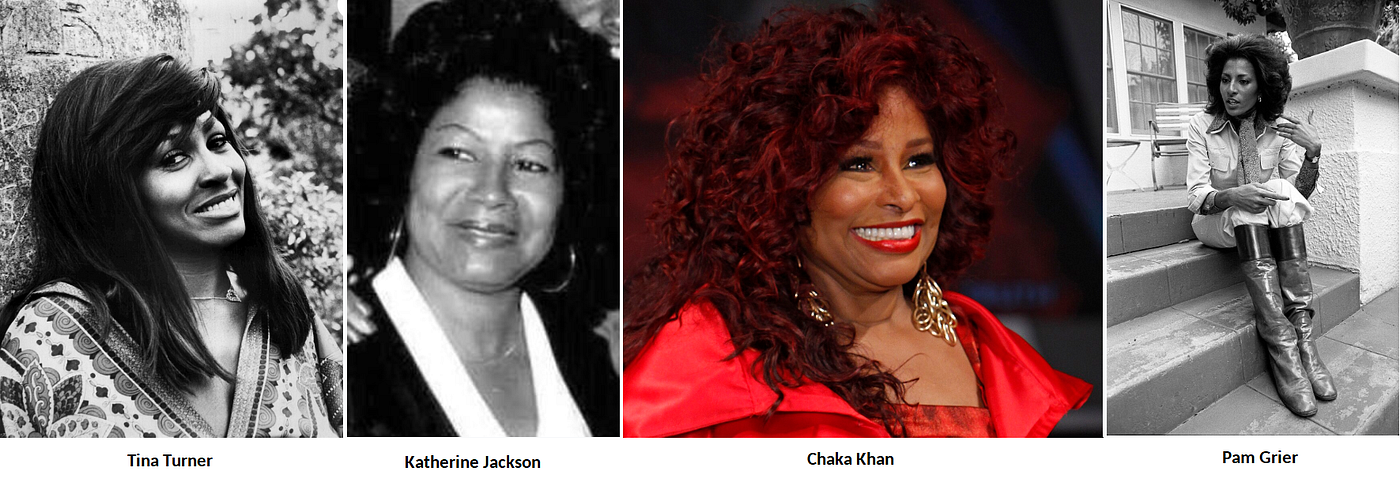
Examples of Black American indigeneity: FAR LEFT: Tina Turner of Tennessee, 1970. Photo taken by Al Kaplan in Miami-Dade County, March 1970. Jay Bernstein Public Relations. Wikimedia Commons. Public domain. CENTER LEFT: Katherine Jackson of Alabama, 1977. The Amsterdam News. Wikimedia Commons. Public Domain. CENTER RIGHT: Chaka Khan of Chicago (IL), 2012. United States Department of Health. Wikimedia Commons. Public Domain. FAR RIGHT: Pam Grier of North Carolina, 1978. “Actress Pam Grier during an interview in Los Angeles.” Wikimedia Commons and https://digital.library.ucla.edu/catalog/ark:/21198/zz0002qf0v
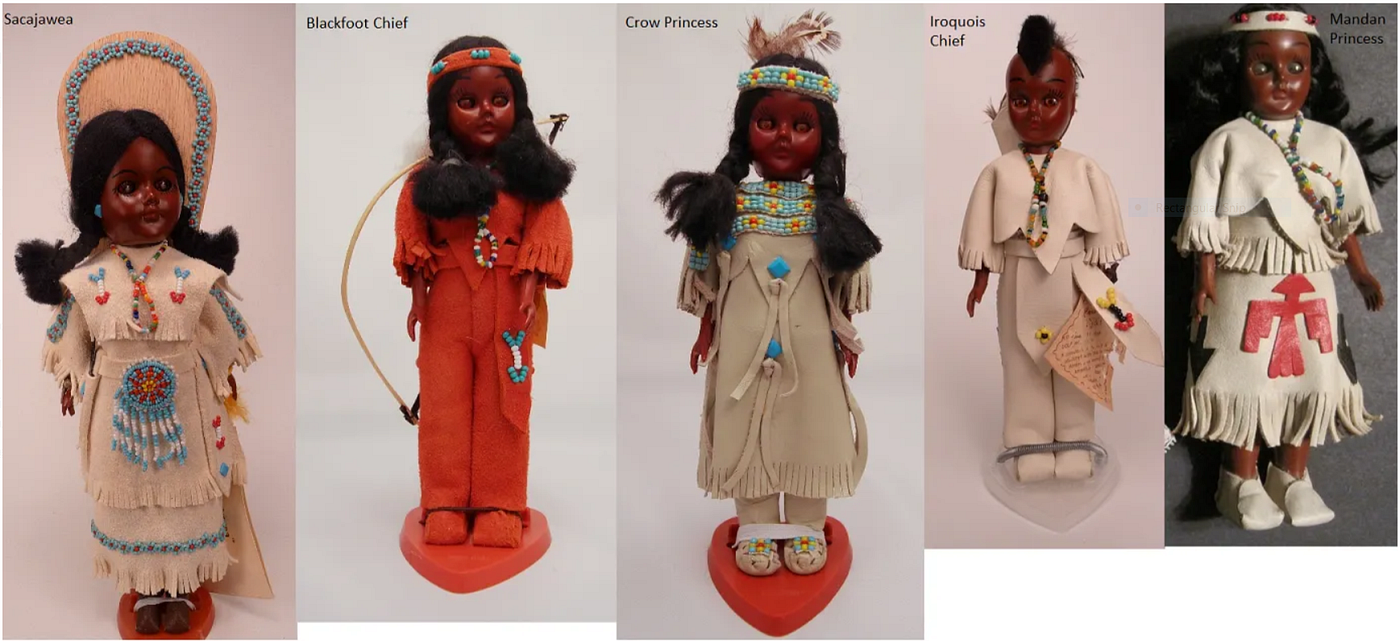
Carlson Dolls, founded in 1946 by Ray and Ann Carlson in Maple Lake, Minnesota. They are well-known vintage collectibles primarily recognized for their extensive series of Native American tribal dolls. These dolls were produced from the early 1950s until 1997. Most images and labels from https://starship2077.com/Carlson/index.htm Wow! They sure are dark! FAR LEFT: Sacajawea LEFT MIDDLE: Blackfoot Chief CENTER: Crow Princess RIGHT MIDDLE: Iroquois Chief FAR RIGHT: Mandan Princess
![One wonders why the dolls appear so very much darker than today’s photographs of federally-recognized tribal members? Most images and labels from https://starship2077.com/Carlson/index.htm FAR LEFT: Nez-Perce Princess LEFT MIDDLE: Pequot Princess CENTER: Pocahontas RIGHT MIDDLE: Ojibwe Chief [on label] FAR RIGHT: Blackfoot Chief [on label]](https://miro.medium.com/v2/resize:fit:1400/1*lWSiATGx2vANvSueF4T8fA.png)
One wonders why the dolls appear so very much darker than today’s photographs of federally-recognized tribal members? Most images and labels from https://starship2077.com/Carlson/index.htm FAR LEFT: Nez-Perce Princess LEFT MIDDLE: Pequot Princess CENTER: Pocahontas RIGHT MIDDLE: Ojibwe Chief [on label] FAR RIGHT: Blackfoot Chief [on label]
The author concludes that conquistador and explorer documentation, negroid remains, artwork, photography, sculptures, paintings, oral traditions, slave narratives, and notations of census workers add evidentiary weight to the presence of Black indigenous populations in America prior to the arrival of European colonizers and Siberian immigrants.
![FAR LEFT: “Portrait head of a Moche man. Peru, Moche Culture, Exhibited at Museum Rietberg, Zurich, Switzerland.” Caption by Chase McGhee. LEFT MIDDLE: Moche artist, Peru, South America, ca. 200–800 [AD], Period 1 [AD]-500[AD], Clay with paint. Caption information by Anenberg Learner. Photo by David Bernstein Fine Art, New York, NY. CENTER: “Portraiture Vessel. Moche Culture. Peru. (2nd-8th Century AD).” Image and caption by Treasures and Beauty Tumblr. FAR RIGHT: “Larco Hoyle Mochica Phase Three Ceramic. Larco Museum, Lima.” Image and caption by Travel to Eat.](https://miro.medium.com/v2/resize:fit:1400/1*kyPqwvT1_rKU_pqQVzAotQ.png)
FAR LEFT: “Portrait head of a Moche man. Peru, Moche Culture, Exhibited at Museum Rietberg, Zurich, Switzerland.” Caption by Chase McGhee. LEFT MIDDLE: Moche artist, Peru, South America, ca. 200–800 [AD], Period 1 [AD]-500[AD], Clay with paint. Caption information by Anenberg Learner. Photo by David Bernstein Fine Art, New York, NY. CENTER: “Portraiture Vessel. Moche Culture. Peru. (2nd-8th Century AD).” Image and caption by Treasures and Beauty Tumblr. FAR RIGHT: “Larco Hoyle Mochica Phase Three Ceramic. Larco Museum, Lima.” Image and caption by Travel to Eat.
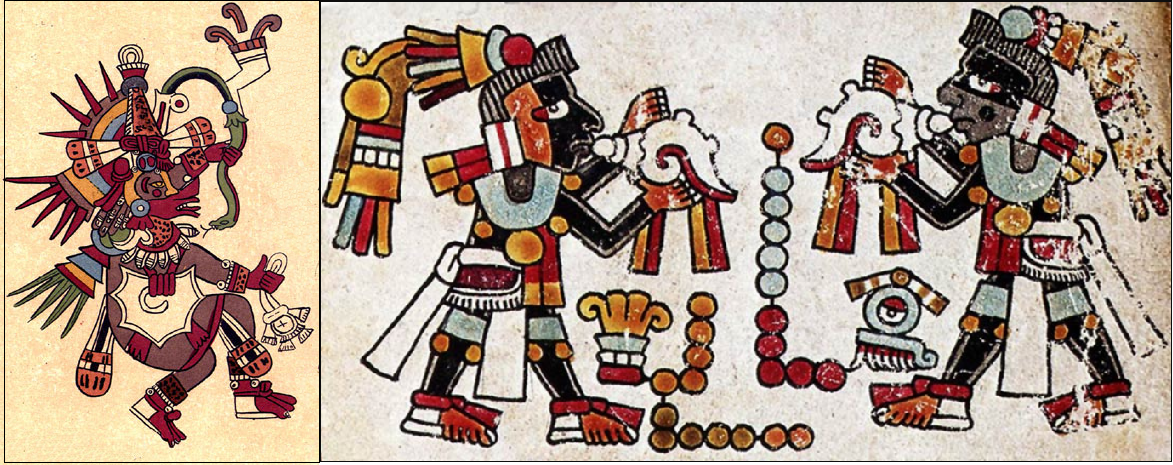
LEFT: “Quetzalcoatl.” Published in the Codex Borbonicus, 16th century, author unknown. Wikimedia Commons. Public domain. RIGHT: “Two named and semi-divine conch players face each other”; Original painted on deer hide approx 1350–1519 AD. Codex Vindobonensis pl. 16. Image scanned from ADEVA facsimile edition of the Codex Vindobonensis, Graz, Austria, 1974. Accessed from https://www.mexicolore.co.uk/aztecs/artefacts/sea-shell/1000
The Black indigenous of America may have migrated from Africa to the Atlantic coasts.
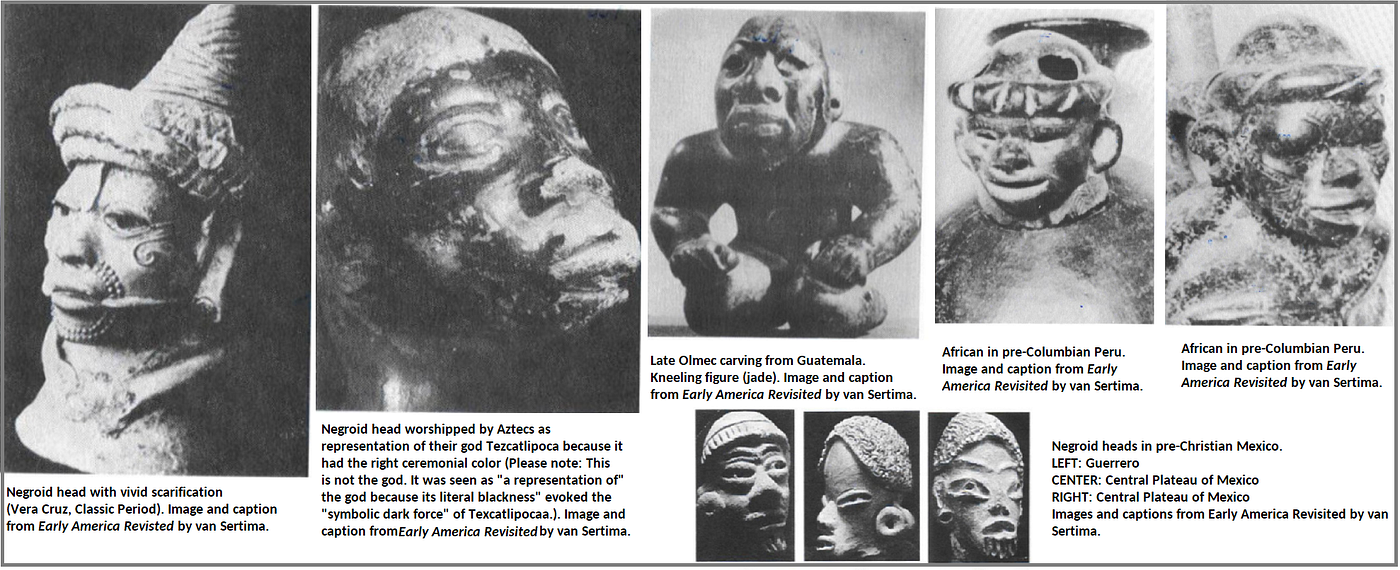
Faced with virulent attacks following his They Came Before Columbus, Ivan van Sertima released Early America Revisted to provide additional evidence to rebut crticism. Early America Revisited has been largely ignored, is not readily available in libraries, and is listed at expensive prices from online sellers. This later work is available at Internet Archive, however. Clockwise: “Negroid head with vivid scarification (Vera Cruz, Classic Period); Negroid head worshipped by Aztecs as representation of their god Tezcalipoca; Late Olmec carving from Guatemala. Kneeling figure (jade); African in pre-Columbian Peru; African in pre-Columbian Peru; Negroid heads in pre-Columbian Mexico — LEFT: Guerrero, CENTER: Central Plateau of Mexico, RIGHT: Central Plateau of Mexico.
Or they migrated from Australia and Melanesia to the Pacific Coasts. And then these groups intermingled as populations do.
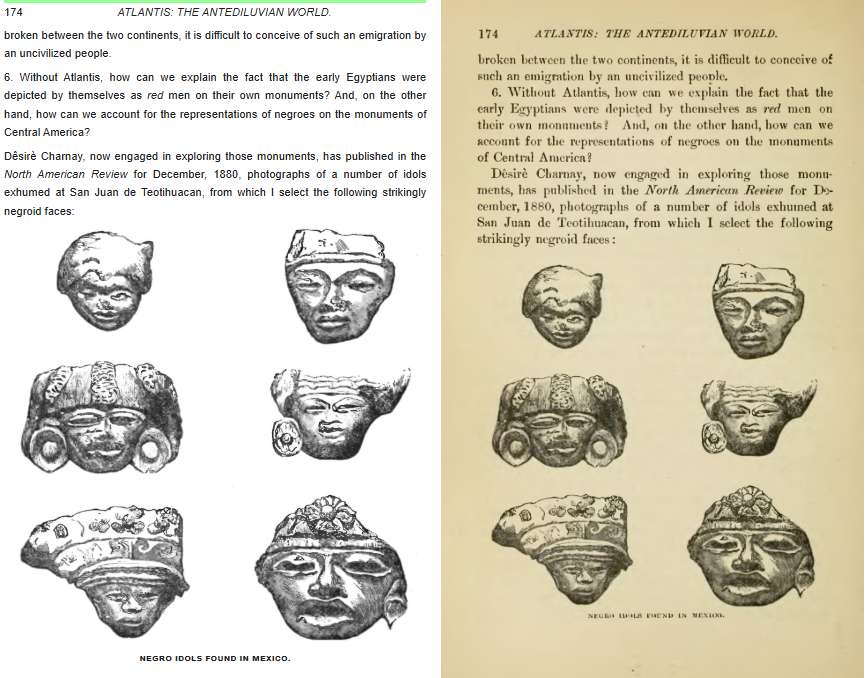
“Negro Idols Found in Mexico.” Exhumed at San Juan de Teotihuacán. Photographed by Désiré Charnay for December 1880 issue of American Review. Published in Atlantis: the Antediluvian World by Ignatius Donnelly, 1882.
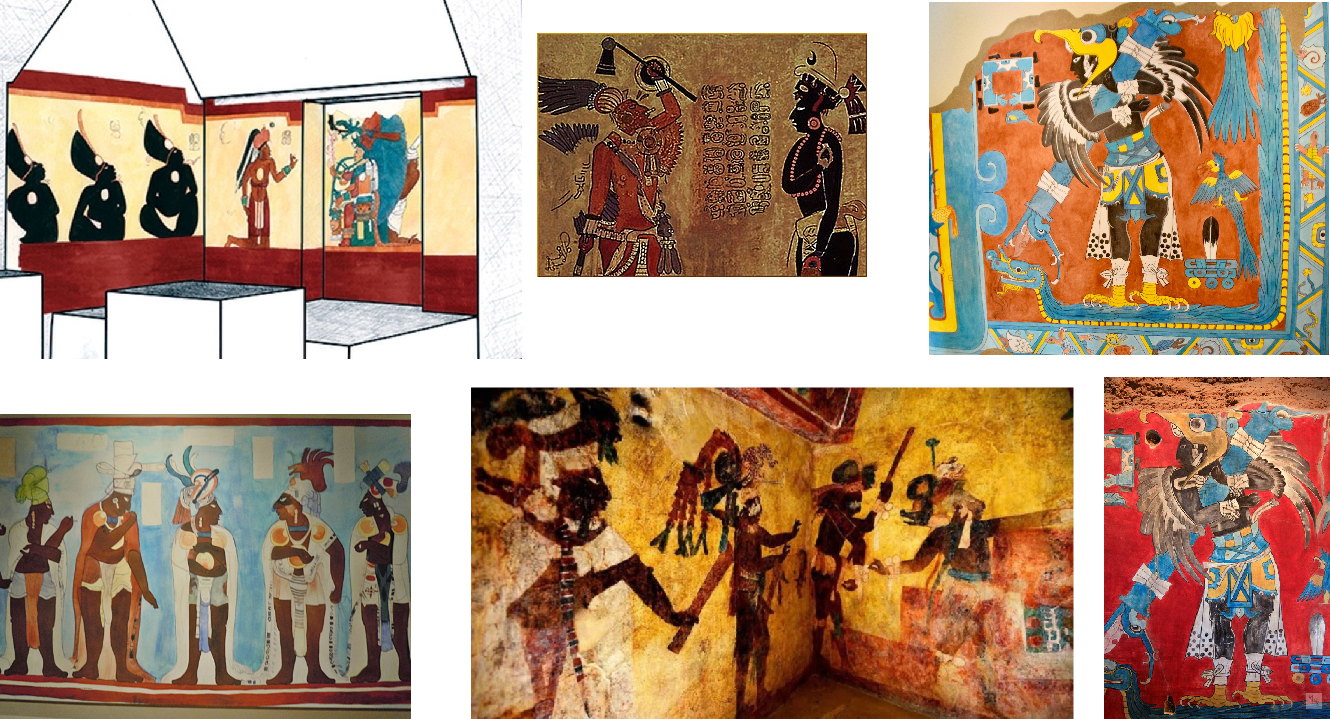
![Murals depicting black-skinned people in pre-Columbian ancient Mesoamerica. FAR LEFT TOP: “El Taller de los Sabios. La producción de murales y códices en Xultún, Guatemala, [ca. 800–820 AD], Late Classic Maya. “Reconstrucción del cuarto 2 de la Estructura 10K-2. Dibujo: H. Hurst” from arqueologia mexicana. CENTER TOP: “Mural maya en Uaxactún.” And, “Uaxactun — Affresco dell’Edificio B-XIII.” [ca. 380–450 AD], Early Classic Maya. Wikimedia Commons. Public domain. TOP RIGHT: “Copy of the Birdman Mural.” Taken from “Cacaxtla — Mexico’s Amazing Ancient Murals,” {ca. 650–750 AD], Epiclassic, Late Classic Transition. BOTTOM LEFT: “Murals at Bonampak Procession of Lords.” And, “The Murals at Bonampak, Chiapas, Mexico.” [792 AD] Late Classic Maya. Image and captions by leonidemartinblog. CENTER BOTTOM: “Murales de Bonampak [Chiapas]: el testimonio eterno de la cultura maya.” And, “Estos frescos, datados alrededor del siglo VIII d.C., son considerados unos de los mejor conservados y más completos de la región mesoamericana.” [ca. 790 AD], Late Classic Maya. Image and caption by Leonardo Ruiz at arrquelogia mexicana blogspot. BOTTOM RIGHT: Comparative version of the Birdman Mural. “Mayan mural, National Museum of Anthropology, Mexico City.” [date of original ca. 650–750 AD], Epiclassic. Image and caption by Michael Stephens.](https://miro.medium.com/v2/resize:fit:1330/1*g9_9LldvZ9lBsT3VucPoXw.png)
Murals depicting black-skinned people in pre-Columbian ancient Mesoamerica. FAR LEFT TOP: “El Taller de los Sabios. La producción de murales y códices en Xultún, Guatemala, [ca. 800–820 AD], Late Classic Maya. “Reconstrucción del cuarto 2 de la Estructura 10K-2. Dibujo: H. Hurst” from arqueologia mexicana. CENTER TOP: “Mural maya en Uaxactún.” And, “Uaxactun — Affresco dell’Edificio B-XIII.” [ca. 380–450 AD], Early Classic Maya. Wikimedia Commons. Public domain. TOP RIGHT: “Copy of the Birdman Mural.” Taken from “Cacaxtla — Mexico’s Amazing Ancient Murals,” {ca. 650–750 AD], Epiclassic, Late Classic Transition. BOTTOM LEFT: “Murals at Bonampak Procession of Lords.” And, “The Murals at Bonampak, Chiapas, Mexico.” [792 AD] Late Classic Maya. Image and captions by leonidemartinblog. CENTER BOTTOM: “Murales de Bonampak [Chiapas]: el testimonio eterno de la cultura maya.” And, “Estos frescos, datados alrededor del siglo VIII d.C., son considerados unos de los mejor conservados y más completos de la región mesoamericana.” [ca. 790 AD], Late Classic Maya. Image and caption by Leonardo Ruiz at arrquelogia mexicana blogspot. BOTTOM RIGHT: Comparative version of the Birdman Mural. “Mayan mural, National Museum of Anthropology, Mexico City.” [date of original ca. 650–750 AD], Epiclassic. Image and caption by Michael Stephens.
Modern professionals in the archaeological and anthropological worlds fear this truth. They have staked their careers, reputations, and personal egos on Beringia-only entry into and Asiatic Siberian-only indigeneity of the Americas.
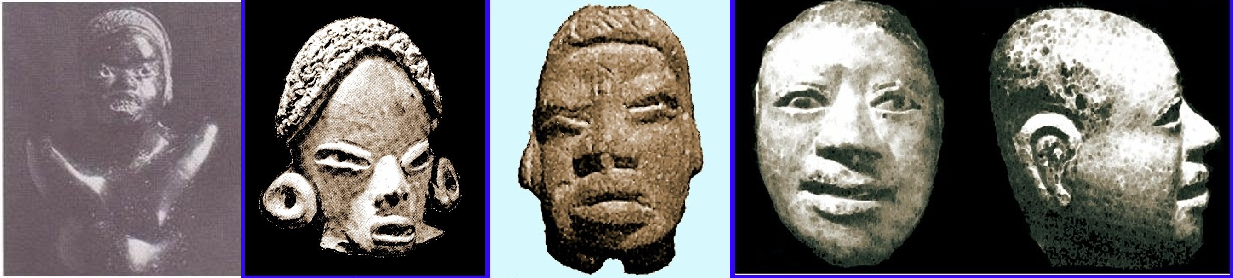
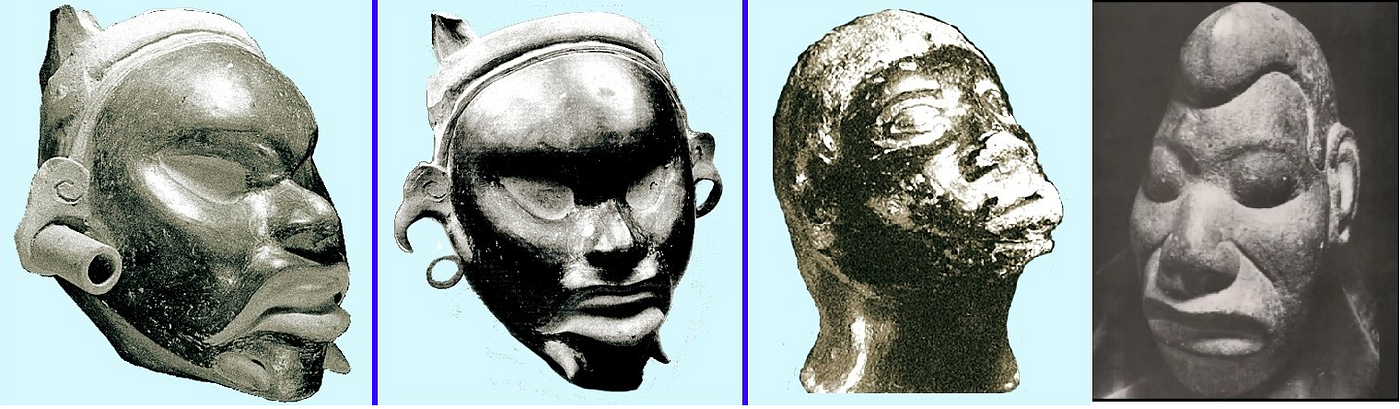
From the Wuthenau Collection: Large protruding lips, noses with wide-spread nostrils, lower-jaw prognathism, short tightly-coiled hair. These are not representations of Siberian migrants. These are Black indigenous or African voyagers. FAR LEFT: Pre-classic Period in America (circa 1800 BC — 150 AD). LEFT MIDDLE: Ceramic figure, 2 in. high, from Tlapacoyán, Mexico (circa 1000 BC), photo 1969. RIGHT MIDDLE: Ceramic head, 1.5 in. high from Tlatilco, Mexico (circa 1000 BC), photo 1965. FAR RIGHT: Ceramic sculpture of a man, frontal and lateral view, 2 1/3rd in. high, from La Venta area, Tabasco (circa 400 BC), photo 1975.
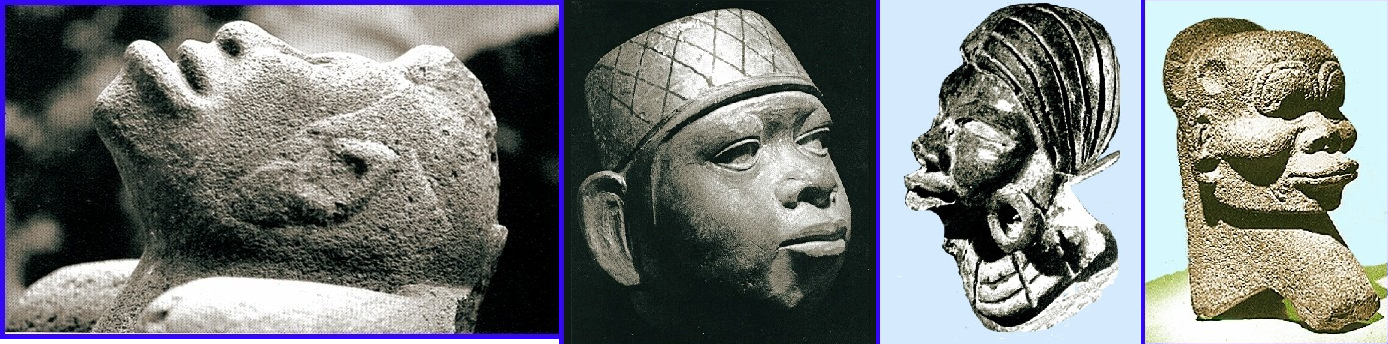
Not Siberian migrants. From the Wuthenau Collection: FAR LEFT: Olmec basalt sculpture of a man gazing at the sky with both hands clasped behind his neck, from La Venta, Tabasco, (circa 600 BC), photo by Stierlin, 1981). LEFT MIDDLE: Ceramic sculpture on a Mochica vessel, 5 1/2 in. high, from northern Peru (circa 600 AD, photo by von Wuthenau, 1975). RIGHT MIDDLE: Ceramic sculpture, 6 in. high, from Teotihuacán, Mexico (circa 150 AD–600 AD, photo by von Wuthenau, 1975). FAR RIGHT: Basalt, head of man, Central Veracruz, Mexico, 9 in. high, Late Classic Period in America (circa 900 AD-1521 AD), photo by Von Winning,
The crime of erasure. The silence of complicity. Neither do these figurines represent Siberian, Asian, or “mongoloid” populations. FAR LEFT: Ceramic figure, 7 in. high, from Oaxaca, Mexico (circa 900 AD–1300 AD), photo by von Wuthenau, 1969). LEFT MIDDLE: Ceramic sculpture, 7.8 in high, from the Mixtec Culture, Oaxaca, Mexico, (circa 1200 AD–1400 AD) photo by Bernonneau et al., 1985. MIDDLE RIGHT: Ceramic sculpture, 5 1/2 in. high, from a site in the Valley of Mexico (circa 1200 AD–1300 AD, photo by von Wuthenau, 1969). FAR RIGHT: Classic Period, Veracruz, Mexico. American Museum of Natural History.
Textbooks have been written, departments have been funded, grants have been allocated, laws have been passed to serve Beringia and Asiatic Siberian-only.
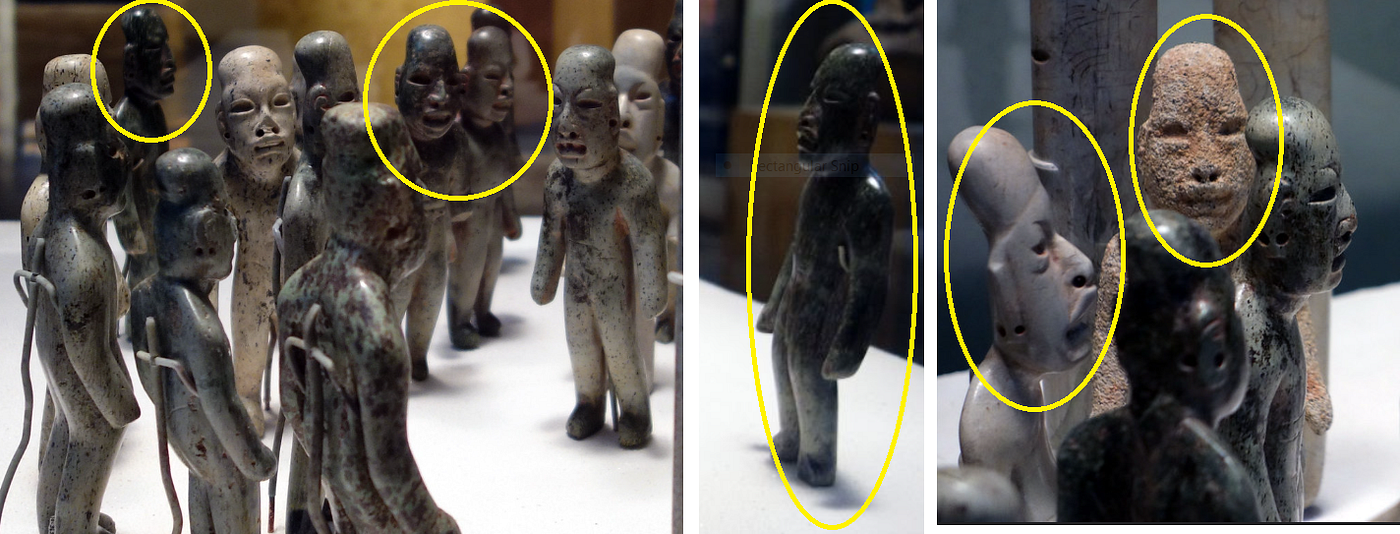
Note: Dark colors, lower-jaw prognathism, broad noses, thick lips. Olmec Offering Figurines. c. 900–400 BC. Serpentine, jadeite, and granite. From La Venta, Mexico (National Museum of Anthropology, Mexico City). Caption and images by Dr. Billie Follensbee, “Offering #4, La Venta,” in Smarthistory, September 8, 2016, accessed May 28, 2026, https://smarthistory.org/offering-4-la-venta/. “Standing human figures excavated at La Venta are some of the most iconic works of Olmec art.” Caption by Olmec art on the Metropolitan Museum of Art’s Heilbrunn Timeline of Art History (by Dr. James Doyle)
The fearful and resentful response of modern archaeological and anthropological professionals to growing evidence against Beringia and Asiatic Siberian-only is to continue the dirty work of Plecker, Hrdlička, Herskovits, and Petrie.
![“All of the 17 known Olmec colossal heads discovered so far. The heads date from at least 900 BCE, and it is thought that they represent portraits of powerful individual Olmec rulers. The head, in the 1st picture, is the largest of them all, measuring 3.4 m in height and weighs 40 tons [2205x2538].” Caption and image by ArtefactPorn via Museum of Artifacts. Reddit. Individual images available at Wikipedia.](https://miro.medium.com/v2/resize:fit:753/1*iSYgkXgJGNZbxX7C8-AslQ.png)
“All of the 17 known Olmec colossal heads discovered so far. The heads date from at least 900 BCE, and it is thought that they represent portraits of powerful individual Olmec rulers. The head, in the 1st picture, is the largest of them all, measuring 3.4 m in height and weighs 40 tons [2205x2538].” Caption and image by ArtefactPorn via Museum of Artifacts. Reddit. Individual images available at Wikipedia.
Question: How were an Asiatic and European people prone to sun damage able to build mounds, pyramids, megaliths, and complex city structures in the most sun-intensive regions of the Americas?
**Answer: **Black indigenous are not prone to sun damage.
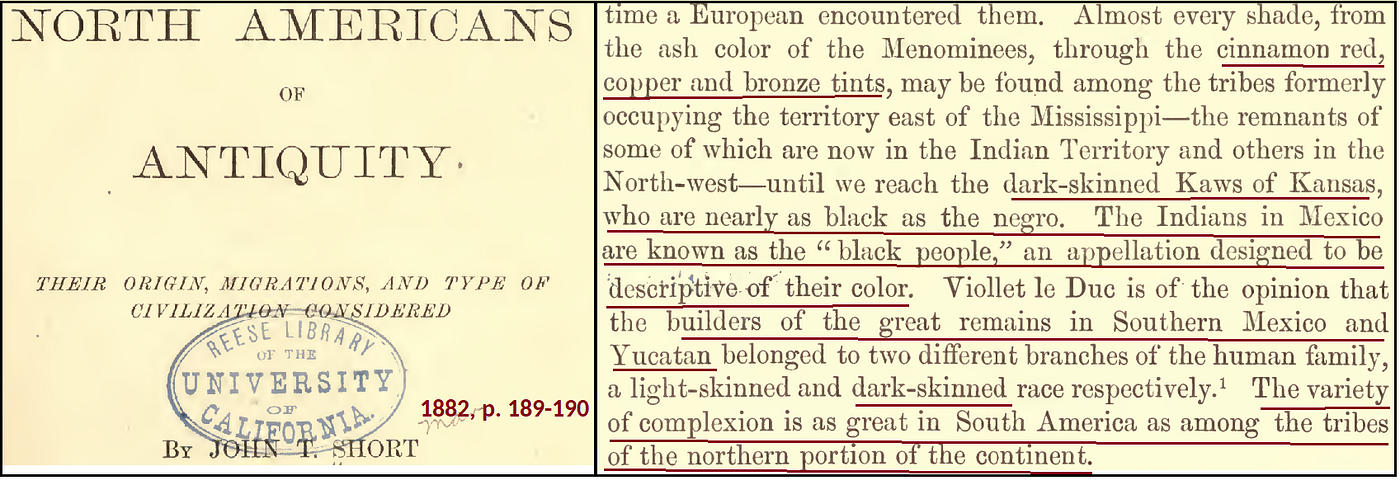
Black indigeneity in the Americas was widely-acknowledged in academia and scholarship until the turn of the twentieth century. “…cinnamon red, copper and bronze tints, may be found among the tribes formerly occupying the territory east of the Mississippi — the remnants of some of which are now in the Indian Territory and others in the North-west — until we reach the dark-skinned Kaws of Kansas, who are nearly as black as the negro. The Indians in Mexico are known as the “black people,” an appelation designed to be descriptive of their color. Viollet le Duc is of the opinion that the builders of the great remains in Southern Mexico and Yucatan belonged to two different branches of the human family, a light-skinned and dark-skinned race respectively. The variety of complexion is as great in South America as among the tribesof the northern portion of the continent.” Short, John T. The North Americans of Antiquity: Their Origin, Migrations, and Type of Civilization Considered. New York: Harper & Brothers, 1879. InternetArchive.org
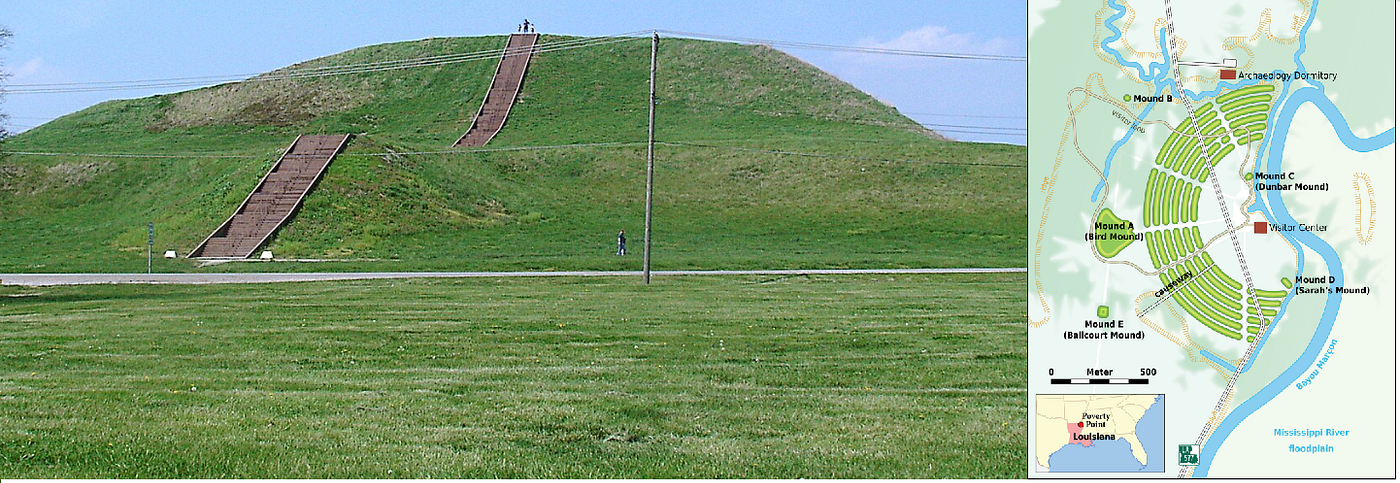
LEFT: “Monk’s Mound, a Pre-Columbian Mississippian culture earthwork, located at the Cahokia site near St. Louis, Missouri and Collinsville, Illinois.” Image and caption from Wikimedia Commons. RIGHT: Located in near the meeting point of Louisiana, Mississippi, and Arkansas, this 3,400-year-old US National Landmark and UNESCO World Heritage Site features a 72-foot tall earthen mound and concentric ridges. “Map of the Poverty Point archaeological site.” Image and caption from Wikimedia Commons.
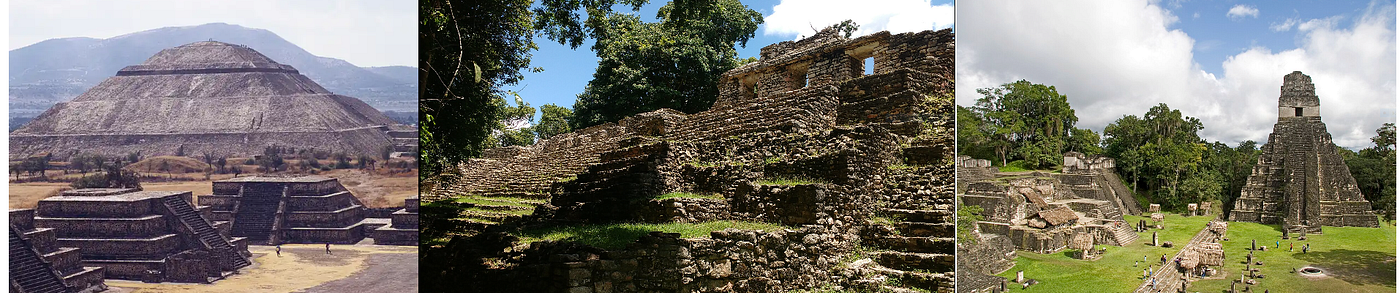
LEFT: Teotihuacan, Mexico. “Human occupation of the valley of Teotihuacan began before the Christian era, but it was only between the 1st and the 7th centuries A.D. that the settlement developed into one of the largest ancient cities in the Americas, with at least 25,000 inhabitants.” Image and caption from UNESCO World Heritage Convention. CENTER: Yaxchilan, Mexico. Photo taken in the Archaeological Zone of Yaxchilan, in the municipality of Ocosingo, Chiapas, Mexico. Wikimedia Commons. RIGHT: Tikal, Guatemala. “Plaza Mayor, Parque Nacional Tikal, Petén, Guatemala.” Image and caption from Wikimedia Commons.

LEFT: Machu Picchu, Peru. Photo from National Geographic. RIGHT: Cuzco, Peru. Photo from Trip Advisor.
메타데이터
- post_id
- ccda5d2ea4ba
- slug
- this-is-america-indigenous-album-ccda5d2ea4ba
- url
- https://medium.com/@leemcqueen3/this-is-america-indigenous-album-ccda5d2ea4ba
- canonical_url
- https://medium.com/@leemcqueen3/this-is-america-indigenous-album-ccda5d2ea4ba
- author_url
- https://medium.com/@leemcqueen3
- status
- ok
- fetched_at
- 2026-08-03 22:49:54