When Actions Speak Louder Than Office
The Hidden Leadership Tradition That Has Guided America for a Century
When Actions Speak Louder Than Office
The Hidden Leadership Tradition That Has Guided America for a Century
A century of First Ladies have shown that leadership isn’t only about authority. It’s also about meaning-making, empathy, and the quiet actions that help a nation endure uncertainty. From Eleanor Roosevelt to Rosalynn Carter, symbolic leadership has shaped America in ways we rarely name — but deeply feel.
I. Opening: Why Symbolic Leadership Matters
You can probably recognize a peace sign, your favorite restaurant’s logo, or a familiar jingle without needing to see or hear the whole thing. Symbols work that way — they carry meaning instantly. They reveal something about where we come from, what shaped us, and the values we hold. The White House itself functions the same way: a single image that represents power, continuity, and national identity, depending on who is looking.
If the building is a symbol, then the First Lady — its most visible inhabitant after the President — inevitably becomes a symbolic leader. Bolman and Deal describe symbolic leadership as the use of shared values and cultural meaning, especially during moments of crisis. Neuberger adds that symbols don’t just reflect meaning; they create it for a culture at a particular moment in time. And the theory of communicative action reminds us that leadership is often expressed through behavior — those moments when “actions speak louder than words.”
First Ladies may not hold an official position in the administration, but they lead nonetheless. They can offer a north star in times of conflict, embody empathy for communities in pain, and provide a sense of continuity when the nation feels unsteady. Their leadership is symbolic, yes — but symbolic leadership is still leadership.
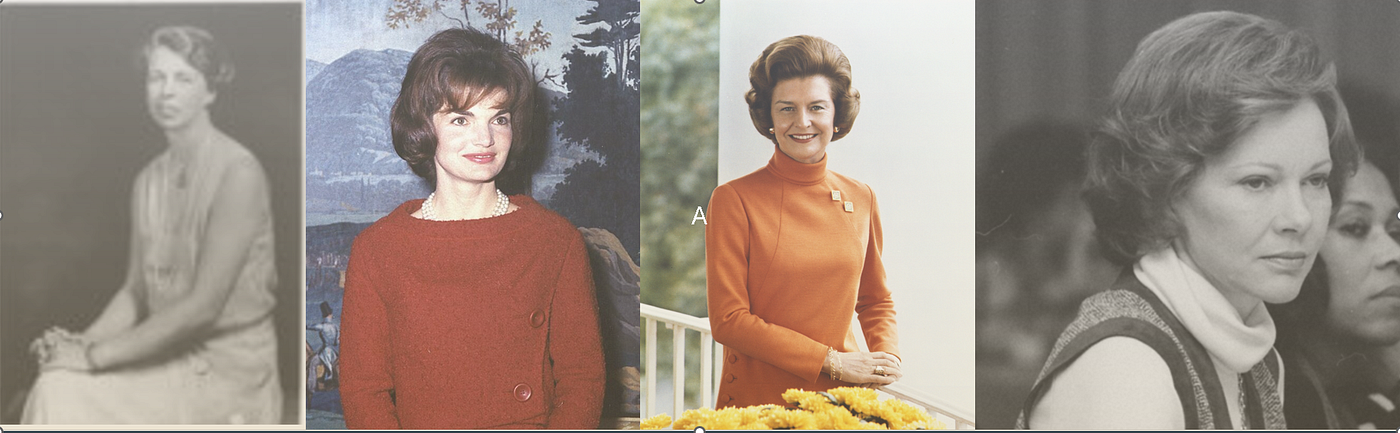
Women whose influence reached far beyond the walls of the White House.
II. The Early Years: Eleanor Roosevelt Before the White House
In my research on Eleanor Roosevelt, Blanche Wiesen Cook’s biography paints a vivid picture of her life before the White House, when Franklin served as Assistant Secretary of the Navy during the final years of World War I. This was a period marked by profound personal upheaval. Eleanor was grieving the loss of her grandmother and her aunt — women whose talents and ambitions had been constrained by the cultural expectations of their era. She was also confronting the emotional fallout of her husband’s infidelities and beginning the difficult work of discovering who she was apart from being “Mrs. Roosevelt.”
Meanwhile, the world around her was reeling from what was then called the “Great War,” the first truly global conflict. More than ten million soldiers and sailors died worldwide, including roughly 100,000 Americans. Against this backdrop of national anxiety and staggering loss, Eleanor Roosevelt stepped into public life with a quiet but unmistakable sense of purpose. Through her volunteer work — creating canteens for soldiers, supporting rehabilitation efforts, and organizing moments of joy — she became a symbol of empathy and steadiness during a turbulent era.
These early acts were not small gestures. They were the beginnings of a lifelong pattern of symbolic leadership: using presence, compassion, and action to help others interpret and endure difficult times. What she practiced during World War I would become the foundation for her later role as a global humanitarian and one of the most influential public leaders of the twentieth century.

Picture courtesy of the Franklin D. Roosevelt Presidential Library
III. Case Study: Eleanor Roosevelt’s WWI Leadership
During the Great War, soldier canteens were established across the country for military personnel preparing to deploy overseas. These spaces offered food, drink, entertainment, and — most importantly — a sense of home for anxious young men facing the unknown across the ocean. Eleanor Roosevelt volunteered in one of these canteens, using the physical environment itself as a tool of comfort. In doing so, she embodied what Bolman and Deal describe as symbolic leadership: creating meaning through shared rituals, gestures, and spaces that reinforce collective values. Her presence in the canteen wasn’t just service; it was a symbolic act that reassured soldiers they were seen, supported, and valued.
Eleanor also visited hospitals treating the physical and psychological wounds of returning servicemen. Many of these facilities were underfunded and ill‑equipped for the scale of suffering they faced. She worked personally — and alongside other volunteers — to raise money to improve conditions. Viewed through the lens of communicative action, her behavior became a powerful symbol of the nation’s commitment to caring for its wounded warriors. Her advocacy communicated values that words alone could not: compassion, responsibility, and the belief that healing was a national obligation.
Finally, she organized a Halloween dance to raise funds for a hospital in France. At a time when families lived with the daily fear that their loved ones might never return, the dance offered a moment of joy and normalcy that had been absent for far too long. It was both a fundraiser and a cultural intervention. As Neuberger suggests, symbolic leadership helps communities create meaning in difficult times — and Eleanor’s event did exactly that. It provided a shared memory of lightness amid darkness, reinforcing the idea that life and community could endure even in wartime.
IV. What These Actions Tell Us About Symbolic Leadership
Eleanor Roosevelt’s early wartime work is more than a list of volunteer activities; it is a clear illustration of how symbolic leadership functions in practice. When viewed through the three major scholarly frameworks — Bolman and Deal’s symbolic frame, Neuberger’s meaning‑centered leadership, and the theory of communicative action — her actions reveal the deeper leadership logic behind what might otherwise seem like small gestures.
1. Bolman & Deal: Symbols, Rituals, and Culture
She used spaces and rituals to create comfort.
2. Neuberger: Meaning‑Making and Social Construction
She created moments of meaning in the midst of fear.
3. Communicative Action: Behavior as Message
She communicated national values through action.
Together, these acts form a coherent leadership pattern — one that would define her public life for decades to come.

Photo courtesy of the White House Historical Association, 1962
V. The First Lady’s Symbolic Power: Beyond Eleanor Roosevelt
Symbolic leadership did not end with Eleanor Roosevelt. It continued through every decade after her husband’s presidency, embodied in different ways by Jacqueline Kennedy, Betty Ford, and Rosalynn Carter. Each woman faced a distinct national moment and used her public presence — her actions, choices, and visibility — to help the country interpret uncertainty, pain, or stigma.
Jacqueline Kennedy: Ritual, Continuity, and National Identity
Her restoration of the White House and televised tour established a national aesthetic that later became a symbol of continuity in the wake of tragedy.
Betty Ford: Vulnerability, Honesty, and Destigmatization
Her openness about addiction reshaped public understanding and created space for women to seek treatment without shame.
Rosalynn Carter: Meaning‑Making and the Fight for Mental Health
Her advocacy reframed mental illness as a public health issue deserving dignity and national attention.
Together, these women show the breadth of symbolic leadership — and its power.

Photo Courtesy of White House Archives
VI. Why Symbolic Leadership Still Matters Today
Symbolic leadership remains essential because the United States continues to face uncertainty, upheaval, and deep cultural division. And because no woman has yet held the highest office in the land, the First Lady remains the most visible woman in national leadership.
Every First Lady takes up a cause — sometimes several — and these causes are not ornamental. They are symbolic responses to the anxieties of their era.
From recession and domestic terrorism in the 1990s, to the trauma of 9/11, to healthcare debates in the 2010s, to today’s polarization and economic strain, symbolic leadership has offered something policy alone cannot: meaning, empathy, and continuity.
It is the quiet thread that helps hold the national fabric together when everything else feels frayed.
VII. Conclusion: Reclaiming the First Lady as a Public Leader
Leadership can be defined in countless ways — and symbolic leadership counts. It has always counted. Whether expressed through action, advocacy, presence, or purpose, First Ladies help hold the nation together from a position that is technically secondary but symbolically powerful.
Eleanor Roosevelt exemplified this form of leadership, and her legacy echoes through every administration that followed. Jacqueline Kennedy, Betty Ford, and Rosalynn Carter each carried that legacy forward in their own way, showing that leadership is not only about authority; it is about meaning‑making, empathy, and the courage to stand steady when the nation feels unsteady.
As we continue to grapple with polarization, uncertainty, and rapid change, symbolic leadership remains essential. Understanding the First Lady’s symbolic role is not just a historical exercise — it is a key to understanding women’s leadership today.
Further Reading
- Blanche Wiesen Cook, Eleanor Roosevelt (Volumes I–III)
- Betty Boyd Caroli, First Ladies
- Carl Anthony, First Ladies: The Saga of the Presidents’ Wives and Their Power
- Rosalynn Carter, Within Our Reach: Ending the Mental Health Crisis
- Michael Beschloss, Presidents of War (for WWI context)
- Bolman & Deal, Reframing Organizations (Symbolic Frame)
- Neuberger, The Power of Symbols in Leadership
메타데이터
- post_id
- cce25e3178e0
- slug
- when-actions-speak-louder-than-office-cce25e3178e0
- url
- https://medium.com/@thefirstladiesproject/when-actions-speak-louder-than-office-cce25e3178e0
- canonical_url
- https://medium.com/@thefirstladiesproject/when-actions-speak-louder-than-office-cce25e3178e0
- author_url
- https://medium.com/@thefirstladiesproject
- status
- ok
- fetched_at
- 2026-07-15 07:46:41



