War Crimes Committed by the Sri Lankan Government
Copyright © 2025 Rajeek Sellathuray
War Crimes Committed by the Sri Lankan Government
Copyright © 2025 Rajeek Sellathuray
All rights reserved. This chapter is an excerpt from Justice in Transition: Sri Lanka’s Pursuit of Justice, written by Rajeek Sellathuray.
No part of this content may be copied or distributed without permission, except for fair use under copyright law.
No part of this book may be reproduced, stored in a retrieval system, or transmitted in any form or by any means — electronic, mechanical, photocopying, recording, or otherwise — without the prior written permission of the author, except for brief quotations used in reviews or scholarly work.
This book is a work of nonfiction. Any references to actual people, events, or situations are used with permission or based on public records and research.
First Edition — March 2025
ISBN-13 : 979–8313597799
Learn more or read the full book at: https://amzn.eu/d/cHorPI5
Introduction
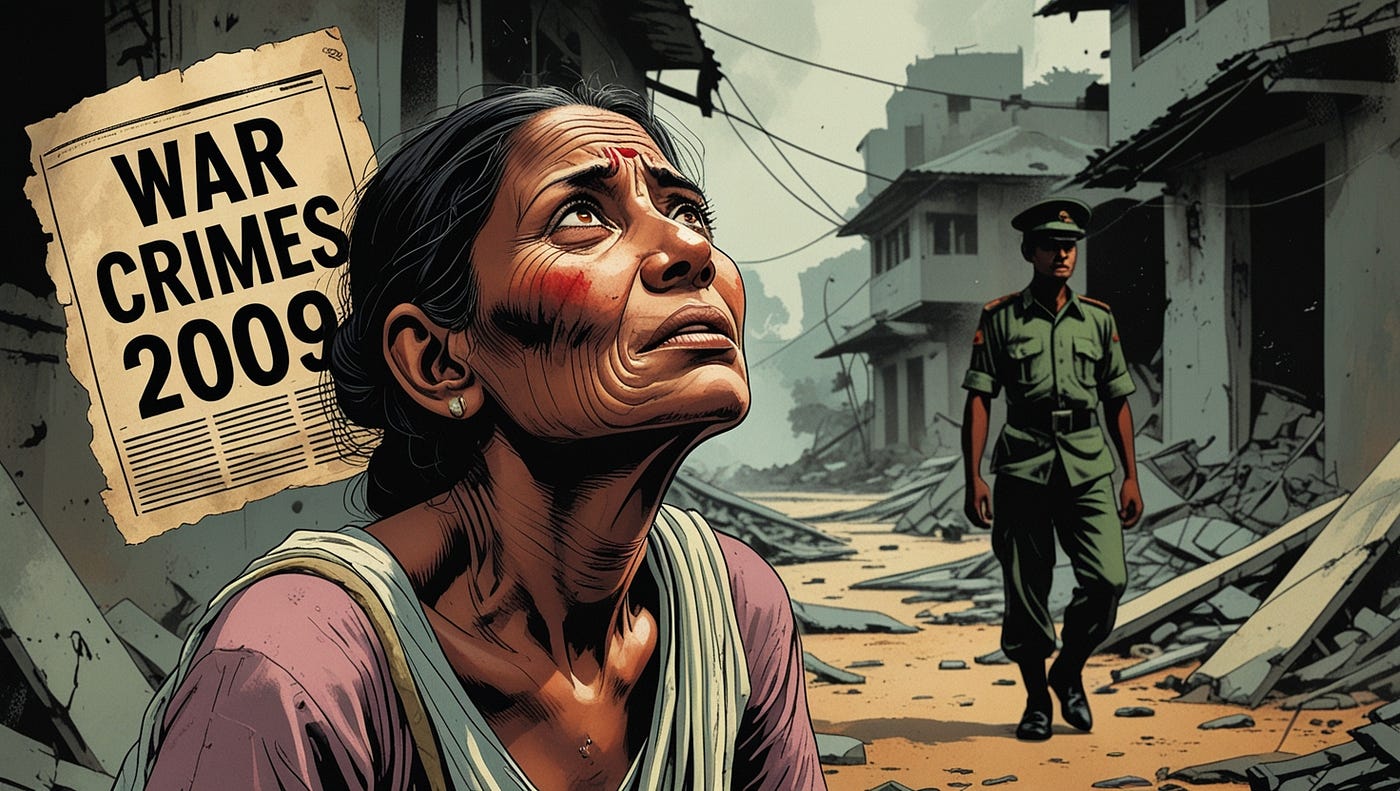
The final stages of the Sri Lankan Civil War, particularly between 2008 and 2009, were marked by numerous allegations of war crimes committed by the Sri Lankan government. These alleged violations have been extensively documented by international organisations, including the United Nations, and have drawn widespread condemnation. This chapter examines the nature of these alleged war crimes, their impact on civilian populations, and the ongoing challenges in seeking justice and accountability
Context of the Conflict
The Sri Lankan Civil War, which spanned from 1983 to 2009, was primarily a conflict between the Sri Lankan government and the Liberation Tigers of Tamil Eelam (LTTE), a separatist organisation seeking an independent Tamil state. The war culminated in a decisive military offensive by the Sri Lankan government against the LTTE in the final years, leading to significant civilian casualties and widespread destruction.
Allegations of War Crimes
During the final stages of the conflict, numerous allegations emerged regarding the conduct of the Sri Lankan military. Reports from international bodies and human rights organisations highlighted instances of indiscriminate shelling of civilian areas, targeting of humanitarian facilities, denial of humanitarian aid, extrajudicial killings, and attacks on media and human rights defenders. These actions have been characterised as violations of international humanitarian law and human rights standards.
Impact on Civilian Populations
The alleged war crimes had a devastating impact on civilian populations, particularly the Tamil ethnic group. Thousands of civilians were killed, injured, or displaced, and many suffered from the destruction of infrastructure, loss of livelihoods, and psychological trauma. The targeting of hospitals, schools, and other civilian infrastructure exacerbated the humanitarian crisis.
Challenges in Seeking Justice
Efforts to hold the Sri Lankan government accountable for these alleged war crimes have faced significant challenges. The government’s resistance to international investigations, lack of domestic accountability mechanisms, and geopolitical considerations have hindered the pursuit of justice. The culture of impunity continues to impede reconciliation and healing for the affected communities.
Context of the Conflict
The Sri Lankan Civil War, spanning from 1983 to 2009, was a protracted and devastating conflict primarily between the Sri Lankan government and the Liberation Tigers of Tamil Eelam (LTTE). The LTTE, led by Velupillai Prabhakaran, sought to establish an independent Tamil state, Tamil Eelam, in the northern and eastern regions of Sri Lanka. This insurgency was fueled by longstanding grievances among the Tamil minority, who faced systemic discrimination and violent persecution by the Sinhalese-majority government.
Historical Background
Post-independence Sri Lanka witnessed escalating tensions between the Sinhalese majority and the Tamil minority. The government’s decision to recognise Sinhalese as the sole official language in 1956 marginalised Tamil speakers, leading to widespread protests and civil unrest. Subsequent anti-Tamil pogroms in 1958, 1977, 1981, and 1983, often carried out by Sinhalese mobs with state support, exacerbated ethnic tensions and fueled the desire among Tamils for self-determination.
Formation of the LTTE
In response to the escalating violence and discrimination, the LTTE was formed in 1976 under the leadership of Velupillai Prabhakaran. The organisation adopted a strategy of armed struggle, aiming to create an independent Tamil state. Over the years, the LTTE became notorious for its military capabilities and tactics, including the use of suicide bombings and child soldiers.
Escalation of the Conflict
The conflict intensified in the 1980s, with both the Sri Lankan military and the LTTE committing acts of violence against civilians. The government’s military operations often targeted Tamil civilian areas, leading to significant casualties and displacement. The LTTE, in turn, engaged in guerrilla warfare, including attacks on military and civilian targets. The cycle of violence perpetuated a humanitarian crisis, with thousands of civilians caught in the crossfire.
International Involvement
In 1987, India intervened by deploying the Indian Peace Keeping Force (IPKF) to enforce a ceasefire and facilitate peace negotiations. However, the IPKF’s presence was met with resistance from both the Sri Lankan government and the LTTE, leading to further complications and casualties. The international community remained largely passive, with limited involvement in mediating the conflict.
End of the War
The war culminated in May 2009 when the Sri Lankan military launched a final offensive against the LTTE, resulting in the defeat of the organisation and the end of the civil war. The final stages of the conflict were marked by significant civilian casualties and widespread destruction, raising serious concerns about potential war crimes committed by both the Sri Lankan government and the LTTE.
Understanding the context of the Sri Lankan Civil War is crucial to comprehending the subsequent events and the allegations of war crimes that emerged during the final stages of the conflict
Allegations of War Crimes
During the final stages of the Sri Lankan Civil War, particularly between 2008 and 2009, numerous allegations emerged regarding war crimes committed by both the Sri Lankan government forces and the Liberation Tigers of Tamil Eelam (LTTE). These allegations have been extensively documented by international organizations, human rights groups, and independent investigations.
Allegations Against the Sri Lankan Government
The Sri Lankan military has been accused of committing several war crimes during the final offensive against the LTTE:
Indiscriminate Shelling of Civilian Areas: Reports indicate that the Sri Lankan military conducted large-scale and widespread shelling in densely populated civilian areas, resulting in significant civilian casualties. The United Nations panel found “credible allegations” that the military shelled hospitals and humanitarian objects, causing large numbers of civilian deaths.
- Targeting of Humanitarian Facilities: The military is accused of deliberately targeting hospitals, food distribution lines, and Red Cross ships, despite being aware of their locations and the presence of civilians. This obstruction of humanitarian aid exacerbated the suffering of the civilian population.
- • Denial of Humanitarian Aid: The government allegedly deprived civilians in the conflict zone of essential humanitarian aid, such as food and medical supplies, adding to their suffering. The government deliberately underestimated the number of civilians to justify withholding aid.
- • Extrajudicial Killings and Enforced Disappearances: There are credible allegations of extrajudicial killings and enforced disappearances carried out by the Sri Lankan military. The United Nations panel found that the military subjected civilians who managed to escape the conflict zone to further deprivation and suffering, including arbitrary detention and torture.
- • Attacks on Media and Human Rights Defenders: The Sri Lankan government is accused of attempting to intimidate and silence the media and other critics of the war Page 5 of 19 through various threats and actions, including the use of white vans to abduct and make people disappear.
International Response and Investigations
The international community has expressed concern over these alleged war crimes, with calls for independent investigations and accountability. In 2011, the United Nations SecretaryGeneral’s Panel of Experts on Accountability in Sri Lanka released a report detailing credible allegations of war crimes committed by both the Sri Lankan government and the LTTE. The report called for an independent international investigation into these allegations.
However, the Sri Lankan government has consistently resisted international investigations, asserting that it can address these issues domestically. This stance has led to criticism from human rights organisations and the international community, who argue that the lack of accountability perpetuates a culture of impunity.
As of 2024, despite the passage of 15 years since the end of the conflict, no individuals have been held accountable for the alleged war crimes committed during the final stages of the war. The lack of justice continues to hinder reconciliation efforts and the healing process for the affected communities.
The allegations of war crimes during the final stages of the Sri Lankan Civil War highlight the urgent need for accountability and justice to address the atrocities committed and to prevent future violations of international humanitarian law.
Impact on Civilian Populations
The Sri Lankan Civil War, which concluded in 2009, had a profound and lasting impact on civilian populations, particularly in the northern and eastern regions of the country. The final stages of the conflict, from 2008 to 2009, were marked by intense military operations that Page 6 of 19 resulted in significant civilian casualties, widespread displacement, and long-term humanitarian challenges.
Civilian Casualties and Displacement
During the final offensive against the Liberation Tigers of Tamil Eelam (LTTE), the Sri Lankan military conducted large-scale and widespread shelling in densely populated civilian areas, resulting in significant civilian casualties. The United Nations panel found “credible allegations” that the military shelled hospitals and humanitarian objects, causing large numbers of civilian deaths.
The conflict also led to the displacement of approximately 300,000 civilians, who were forced to flee their homes to escape the fighting. These internally displaced persons (IDPs) were relocated to camps in Vavuniya District, where they were detained against their will. The conditions inside the camps attracted much criticism from both domestic and international sources.
Humanitarian Challenges
The final stages of the war created 300,000 internally displaced persons (IDPs) who were transferred to camps in the Vavuniya District and detained there against their will. The camps were surrounded by barbed wire, and the conditions inside the camps attracted much criticism from inside and outside Sri Lanka.
The end of the war left past conflict zones heavily contaminated with approximately 1.6 million land mines. By September 2023, deminers employed by the Sri Lankan army and foreign-funded agencies had cleared 1,287 square kilometres, leaving about 17 square kilometres yet to be cleared.
Psychosocial Impact
The civil conflict had an enormous impact on the mental health of the country’s population, especially in the areas of Northern and Eastern provinces. This impact was compounded by the 2004 tsunami, which struck many conflict areas and caused death and destruction among communities already burdened by many years of war-related trauma.
Long-Term Effects
As of 2024, despite the passage of 15 years since the end of the conflict, no individuals have been held accountable for the alleged war crimes committed during the final stages of the war. The lack of justice continues to hinder reconciliation efforts and the healing process for the affected communities.
The impact on civilian populations during and after the Sri Lankan Civil War underscores the urgent need for comprehensive post-conflict recovery strategies, including justice and reconciliation processes, to address the profound humanitarian and psychosocial challenges faced by the affected communities.
Challenges in Seeking Justice
The pursuit of justice for alleged war crimes committed during the Sri Lankan Civil War has been fraught with significant challenges, impeding accountability and reconciliation efforts. These obstacles stem from a combination of political resistance, legal complexities, and societal factors.
Political Resistance and Lack of Political
The Sri Lankan government’s persistent resistance to international investigations has been a major impediment to justice. Despite credible allegations of war crimes, the government has consistently rejected calls for independent inquiries, asserting that it can address these issues domestically. This stance has led to criticism from human rights organizations and the international community, who argue that the lack of accountability perpetuates a culture of impunity.
Weak Domestic Legal Framework
Sri Lanka’s domestic legal framework has proven inadequate for effectively prosecuting war crimes. The country’s judicial system lacks the necessary mechanisms and resources to handle complex international crimes. Previous attempts to establish domestic bodies to investigate wartime abuses have been criticized for replicating failed efforts and falling short of meeting international legal obligations.
Intimidation and Threats Against Victims and Witnesses
Victims and witnesses seeking justice have faced intimidation and threats, discouraging them from coming forward. The government’s use of draconian counterterror laws and attempts to bring in new laws to counter dissent and threaten freedom of expression have resulted in arbitrary arrests and detentions. The right to freedom of peaceful assembly has been restricted amid the continued use of excessive and unnecessary force against protesters.
International Community’s Limited Influence
The international community’s influence has been limited, with calls for independent investigations often met with resistance from the Sri Lankan government. While international organisations have documented alleged war crimes, their ability to enforce accountability has been constrained by the lack of cooperation from the Sri Lankan authorities.
Societal Divisions and Lack of Trust
Deep-seated societal divisions and a lack of trust between different ethnic communities have further complicated the pursuit of justice. The Tamil minority, in particular, has expressed scepticism about the government’s commitment to accountability, given the historical context of discrimination and violence. This mistrust has hindered efforts to build a unified front for justice and reconciliation.
These challenges underscore the urgent need for a comprehensive and inclusive approach to transitional justice in Sri Lanka, one that addresses the root causes of the conflict, ensures accountability, and fosters reconciliation among all communities.
Widespread Shelling of Civilian Areas
During the final stages of the Sri Lankan Civil War, particularly between 2008 and 2009, the Sri Lankan military conducted extensive shelling in densely populated civilian areas, leading to significant civilian casualties and widespread destruction. This indiscriminate use of heavy artillery and aerial bombardments has been widely documented and remains a central concern in discussions about the conflict’s humanitarian impact.
Indiscriminate Attacks on Civilian Zones
The Sri Lankan military’s shelling targeted areas densely populated by civilians, including hospitals, schools, and shelters. Reports indicate that the military shelled hospitals and humanitarian facilities, causing large numbers of civilian deaths. The United Nations panel found “credible allegations” that the military shelled hospitals and humanitarian objects, resulting in significant civilian casualties.
Impact on Humanitarian Operations
The shelling disrupted humanitarian operations, hindering the delivery of essential aid to civilians. The military’s actions obstructed food and medical supplies, exacerbating the suffering of the civilian population. The government deliberately underestimated the number of civilians in the conflict zone to justify withholding aid.
International Response and Accountability
The international community has expressed concern over these alleged war crimes, with calls for independent investigations and accountability. In 2011, the United Nations Secretary- Page 9 of 19 General’s Panel of Experts on Accountability in Sri Lanka released a report detailing credible allegations of war crimes committed by both the Sri Lankan government and the LTTE. The report called for an independent international investigation into these allegations.
However, the Sri Lankan government has consistently resisted international investigations, asserting that it can address these issues domestically. This stance has led to criticism from human rights organisations and the international community, who argue that the lack of accountability perpetuates a culture of impunity.
Targeting of Humanitarian Facilities
During the final stages of the Sri Lankan Civil War, the Sri Lankan military conducted attacks on humanitarian facilities, including hospitals and medical centres, resulting in significant civilian casualties and raising serious concerns about compliance with international humanitarian law.
Attacks on Hospitals and Medical Facilities
The Sri Lankan armed forces carried out repeated shelling and aerial attacks on hospitals in the northern Vanni region, areas densely populated by civilians. These attacks targeted medical facilities such as the Mullivaikkal Hospital and the Ponnampalam Memorial Hospital, leading to numerous civilian deaths and injuries. Human Rights Watch reported that these attacks were indiscriminate and violated the laws of war.
Impact on Medical Services
The targeting of hospitals severely disrupted medical services, depriving civilians of essential healthcare during a critical period. Medical personnel were killed or injured, and medical supplies were destroyed, exacerbating the humanitarian crisis. The attacks on medical facilities also forced many hospitals to cease operations, leaving civilians without access to necessary medical care.
International Response and Accountability
The international community expressed grave concern over these attacks, with calls for independent investigations and accountability. The United Nations Secretary-General’s Panel of Experts on Accountability in Sri Lanka found credible allegations that the Sri Lankan military shelled hospitals and humanitarian objects, resulting in significant civilian casualties.
However, the Sri Lankan government has consistently denied these allegations, asserting that it did not target civilian infrastructure. The government’s stance has been met with criticism Page 10 of 19 from human rights organisations and the international community, who argue that the lack of accountability perpetuates a culture of impunity
Denial of Humanitarian Aid
During the final stages of the Sri Lankan Civil War, the government implemented policies that severely restricted the delivery of humanitarian aid to civilians in conflict zones, exacerbating the humanitarian crisis and leading to significant civilian suffering.
Governmental Restrictions on Aid
The Sri Lankan government imposed stringent controls on the distribution of humanitarian assistance, including food, medical supplies, and other essential resources. These restrictions were particularly severe in the northern regions, where the conflict was most intense. The government deliberately underestimated the number of civilians in the conflict zone to justify withholding aid.
Impact on Civilian Populations
The denial of humanitarian aid led to widespread malnutrition, preventable diseases, and a lack of medical care among civilians. The United Nations reported that tens of thousands of civilians were killed in northern Sri Lanka from January to May 2009, with the government knowingly shelling areas where it had encouraged civilians to gather.
International Response and Accountability
The international community expressed grave concern over the denial of humanitarian aid, with calls for independent investigations and accountability. The United Nations SecretaryGeneral’s Panel of Experts on Accountability in Sri Lanka found credible allegations that the Sri Lankan government systematically deprived civilians in the conflict zone of humanitarian aid, adding to their suffering.
However, the Sri Lankan government has consistently denied these allegations, asserting that it did not target civilian infrastructure. The government’s stance has been met with criticism from human rights organizations and the international community, who argue that the lack of accountability perpetuates a culture of impunity.
Extrajudicial Killings and Enforced Disappearances
During the Sri Lankan Civil War, particularly in its final stages, the Sri Lankan government and associated forces were implicated in numerous extrajudicial killings and enforced disappearances. These actions targeted individuals suspected of supporting the Liberation Tigers of Tamil Eelam (LTTE) and were characterised by their unlawful nature and lack of due process.
Extrajudicial Killings
Extrajudicial killings refer to the deliberate, unlawful killings carried out by state actors without judicial proceedings. In Sri Lanka, these killings often involved the targeted assassination of individuals perceived as threats to national security. For instance, the murder of five Tamil students, known as the “Trinco Five,” by security forces on January 2, 2006, exemplifies such extrajudicial actions.
Enforced Disappearances
Enforced disappearances involve the abduction or detention of individuals by state agents, followed by a refusal to acknowledge their fate or whereabouts, effectively placing them outside the protection of the law. In Sri Lanka, this practice was widespread, with thousands of individuals, particularly Tamils, reported missing during the conflict. Between 1995 and 1996, over 600 Tamils disappeared in Jaffna, many believed to have been buried by the Sri Lankan Army in mass graves in Chemmani.
Impact on Civilian Populations
The prevalence of extrajudicial killings and enforced disappearances instilled widespread fear among civilian populations, particularly within Tamil communities. Families endured prolonged uncertainty and grief, with many left without closure regarding the fate of their loved ones. The lack of accountability for these actions further eroded trust in state institutions and hindered post-conflict reconciliation efforts.
International Response and Accountability
The international community has expressed grave concern over these human rights violations. Reports from organisations such as Human Rights Watch and the United Nations have called for thorough investigations and accountability for those responsible. However, the Sri Lankan government has often denied these allegations, asserting that it did not target civilian infrastructure. The government’s stance has been met with criticism from human rights organizations and the international community, who argue that the lack of accountability perpetuates a culture of impunity.
Attacks on Media and Human Rights Defenders
Throughout the Sri Lankan Civil War and in its aftermath, media personnel and human rights defenders faced significant threats, including harassment, intimidation, and physical attacks. These actions aimed to suppress dissenting voices and hinder the dissemination of information critical of the government.
Harassment and Intimidation
Human rights organisations and media outlets reported numerous instances of harassment and intimidation. Between May 2019 and January 2020, authorities conducted unscheduled visits to human rights and media organisations, perceived as acts of harassment.
Physical Attacks and Threats
Journalists and human rights defenders were subjected to physical attacks and threats. For example, in July 2020, state security forces attacked reporters from Sirasa TV as they covered protests outside the Prime Minister’s office.
Legal and Administrative Harassment
Lawyers and activists taking on human rights cases faced legal and administrative challenges, including smear campaigns in the media. Journalists and individuals voicing critical opinions on social media were also arbitrarily arrested.
Impact on Freedom of Expression
These attacks and intimidations have a chilling effect on freedom of expression, leading to self-censorship among journalists and human rights defenders. The suppression of critical voices undermines democratic processes and the protection of human rights.
International Response
International human rights organisations have condemned these actions and called for the protection of media personnel and human rights defenders. They urge the Sri Lankan government to ensure the safety of individuals exercising their rights to freedom of expression and assembly.
Lack of Accountability and Ongoing Impunity
The Sri Lankan Civil War, which concluded in 2009, was marked by numerous human rights violations and alleged war crimes committed by both the Sri Lankan government and the Liberation Tigers of Tamil Eelam (LTTE). Despite over a decade since the conflict’s end, there has been a significant lack of accountability for these actions, leading to a culture of impunity that continues to affect the nation’s human rights landscape.
Governmental Resistance to Accountability
The Sri Lankan government has consistently resisted international calls for independent investigations into alleged war crimes. In 2019, Amnesty International emphasised the need for the government to end impunity and prioritise accountability for crimes under international law and human rights violations.
International Community’s Concerns
The United Nations and various human rights organisations have expressed alarm over Sri Lanka’s failure to address past violations. In 2021, the UN reported that the lack of accountability has significantly heightened the risk of human rights violations being repeated, highlighting trends such as deepening impunity and increasing militarisation of governmental functions.
Implications for Future Stability
The absence of accountability has broader implications for Sri Lanka’s future stability. The UN has warned that the failure to address past crimes could result in a resurgence of similar violations, potentially leading to renewed conflict.
International Response and Challenges
The international community has expressed significant concern over human rights violations in Sri Lanka, particularly those committed during the civil war and in its aftermath. However, efforts to address these issues have encountered substantial challenges.
International Calls for Accountability
Various international bodies, including the United Nations and human rights organisations, have called for independent investigations into alleged war crimes and human rights abuses in Sri Lanka. For instance, the United Nations Human Rights Council has passed resolutions urging the Sri Lankan government to ensure accountability for past violations.
Sri Lanka’s Response
The Sri Lankan government has often resisted international pressure, asserting its sovereignty and the need for domestic solutions to human rights issues. This stance has led to tensions with international partners and has hindered the implementation of recommended reforms.
Challenges in Implementation
Efforts to promote human rights and accountability in Sri Lanka face several challenges:
• Political Will: There is a lack of political will within the Sri Lankan government to fully implement international recommendations, often due to domestic political considerations and resistance from powerful factions.
• Legal and Institutional Barriers: The existing legal framework and institutions are often inadequate to address complex human rights violations, leading to a culture of impunity.
• Economic and Social Factors: Economic challenges and social unrest can divert attention from human rights issues, complicating efforts to prioritise and address them effectively.
Conclusion
The Sri Lankan Civil War, which concluded in 2009, left a profound impact on the nation, with numerous human rights violations and alleged war crimes committed by both the Sri Lankan government and the Liberation Tigers of Tamil Eelam (LTTE). Despite the passage of time, Page 15 of 19 significant challenges remain in addressing these issues and fostering a culture of accountability.
Key Findings:
- Human Rights Violations: Both the Sri Lankan government and the LTTE were implicated in serious human rights abuses during the conflict, including extrajudicial killings, enforced disappearances, and attacks on civilian populations. The final stages of the war were particularly marked by allegations of indiscriminate shelling and targeting of humanitarian facilities.
- • Lack of Accountability: Over 15 years since the conflict’s end, there has been a notable absence of accountability for these violations. The Sri Lankan government’s resistance to international investigations and the lack of domestic legal proceedings have perpetuated a culture of impunity.
- • International Response: The international community has expressed grave concern, with calls for independent investigations and accountability. However, these efforts have been hindered by the Sri Lankan government’s resistance and the complexities of international law.
- • Recent Developments: In September 2024, Anura Kumara Dissanayake, a Marxist leader, was elected as Sri Lanka’s president. His victory is seen as a potential turning point, with commitments to combat corruption and investigate past crimes.
References:
Books:
- Pears, R. and Shields, G. (2019) Cite them right: The essential referencing guide. 11th edn. London: Macmillan.
Websites:
- • Amnesty International (2024) Sri Lanka: Human rights concerns. Available at: https://www.amnesty.org/en/location/asia-and-the-pacific/south-asia/srilanka/report-sri-lanka/ (Accessed: 28 February 2025).
- • Human Rights Watch (2024) Sri Lanka: Human rights overview. Available at: https://www.hrw.org/world-report/2024/country-chapters/sri-lanka (Accessed: 28 February 2025).
- • The Guardian (2024) Tamils stranded on Diego Garcia for three years allowed to enter UK. Available at: https://www.theguardian.com/uk-news/2024/nov/04/tamilsstranded-on-diego-garcia-for-three-years-allowed-to-enter-uk (Accessed: 28 February 2025).
- • The Lemonde (2024) Sri Lanka elects a Marxist to lead a country shattered by five years of crisis. Available at: https://www.lemonde.fr/en/international/article/2024/09/23/sri-lanka-elects-amarxist-to-lead-a-country-shattered-by-five-years-of-crisis_6726961_4.html (Accessed: 28 February 2025).
Reports:
- • United Nations Human Rights Council (2024) Resolution on Sri Lanka. Available at: https://www.amnesty.org/en/latest/news/2024/10/geneva-un-hrcresolution-on-sri-lanka-underscores-continued-need-for-international-scrutiny/ (Accessed: 28 February 2025).
- • “Sri Lanka’s Ethnic Conflict: At a Crossroad between Peace and War.” (n.d.). JSTOR. Available at: https://www.jstor.org/stable/3993700 [Accessed 28 Feb. 2025].
- • “Federalism and Ethnic Conflict in Sri Lanka.” (n.d.). JSTOR. Available at: https://www.jstor.org/stable/3330279 [Accessed 28 Feb. 2025].
- • “Democratic Socialism in Sri Lanka.” (n.d.). JSTOR.
- • “Legacies and Lessons: Sexual Violence against Men and Boys in Sri Lanka and Bosnia & Herzegovina.” (n.d.). JSTOR.
- • “Political Polarization in South and Southeast Asia: Old Divisions, New Dangers.” (n.d.). JSTOR.
- • “‘Terrorism’ or ‘Liberation’? Towards a Distinction: A Case Study of the Armed Struggle of the Liberation Tigers of Tamil Eelam (LTTE).” (n.d.). JSTOR.
- • “Jaffna Hospital Massacre.” (n.d.). Wikipedia. Available at: https://en.wikipedia.org/wiki/Jaffna_Hospital_Massacre [Accessed 28 Feb. 2025].
- • “2006 Trincomalee Massacre of NGO Workers.” (n.d.). Wikipedia. Available at: https://en.wikipedia.org/wiki/2006_Trincomalee_massacre_of_NGO_workers [Accessed 28 Feb. 2025].
- • “War Crimes During the Final Stages of the Sri Lankan Civil War.” (n.d.). Wikipedia. Available at: https://en.wikipedia.org/wiki/War_crimes_during_the_final_stages_of_the_Sr i_Lankan_Civil_War [Accessed 28 Feb. 2025].
- • “Uncovering Sri Lanka’s War Crimes.” (n.d.). Human Rights Watch. Available at: https://www.hrw.org/report/2011/03/15/uncovering-sri-lankaswar-crimes [Accessed 28 Feb. 2025].
- • “15 Years On, Sri Lanka’s Conflict Ended but No Justice for War Crimes.” (2024). Human Rights Watch. Available at: https://www.hrw.org/news/2024/05/14/15-years-sri-lankas-conflict-ended-nojustice-war-crimes [Accessed 28 Feb. 2025]
메타데이터
- post_id
- cce78c2d9bea
- slug
- war-crimes-committed-by-the-sri-lankan-government-cce78c2d9bea
- url
- https://medium.com/@thalarajeek/war-crimes-committed-by-the-sri-lankan-government-cce78c2d9bea
- canonical_url
- https://medium.com/@thalarajeek/war-crimes-committed-by-the-sri-lankan-government-cce78c2d9bea
- author_url
- https://medium.com/@thalarajeek
- status
- ok
- fetched_at
- 2026-06-26 03:39:16