How Ancient Arthropods Evaded the Jaws of Armored Fish
The latest research on Middle Devonian Trilobites suggests that these ancient arthropods possessed camouflage pigmentation in their…
FOSSILS ET AL.
How Ancient Arthropods Evaded the Jaws of Armored Fish
The latest research on Middle Devonian Trilobites suggests that these ancient arthropods possessed camouflage pigmentation in their exoskeletons
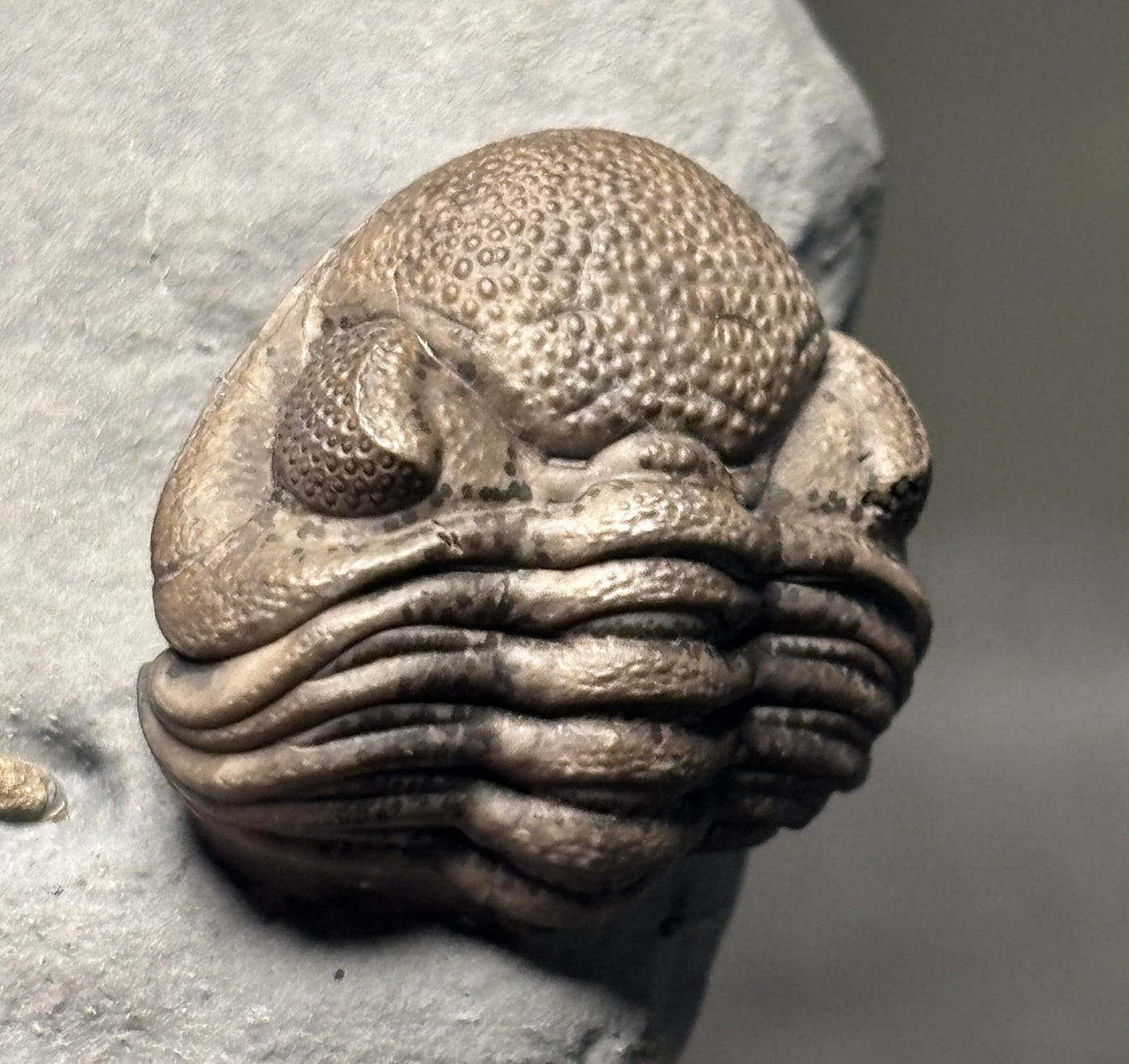
18.4mm Camouflage Pattern Eldredgeops rana, Middle Devonian-Givetian Stage, Hamilton Group, Wanakah Shale, New York. Credit: Jerry Xing-Personal Collection
The Middle Devonian Seas, approximately 390 million years ago, were teeming with aquatic life and new predatory forms that patrolled the waters. The Devonian seas are best characterized as warm, shallow, and very fishy. The emergence of large armored jawed fish called *Placoderms *meant that previously sufficient defense mechanisms like hard exoskeletons present in brachiopods, trilobites, and orthocone cephalopods were able to be exploited by Mother Nature’s revolutionary invention: jaws…cue the infamous movie music
So that begs the question: How did Devonian life persevere and adapt?

Paleoart of Dunkleosteus: a large Late Devonian Placoderm. Early placoderms had crushing plates rather than teeth, but were just as effective in bite force simulations. Credit: Nobu Tamura
Trilobite Background Information
Today’s focus is on trilobites: an extinct class of ancient arthropods similar to modern-day horseshoe crabs in the sense that they are both marine arthropods. For hundreds of millions of years before the existence of jaws, trilobites roamed the sea floors, evolving defense mechanisms against early predators. Trilobites are notable for surviving two major mass extinctions until the end of the Paleozoic meaning that they persevered and adapted for nearly 300 million years.
To put it in perspective, we humans have existed for only three hundred thousand years. So, needless to say, trilobites know a thing or two about overcoming the odds.
Eldredgeops Rana Background Information
Paleontologists have taken a particular interest in the Middle Devonian-Givetian Stage trilobite species called *Eldredgeops rana, specifically for their unusual dark spots that mottle the exoskeleton. Outside of this scientific research, Eldredgeops *is also notable for its large schizochroal compound eyes, adapted to give the trilobite near 360-degree vision to avoid predators and stalk prey, and is widely studied as an archetype for North American Phacopids. It is commonly referred to by its nickname, the “frog-eyed” trilobite.
The fossils from the Windom and Wanakah shales in New York State, where the Eldredgeops originate from, are Middle Devonian, spanning from 393 to 382 million years ago. The formation itself is notable for its extremely diverse and bountiful representation of the animals that lived in the habitat. Likely the result of a storm drainage area that buried the animals quickly, the fossils are usually preserved in calcite with occasional deposits of pyrite.

Stratigraphy of Hamilton Group containing the Windom and Wanakah Shales. Credit: McRoberts et al. 2013
Common fauna represented here include a variety of Middle Devonian trilobites, solitary and colonial horn corals, tabulate corals, brachiopods, crinoids, and placoderms, making up a warm, inland sea. The type of sediment preservation found throughout the shales is described as that of a “thick, blocky, gray carbonate mudstone” (McRoberts et al. 2013).

Reconstruction of Devonian Reef-James St. John
Scientific Significance of Trilobite Camouflage

Specimens of Eldredgeops rana displaying the spotted camouflage pattern taken by the Paleontological Research Institute. Credit: McRoberts et al. 2013
The fossil assemblages from which *Eldredgeops rana are from are abundant but rarely preserve soft tissue, like the Maotianshan Shales Konservat-Lagerstätten in China, which preserves the most extraordinary soft-bodied organisms. Because the mottled pattern is directly present in the hard exoskeleton rather than soft tissue, the preservation of this pattern in Eldredgeops *is especially rare and perhaps confounding.
There are two existing theories about these spots that exist on the trilobites. One is that the spots represented places on the exoskeleton where muscle lining connected with the soft parts underneath the trilobite’s exoskeleton. This theory makes sense when we think of the assumption that organic pigmentation, like in human skin, cannot be preserved in a fossil formation that only yields preserved hard, outer exoskeletons made of calcite. The other theory is that these spots served as remnants of organic pigmentation that the trilobite used for camouflage purposes.
A study done in 2013 by paleontologist Christopher McRoberts and colleagues into the dark, concentric dots found within the preserved exoskeletons of Eldredgeops using electron microscope imaging, energy-dispersive X-ray spectroscopy, and other techniques hypothesized that the coloration in the fossils may be indicative of either organic pigments or structural colors with the exoskeleton rather than muscle attachment sites (McRoberts et al. 607).

Imaging from the scans done by Paleontologists studying the camouflage pattern showing the different sizes of the spots. Credit: McRoberts et al. 2013

Credit: McRoberts et al. 2013
The study most notably ruled out the possibility that the spots represented sites of muscular attachment due to the prevalence and location of the spots throughout the specimens analyzed (McRoberts et al. 608).
The spots themselves are observed under imaging to be microcrystalline cuticles of calcite that are embedded into the exoskeleton(McRoberts et al. 2013). The crystalline nature of the prevalent splotches within the trilobite exoskeleton suggests that, in life, the pattern was likely Sclerochrome pigment.
Sclerochrome is a natural pigment found in the shells of modern mollusks like scallops and snails that scatter light to create color. The existence of colorful shells explains why shell-collectors will eagerly storm the beaches like a reenactment of Normandy after changing tides, but also provides an important implication for the trilobite mystery splotch pattern.

Photograph of modern Pecten Scallop showing pigment in the shell. Credit: Andreas Tille
Sclerochrome, as a pigment, is especially valuable because it is preserved after the animal dies. For the trilobites, the crystalline cuticles were part of the calcified exoskeleton, meaning that the pattern was either actually camouflage that contrasted a already colorful exoskeleton or were clear spheres that served as areas to the skin underneath the hard exoskeleton (McRoberts et al. 607).
Conclusion
The study done by these paleontologists brings more clarity to the matter of trilobite camouflage patterns present in their exoskeletons. It also suggests that arthropods evolved to have colorful mottled shells to blend in with their environments more than 300 million years ago.
With the advent of new technologies such as the electron microscope, paleontologists are able to more conclusively study phenomena that they could previously only speculate on. Many argue that the emergence of specialized technologies may open up a golden age for fossil research. Personally, I love finding research studies like this that enable my imagination to run rampant more accurately.
Now that trilobite camouflage is somewhat more substantive, I will find peace in visualizing a colorfully mottled Eldredgeops trilobite crawling along the sunlit, silty seafloor, dwarfed by comparatively massive orthocone cephalopods and menacing armored placoderms patrolling the primitive reef composed of the swaying appendages of crinoids, the colorful polyps of rugose coral colonies, and the suctioning openings of brachiopod filter feeders.
References:
McRoberts, Christopher & Hegna, Thomas & Burke, Jeri & Stice, Morgan & Mize, Steven & Martin, Markus. (2013). Original spotted patterns on Middle Devonian phacopid trilobites from western and central New York. Geology. 41. 607–610. 10.1130/G34158.1.
Published in Fossils et al. **Follow **to learn more about Paleontology.
메타데이터
- post_id
- cd12c3aa6cb0
- slug
- how-ancient-arthropods-evaded-the-jaws-of-armored-fish-cd12c3aa6cb0
- url
- https://medium.com/fossils-et-al/how-ancient-arthropods-evaded-the-jaws-of-armored-fish-cd12c3aa6cb0
- canonical_url
- https://medium.com/fossils-et-al/how-ancient-arthropods-evaded-the-jaws-of-armored-fish-cd12c3aa6cb0
- author_url
- https://medium.com/@x.jerry012
- status
- ok
- fetched_at
- 2026-06-12 07:40:50