New Nepali Government at crossroads in a month!
Current behavior leaning more toward old-style political practice wearing new branding.
New Nepali Government at crossroads in a month!
Current behavior leaning more toward old-style political practice wearing new branding.
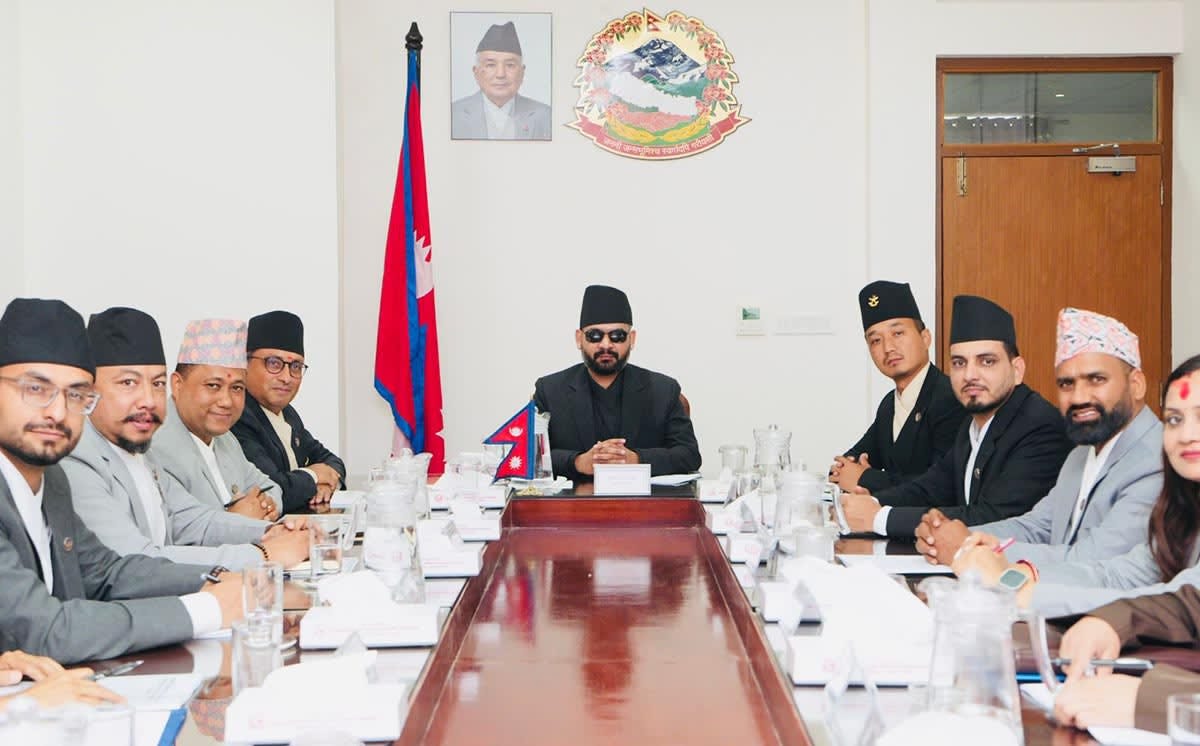
“Photo: Office of the Prime Minster of Nepal”
Rastra Swatantrata Party administration’s 100-point roadmap explicitly targets the transition from existing extractive or inefficient structures toward Inclusive Economic Institutions and Pluralistic Political Institutions.
The RSP government’s agenda attempts to shift the country by addressing the two dimensions of the institutional framework:
- Inclusive Economic Reforms: The government is focusing on creating a “delivery-based” model, which includes digital transformation of public services (passports, citizenship, driver’s licenses), reducing bureaucratic layers, and fostering an environment for entrepreneurship and sustainable high-growth sectors like tourism. These are designed to replace “extractive” tendencies, such as patronage-based procurement and bureaucratic rent-seeking, with transparent and secure systems.
- Pluralistic Political Reforms: The administration is pushing to depoliticize state institutions, dismantle political trade unions within the civil service, and implement a 24-hour grievance system to increase citizen participation and accountability. By advocating for a “citizen-centered” state, they aim to move away from “absolutist” or opaque decision-making toward a more transparent, checks-and-balances-oriented model of governance.

Fig: Framework of institutional dynamics as described on Why Nations Fail by Daron Acemoglu & James A. Robinson
Why bypass parliamentary gridlock while having almost two third majority?
We can argue that utilizing executive orders (ordinances) in place of legislative deliberation can paradoxically resemble “absolutist” behavior, potentially threatening the very pluralistic foundations it claims to defend.
RSP’s turn to ordinance rule and its intolerance of internal dissent are appearing early signals of potential democratic backsliding from its own promised vision of a pluralistic, rule‑bound democracy. The pattern is less about one ordinance and more about a growing comfort with concentrating power in a small leadership circle while sidelining both Parliament and plural voices inside the party. The government is borrowing old habits from previous governments, but it is also trying to brand itself as a “new politics” alternative to resolve systemic policy bottlenecks and administrative deadlocks that have long paralyzed public service delivery. The problem is that the more it relies on ordinances, centralized decision-making, and personality-driven control, the less “new” it becomes in practice.
At the same time, RSP was not born as a conventional establishment party; it came to power as a protest against corruption, stagnation, and elite capture. That gives it a chance to do politics differently: fewer patronage networks, more policy discipline, and a stronger commitment to institutional reform. Its manifesto and public messaging have also floated more structural reforms than older parties usually dare to discuss, including electoral and governance redesigns. So in theory, it could still be paving a new path if it uses its mandate to strengthen institutions rather than bypass them.

The key difference is not the language of reform but the method of governing. If the government rules through ordinances, suppresses internal debate, and treats Parliament as an obstacle, then it is reproducing the very system it claimed to replace. If instead it uses its majority to legislate transparently, tolerate dissent, and deepen accountability, then it would be genuinely charting a new path.
Potential democratic backsliding as a lens
Using ordinances to sidestep Parliament is a classic Nepali pattern, not a new one, and commentary around the latest move explicitly says the government is “following a familiar path.” Critics note that the rationale of urgency is weak when the ruling side already has overwhelming parliamentary strength, because a strong majority should make normal legislative scrutiny easier not unnecessary.
This is why many observers read the current government as walking into the footsteps of past governments that treated Parliament as a formality and concentrated power in the executive. In democratic terms, that is continuity with the old political culture, not rupture from it. Comparative research describes democratic backsliding as the gradual erosion of democratic norms and institutions, typically through legalistic moves that weaken checks and balances rather than through a single coup‑like rupture. Common mechanisms include hollowing out parliaments, empowering the executive to rule by decree or ordinance, and undermining independent institutions and opposition voices while maintaining a facade of constitutionalism.
Scholars also stress that backsliding is often driven by leaders who initially campaign on “fixing” or “renovating” democracy but then systematically concentrate power by overriding counter‑vailing institutions and bending procedures to their convenience. In other words, the rhetoric is reformist and anti‑establishment, but the practice becomes increasingly centralized and intolerant of institutional constraints.

RSP’s pluralist promise vs internal reality
In its own documents and public presentation, the Rastriya Swatantra Party defines itself as a “pluralistic democratic party that believes in liberal economics,” projecting an image of internal debate, ideological openness, and respect for the rule of law. However, a wave of resignations and disciplinary actions suggests a widening gap between that promise and the party’s organizational practice.

Former Education Minister/ MP Sumana Shrestha. Photo https://substack.com/@sumanashrestha
Former leaders such as Sumana Shrestha and Santosh Pariyar repeatedly raised concerns about weak internal democracy, the sidelining of policy debates, and the primacy of individuals over institutions inside the party. Shrestha has said that when she demanded more internal reform and rule‑bound decision‑making, the response from the leadership was essentially “if you want to leave, then leave,” which she interpreted as a refusal to tolerate principled dissent.
Some netizens lashed former Education Minister and MP Sumana Shrestha rushed on leaving the party during the GenZ revolution back in September citing “Afno Khutta ma afai bancharo hanin” on her resignation. Today we wonder and could try relating in some parts where she shared about the integrity alignment as she couldn’t tolerate the party leadership. Shrestha denounced what she called the party’s “culture of impunity” leaders who never own up to their mistakes, repeat them, and then expect the entire membership to pay the price. Additionally, she charged that the party was holding internal critics in media trials.
Ex–general secretary Mukul Dhakal similarly criticized what he called the transition from ideology to individualism, recounting how his attempt to organize a structured debate on whether the party should be more “left” or “right” was blocked rather than resolved through democratic procedures. He has summarized the problem as, “Let’s build the RSP, not Rabi’s party, but those who express dissent are kept inside a cage,” pointing to a leadership style that personalizes power instead of institutionalizing collective deliberation.

Photo: Rabi Lamichhane during Election Campaign/ Nepal Photo Library
Ordinances and the sidelining of Parliament
The latest move to govern via ordinances, despite RSP commanding close to a two‑thirds majority, sits squarely in the classic repertoire of backsliding: using exceptional instruments to bypass normal parliamentary scrutiny. The Shah government abruptly ended the parliamentary session and then recommended ordinances, including changes related to the Constitutional Council, even though Article 114 of the Constitution envisions ordinances only when Parliament is not in session and immediate action is genuinely necessary.

Photo: Federal Parliament of Nepal
Constitutional expert Bipin Adhikari has argued that it is “wrong for a government with such a huge representation to bypass Parliament,” noting that the party had a rare opportunity to set healthy parliamentary norms instead of repeating older patterns of executive overreach. He also points out that the government’s justification of a “legal vacuum” is misleading, since a full bench of the Supreme Court has already held that when an ordinance lapses or is withdrawn, the previous law automatically comes back into force, meaning there was no genuine emergency requiring ordinance rule.
Opposition parties from across the spectrum have condemned the move as an attack on democratic values and parliamentary dignity, describing it as a clear case of the executive intruding into the legislature’s core law‑making role. Even within RSP, MP Ganesh Karki has questioned why a leadership with a two‑thirds majority needs to rely on ordinances at all, warning that ruling through ordinances while keeping Parliament inactive undermines the spirit, if not always the letter, of the Constitution.
From reformist pluralism to absolutist drift
Commentary on the current government notes that the RSP’s “unprecedented electoral dominance” has created structural conditions for an authoritarian drift, even if individual leaders do not openly identify as authoritarians. Analysts highlight patterns such as centralising power in the prime minister’s office (with Shah also holding the home ministry), attacking or delegitimizing civil‑society organisations, and weaponising accountability mechanisms selectively against opponents moves that cumulatively signal democratic backsliding rather than deepening pluralism.

This pattern closely fits what comparative work on backsliding warns about: leaders elected on a reformist, anti‑corruption, or technocratic efficiency platform who then bypass institutional checks in the name of speed and “getting things done,” eroding pluralistic contestation and oversight along the way. RSP’s internal suppression of dissent, its shift from programmatic debate to personality‑centric loyalty, and its readiness to circumvent Parliament through ordinances together resemble the early stages of a Schmittian “state of exception,” where the executive claims exceptional authority to decide for the polity while hollowing out parliamentary deliberation.
The irony is that RSP emerged precisely as a rebuke to the old parties’ culture of impunity and executive overreach, raising public expectations of a more accountable, participatory, and transparent politics. By reproducing some of the same practices centralized control, intolerance of internal critics, governance by ordinance it risks not only delegitimising its own reformist narrative but also deepening citizens’ broader cynicism about the possibility of genuine democratic renewal.
[embed]
A normative assessment
Seen through the lens of democratic theory, RSP’s recent behaviour looks less like a temporary tactical misstep and more like an emerging pattern where efficiency and control are consistently prioritized over pluralism and procedure. A party that brands itself as pluralistic and liberal but routinely sidelines internal dissent and bypasses Parliament when it has the numbers to legislate is, in effect, normalising an absolutist style of governance under democratic branding.
If this trajectory continues centralizing decision‑making, ruling through ordinances despite strong majorities, and treating both opposition and internal critics as obstacles rather than legitimate interlocutors it will mark a clear deviation from the pluralistic democratic values RSP promised and an unmistakable contribution to Nepal’s broader democratic backsliding. The political task for those within and outside the party who still believe in pluralist democracy is to insist that “new politics” be measured not by speed or media spectacle, but by the depth of its commitment to institutional checks, internal democracy, and respect for parliamentary processes.
The success of the RSP government depends on whether these institutional changes prove durable and truly inclusive, or if the reliance on centralized executive power leads to further volatility.


Connect with me further on:
Linktree: https://linktr.ee/youbeshhh
LinkedIn: https://www.linkedin.com/in/youbeshdhdl/
Website: https://youbesh.com/
Medium: https://medium.com/@youbeshdhdl
X/ Twitter:
Official: https://x.com/youbeshhh
Photography: https://x.com/youbesh_dhdl/
Analysis: https://x.com/youbeshanalyzes
Facebook:
Photography: https://www.facebook.com/youbesh.dhdl/
Analysis: https://www.facebook.com/youbeshanalyzes
Instagram:
Official: https://www.instagram.com/youbeshhh/
Photography: https://www.instagram.com/youbesh.dhdl/
Food Blog: https://www.instagram.com/youbesh.eats/
Tiktok:
Official: https://www.tiktok.com/@youbeshhh
Photography: https://www.tiktok.com/@youbesh.dhdl
Youtube:
Photography: https://www.youtube.com/playlist?list=PLSEqMNOz_kNbWbvX5HFo8uWmHbeuyUYAM
Travel: https://www.youtube.com/playlist?list=PLSEqMNOz_kNYKhg0pLAwYJyqgfVmfFLyP
메타데이터
- post_id
- cd163ef2f1c7
- slug
- new-nepali-government-at-crossroads-in-a-month-cd163ef2f1c7
- url
- https://medium.com/@youbeshdhdl/new-nepali-government-at-crossroads-in-a-month-cd163ef2f1c7
- canonical_url
- https://medium.com/@youbeshdhdl/new-nepali-government-at-crossroads-in-a-month-cd163ef2f1c7
- author_url
- https://medium.com/@youbeshdhdl
- status
- ok
- fetched_at
- 2026-08-03 06:38:07