ETHER CHANNEL (LINK AGGREGATION)
Welcome, just like my previous article, i try to break down concepts to help you understand them properly and i point out what is necessary…
ETHER CHANNEL (LINK AGGREGATION)
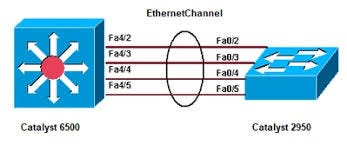
Welcome, just like my previous article, i try to break down concepts to help you understand them properly and i point out what is necessary for better clarity.
Today , we will be looking at a very interesting concept called ether-channel , also called link aggregation. In networking, we all know what a “link” is — basically, a connection — and aggregation is the process of integrating or combining several different items (objects)into a single entity. This concept provides a clear understanding of an Ether channel.
In short, ether channel is a technology in which physical ports are combined together to form a single logical link. The main purpose of ether channel is to increase throughput.
Ether-channel protocols
There are two ether-channel protocols, they include:
- LINK AGGREGATION CONTROL PROTOCL(LACP)
- PORT AGGREGATION PROTOCOL (PAGP)
LINK AGGREGATION CONTROL PROTOCL(LACP)
This is an IEE802.3ad standard. In other words it is industry standard and it is used by all vendors. it can also combine up to 8 ports.
Modes in LACP
- Active: this is a mode that actively negotiates for the ether channel, connection will happen if one of the switches is in active mode.
- Passive: this is a mode that passively negotiates for the ether channel. It does not have the authority to fully implement ether channel.
- ON: this is a static ether channel. The port is not running LACP messages but are statically bundled. That is they work well (there is connection)without LACP protocol.
PORT AGGREGATION PROTOCOL
Now , if you have read about the first protocol, you might not really get the point, but that is understandable. I will make use of two scenarios that will give you the full picture of what i am explaining.
The first one is this , imagine a situation where you have two switches connected to each other, for PAGP to work one must be ‘active’ and the other must the ‘passive’. In the sense that one of the switches has an interest in the link aggregation, but is not actively seeking for the ether channel, while the other has the interest and is actively seeking for the ether channel. The one that is active is called the “AUTO MODE”. while the other that is passive is called “ DYNAMIC DESIRABLE”.
The scenario actually originated from my mentor and it goes like this imagine a setting where a boy is interested in a girl and also the girl is interested in him but they don’t have the courage to talk to each other, in networking terms they are both on “AUTO MODE” and therefore ether channel can’t work out, but if one of them summons the courage then in networking terms that switch is a “DYNAMIC DESIRABLE”.
In summary;
LACP industry standard while PAGP is cisco standard they can both accommodate up to 8 ports auto in PAGP works like passive in LACP *dynamic desirable in PAGP works like active in LACP
ETHERCHANNEL CONFIGURATION

command for ether channel
The first arrow shows the command used to create an ether channel which is “channel-group <group number> mode<type of mode>”
In this case , the number used here is “1” and mode used here is “active”. You can change those values to your preferred choice like instead of active you could put passive or active.

command to verify configuration
The explanation for the diagram is that , the command “show etherchannel summary” is used to verify the configuration you have done.
if you look closely at the illustration , you would see an arrow pointing to “SU” the meaning has already been explained at the flags section which means that the ether channel is in use.
The third arrow is telling us the ports used for ether channel configuration, which in this case it is port 10 and port 11.
In conclusion, EtherChannel is a simple yet powerful solution for boosting network performance and reliability. Combining several physical links into a single logical connection boosts bandwidth and guarantees that traffic continues to flow even in the event of a link failure. Managing several connections as a single entity is made simple by EtherChannel, regardless of whether you use LACP, PAGP, or a static setup. Modern networks require this capability because it offers a dependable and effective means of managing increasing data demands while maintaining network speed and stability.
메타데이터
- post_id
- cd19a585f1ae
- slug
- ether-channel-link-aggregation-cd19a585f1ae
- url
- https://medium.com/@danielbenjamin562/ether-channel-link-aggregation-cd19a585f1ae
- canonical_url
- https://medium.com/@danielbenjamin562/ether-channel-link-aggregation-cd19a585f1ae
- author_url
- https://medium.com/@danielbenjamin562
- status
- ok
- fetched_at
- 2026-07-07 02:51:59