China's gray-zone squeeze risks new taiwan strait status quo
Taipei's Ocean Affairs Council warns that Beijing's calibrated pressure is rewriting maritime rules without triggering a formal crisis, and…
China's gray-zone squeeze risks new taiwan strait status quo
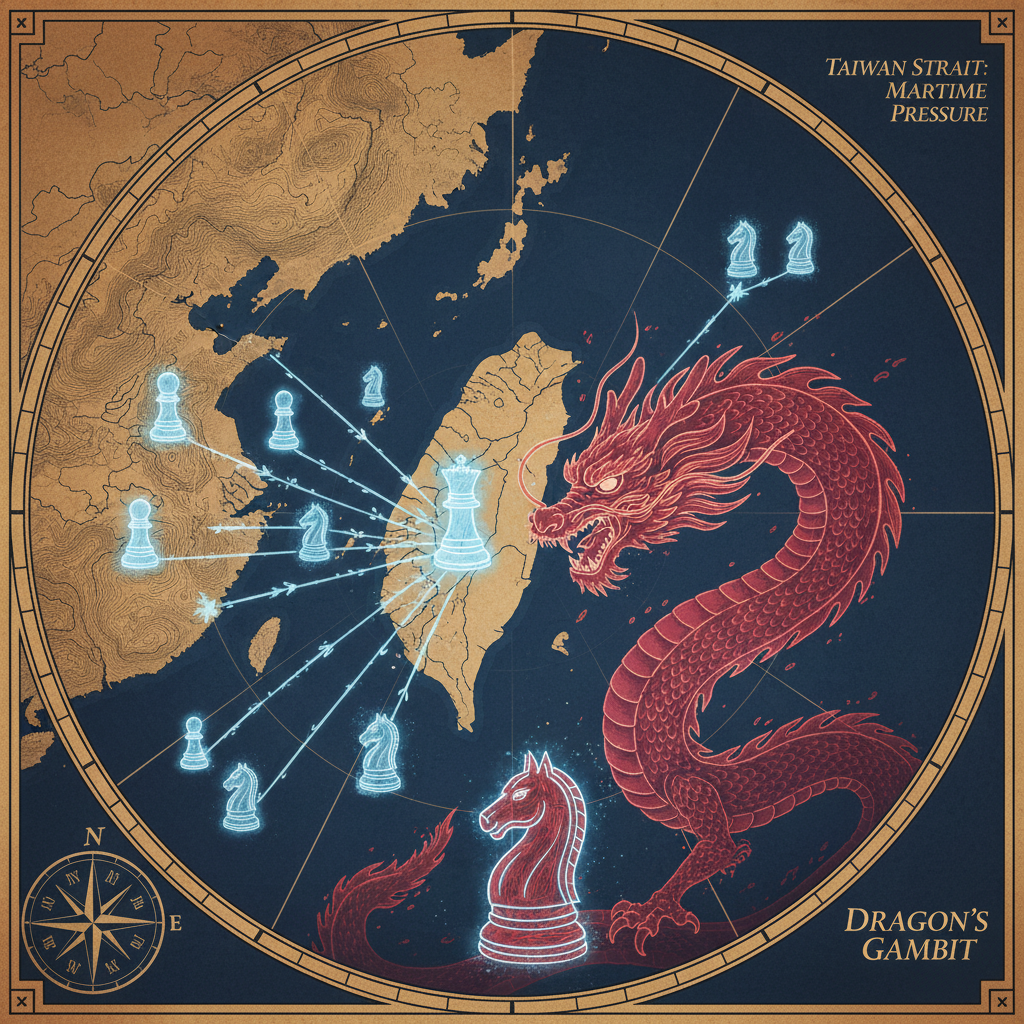
Taipei's Ocean Affairs Council warns that Beijing's calibrated pressure is rewriting maritime rules without triggering a formal crisis, and allies are not responding.
The warning from Taipei
Kuan Bi-ling stood in front of a room of maritime security officials in Taipei on July 8 and laid out a problem most capitals do not want to hear. China is not going to invade Taiwan tomorrow. It does not need to. The strategy is slower, more patient, and harder to reverse.
Kuan, Taiwan's Ocean Affairs Council minister, described a campaign of incremental pressure. A Chinese military sortie here. A Coast Guard patrol east of Taiwan there. A demand dressed up as "law enforcement." Each move looks too small to trigger a crisis. Each one is calibrated to stay below the threshold of war. But the accumulation is the weapon.
Beijing is trying to make commercial shipping, insurance markets, and frontline personnel quietly adjust to Chinese Communist Party (CCP) coercion as if it were normal. That is the trap. When every escalation is judged separately, the larger campaign disappears from view.
Three paths to crisis
Samuel Ramani, a geopolitical analyst, laid out three scenarios for a Chinese escalation in a Twitter thread last September. The first is a joint sea and air blockade. The second is annexation of an offshore island. The third is a decapitation strike operation.
The blockade scenario is the most discussed in Taipei and Washington. China would not need to sink ships. It would just need to make the cost of shipping to Taiwan prohibitive. Insurance rates would spike. Crews would refuse to sail. Supply chains would grind to a halt. The pressure would be economic, not military. Beijing could deny it was a blockade at all.
The offshore island scenario is closer to what China has already done. Take one of Taiwan's outlying islands — Kinmen, Matsu, or the Pratas Islands. China could seize it in a quick, deniable operation. The international response would be confused. Is it an invasion or a local incident?
The decapitation strike is the highest-risk play. A precision missile attack on Taiwan's command and control centers. The goal would be to paralyze decision-making and force a quick political collapse. The gamble is that Taiwan's military would not respond in time. The danger is that it does.
The gray-zone trap
Kuan's warning fits a pattern that runs across the first island chain. Japan sees it in the East China Sea. The Philippines sees it in the South China Sea. The method varies by geography, but the logic is consistent: apply pressure, avoid formal war, normalize the intrusion, then demand recognition of the new reality.
The problem for democratic allies is that their own systems are not built to respond to this. A single Chinese Coast Guard vessel operating east of Taiwan is not a casus belli. It is a diplomatic note. A routine patrol becomes a fact on the water. By the time anyone in Washington or Tokyo decides it is a problem, the patrol has already happened. The status quo has shifted by a few nautical miles.
Kuan said the international community should stop measuring Beijing's conduct only by whether it starts a shooting war. The sharper test is whether each action pushes lawful activity, freedom of navigation, or Taiwan's security environment closer to CCP control.
The response problem
The United States has not solved this. Neither has Japan. Both are structured to respond to crises, not to prevent the slow erosion of a status quo. A blockade would trigger a major response. A gradual constriction of Taiwan's maritime space might not.
The U.S. Navy can surge forces into the Taiwan Strait in a crisis. But it cannot keep them there indefinitely. The cost is too high. The political will is too fragile. China knows this. It is why the gray-zone strategy works.
Taiwan's defense budget has grown. It hit $19.6 billion in 2025, up from $16.5 billion in 2023. But money alone does not solve the strategic problem. Taiwan needs allies to recognize the threat before it becomes a crisis. That means changing how they measure Chinese activity.
The opening move
Kuan's speech was itself a gambit. She is trying to force a conversation that most governments want to avoid. The conversation is uncomfortable because it asks a hard question: what is the status quo, and when does it stop being the status quo?
Beijing has already changed the answer. In 2022, Chinese military aircraft crossed the median line of the Taiwan Strait 1,700 times. That was up from fewer than 100 in 2020. The median line was once a de facto boundary. Now it is a line in the water that nobody defends.
The same thing is happening at sea. Chinese Coast Guard vessels now operate regularly east of Taiwan. They board fishing boats. They demand documents. They enforce Chinese law in waters that Taiwan considers its own. Each incident is small. The cumulative effect is not.
What comes next
No decisive war will arrive on any single day. That is precisely the point. Beijing is trying to win the space below war before the world admits the battlefield has moved.
Taiwan's best move is to make the gray zone visible. That means more transparency about Chinese activity. More data shared with allies. More coordination with Japan and the Philippines. The goal is to remove deniability. If every small move is documented and reported, China cannot claim it is just routine.
The second move is to make the cost clear. Taiwan should signal that any Chinese attempt to board a Taiwanese vessel will be met with a proportionate response. Not war. But not inaction. The goal is to raise the risk for China without crossing into escalation.
The third move is diplomatic. Taiwan needs allies to adopt a new framework for measuring Chinese pressure. Not just whether a crisis has started. But whether the operating environment has shifted. Kuan's speech was a start. The question is whether anyone was listening.
메타데이터
- post_id
- cd1b594dea89
- slug
- chinas-gray-zone-squeeze-risks-new-taiwan-strait-status-quo-cd1b594dea89
- url
- https://medium.com/@powermeridian/chinas-gray-zone-squeeze-risks-new-taiwan-strait-status-quo-cd1b594dea89
- canonical_url
- https://medium.com/@powermeridian/chinas-gray-zone-squeeze-risks-new-taiwan-strait-status-quo-cd1b594dea89
- author_url
- https://medium.com/@powermeridian
- status
- ok
- fetched_at
- 2026-07-20 03:13:53