How Search Engines Use AI to Rank Websites: The Complete Guide for 2026
Artificial Intelligence (AI) has fundamentally changed the way search engines rank websites. Instead of relying solely on keywords and…
How Search Engines Use AI to Rank Websites: The Complete Guide for 2026
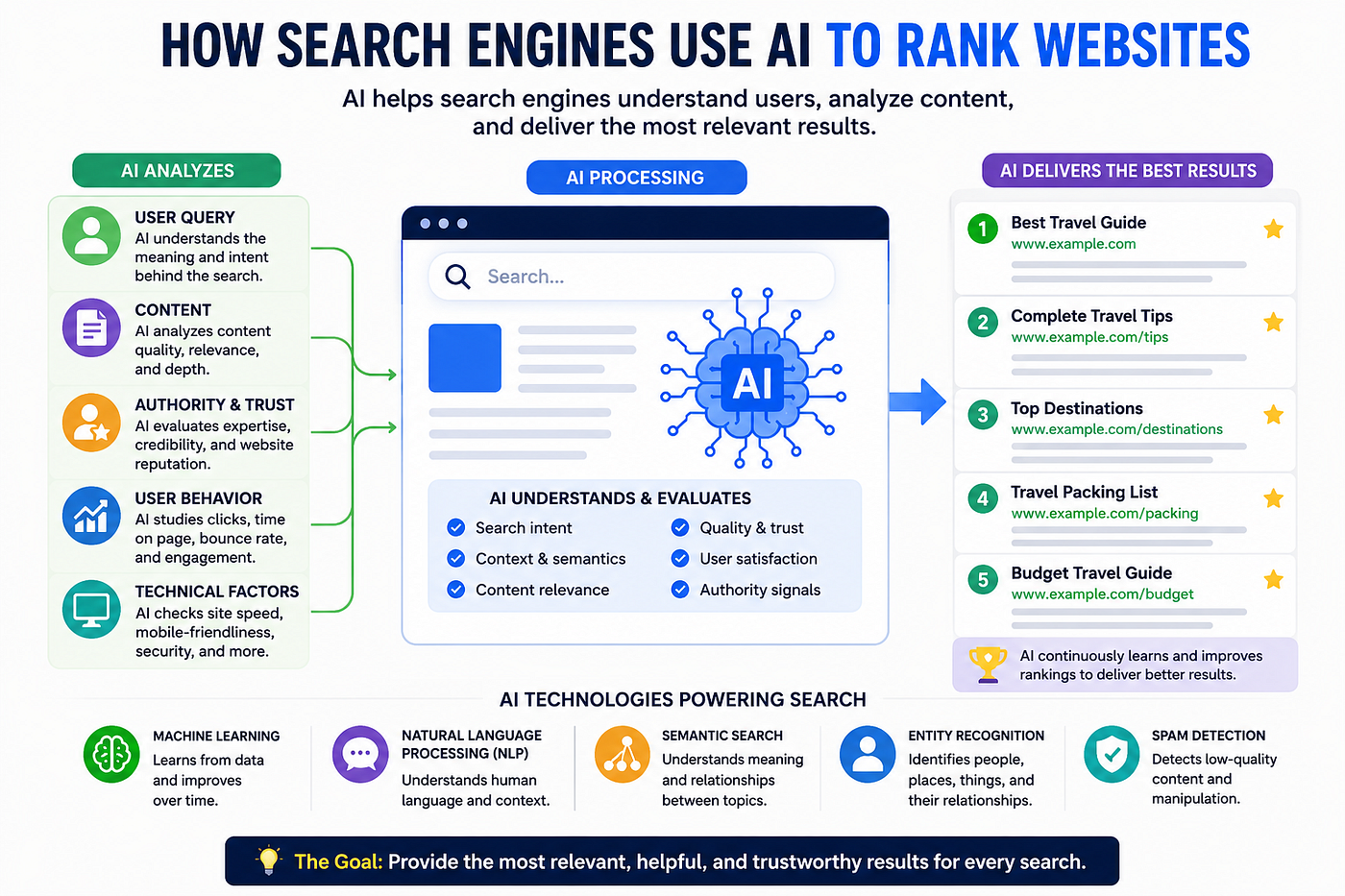
How Search Engines Use AI to Rank Websites
Artificial Intelligence (AI) has fundamentally changed the way search engines rank websites. Instead of relying solely on keywords and backlinks, modern search engines now use sophisticated AI systems to understand content, interpret user intent, evaluate website quality, and deliver the most relevant search results.
If you’ve noticed that some websites consistently rank at the top of search results despite having fewer backlinks or lower keyword density, AI is likely one of the reasons why.
Whether you’re an SEO professional, business owner, blogger, or digital marketer, understanding how AI influences search rankings is essential for long-term SEO success.
In this guide, we’ll explore how search engines use AI, the ranking factors that matter most in 2026, and practical strategies to optimize your website for AI-powered search.
What Is AI in Search Engines?
Artificial Intelligence refers to computer systems that can analyze data, recognize patterns, understand language, and make decisions in ways that resemble human thinking.
Search engines use AI to process billions of search queries every day. Rather than simply matching exact keywords, AI helps search engines understand:
- What users actually mean when they search
- Which pages best answer their questions
- Whether content is trustworthy and helpful
- How users interact with search results
- Which websites deserve higher rankings
This results in more accurate, personalized, and useful search experiences.
Why Search Engines Use AI
The internet contains billions of webpages, and millions of new pages are published every day. Without AI, it would be nearly impossible to organize and rank this information effectively.
AI enables search engines to:
- Understand natural language
- Interpret conversational searches
- Detect spam and low-quality content
- Analyze search intent
- Improve ranking accuracy
- Learn continuously from user behavior
- Deliver faster and more relevant results
As AI becomes more advanced, search engines are better equipped to reward content that genuinely helps users.
How AI Understands Search Queries
One of AI’s most important jobs is understanding the intent behind a search.
Consider the search query:
“Best running shoes for flat feet.”
Rather than focusing only on the words “running shoes,” AI recognizes that the user wants:
- Product recommendations
- Shoes designed for flat feet
- Buying advice
- Comfort and support comparisons
- Reviews or expert opinions
Because AI understands context, pages that comprehensively address these needs are more likely to rank higher than pages that simply repeat the keyword.
Natural Language Processing (NLP): Understanding Human Language
Natural Language Processing (NLP) allows search engines to understand human language much like people do.
Instead of treating every word independently, NLP analyzes:
- Context
- Synonyms
- Grammar
- Sentence structure
- Relationships between concepts
For example, AI understands that these phrases have similar meanings:
- Affordable smartphones
- Budget mobile phones
- Cheap Android devices
This means content no longer needs to repeat the exact keyword dozens of times. Clear, natural writing performs much better than keyword stuffing.
Machine Learning: Improving Rankings Over Time
Machine learning enables search engines to improve continuously.
AI studies enormous amounts of search data, including:
- Which results users click
- How long visitors stay on pages
- Whether users return to search results
- Which content satisfies user intent
Over time, AI identifies patterns that help improve future rankings.
This continuous learning process allows search engines to adapt quickly as user behavior changes.
Understanding Search Intent
Search intent has become one of the strongest ranking signals.
Every search falls into one of several intent categories:
Informational Intent
Users want information.
Example:
- What is AI SEO?
- How does Google rank websites?
Navigational Intent
Users want to reach a specific website.
Example:
- Gmail login
- YouTube
Commercial Intent
Users are researching before making a purchase.
Example:
- Best SEO tools
- Top AI content writers
Transactional Intent
Users are ready to buy.
Example:
- Buy SEO software
- Hire SEO agency
Understanding and matching search intent helps search engines identify the best page for every query.
AI Evaluates Content Quality
Search engines don’t simply count keywords.
AI evaluates overall content quality by analyzing:
Originality
Is the content unique?
Accuracy
Are the facts correct?
Depth
Does the article answer related questions?
Readability
Is the content easy to understand?
Organization
Are headings, lists, and paragraphs structured clearly?
Freshness
Has the content been updated recently?
The more useful and comprehensive your content is, the more likely AI is to reward it.
User Experience Matters More Than Ever
AI doesn’t just evaluate content — it also measures the overall experience visitors have on your website.
Important user experience factors include:
- Fast loading speed
- Mobile responsiveness
- Easy navigation
- Clear page structure
- Secure HTTPS connection
- Minimal intrusive pop-ups
A website that provides a smooth user experience sends positive signals to search engines.
Topical Authority: Becoming an Expert
Rather than judging individual pages in isolation, AI evaluates your website’s expertise across an entire topic.
For example, if your website focuses on SEO, you should create high-quality content covering subjects such as:
- Keyword research
- Technical SEO
- Local SEO
- Link building
- On-page optimization
- Content marketing
- AI SEO
- Google Search Console
- Analytics
- SEO tools
A network of related articles demonstrates topical authority and builds trust with both users and search engines.
E-E-A-T: The Human Quality Signal
One of the most important concepts in modern SEO is E-E-A-T:
- Experience
- Expertise
- Authoritativeness
- Trustworthiness
Search engines use these signals to determine whether content is reliable and created by knowledgeable sources.
Ways to strengthen E-E-A-T include:
- Publish original insights
- Showcase author credentials
- Cite reputable sources
- Keep content accurate and updated
- Display contact information and business details
- Include real examples and case studies
AI Detects Low-Quality Content
AI is highly effective at identifying content that provides little value.
Common issues include:
- Keyword stuffing
- Thin articles
- Duplicate content
- Automatically generated pages without human editing
- Misleading headlines
- Spammy backlinks
- Hidden text
- Poor grammar
Instead of trying to manipulate rankings, focus on creating content that genuinely helps your audience.
How AI Understands Entities
Modern search engines recognize entities — people, organizations, products, places, and concepts — and understand how they relate to each other.
For example, an article about AI SEO may naturally mention:
- Machine learning
- Natural language processing
- Search intent
- Content optimization
- Technical SEO
These relationships help search engines understand the broader context of your content.
The Role of Backlinks in the AI Era
Backlinks remain an important ranking factor, but AI now evaluates their quality rather than simply counting them.
High-value backlinks come from:
- Relevant websites
- Trusted publications
- Industry blogs
- Educational institutions
- Government websites
A few authoritative backlinks often provide more value than hundreds of low-quality links.
Optimizing for AI-Powered Search
To improve rankings, focus on these best practices:
Create Helpful Content
Answer real questions thoroughly.
Cover Topics in Depth
Don’t stop at the primary keyword. Address related questions, comparisons, and common challenges.
Write Naturally
Avoid awkward keyword repetition. Use conversational, reader-friendly language.
Improve Technical SEO
Ensure your site is:
- Fast
- Secure
- Mobile-friendly
- Easy to crawl
- Properly indexed
Use Clear Headings
Organize your content with descriptive headings and logical sections.
Strengthen Internal Linking
Link related pages together to help users and search engines understand your website structure.
Update Older Content
Regularly refresh articles with new information, examples, and statistics to keep them relevant.
Common SEO Mistakes to Avoid
Many websites still lose rankings because they:
- Publish AI-generated content without editing
- Ignore search intent
- Overuse keywords
- Neglect mobile optimization
- Create thin or duplicate pages
- Fail to update outdated content
- Build low-quality backlinks
- Ignore user experience
Avoiding these mistakes can significantly improve your long-term SEO performance.
The Future of AI and Search
AI-powered search is becoming increasingly conversational and personalized.
Emerging trends include:
- AI-generated search summaries
- Voice search optimization
- Visual and multimodal search
- Personalized search experiences
- Greater emphasis on trust and expertise
- Generative Engine Optimization (GEO) alongside traditional SEO
Businesses that focus on creating valuable, trustworthy, and user-first content will be best positioned to succeed.
Final Thoughts
Artificial Intelligence has transformed search engine optimization. Modern search engines no longer rank pages based solely on keywords or backlinks. Instead, they analyze search intent, content quality, user experience, topical authority, and trustworthiness to determine which pages deserve the highest rankings.
The good news is that the core principle of SEO hasn’t changed: create content that genuinely helps people.
If you consistently publish accurate, comprehensive, and user-focused content while maintaining a technically sound website, you’ll be well-positioned to perform well in AI-powered search.
Remember, successful SEO in 2026 isn’t about tricking search engines — it’s about understanding your audience, answering their questions better than anyone else, and building lasting trust.
메타데이터
- post_id
- cd2260394b3d
- slug
- how-search-engines-use-ai-to-rank-websites-the-complete-guide-for-2026-cd2260394b3d
- url
- https://medium.com/@followshubhu/how-search-engines-use-ai-to-rank-websites-the-complete-guide-for-2026-cd2260394b3d
- canonical_url
- https://medium.com/@followshubhu/how-search-engines-use-ai-to-rank-websites-the-complete-guide-for-2026-cd2260394b3d
- author_url
- https://medium.com/@followshubhu
- status
- ok
- fetched_at
- 2026-07-24 10:18:17




