Cognitive Dissonance: From White Fragility to Climate Guilt, Why We Love Animals Yet Eat Them
The Little Lies We Tell Ourselves
Cognitive Dissonance: From White Fragility to Climate Guilt, Why We Love Animals Yet Eat Them
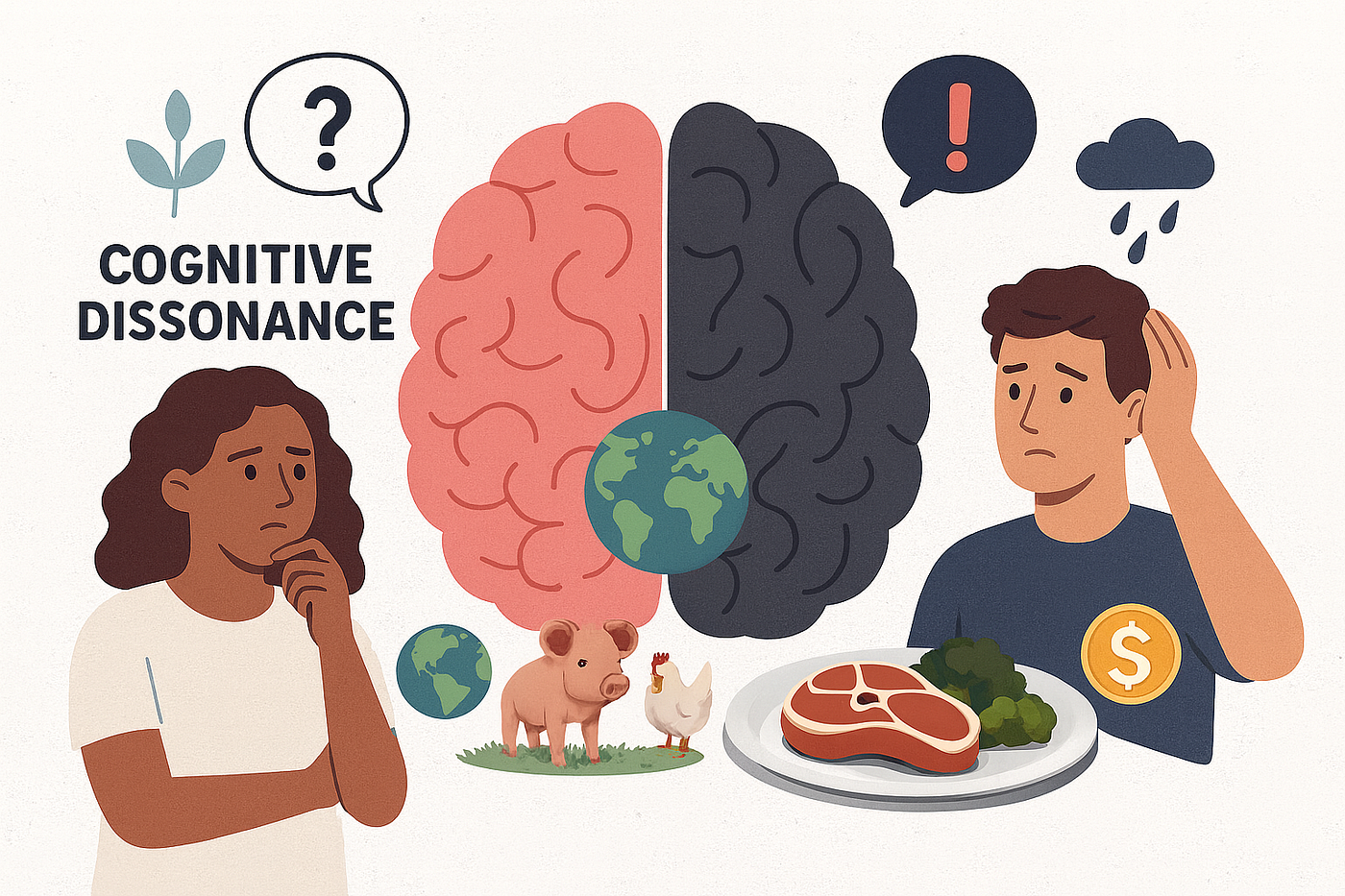
An illustration of cognitive dissonance, showing a mind torn between empathy for animals and the act of consuming them
The Little Lies We Tell Ourselves
You care about the planet, but you book that flight. You adore animals, but you eat them. You say you believe in equality, but you laugh at a sexist joke.
We all do it. And somewhere deep inside, a small voice whispers: “Something doesn’t add up.”
That feeling is cognitive dissonance, the mental tension between what we believe and what we actually do. Coined by psychologist Leon Festinger in 1957, the concept feels more alive than ever in 2025. We live in a world that worships “authenticity,” yet most of us are walking contradictions, scrolling through climate news on a phone made by exploited labor, defending gender equality but voting for comfort over change.
A 2024 Pew Research report found that 72% of young adults admit to feeling “guilty” about how their actions conflict with their values, but less than 25% actually change their habits. The mind’s trick? It doesn’t change the act, it changes the story.
Why the Brain Lies to You
Humans crave internal harmony. When our actions clash with our ideals, the brain scrambles to make peace.
It does this in three ways:
- Changing the belief “Flying once a year isn’t that bad.”
- Justifying the act, “I’ll donate to carbon offsets later.”
- Ignoring the conflict, “I don’t want to think about it.”
This is your mind’s self-defense mechanism. A Harvard Behavioral Study (2023) found that over 80% of participants rationalized choices that went against their ethics, often within seconds. The brain doesn’t like guilt; it prefers coherence, even when that coherence is fake.
The Everyday Contradictions We Live With
White fragility
You believe in equality, but when someone calls out bias, you tense up. You say, “I’m not racist.” That discomfort isn’t proof of guilt, it’s proof of growth trying to happen.
Social psychologist Robin DiAngelo describes this as a “defensive reflex protecting one’s moral identity.”**
Loving animals, eating animals
We cry over dying whales and rescue dogs, then eat steak for dinner.
Psychologist Melanie Joy calls this the “carnism paradox.” Her 2024 study found that 60% of meat-eaters describe themselves as “animal lovers.” It’s not hypocrisy; it’s compartmentalization.
Internalized sexism and racism
We condemn oppression but reproduce it, mocking our own cultures, judging ambitious women, praising emotional men as “brave.” That’s dissonance wrapped in conditioning.
Climate guilt
We march for the planet but overconsume, overshop, overpost. A Yale Climate Communication survey (2023) revealed that 58% of people say they care deeply about climate change, yet only 19% have reduced their travel or diet-related emissions. Our values are loud. Our habits are louder.
The Hidden Cost of Living in Conflict
When we live out of sync with our values, something fractures inside. The gap between who we think we are and how we act eats away at us quietly.
Studies show that prolonged cognitive dissonance increases stress hormones, weakens decision-making, and fuels self-doubt. The World Health Organization (2024) reported that global burnout and anxiety rates rose by 25% in a decade, especially among people aged 18–34, the most idealistic generation yet the most disillusioned.
In severe cases, this disillusionment can morph into existential fatigue a sense that nothing matters. In the U.S., suicide rates among young adults have risen by nearly 60% since 2007, according to the CDC (2023). Not all of that is due to dissonance, of course but living in a system where values and reality never match takes a psychological toll.
As social psychologist Catherine Hakim wrote:
“When people are told merit matters but see networks rule, they stop trusting the game or themselves.”
How to Live with Your Contradictions (and Still Grow)
You can’t kill cognitive dissonance. But you can use it like a compass pointing you toward integrity.
1. Face the gap. List what you believe and what you do. Seeing it in black and white dissolves denial.
2. Choose honesty over comfort. Ask “why” instead of defending. Discomfort is data.
3. Start micro. One less flight, one honest conversation, one meal that matches your values.
4. Surround yourself with aligned people. Consistency is contagious. Being around people who walk their talk strengthens yours.
5. Forgive yourself, but stay awake. You don’t need purity. You need awareness.
Conclusion: When Discomfort Becomes a Compass
Cognitive dissonance isn’t proof that you’re a hypocrite. It’s proof that you care.
It’s your conscience whispering, “You can do better.” That tension between who you are and who you want to be, that’s where transformation lives.
The most honest people aren’t those who never contradict themselves. They’re the ones who notice when they do, and dare to realign.
Because when we stop running from our inconsistencies, we finally start becoming the people we say we are.
Sources
- Festinger, L. (1957). A Theory of Cognitive Dissonance. Stanford University Press.
- Pew Research Center, Ethics and Behavior Study, 2024.
- Harvard Behavioral Insights Lab, Moral Rationalization Patterns, 2023.
- Yale Climate Communication, Climate Perception Report, 2023.
- CDC, Suicide Mortality Data, 2023.
- WHO, Global Mental Health Report, 2024.
- DiAngelo, R. (2020). White Fragility. Beacon Press.
- Joy, M. (2024). The Psychology of Eating Animals.
메타데이터
- post_id
- cd29bd1832f9
- slug
- cognitive-dissonance-from-white-fragility-to-climate-guilt-why-we-love-animals-yet-eat-them-cd29bd1832f9
- url
- https://medium.com/@aich.dano/cognitive-dissonance-from-white-fragility-to-climate-guilt-why-we-love-animals-yet-eat-them-cd29bd1832f9
- canonical_url
- https://medium.com/@aich.dano/cognitive-dissonance-from-white-fragility-to-climate-guilt-why-we-love-animals-yet-eat-them-cd29bd1832f9
- author_url
- https://medium.com/@aich.dano
- status
- ok
- fetched_at
- 2026-07-15 05:48:35