Words and Wounds? A correlation?
The Legacy of Hivzija Hasandedić
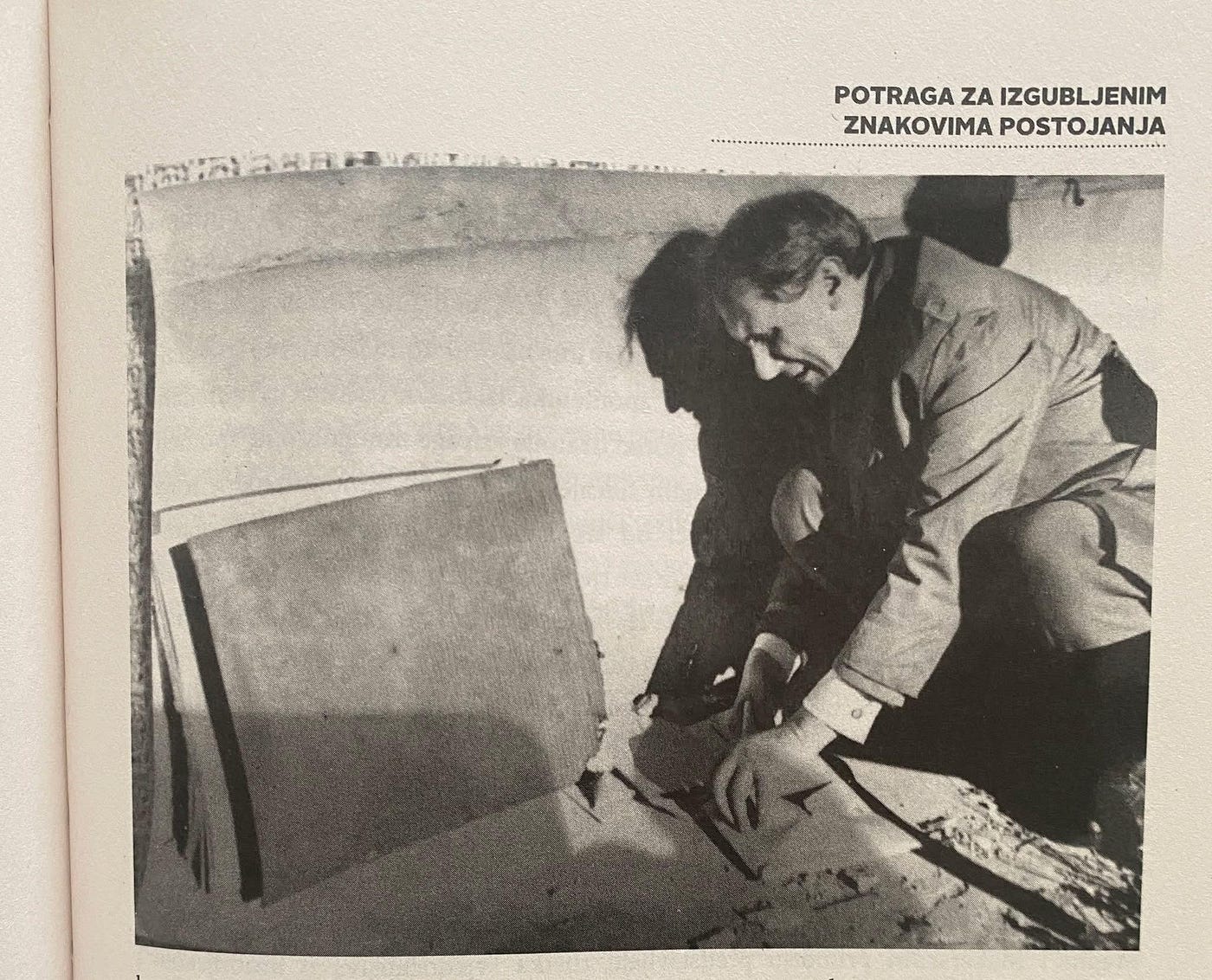
Hivzija Hasandedić, the great archiver and chronicler of East Herzegovina, among others.
Are we writing ‘wounds’ or are ‘wounds’ writing themselves? Have you ever thought about it? When we write about calamities or painful events we are in fact writing “wounds”. When we write having been inspired by some pain in our lives, we are allowing our wounds to write “themselves”.
Ibn Arabi said the following, “Just as a cut opens up a physical body and reveals what is hidden beneath the skin, words open up a world of meaning.” He wanted to bring attention to the Arabic words that refer to a wound (kulum) and that of writing (kalam). Note the triliteral ‘klm’ root.
In that sense, when I first came across the writings of Hivzija Hasandedić, I felt like it opened up a new world for me that I did not know about. Like a wound opening up “wounds” (i.e. tragic events and calamities that have befallen the people of Herzegovina).
I remembered standing at Korita, a location between Gacko and Bileća, and all I see are just rocks, piles of rocks, destroyed buildings long gone. I see the hills surrounding the flat landscape, and I understood why Korita had cold winters.

The landscape surrounding Korita which explains why the winters are cold.
I see a čatrnja (cistern) that still existed. I dropped a small piece of rock. I heard it splatter on the water. In doing so I felt like I was reliving the past.
Maybe if one day if you were to stand there in the cold blistery cold, maybe you could hear the howling of the wind eerily reminding you of the wedding massacre that had happened here… where the bride dreamt of her death… of a gunshot that would pierce her heart…

A čatrnja which stores rainwater for usage. Henrik Renner writes in his book that the shortage of water was the norm in Bileća. It was also a norm for every house to have at least a čatrnja due to the hot summers and the karst region which prevents water storage above the ground.
Hivzija did not just document the architectural embodiment of the people of Hercegovina but he also recorded stories.
Through Hivzija you would come across other authors like Henrik Renner and Evlija Čelebi. Through one channel you pore through more channels…like an endless ocean. As a linguist I was very much intrigued by one finding from Čelebi’s book — the word ‘lacmanin’ used in a passage describing Staro Slano, a tower in Trebinje which used to be an important route between Dubrovnik and Sarajevo. ‘Lacmanin’ was described as a person wearing clothes of non-Turkish cut, but in the Malay world, a ‘laksmana’ was related to someone pioneering the ship — the Malay-Polynesians were at one point in time known to be great sea voyagers. Things like these intrigue me and I am sure some may find such finds fascinating.

The aforementioned text which talks about a ‘lacmanin’ which sounds similar to the Malay ‘laksmana’.
So when the opportunity presented itself to attend the promotion of a book written by Mufti Mevludin Dizdarević who wrote his PhD thesis on Hivzija Hasandedić, it was an opportunity that presented itself naturally as something one would naturally be drawn towards.
During the presentation, Mufti Dizdarević explained how Hivzija had travelled to far-flung locations by bus as he did not have a car, that he had personally done measurements on remains of buildings that were still left standing and that he had his camera with him all in the name of wanting to document what should be documented for future generations.

Hivzija Hasandedić’s book is considered the par excellence for one interested in the Islamic heritage of East Herzegovina. On the left side is Mufti Mevludin Dizdarević’s book which documented the life of Hivzija Hasandedić.
The impetus for Hivzija’s work came from the very first Quranic word ‘Read’. Hivzija understood this as the necessity for knowledge to be recorded so that they would be transmitted like a chain to the next in line. The Mufti later shared that he had met Hivzija once in Mostar at a time when he was not aware of the incredible work that Hivzija had worked on.
In a meeting at a cafe attended by his work colleague as well, he said to me, “My English is not good but it is still better than your Bosnian.” I smiled and acknowledged, but in my defence, how many of us read the Quran through translations of the language we know and not through the original Arabic? In my quest to understand the culture and history of the Bosnian people, I have resorted to English translations and when archaic words are encountered my search would be “the archaic word and ‘značenje’.” The latter means meaning in Bosnian.
On a lighter note, later, the Mufti had asked me if I drank Bosnian coffee and I said that I could make Bosnian coffee. “Can you make Bosnian pita (pie)?” he asked. I said, “Yes, in my dreams…” It was not just a unique multicultural meeting, but one that combined both intellect and wit!
A down-to-earth person who seems to carry a sense of childlike-joy (joie de vivre) despite his age, the Mufti started laughing when I used some Bosnian words. He said that he does not use much English and I replied that now was the time.
On a more serious note, Mufti Dizdarević asked me why I was drawn to Hivzija. And I said to be honest, in a way, the stories and the history of Herzegovina brought me back to life. The Mufti and his colleague looked at me and were quiet. I explained, “I find the square-shaped minarets interesting, they’re beautiful, I don’t have those structures where I come from. And you know, how sad it is? That they were kicked out of Herceg Novi in 1687 and then they moved to Trebinje to Bileća, and then you think there is peace but you know that there was no peace even in Ottoman times, and then in WWI, you had this exodus to Turkey, and then again the atrocities in WWII (i.e. Čavkarica)… it is like this continuous onslaught… where people just keep moving inwards to safer zones.” They nodded in agreement.

Bosniak women and children from Zaušje, Bileća between 1914–1918. (Picture: Ernst Neweklowsky)
And in one conversation I said, “Also, if I were to die in Singapore, my body would be moved into a mass grave after a number of years.” They just looked at me and did not say anything else. Maybe that is why I personally feel such a close affinity to cemeteries, to graves. Because there are still places in the world where the dead could remain buried, untouched, unmoved, undesecrated. I was at the harem in Fethija Mosque in Bihać and I was observing the beautiful calligraphy trying to make out the names of the deceased and thought how beautiful the gravestones were…

A gravestone at Fethija mosque, Bihać.
Mufti Dizdarević’s book “Potraga za Izgubljenim Znakovima Postojanja” (The Search For Lost Signs of Existence) should be a mainstay for those keen to understand more about Hivzija Hasandedić. The Mufti has dedicated the book to his father who had passed on from cancer at the age of 37 years and to his brother who had passed on in the last aggression in Bosnia at the age of 24. He is the youngest among his siblings and when asked if he had been the naughtiest as youngest children usually are, he vehemently denies, “I am the most successful!”

Mufti Mevludin Dizdarević talking about the incredible and possibly unmatchable legacy of Hivzija Hasandedić.
PS: Thank you Mufti Dizdarević for your open, tolerant and humble disposition despite the position you have. I wish you all the best and more works of ihsan (good and beautiful works). You remind me of the tolerance and openness of the Andalusians who once lived.

The view overlooking Alhambra. Prof. James W. Morris explains how Andalusia allowed great minds like Ibn Arabi, Averroes and Maimonides to flourish because of its openness and tolerance to diversity.
메타데이터
- post_id
- cd2be14409c2
- slug
- words-and-wounds-a-correlation-cd2be14409c2
- url
- https://medium.com/@haslindah.hashim/words-and-wounds-a-correlation-cd2be14409c2
- canonical_url
- https://medium.com/@haslindah.hashim/words-and-wounds-a-correlation-cd2be14409c2
- author_url
- https://medium.com/@haslindah.hashim
- status
- ok
- fetched_at
- 2026-06-25 12:15:08
