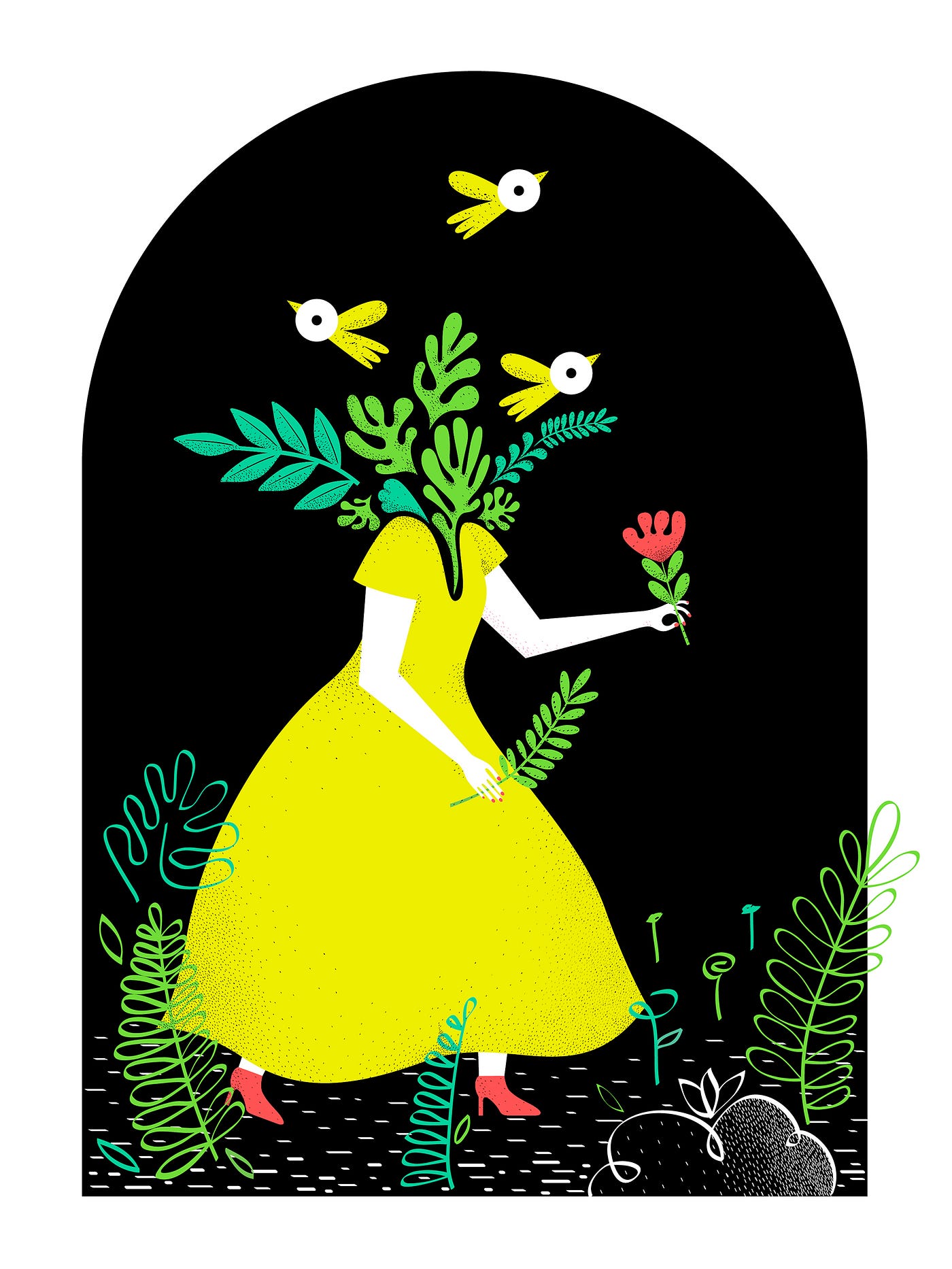
The hidden sensory world of dogs
What a pulling leash can teach us about curiosity, attention, and the limits of human perception.
On walking the dog
Astro pulls and pulls, heading who knows where.
It’s as if off in the distance, or at the next little tree, there were a clue he just can’t wait to investigate. We get there, he sniffs, and keeps going, tugging and tugging without ever letting up.
I follow him because I don’t understand much about walks and I trust his well-trained nose. Where I see nothing but posts and trees, he seems to find a world that’s permanently off‑limits to me.
Suddenly Astro finds a spot and, without wasting a single precious second, he positions himself and leaves his mark. Maybe it’s not the map but the territory that concerns him, and off he goes, resolving the matter with a little pee. Or maybe it’s just a message that someone else will later take as a clue, in a back‑and‑forth that in our eternal ignorance we’ll never know how to read.
When I walk Astro — the little dog we adopted a few weeks ago — I find it hard to see the world except through his eyes — and his nose. If one species’ trash is another’s treasure, there’s probably no more eloquent demonstration than the delight with which his snout conducts a sophisticated tasting of ferments and filth.
You have to follow the nose because the nose knows, my mom says, and few noses are wiser than a dog’s. Without arrogance they remind us that somewhere along the way we forgot our own nose, fifty times less powerful than theirs — even when we wear ours right on our face. As Alexandra Horowitz points out in *Inside of a Dog* (2009), if we humans can detect a teaspoon of sugar in a cup of coffee, a dog’s equivalent would be a teaspoon of sugar in two Olympic‑size swimming pools.
What a walk means to a dog is something we can only speculate about. Maybe he gets impatient to go out because after a while he starts to wonder whether everything is still in its place. Maybe we humans are badly accustomed to the violent stability of being, and canine metaphysics is simply better tuned. The dog delights in irregularity, and without pipe or hat, sets out to investigate what the hell happened in his absence.
But the first thing we have to try, if we want to understand what it feels like to be a dog, is to forget what we know about being a dog. We think, imagine, and judge their behavior as if their experiences, their emotions, their lives were hairier versions of our own. And it’s in that arrogance that the life of dogs, in all its splendor, gets forgotten.
As Horowitz reminds us — and as Ed Yong does in his fabulous *An Immense World (2022) — to get a little closer to the life of a dog, we’d do well to adopt its umwelt*, its own world. That marvelous word was defined and popularized in 1909 by the zoologist Jakob von Uexküll, with the aim of turning our attention to the surrounding sensory world of other sensitive beings.
It’s when we manage to lose the sensory pride of assuming the world is exactly as our species perceives it that the world as others know it can begin to become real. When Astro stops for no apparent reason, the opportunity I’m offered is to learn that my reasons aren’t the only ones that exist. The world, it seems, is larger than my human experience will ever be able to comprehend, and embracing a phenomenology of the canine might let me transcend, even if only speculatively, the limits of my own lived experience.
A flea’s umwelt is made of body heat, the touch of hair, and the smell of butyric acid that we warm‑blooded animals exude. In its world there are no sounds, no images or colors; there is only heat and a very special smell, and that’s the only thing that matters. Its world is shaped by what it perceives and what it can do about it. As we should suspect, ours is too.
When we walk a dog we have the privilege of allowing the tediously familiar stuff of everyday life to give way to whatever we’d never thought to notice. Gazing forward, and sometimes at the ground, forces us also to recognize the detail of every tile, flagstone, and cobblestone that crosses our path. Maybe the best guide on a walk is the most unexpected one: sometimes the best way to explore is simply to wander, with no goal other than to chase some sound, some smell, some mysterious gravitational force that points the way without our ever quite noticing.
Back in 1873, when the Kingdom of Italy had just come into being, Henry James wrote “A Chain of Italian Cities,” an essay in which he recounts his fortuitous wanderings through the central region of the peninsula, and already in its first line he laments having had to sacrifice curiosity in the name of haste.
“I should perhaps do the reader a service by telling him just how a week at Perugia may be spent,” he writes. “His first care must be to ignore the very dream of haste, walking everywhere very slowly and very much at random, and to impute an esoteric sense to almost anything his eye may happen to encounter.”
I, dragged along by my canine companion’s hurry, come to realize that letting myself be led by him is nothing other than letting myself be turned into a flâneur, that street archetype of the “passionate spectator,” as Baudelaire would put it — with the notable distinction that I’m following Astro’s little nose instead of my own.
If one of the greatest tragedies of adulthood is never being able to return to that childhood gaze in which almost everything could be fascinating, a somewhat more modest tragedy is never being able to return to the tourist’s gaze in your own city. It probably takes just a week for our brain to do its thing, and what once made us open our eyes one day slips past unnoticed the next.
But even if the childlike gaze seems permanently closed off, the very key of curiosity and wonder appears to bring us back to the experience of wandering our familiar spaces as if for the first time. And if our senses can feel atrophied at times, crouched in the comfort of the everyday, it’s on a walk with a dog that we can count on an unmatched companion to let ourselves be awakened by what surrounds us and to delight in everything that very likely would have escaped us.
Of course, the fact that on my walks with Astro he’s the one leading me and I’m the one imagining myself as a nineteenth‑century literary figure doesn’t mean he doesn’t know where he’s going — it means I choose to enjoy my walking steeped in ignorance — and in wonder. As if it were a stroll, no longer through my world, but through his.
Even on walks along the exact same everyday route, it’s not only sensory experiences that can fill us with wonder. Sometimes, walking the dog can also launch us on unexpected intellectual adventures, even if only in a tangential and slightly clumsy way.
In a charming 1976 column, the writer Sheila S. Klass recounts how, newly moved with her family, the task of walking Ringo fell unfairly and exclusively on her. She’d put on her coat, open the door, and head out, always looking straight ahead until it was time to turn back. Until one day, sick of such tedium, she decided to pick up a diary and little by little developed the enviable ability to read while walking.
Her ears became antennas for danger — bicycles, dogs, cars — and the walks could stretch longer so she could read a little more each time. They even sparked a touch of envy: “I wish I had time to read,” a neighbor told her, “I used to be a great reader before we bought this house.” “Get a dog,” she answered. “That’s how I got started.”
Those solitary moments, now also open to the pleasure of reading, finally allowed her to browse the feminist works for which there never seemed to be time.
And so, between walks with Ringo, she made her way through Friedan, de Beauvoir, Greer, and Millett, until one day, at walk time, she stood in front of her family and declared that her days as the dog‑walker were over. It was time for a fairer distribution of household tasks.
“In order to really enjoy a dog,” Edward Hoagland writes in “Dogs and the Tug of Life,” “one doesn’t merely try to train him to be semihuman. The point of it is to open oneself to the possibility of becoming partly a dog.” A friendship in which we only seek for the other to resemble us cannot be true — it would be a monstrosity.
To keep a friendship is to tug and be tugged, and no truly worthwhile one seems possible without a give‑and‑take. Though I casually say I’m taking Astro for a walk, it’s more than obvious that most of the time he’s the one taking me for a walk.
In his generosity he shows me which way to go and even at what pace we should do it. In a week of walking with him, my world became perhaps a little larger, or at least more interesting.
Astro pulls and pulls, heading where only he knows. We walked barely a few blocks, and before I knew it, we had gone around the world.
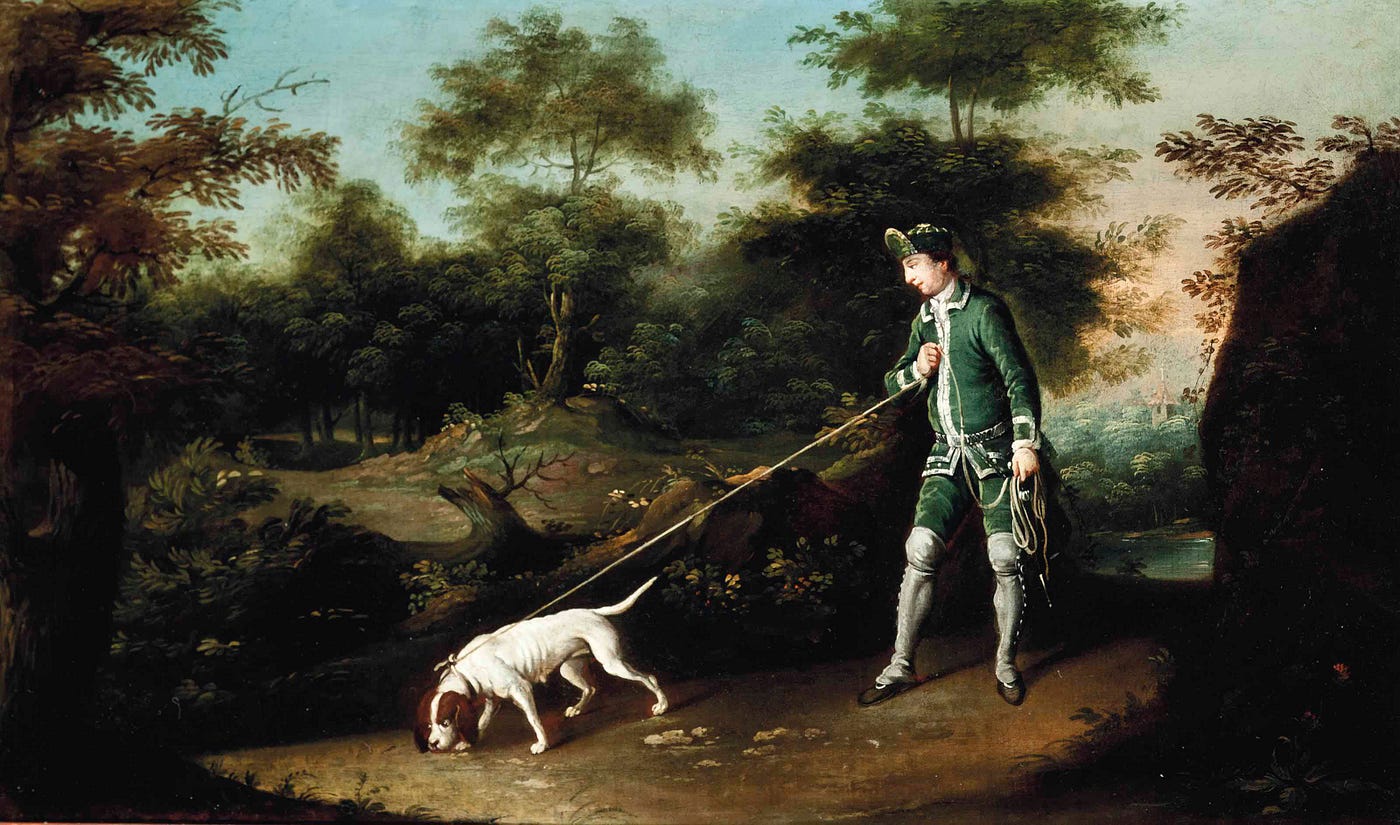
“A gentleman walking a hound in a wooded landscape” (probably by Wenzel Ignaz Prasch, 1708–1761). Oil on canvas.

This text was originally sent on June 25th, 2023 through Cómo funcionan las cosas, in Spanish.
Some book links are affiliate links. If you buy through them, I may earn a small commission at no extra cost to you. As an Amazon Associate I earn from qualifying purchases.
메타데이터
- post_id
- cd41a854b9bb
- slug
- walking-the-dog-cd41a854b9bb
- url
- https://peopleandthin.gs/walking-the-dog-cd41a854b9bb
- canonical_url
- https://peopleandthin.gs/walking-the-dog-cd41a854b9bb
- author_url
- https://medium.com/@valenzine
- status
- ok
- fetched_at
- 2026-06-13 00:25:45