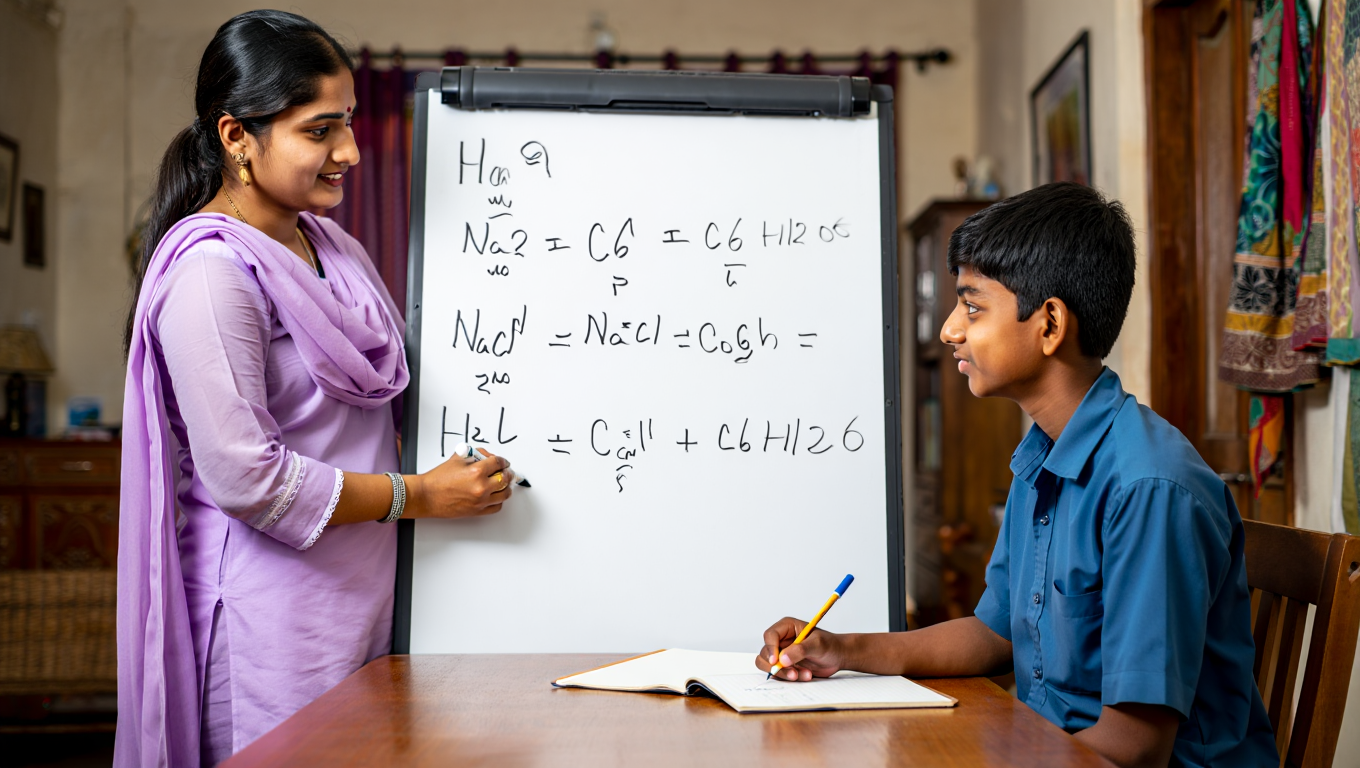
Why Heat Transfer (Conduction, Convection, Radiation) Becomes Easy with Tutors
Physics is full of fascinating concepts that explain how the world around us works. Among these, heat transfer — the processes of…
Why Heat Transfer (Conduction, Convection, Radiation) Becomes Easy with Tutors

Physics is full of fascinating concepts that explain how the world around us works. Among these, heat transfer — the processes of conduction, convection, and radiation — is one of the most important. From why a metal spoon becomes hot when left in boiling water to how the Earth receives energy from the Sun, these concepts underpin many daily-life observations and exam questions.
Yet, when students encounter these topics in classrooms or textbooks, they often struggle to make sense of the distinctions, equations, and applications. That’s where tutors come in — breaking down the complexity, connecting concepts with real-life experiences, and guiding students through problem-solving.
In this article, we’ll explore why students find heat transfer challenging, how tutors make it easier, and why personalized guidance can be especially effective for mastering this core area of physics.
1. Why Students Struggle with Heat Transfer Concepts
Heat transfer is simple in everyday experience — things get hot or cold — but its scientific explanation involves nuances that aren’t always intuitive. Common challenges include:
- Conduction Confusion: Students may know conduction involves heat transfer through solids, but they confuse the roles of molecular vibration vs free electron movement in metals.
- Convection Misunderstanding: Many learners find it hard to visualize how fluids circulate and transfer heat due to density differences.
- Radiation Oversights: Since it doesn’t require a medium, radiation feels “invisible” and harder to grasp. Students often mix it up with light reflection or conduction.
- Equation Overload: Remembering formulas like Fourier’s law for conduction, Newton’s law of cooling, or Stefan–Boltzmann’s law can overwhelm students.
- Application Gaps: When faced with numerical problems, learners often know the formulas but cannot decide which one applies.
These struggles highlight why independent study sometimes isn’t enough — and why tutor-led sessions make learning more effective.
2. How Tutors Simplify Conduction, Convection, and Radiation
Tutors bridge the gap between abstract theory and practical understanding. Here’s how they approach each type of heat transfer:
a) Conduction
- Tutors often use simple analogies like “passing energy down a line of people” to explain molecular vibration.
- For metals, they highlight the role of free electrons, making the contrast between conductors and insulators clear.
- They show real-life demonstrations, like touching one end of a metal rod while heating the other.
b) Convection
- Tutors illustrate convection currents with visual examples: boiling water, air circulation in a room, or ocean currents.
- Diagrams help students visualize how warmer, less dense fluid rises while cooler, denser fluid sinks.
- Numerical practice ensures learners understand rate-based problems (e.g., Newton’s law of cooling).
c) Radiation
- Tutors clarify that radiation requires no medium — hence why sunlight warms the Earth.
- Everyday examples like microwaves, heaters, or solar panels make the concept tangible.
- When teaching Stefan–Boltzmann’s law, tutors break it into simple proportionalities before diving into constants.
3. Step-by-Step Problem Solving
Physics exams rarely test concepts in isolation. Tutors therefore train students to:
- Identify the mode of heat transfer (Is it a solid object? Is fluid circulation involved? Is it vacuum-based?)
- Select the relevant equation (e.g., Q=kAΔT/ΔxQ = kAΔT/ΔxQ=kAΔT/Δx for conduction, Q=hAΔTtQ = hAΔTtQ=hAΔTt for convection, Q=σAT4Q = σAT⁴Q=σAT4 for radiation).
- Apply units consistently and cross-check dimensions.
- Interpret the result physically — does the number make sense?
By practicing under supervision, students learn not just the “how” but also the “why” of solving problems correctly.
4. Building Confidence Through Examples
Tutors often bring in practical, exam-relevant examples:
- Conduction: Why do cooking utensils have wooden handles?
- Convection: Why does smoke rise up a chimney?
- Radiation: Why do black clothes feel hotter in sunlight than white clothes?
By linking textbook material to real-world experiences, tutors help students remember concepts more easily. Instead of rote memorization, students gain conceptual mastery.
5. Personalized Learning vs. Classroom Teaching
In a classroom, a teacher must move at a fixed pace. Some students grasp concepts quickly, while others lag behind. Heat transfer, being a multi-layered topic, often leaves weaker students behind.
Tutors provide:
- One-on-one attention where doubts can be clarified instantly.
- Adaptive teaching methods depending on whether the student learns better with visuals, analogies, or numericals
- Targeted problem practice aligned with the student’s exam board (CBSE, ICSE, or state syllabi).
This individualized approach ensures no student is left confused about conduction, convection, or radiation.
6. How Tutoring Shapes Exam Readiness
Tutors not only teach concepts but also prepare students for exam situations:
- Time management: practicing numerical questions under time limits.
- Common pitfalls: avoiding unit mismatches, wrong equation selection, or careless arithmetic errors.
- Diagram practice: since labeled diagrams (like convection currents or radiation absorption curves) often fetch direct marks.
- Confidence-building: by revising repeatedly through quizzes, flashcards, and short answer drills.
Students who practice under guided conditions tend to perform better, not because they’ve memorized formulas, but because they’ve internalized the logic behind them.
7. Real-Life Case: Tutoring in North Delhi
Take a student preparing for board exams in North Delhi. They understand basic physics but consistently lose marks on heat transfer numericals.
A tutor steps in, diagnosing the issue: the student understands conduction well but confuses convection with radiation in mixed problems. Over weeks of guided practice, the tutor uses everyday examples — like hot air rising in Delhi summers or solar heating during winters — to clarify the concepts. The student not only improves test performance but also begins enjoying physics.
For learners seeking similar support, there are dedicated services that connect students with subject-focused tutors. Platforms like Concept Tutor provide structured learning that focuses on clarity of concepts, while options such as home tuition in North Delhi make personalized teaching accessible right at the student’s doorstep. These localized approaches ensure that students get consistent guidance tailored to their academic requirements.
8. Beyond Exams: Lifelong Understanding
Mastering heat transfer is not just about clearing a test — it builds a foundation for advanced studies in:
- Thermodynamics (engineering, physics, chemistry).
- Environmental sciences (heat balance in Earth systems).
- Everyday problem-solving (energy efficiency, cooking, climate science).
Tutors instill not only exam readiness but also curiosity and appreciation for physics as a whole.
Conclusion
Heat transfer — through conduction, convection, and radiation — can seem abstract and formula-heavy at first. But with the right tutor, students see these processes not as disconnected theories but as parts of the real world they interact with every day.
By simplifying concepts, guiding step-by-step numerical problem solving, and connecting learning with daily life, tutors help students transform confusion into clarity. Whether through in-person guidance or structured tutoring services, students gain not just marks, but a deeper, long-lasting understanding of physics.
메타데이터
- post_id
- cd4e7d3fe09c
- slug
- why-heat-transfer-conduction-convection-radiation-becomes-easy-with-tutors-cd4e7d3fe09c
- url
- https://medium.com/@edu.hub1180/why-heat-transfer-conduction-convection-radiation-becomes-easy-with-tutors-cd4e7d3fe09c
- canonical_url
- https://medium.com/@edu.hub1180/why-heat-transfer-conduction-convection-radiation-becomes-easy-with-tutors-cd4e7d3fe09c
- author_url
- https://medium.com/@edu.hub1180
- status
- ok
- fetched_at
- 2026-09-02 19:00:23