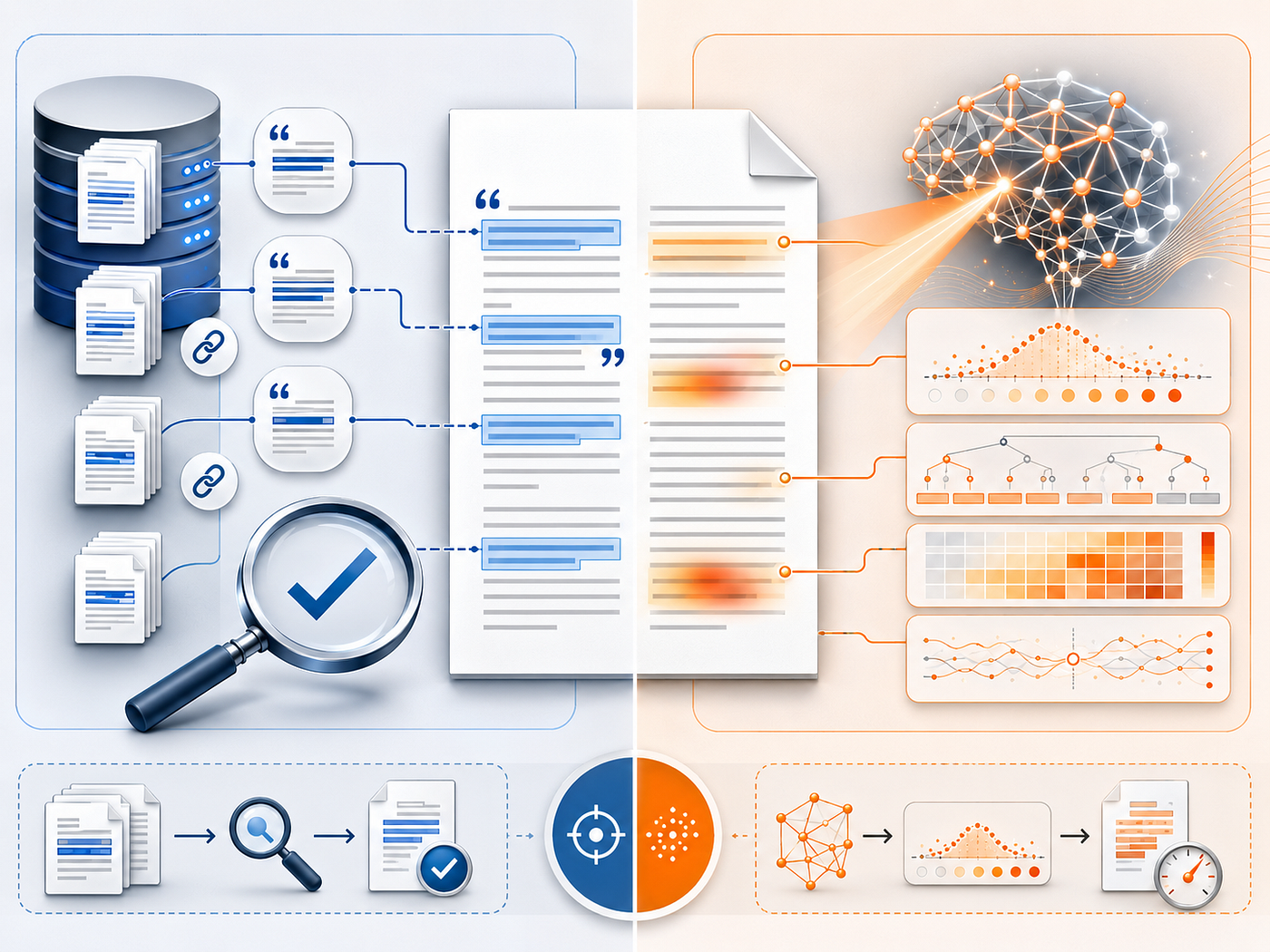
When an AI Detector Calls Human Writing “AI,” Who Has to Prove It Wrong?
False positives are not minor technical errors. In classrooms and workplaces, they can turn a probability score into an accusation.
When an AI Detector Calls Human Writing “AI,” Who Has to Prove It Wrong?
False positives are not minor technical errors. In classrooms and workplaces, they can turn a probability score into an accusation.
The first message we received after launching Naturalmelo was not about benchmark accuracy or processing speed.
It came from a student.
“Your detector called my essay AI, but I spent hours writing it. Why does it feel like I’m being accused of cheating?”
That message changed how I thought about AI detection.
At the beginning, building an AI detector felt like a conventional machine-learning problem: collect human and AI-generated samples, train a classification model, evaluate its performance, and improve the metrics. The technical goal seemed clear. A stronger detector would identify more AI-generated writing while making fewer mistakes.
But once real people began using the product, the meaning of those mistakes changed.
A false positive was no longer just a row in an evaluation table. It was a student wondering whether a teacher would believe them. It was a freelance writer worried that a client might question their work. It was a careful writer being told that their natural voice looked synthetic.
Every AI detection result may be probabilistic, but users rarely experience it that way. A high score feels personal.
That creates the central problem facing AI detection today:
How should an AI detector be used when it cannot reliably prove authorship?
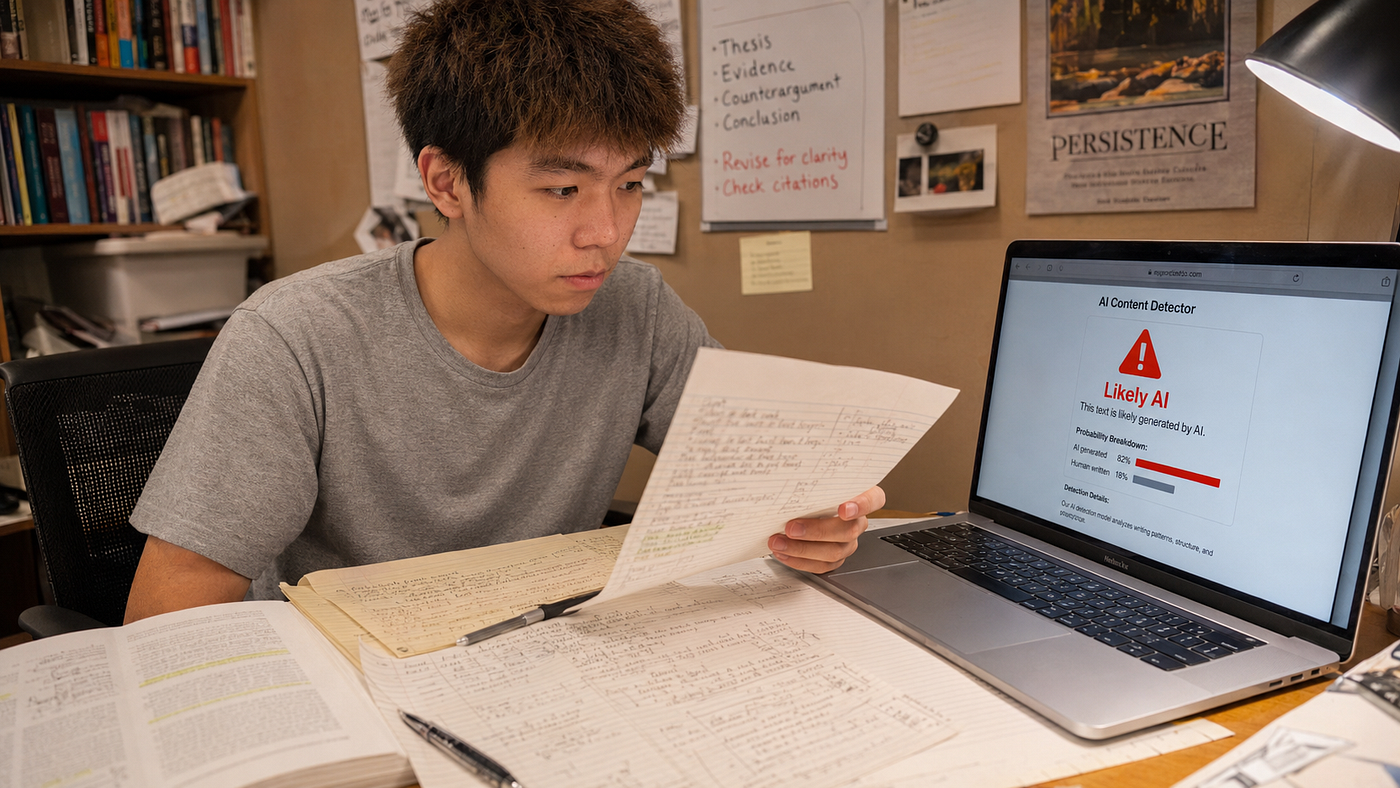
A student anxiously reviews a high AI-detection score beside handwritten notes, highlighting the personal impact of a possible false positive.
What Does an AI Detector Actually Measure?
An AI detector does not directly determine who wrote a document.
It analyzes patterns in the text and estimates how closely those patterns resemble material produced by the models or datasets it was trained to recognize. Depending on the system, those patterns may involve word predictability, sentence variation, repeated structures, stylistic consistency, or relationships between phrases.
This distinction is essential.
An AI detector does not observe the writing process. It does not know whether the author spent six hours drafting the essay, used an AI assistant for grammar, rewrote an AI-generated outline, or wrote everything independently.
It only sees the final text.
The result is therefore better understood as a classification estimate than an authorship verdict. Even Turnitin’s current documentation explicitly acknowledges that false positives are possible. To reduce their impact, Turnitin does not display exact scores between 1% and 19%, where results are considered less reliable and false positives are more likely. (Turnitin Guides)
That policy illustrates an important point: the score itself requires interpretation.
A result of “80% AI” does not mean that 80% of the essay was conclusively written by a machine. It means the detector found patterns that its model associates with AI-generated writing. Those two statements may sound similar, but they have very different consequences.
Why Do Human Essays Get Flagged as AI-Generated?
Human writing can trigger AI detectors because the statistical features associated with AI are not exclusive to machines.
A student may use a predictable five-paragraph structure because that is what they were taught. A business writer may repeat standard transitions because professional communication often rewards consistency. A non-native English writer may choose common and grammatically safe vocabulary. A technical author may intentionally avoid stylistic variation to remain precise.
All of these choices can produce writing that appears statistically regular.
During our own development and testing, many disputed results came from cautious rather than deceptive writers. Their sentences were clear, controlled, and formulaic. Ironically, these are often the same qualities encouraged by standardized testing, academic rubrics, and professional style guides.
Research has documented how serious this problem can become. Liang and colleagues evaluated several GPT detectors and found that they frequently misclassified writing by non-native English authors as AI-generated. Their study warned that detector use in educational settings could unfairly penalize writers whose linguistic patterns differ from those represented in the systems’ assumptions. (ScienceDirect)
This does not prove that every modern detector behaves identically. Detection systems continue to change, and newer research has produced more mixed findings in some languages and settings. But the earlier results expose a broader structural problem: detectors infer authorship through linguistic proxies, and those proxies may overlap with perfectly legitimate human writing. (arXiv)
The practical lesson is simple:
A detector can identify unusual statistical patterns, but it cannot determine why those patterns exist.
Why False Positives Matter More Than an Accuracy Percentage Suggests
Suppose a detector performs well on a controlled benchmark. That result may still tell us little about the experience of a student using it on an unusual essay.
Benchmark datasets usually contain defined categories of human and AI-generated samples. Real users submit far messier material:
- essays edited with grammar tools;
- writing created jointly by students and tutors;
- formulaic laboratory reports;
- personal reflections;
- translated or multilingual text;
- heavily revised AI-assisted drafts;
- text extracted imperfectly from PDFs.
The performance of a detector on a closed dataset does not automatically transfer to every one of these situations.
The consequences are also uneven. A false negative may allow AI-generated writing to pass unnoticed. A false positive can trigger an accusation against someone who wrote the material themselves.
That asymmetry changes how the technology should be governed.
Vanderbilt University disabled Turnitin’s AI detector after testing and reviewing the tool, citing concerns about its limitations and the consequences for students and faculty. The university’s guidance emphasizes that generative AI tools and automated detectors cannot reliably establish unauthorized AI use on their own. (Vanderbilt University)
MIT Sloan Teaching & Learning reaches a similarly practical conclusion. Its guidance warns instructors that AI detectors have high error rates and can lead to false accusations. Instead of treating detection software as proof, it recommends clearer policies, transparency, and assignment design that makes students’ learning processes more visible. (MIT Sloan Tech & Learning)
These are not abstract ethical objections. They are operational warnings about how uncertain technology should be used when the stakes are academic discipline or professional trust.
Why “Humanizing” Text Can Make the Problem Worse
After receiving repeated questions from users, we introduced tools that allowed writers to revise flagged passages and check them again.
At first, this seemed like a simple usability improvement. A user could identify passages associated with AI-like patterns, rewrite them, and observe how the score changed.
But the behavior revealed a deeper issue.
Many users were not asking how to improve their ideas. They were asking how to make the detector believe them.
Some shortened sentences. Others inserted informal phrases, minor errors, or personal details simply to reduce the score. A few intentionally made clear writing less polished because they believed imperfection would appear more human.
This is a bad incentive.
A system designed to protect authentic writing can accidentally encourage people to distort their writing for the benefit of the classifier. Instead of asking whether a paragraph is accurate, clear, and meaningful, the writer starts asking whether it looks statistically human.
Research on AI-detection robustness supports this concern. Liang and colleagues found that relatively simple prompting and stylistic transformations could reduce the effectiveness of detectors on AI-generated material. In other words, the same systems that may flag legitimate human writing can sometimes be bypassed by deliberately altered machine-generated text. (PubMed)
This produces an uncomfortable paradox:
- honest writers may feel pressure to prove that they are human;
- strategic users may learn how to avoid detection;
- the score becomes a target to manipulate rather than a source of understanding.
That is why “humanization” should not mean randomly adding imperfections. A better revision process asks whether the text contains the writer’s actual reasoning, evidence, examples, and judgment.
Should Schools Use AI Detectors to Prove Cheating?
AI detection should not be the primary evidence in an academic misconduct case.
A detector may provide a reason to inspect an assignment more closely, but it cannot independently establish who wrote it or how it was produced.
A fair review should consider broader evidence:
- earlier drafts and outlines;
- document revision history;
- notes and source annotations;
- consistency with the student’s previous work;
- the student’s ability to explain the argument;
- course rules governing permitted AI assistance.
Stanford’s Teaching Commons recommends that instructors create explicit, course-specific AI policies that balance academic integrity, student success, and faculty workload. It also notes that instructors should clearly communicate whether and how generative AI may be used. (Teaching Commons)
This matters because “AI use” is not a single behavior.
Using AI to brainstorm possible research questions is not equivalent to submitting an untouched generated essay. Grammar assistance is different from outsourcing an argument. Asking for counterarguments is different from asking a model to invent sources.
A policy that treats all assistance as identical will be difficult to enforce and may discourage honest disclosure. A better policy defines acceptable uses in advance and evaluates whether the student remained responsible for the final work.
UNESCO’s guidance similarly advocates a human-centered approach to generative AI in education, emphasizing human agency, inclusion, capacity development, and long-term policy rather than purely technical control. (UNESCO)
What Is a Better AI-Writing Review Process?
A practical review process separates detection from judgment.
Step 1: Treat the score as a screening signal
The result may justify closer review, but it should not be interpreted as proof.
Step 2: Inspect the relevant passages
Look for abrupt changes in tone, fabricated citations, generic explanations, unsupported claims, or unusual inconsistency with the writer’s earlier work.
These are meaningful writing problems even when AI was not involved.
Step 3: Review the writing process
Ask for outlines, notes, version history, sources, or earlier drafts. Process evidence is often more informative than another detector score.
Step 4: Ask the writer to explain the work
Can the student summarize the argument? Can they explain why they selected particular evidence? Can they defend their conclusion or revise it in response to questions?
A writer who understands the work can usually discuss its development more convincingly than someone who merely submitted generated prose.
Step 5: Apply a clearly stated policy
The final judgment should depend on the assignment’s rules, not on a universal assumption that any AI involvement is misconduct.
This process takes more time than accepting a percentage. But that is precisely the point. Authorship and learning are human questions, and they cannot always be resolved through automated classification.

A balance scale weighs a single AI score against drafts, sources, revision notes, and human discussion, showing why evidence of process matters more than an isolated result.
What Building Naturalmelo Changed About Our View of Detection
Working on Naturalmelo gradually changed our understanding of what an AI-detection product should do.
At first, the obvious goal was accuracy. We wanted the model to separate human and AI-generated writing as reliably as possible.
That goal remains important, but real usage showed us that accuracy alone is not enough. Users also need context, uncertainty, and a way to understand what the result can and cannot establish.
Some human essays contain machine-like patterns. Some AI-generated passages become difficult to detect after revision. Mixed-authorship documents resist a simple human-or-AI label. File formatting, language, genre, and text length can all affect the analysis.
As a result, Naturalmelo is more useful when treated as a review layer rather than an automated judge. It can help identify passages worth examining and give writers a reason to reconsider generic, repetitive, or overly templated language. It cannot determine guilt, intention, or ownership on its own.
That is a less dramatic promise than perfect detection.
It is also a more honest one.
The most productive question after receiving a score is not “How do I defeat the detector?” It is:
What should I inspect more carefully before I trust or submit this writing?
What Should AI Detection Be Used For?
AI detection is most defensible when the consequences are limited and human review remains central.
Appropriate uses may include:
- helping writers inspect AI-assisted drafts before publication;
- identifying sections that deserve fact-checking or revision;
- supporting conversations about permitted AI use;
- screening large volumes of content for closer human review;
- studying broad patterns across groups of documents.
It is much less defensible when used as the sole basis for:
- accusing a student of misconduct;
- rejecting an applicant;
- terminating a contract;
- determining authorship;
- publicly labeling a writer dishonest.
The distinction depends on whether the detector supports judgment or replaces it.
Turnitin itself describes AI writing scores as tools that can help investigators prioritize submissions requiring closer review. That framing is more responsible than treating the score as a self-executing verdict. (Turnitin Guides)
The Real Question Is Not Whether Writing Is Purely Human
AI-assisted writing is becoming increasingly mixed.
A student may generate an outline, write the paragraphs independently, use a grammar assistant, and ask an AI model for feedback on the conclusion. A professional may draft an email, use AI to shorten it, and then restore their own wording. A researcher may use a model to organize notes while personally verifying every claim.
Trying to classify these documents as completely human or completely AI-generated may no longer reflect how writing is actually produced.
The more useful questions are about responsibility:
- Did the writer understand the material?
- Were the facts and sources verified?
- Did the final text comply with the relevant policy?
- Can the writer explain and defend the argument?
- Did AI support the work or replace the work being assessed?
Those questions are harder to automate. They are also closer to what schools, editors, and employers actually care about.
An AI detector can contribute evidence. It cannot resolve the entire case.
The first student who contacted us was not asking for a technical explanation of classification thresholds. They were asking whether their own account of their writing process still mattered.
It should.
The future of AI detection should not be a search for a machine that makes human judgment unnecessary. It should be the development of tools and policies that help people judge more carefully.
Because behind every score is not just a document.
There is also a person hoping that evidence, context, and their own words will still be heard.
References
Liang, W., Yuksekgonul, M., Mao, Y., Wu, E., & Zou, J. (2023). GPT detectors are biased against non-native English writers. Patterns, 4(7), 100779. https://www.sciencedirect.com/science/article/pii/S2666389923001307
MIT Sloan Teaching & Learning Technologies. AI Detectors Don’t Work. Here’s What to Do Instead. https://mitsloanedtech.mit.edu/ai/teach/ai-detectors-dont-work/
Stanford Teaching Commons. Creating Your Course Policy on AI. https://teachingcommons.stanford.edu/teaching-guides/artificial-intelligence-teaching-guide/creating-your-course-policy-ai
Turnitin. Using the AI Writing Report. https://guides.turnitin.com/hc/en-us/articles/22774058814093-Using-the-AI-Writing-Report
Turnitin. AI Writing Detection Model. https://guides.turnitin.com/hc/en-us/articles/28294949544717-AI-writing-detection-model
UNESCO. Guidance for Generative AI in Education and Research. https://www.unesco.org/en/articles/guidance-generative-ai-education-and-research
Vanderbilt University. Guidance on AI Detection and Why We’re Disabling Turnitin’s AI Detector. https://www.vanderbilt.edu/brightspace/2023/08/16/guidance-on-ai-detection-and-why-were-disabling-turnitins-ai-detector/
Disclosure: This article reflects observations made while developing and testing Naturalmelo. Product-related examples describe internal experience and should not be interpreted as independent academic research. AI-detection outputs are probabilistic and should not be used as conclusive evidence of authorship.
메타데이터
- post_id
- cd5bd5a170aa
- slug
- when-an-ai-detector-calls-human-writing-ai-who-has-to-prove-it-wrong-cd5bd5a170aa
- url
- https://medium.com/@naturalmelo/when-an-ai-detector-calls-human-writing-ai-who-has-to-prove-it-wrong-cd5bd5a170aa
- canonical_url
- https://medium.com/@naturalmelo/when-an-ai-detector-calls-human-writing-ai-who-has-to-prove-it-wrong-cd5bd5a170aa
- author_url
- https://medium.com/@naturalmelo
- status
- ok
- fetched_at
- 2026-07-25 20:14:21