Community design: how connecting people helps solve loneliness in aging societies
Lessons from older adults on designing experiences, relationships, and daily motivation
Community design: how connecting people helps solve loneliness in aging societies
Lessons from older adults on designing experiences, relationships, and daily motivation
Designing communities that solve real problems together
‘Community design’
The term is slightly unfamiliar. Let’s start by looking at the definition of community. The laziest thing I can do as a writer is to copy what the dictionary says. My favourite one is ‘the people living in one particular area or people who are considered as a unit because of their common interests, social group, or nationality.’ Traditionally, it was bound by physical distance, but now communities form around shared interests, values, needs, and sometimes shared struggle.
Japanese designer Yamazaki Ryo, who has spent decades thinking about community design, made a comment. In the past, community design focused on physical arrangements of residentials, public squares or facilities. But he said, it’s now about connecting people. In other words, it’s focusing on how to connect people and solve shared problems together.
In Japan, more than one million people are estimated to suffer from depression. Every year, around 30,000 people die by suicide, and another 30,000 die alone. By this we know Japan is now what is often called ‘disconnected society,’ where people are losing ties to family, neighbors, and social networks. In this context, Yamazaki Ryo realized that better housing or well-designed public parks are not enough.
Korea faces a similar issue. It has one of the highest suicide rates in every 100,000 people among OECD countries, and the number of people dying alone continues to rise. What role should communities play in this lonely society?
According to its definition, each community has different goals with different characteristics. Some are for improving members’ physical wellness or some are for learning.
We recently worked with a community of life-long learners whose average age was over 75. For three weeks, we ran a design-thinking based problem-solving workshop.
We began by asking ourselves.
What feels like a barrier in everyday life?
Through conversation and shared stories, we found some issues in common. From there, we explored what might actually help. This article shares several insights from this workshop to contribute to forming the community that truly supports older adults in living well.

What feels like a barrier in everyday life for older adults? All participants had an open discussion during the workshop. ©Missionit
Why community matters
A community of older adults is not for only one purpose. It’s usually framed as a ‘living environment,’ regardless of the purpose of gathering. The community that we worked with was for learning but participants came along for many different reasons.
One said, “I’m here to get out of loneliness and enjoy being with people,” and another said, “To learn what I couldn’t learn when I was young,” “Not to fall behind younger generations,” or “To establish healthy routines by attending something happening on a regular basis.”
When you think about it, this community is not about self-development. It’s more about survival.

Communities (programs) chosen by older adults who are mindful of their health and wellness. Low-sodium diet, walking, swimming, just for fun etc,. ©Missionit
Let’s listen to what they think of this community.
Community as motivation for daily life
“Honestly, I didn’t even wash my face, and stayed home all day yesterday (laughing). But today, because of this, I woke up early, got dressed up and put on some makeup. Just having somewhere to go gives me energy.”
Dementia prevention
“My neighbor got lost the other day. A caregiver helps her on weekdays, but she goes out alone on Sundays. She went out alone yesterday, and couldn’t find the way home. It didn’t feel like someone else’s problem. So, I think learning is important. It’s good for preventing dementia.”
Not to fall behind generations
“I simply can’t keep up with this generation, but as I take classes, I think I understand them better. Also, my English isn’t good enough so I feel behind when I talk with my kids. I don’t think learning ends with age. The more you learn, the better.”
Preparing to stand alone
“My husband and I are the same age. We are all 72. I always relied on him for certain things. Well.. sending messages or searching something on the Internet isn’t that bad. But it was the other day that he was getting ready to go to work and I was about to book swimming classes. I found it difficult but, at the same time, I felt embarrassed asking him to help me sign up for swimming lessons.
We don’t know who will live longer, and I realized I can still do these things. Why hadn’t I even tried? I decided to try my best doing things on my own.”
What makes a good community for older adults?
Community with long-term and sustainable relationships
“There are staff members who greet us with a big smile in this place, and we can build a relationship with them. It’s not like classes from the local council where people disappear right after the class. I think this is what makes the place people want to visit.”
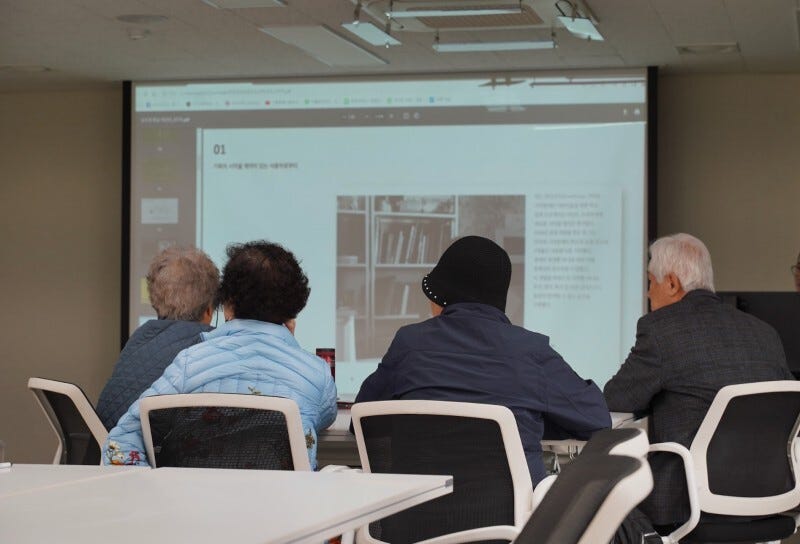
Long-term and sustainable relationships will add closeness and immersive experience. ©Missionit
Billiard balls strike each other, and they roll away immediately.
Many relationships now unfold this way in modern society. Short and transactional relationships.
In the past, the local community built long-term relationships. They often shared their lives for decades and built strong bonds. In the workshop, what older participants expressed most regret about was its short duration. It was only 3 weeks. What they longed for was not a goal-oriented group that dismisses once objectives are met, but a true community that continues over time.
Learning matters but relationships matter just as much. This is why participants had positive feedback for the place where the same staff members welcomed them over years.
Community that builds self-esteem through own choices
This community also has a meal gathering twice a month, jokingly called ‘Girl Food.’ It’s because there are 10 females with 4 males, and men tease themselves as ‘just the extras.’ Attendance is always 100%. It’s a very lively gathering. They decide on a menu, cook together, and sit down to eat. Someone shares information about the recipe, then everyone brings ingredients accordingly. Apart from the space provided by an external organization, everything else is decided and run by themselves.
In Self-Determination Theory, psychologists Richard Ryan and Edward Deci also emphasize autonomy, competence, and relatedness as a key driver of motivated behavior. Older adults should be able to find satisfaction in these human basic needs in communities. This will build their self-esteem and reduce loneliness and depression that they experience in their age. Therefore, communities should be able to provide a sense of being created by members’ participation, and encourage them to do so.

Members build their self-esteem in the process of creating communities. ©Missionit
Community that shares verified information
“Some say the egg yolk is good, but some say it’s high in cholesterol. There is too much information on the Internet and I’m confused. I’d like to get more accurate and tailored information for me.”
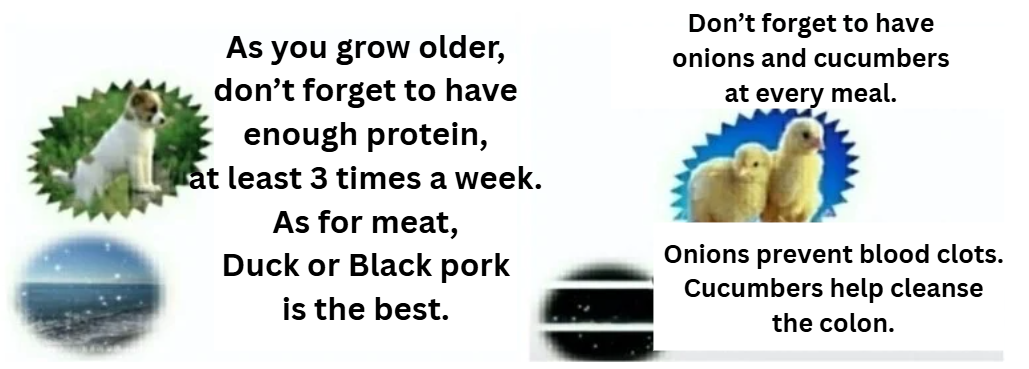
This is the image that I received from my father a few days ago. It’s not clear where this information comes from, and it’s confusing. Researchers from MIT looked at 120,000 news shared by 3 million people on X (former Twitters) from 2006 to 2017, fake news had spread more than 6 times faster than real ones. It’s due to the following assumption. If someone shares new information on social media, that person is considered as an expert in the domain.
Since older adults are highly interested in and sensitive to health information, they tend to share a lot of them with each other. Unfortunately, however, many of them lack evidence, and are conflicting. Participants expressed a strong desire for verified and personalized information around health and exercise. Therefore, communities ought to be a space where verified and safe information is shared.
Designing experiences, not just spaces
“Designing a park is not about planting beautiful flowers and trees. It’s about designing what people will do there with whom.” — Yamazaki Ryo, Community Design
Design has long focused on the physical environment so far, but the focus must shift to experience now. Experience-centered design is much harder, because it requires a holistic approach with participant’s behavior, psychology and social interactions in mind.
Communities are interaction-oriented spaces, so experience with other participants should be taken into account when designing ones. Valued time and experience. This is essentially what community design is for.
All my articles are grounded in real-world insights drawn from recent projects. Each piece is carefully crafted by me and thoughtfully edited by Andy Taekhyung Kim in the UK. By reading and sharing my stories, you’re supporting a genuine human effort to make the world a more inclusive place.
If you’re interested in insights on inclusive UX and accessibility, particularly in South Korea, the UK, or Southeast Asia, feel free to reach out (hello@missionit.co). I’d love to connect.
메타데이터
- post_id
- cd66af367648
- slug
- community-design-how-connecting-people-helps-solve-loneliness-in-aging-societies-cd66af367648
- url
- https://medium.com/design-bootcamp/community-design-how-connecting-people-helps-solve-loneliness-in-aging-societies-cd66af367648
- canonical_url
- https://medium.com/design-bootcamp/community-design-how-connecting-people-helps-solve-loneliness-in-aging-societies-cd66af367648
- author_url
- https://medium.com/@hello_37058
- status
- ok
- fetched_at
- 2026-06-09 15:37:30