Data is the New Battlefield: Aligning Cybersecurity with DPDP in the Age of AI
A recent pattern across global enterprises is hard to ignore: organizations are not failing because they lack security tools they’re…
Data is the New Battlefield: Aligning Cybersecurity with DPDP in the Age of AI
A recent pattern across global enterprises is hard to ignore: organizations are not failing because they lack security tools they’re failing because their security strategies are misaligned with how data actually behaves in an AI-driven ecosystem.
The shift is structural. Data is no longer static. It is continuously processed, learned from, and redistributed across intelligent systems. In this environment, **cybersecurity is no longer a perimeter function — it is a data governance challenge.**
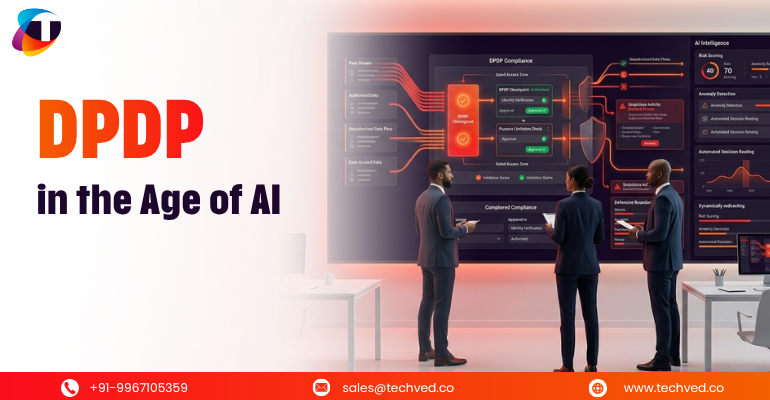
The Real Problem: Security Models Built for a Different Era
Most enterprise frameworks still treat security as an infrastructure layer. Firewalls, endpoint protection, and compliance checklists dominate boardroom conversations. But AI systems don’t operate within static boundaries.
They:
- Continuously ingest data
- Generate new data patterns
- Interact across distributed environments
- Learn from user behavior in real time
This creates a new class of vulnerabilities — ones that traditional systems were never designed to handle.
The rise of ***AI-powered cyber attacks*** has exposed this gap. Attackers are no longer exploiting systems; they are manipulating intelligence layers — models, training datasets, and decision engines.
Why It Fails: Compliance Without Context
India’s DPDP Act is a significant regulatory step, but many enterprises are approaching it as a compliance exercise rather than a transformation opportunity.
The issue isn’t regulation — it’s interpretation.
Organizations often:
- Focus on data storage compliance instead of data lifecycle governance
- Treat consent as a legal checkbox rather than a user experience
- Isolate security teams from AI and product teams
This results in fragmented execution, especially when dealing with emerging areas like ***cybersecurity for AI systems***.
Meanwhile, AI systems continue to expand, often without a unified ***enterprise cybersecurity strategy*** that accounts for how data flows across intelligent systems.
Strategic Insight: Security Must Move Closer to Intelligence
The real shift isn’t about stronger defenses it’s about embedding security into the intelligence layer itself.
AI is both:
- A threat amplifier
- A defense accelerator
This duality defines the next decade of ***AI in cybersecurity***.
Enterprises that succeed will not treat AI as an add-on to security. They will design systems where:
- Data governance is automated
- Threat detection is predictive
- Privacy is embedded into system architecture
This is where the ***future of ai in cyber security*** becomes less about tools and more about design philosophy.
Practical Framework: Aligning AI, Cybersecurity, and DPDP
To move from fragmented efforts to strategic alignment, enterprises need a framework that integrates regulation, intelligence, and experience.
1. Data-Centric Security Architecture
Shift focus from systems to data.
- Classify data based on sensitivity and usage
- Track data lineage across AI pipelines
- Secure data at creation, not just storage
This is foundational to building resilient ***cyber digital solutions***.
2. AI-Aware Threat Modeling
Traditional threat models don’t account for AI behaviors.
Modern models must consider:
- Model poisoning
- Data inference attacks
- Algorithm manipulation
This is where advanced ***cyber security solutions*** need to evolve beyond reactive defense.
3. Consent as Experience Design
DPDP mandates consent — but enterprises must design for it.
- Transparent data usage interfaces
- Real-time consent management
- Contextual privacy controls
This transforms compliance into trust.
4. Integrated Governance Platforms
Regulation, AI, and security cannot operate in silos.
An effective ***india dpdp technology platform*** must unify:
- Data governance
- Security monitoring
- Regulatory compliance
This is where platforms like a dpdp tech platform or india dpdp tech platform become critical infrastructure rather than optional tools.
5. Security as a Business Function
Security decisions must move beyond IT.
- Align with product strategy
- Integrate with customer experience
- Influence business model decisions
This is the evolution from vendor-led solutions to strategic partnerships with a ***cyber security solution provider***.
Realistic Enterprise Example
Consider a financial services enterprise deploying AI-driven credit scoring.
Traditional approach:
- Secure databases
- Ensure regulatory documentation
- Monitor system access
AI-aligned approach:
- Audit training datasets for bias and integrity
- Monitor model behavior for anomalous decisions
- Track how user data influences outcomes
- Embed DPDP compliance directly into data pipelines
The difference is subtle but transformational.
The first approach protects systems. The second protects intelligence.
Where Most Enterprises Still Struggle
Despite awareness, execution gaps remain:
- Over-reliance on legacy cyber security solutions
- Lack of integration between AI and security teams
- Minimal investment in data observability
- Treating regulation as a constraint rather than a design input
This is why even well-funded enterprises remain vulnerable — not due to lack of tools, but lack of alignment.
A More Relevant Way Forward
The convergence of AI, cybersecurity, and DPDP is not a technical challenge — it is an architectural one.
Enterprises need to rethink:
- How data is created, used, and governed
- How AI systems are secured from within
- How compliance frameworks shape system design
A deeper exploration of this intersection is outlined here: https://www.techved.com/blog/dpdp-cybersecurity-ai-data-protection
The conversation is no longer about securing infrastructure. It’s about securing intelligence ecosystems.
Conclusion
Data has become the most contested asset in the enterprise landscape. And in the age of AI, its movement not just its storage defines risk.
Aligning cybersecurity with DPDP is not about ticking regulatory boxes. It’s about building systems where trust, intelligence, and security are inherently connected.
Organizations that recognize this shift will move beyond fragmented defenses and toward integrated resilience.
TECHVED, through its work in digital transformation and experience-led innovation, is helping enterprises rethink how security, AI, and compliance converge at scale — especially in designing systems aligned with evolving regulatory frameworks.
If this space is relevant to your organization, **read more related insights from TECHVED.**
메타데이터
- post_id
- cd67504f7beb
- slug
- data-is-the-new-battlefield-aligning-cybersecurity-with-dpdp-in-the-age-of-ai-cd67504f7beb
- url
- https://medium.com/@anayamehta377/data-is-the-new-battlefield-aligning-cybersecurity-with-dpdp-in-the-age-of-ai-cd67504f7beb
- canonical_url
- https://medium.com/@anayamehta377/data-is-the-new-battlefield-aligning-cybersecurity-with-dpdp-in-the-age-of-ai-cd67504f7beb
- author_url
- https://medium.com/@anayamehta377
- status
- ok
- fetched_at
- 2026-07-23 16:39:33






