Hovercraft And Amphibious Military Operations
LCACs: Why are we not seeing them in action in Ukraine?
Military
Hovercraft And Amphibious Military Operations
LCACs: Why are we not seeing them in action in Ukraine?
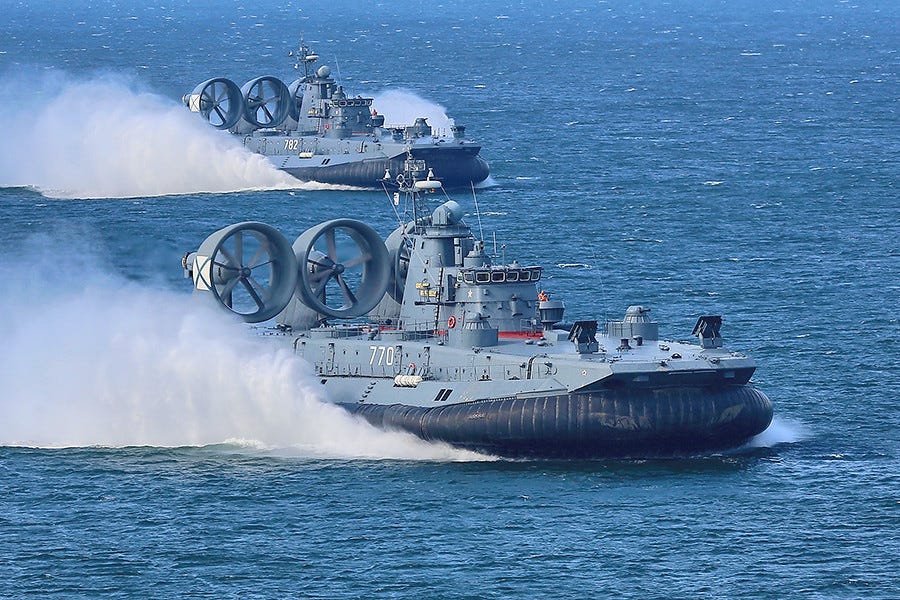
Russia’s 550 ton LCAC (hovercraft), Mordovia and Yevgeniy Kocheshkov landing in Kaliningrad Oblast. By Mil.ru, CC BY 4.0, https://commons.wikimedia.org/w/index.php?curid=44091506
I was researching the Russian A-22 Ogon naval multiple rocket launcher when I stumbled across these beasts. It led me into a labyrinth, starting with the Russian hovercraft aka Landing Craft Air Cushion (‘LCAC’). The Zubr class: 340 tons light, 550 tons fully loaded with a top speed of 63 knots.
What can compare with that?
I did a quick calculation. The Lockheed Martin SuperHercules could carry 20 tons at a maximum speed of 360 knots. That’s 7,200 ton-knots.
The Russian Zubr class LCAC carries 210 tons at 63 knots. That’s 13,200 ton-knots, almost double that of the Super Hercules. So for the sheer ability to move weight quickly, that’s a winner.
Yes, range is an issue — the Zubr’s 300 miles cannot compete with the SuperHercules — but so is the ability to unload ships and land almost anywhere with a beach. Apparently they can land on 80% of the world’s coastline.
It is the world’s largest cushion craft.
Zubr LCACs
The Zubr LCAC is a formidable amphibious assault hovercraft originally designed and manufactured by the Ukrainian company, Almaz Shipbuilding. Also known as the “Pomornik” (a European bison) in Ukrainian and Russian, the Zubr LCAC is recognized as one of the largest and most powerful hovercraft in the world, offering unparalleled capabilities in transporting troops and heavy equipment from ship to shore.
The Zubr-class LCAC was specifically developed to address the challenges of amphibious operations, providing a high-speed and versatile means of landing forces on both prepared and non-prepared shores. With its air-cushioned landing system, the craft is capable of traversing a variety of terrains, including mud flats, marshes, ice-covered areas and even low walls, making it a versatile asset for military forces operating in diverse environments.
One of the key features of the Zubr LCAC is its impressive size. This substantial size allows the Zubr to carry a significant payload, including up to three main battle tanks or ten armored personnel carriers, along with troops and equipment. Or just 360 troops.
The Zubr is powered by a combination of four 10,000 hp gas turbines and diesel engines.
In terms of armament, the Zubr LCAC is equipped with a range of defensive systems. This includes Strela anti-aircraft missile systems, anti-missile decoy launchers and close-in machine guns, providing layered protection against potential threats. And, as I discovered, the A-22 naval flamethrower.
The Zubr-class LCAC gained international recognition, with several countries expressing interest in its capabilities. Its deployment has been seen in various naval exercises and military operations, showcasing its effectiveness in enhancing the mobility and flexibility of amphibious forces. But only Greece and China bought them. Ukraine inherited four from the USSR.

A-22 Ogon MLR on Zubr LCAC, Credit: roe.ru
Fifteen Zubrs were built, with Ukraine having four (three now scrapped and one sold to Greece), Russia has two in operation and China has two (and is building two). Greece operates four. However, there are varying reports that Ukraine sold two or four of them to China in 2013.
The numbers don’t stack up. I discovered this image of a Zubr on a Ukrainian military site:

The caption states: Captured in Crimea Ukrainian air-cushioned landing craft “Horlivka”. The report was date June 2023.
There are rumours that Russia is trying to re-start production but gas turbine engines are not easily obtainable in Russia.
Russia also has ten of the 150 ton Tsaplya class in service, which it has sold to the South Korean Navy. Payload 45 tons, speed 50 knots.

A Tsaplya-class LCAC in South Korean service. Credit: By 썬창 — Own work, CC BY-SA 4.0, https://commons.wikimedia.org/w/index.php?curid=97676147
In January 2023, it was reported that the Khabarovsk shipbuilding plant is planning to resume construction of a modernised version of the Tsaplya class in 2023. (Eurasian Times)
The US has equivalents
In fact the US has built a whole ‘system’ around them.
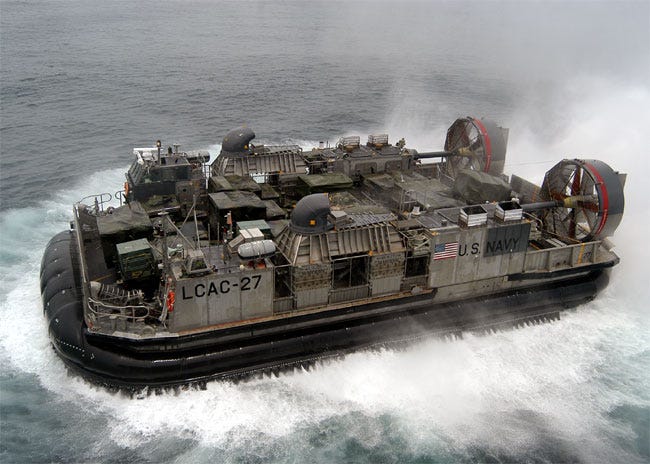
US LCAC Credit: Public Domain, https://commons.wikimedia.org/w/index.php?curid=129785
The US LCAC is broadly equivalent to the Russian Tsaplya.
The U.S. Navy has accepted delivery of the next-generation landing craft, ship-to-shore connector (SSC), landing craft, air cushion (LCAC) 106.(Naval Today)

LCAC-55, a Navy Landing Craft Air Cushion (LCAC), maneuvers to enter the well deck of the amphibious assault ship USS Kearsarge (LHD-3). Credit: US Navy, Public Domain

A LCAC approaching USS Wasp’s ‘hangar’. US Navy photo. Public Domain.
Video of US Marines loading an LCAC into USS Kearsage:
How do cushion craft work?
Cushion craft operate on the principle of utilizing a cushion of air to lift the vehicle above the surface and reduce friction during movement. This technology allows these craft to traverse a variety of terrains, including water, mud, ice, and marshy areas, making them well-suited for diverse amphibious operations.
The key component enabling this unique mode of transportation is the hovercraft’s skirt system. The skirt, typically made of flexible material, forms a seal with the surface underneath, trapping air within and creating a cushion. The pressure from this cushion of air lifts the craft, reducing the friction between the hull and the ground. This air-cushion effect allows the vehicle to glide smoothly over surfaces that would be challenging or impassable for traditional watercraft or land vehicles.

Hovercraft principle. Credit: By MesserWoland — Own work, CC BY-SA 3.0, https://commons.wikimedia.org/w/index.php?curid=1905531
To control the hovercraft’s movement, propulsion systems, such as gas turbine and diesel engines, are employed. These engines generate the necessary thrust to propel the craft forward or backward, while rudders and other control surfaces help in steering. The combination of powerful engines and air-cushion technology allows cushion craft to achieve impressive speeds and exhibit exceptional maneuverability.
Apart from military use, they have wide application.
- Search and Rescue: Hovercraft can reach areas inaccessible to traditional vehicles, making them effective in search and rescue missions in flooded or marshy regions and they can respond quickly. They are used by the UK’s RNLI, for example (lifeboat charity).

Credit: By Chris McKenna (Thryduulf), CC BY-SA 4.0, https://commons.wikimedia.org/w/index.php?curid=7554659
- Cargo Transport: Hovercraft can transport large and heavy cargo across water and land, overcoming obstacles that would hinder conventional vehicles.
- Arctic Operations: In icy environments, cushion craft facilitate transportation by gliding over frozen surfaces, providing a unique advantage in Arctic logistics.
- Tourism and Recreation: Hovercraft offer a low-impact means of exploring natural habitats, such as wetlands and wildlife reserves, without disturbing the environment, but the high noise levels can disturb wildlife.
- Icebreaking Operations: This was a new one for me. In icy waters, hovercraft can break through thin ice, providing access to areas that would be challenging for traditional icebreakers.
[embed]
Why don’t we see them in military actions?
They are used, but they don’t often make the news.
During Operation Desert Storm in 1991, there were eleven LCACs stationed on the Persian Gulf; this was the US LCAC’s largest deployment.
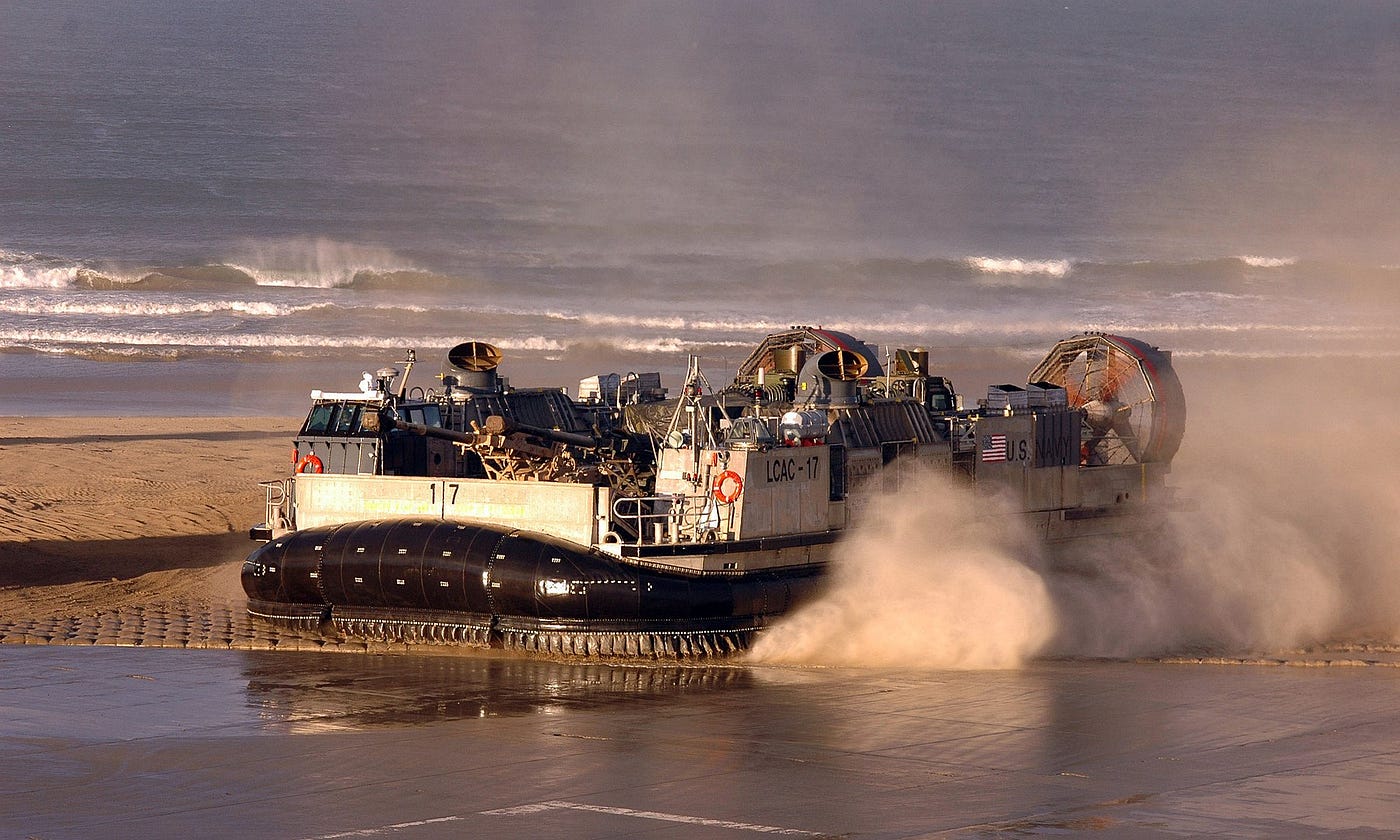
Assault Craft Unit Five (ACU-5), prepares to unload a howitzer artillery gun along the Camp Pendleton coast. Credit: By U.S. Navy photo by Photographer’s Mate 1st Class Alan Warner (RELEASED). Public Domain.
A fleet of Zubrs or equivalents would have been of great use in the recent amphibious operation where Ukraine has opened up multiple bridgeheads on the left bank of the Dnipro river along a 20 mile front. All regular bridges had been destroyed and Ukraine has been unable to build pontoon bridges because of Russian artillery and gliding bombs. Getting armour, artillery and supplies across has been difficult, risky and slow using barges.
A fleet of LCACs would have transformed that operation, but getting them there would have been difficult — and from where? With more preparation they could have been built inland at Ukraine and driven to the dispersal points.
Because the LCACs are highly mobile they make more difficult artillery targets but would be susceptible to helicopter missile attack and FPV drones: They present a large radar cross-section and are very noisy.
There is one question that I have not been able to find an answer to: Can they cross minefields? The skirts are vulnerable, but I’d hazard a guess at Yes. Maybe.
메타데이터
- post_id
- cd69024cbb59
- slug
- hovercraft-and-amphibious-military-operations-cd69024cbb59
- url
- https://medium.com/the-dock-on-the-bay/hovercraft-and-amphibious-military-operations-cd69024cbb59
- canonical_url
- https://medium.com/the-dock-on-the-bay/hovercraft-and-amphibious-military-operations-cd69024cbb59
- author_url
- https://medium.com/@james-marinero
- status
- ok
- fetched_at
- 2026-08-04 04:09:53