The South and West Asian Foundations of Chariot Technology: A Critical Reappraisal of the…
Introduction
The South and West Asian Foundations of Chariot Technology: A Critical Reappraisal of the Steppe-Origin Hypothesis
Introduction
In popular perception, a “cart” and a “chariot” are distinct. A cart is imagined as a heavy, clumsy vehicle with four solid wheels, usually drawn by oxen or other non-equine animals. A chariot, by contrast, is viewed as a light, fast vehicle with two spoked wheels, drawn by horses. However, this distinction, when projected into the past, is misleading. Applying these modern definitions to ancient terms for animal-drawn vehicles such as ratha oversimplifies the historical reality. The development of animal-drawn vehicles followed at least three independent lines of evolution, which did not necessarily progress together. As a result, ancient vehicles display a wide variety of forms and combinations.
The Three Dimensions of Vehicle Development
- Type of wheels: solid wheels in earlier stages, spoked wheels later.
- Number of wheels: four in earlier types, two in later.
- Draft animals: oxen, onagers, or asses in early use; horses introduced later.
While the “war chariot” typically refers to the two-wheeled, horse-drawn, spoked-wheel type, historical evidence shows many hybrid forms: two-wheeled bullock carts, four-wheeled horse-drawn royal vehicles, and toy models with solid wheels. Therefore, interpreting ancient terminology without corroborating archaeological or contextual evidence leads to serious distortions.
The Northern and Southern Equid Zones
Eurasia is divided into northern and southern equid zones by a vast east–west mountain chain.
- The northern equid zone — stretching from Ukraine to Mongolia and Central Asia — was home to Equus ferus (the true horse) as well as onagers.
- The southern equid zone, covering West Asia and India, was inhabited only by species of onagers or wild asses.
Though both zones share many features, the difference in documentation has shaped modern interpretations. West Asia has extensive written and visual records of its equid history, while India does not, allowing speculative and often misleading assumptions to dominate the narrative. (for more on Equids/ Horses Check out my Article on that)
West Asia and India Compared
Evidence from West Asia (Sumerians, 3500–3350 BCE) shows the earliest wheeled vehicles, initially ox-drawn and later pulled by onagers or asses. Horses appear there only after 2000 BCE. India, independently, had wheeled vehicles as early as 3500 BCE, likewise drawn by oxen.
- West Asia was geographically cut off from the northern equid zone by Anatolia and the Caucasus.
- Northwestern India the Vedic-Harappan region was directly connected to Central Asia, sharing both onager species and cultural continuity with the northern equid zone.
Assumptions and Misrepresentations
Modern narratives often conflate the presence of horses with Indo-European identity. This major assumptions dominate the “Aryan horse and chariot” theory: —
Indo-Europeans brought the ratha (spoked-wheel chariot) into India, where it became central to Rigvedic culture ?
This Article will examine the actual archaeological, textual, and iconographic evidence that Refutes that claims also demonstrating that the steppe was neither the origin of the chariot nor of the spoked wheel. Instead, we will explore why the true technological and conceptual origins of the chariot lie in the southern civilizations, which developed these innovations before the steppe cultures.
Wheeled Vehicles of the Indus
According to M. J. Kenoyer (Wheeled Vehicles of the Indus Valley Civilization of Pakistan and India, 2004), although wood rarely survives at Indus sites and no graphic depictions of carts have been found, the evidence from terracotta and bronze model carts and wheels is substantial. These models demonstrate both heavy and light wheeled vehicles, a wide range of cart types, and a remarkable diversity in design — including depictions that may represent spoked wheels. Kenoyer notes that the lighter forms of carts are particularly intriguing, as some are small enough to have been used by a single rider for speed or racing. He emphasizes that “the diversity of model carts is quite significant,” and questions why scholars have overlooked the evident complexity and specialization of Indus transport systems. The earliest wheeled vehicles, Kenoyer argues, were developed not in Central Asia but in the alluvial plains of the Indus Valley itself. At Harappa, terracotta carts appear as early as 3500 BCE during the Ravi phase. During the mature Harappan phase (2600–1900 BCE), there is a marked increase in cart and wheel types, including examples that may depict spoked wheels. Kenoyer concludes that “the unique forms and the early appearance of carts…suggest that they are the result of indigenous development and not diffusion from West Asia or Central Asia as proposed by earlier scholars,” reaffirming that these innovations were “the result of indigenous processes and not the result of diffusion from mountainous regions to the west.”
Jonathan Mark Kenoyer 2004

Jonathan Mark Kenoyer 2004

Jonathan Mark Kenoyer 2004

From IVC

Bronze model of chariot-boxes, Chanhudaro, Harappa, ca. 2500 BCE. Copper model of a passenger box on a cart, Chanhudaro, ca. Source for Picture 27.2 of Harappa copper model: Figure 35 from Excavations at Harappa by MS Vats, 1940. “Two types of two-wheeled carts are represented. The first one has curved platform with holes for uprights (Mohenjo-daro, Chanhu-daro). The second one has a seat placed over the axle (bronze model from Chanhu- daro)(Mackay, 1951: 97, pl. xxi:13; ; xix:1; Piggott 1970: 200–202; Allchins 1973: fig.30). (loc.cit. Elena Efimovna Kuz’mina, 2007, The origin of the Indo-Iranians, BRILL., p.336).”

(Top) “Extremely delicate miniature of a two-wheeled copper chariot” — M.S. Vats (1940) at Harappa, urban phase. (Bottom) S. Piggott (1950) proposed that the draught animal should have been a horse, as he associated with the chariot two copper figurines from Mohenjo-daro, with the same loop below and “each with a broken rod protruding from its hind quarters”; one of them was found “in the lower levels” of the DK area of Mohenjo-daro’s lower town. “It seems likely in fact that it was not intended to represent a draught ox at all, and may rather be an attempt at the portrayal of an equid, and presumably of a horse.”
Daimabad —


Harappa Phase Wheel types, 2600 BC


Harappa Phase Wheel types, 2600 BC

Terracotta wheels from Banawali and Rakhigarhi, displaying spokes painted or in relief

from Mehrgarh 4509–3600 BCE
The copper amulet from Mehrgarh (Baluchistan) is frequently identified as the earliest known object produced through the lost-wax casting technique. Notably, the artefact also constitutes one of the earliest known representations of a spoked wheel. Although it is a schematic form rather than a functional wheel, its existence raises an important historical question — can a symbolic representation of a wheel predate the technological invention of the wheel itself? This issue invites a broader discussion on whether symbolic or conceptual forms may precede material innovations.

Contextual Background. The artefact, inventory number MR.85.03.00.01, was recovered in 1985 from the MR2 locality of Mehrgarh by the “Mission Archéologique de l’Indus” under Jean-François Jarrige. MR2 belongs to Period III of Mehrgarh, generally dated to the Early Chalcolithic (ca. 4500–3600 BCE). Supplementary documentation notes that although the amulet was retrieved from the surface, the MR2 site is entirely Chalcolithic, permitting secure cultural attribution. The frequently cited estimate of “6000 years old” is a rounded approximation derived from the site’s chronological range. Additional wheel-shaped objects have been recovered from the same site, including a fragmentary specimen near the skull of a woman in tomb H33, suggesting the symbolic form held ritual or funerary significance. Comparable symbolic wheels occur elsewhere, notably in the Celtic Bronze Age, where votive wheels (typically four-spoked) were deposited in shrines, rivers, tombs, or worn as amulets. These are widely interpreted as solar emblems. Similar forms — Zierscheiben — appear in Germanic contexts. The association of the Sun with a wheel or chariot is well-attested in Germanic, Greek, and Vedic traditions. several pieces of evidence from South Asia and eastern Iran. Indus–Saraswati and Helmand Region Evidence. Terracotta wheels from model carts have been recovered from several Mature Harappan sites — Banawali, Rakhigarhi, Bhirrana — as well as Shahr-i Sokhta (Iran), dated to ca. 2750–2200 BCE, predating or contemporaneous with early steppe materials.
According to Kenoyer (“Wheeled Vehicles of the Indus Valley Civilization”, 2004):- Terracotta cart models appear at Harappa as early as ca. 3500 BCE during the Ravi Phase. No comparably early wheeled vehicles have been reported from Afghanistan, Central Asia, Mehrgarh, or Nausharo. The development of wheeled carts in the Indus Valley appears indigenous, not diffused from western highlands. Kenoyer did not discuss the Mehrgarh amulets, as his focus was specifically on terracotta cart models. Nevertheless, his conclusions underscore the technological priority of the Indus region. Despite such evidence, Western syntheses — e.g., the Wikipedia overview of wheel origins — traditionally describe earliest wheeled vehicles as appearing “near-simultaneously” in Mesopotamia, the Northern Caucasus, and Central Europe, omitting the Indus Valley entirely. Anthony’s monograph similarly fails to incorporate Harappan evidence, even though the Baden ceramic wagon models (3300–3100 BCE) he cites are not earlier than the Harappan cart models. An important exception is M. Ivanova (The Black Sea and the Early Civilizations of Europe, the Near East and Asia, pp. 121–22), who explicitly notes that clay models of two-wheeled carts with rotating wheels appear in:
Altyn-depe, Turkmenistan (late 4th millennium BCE), and
Harappa, during the Ravi Phase (3500–3300 BCE), citing Kenoyer 2004.
Kenoyer also identifies Early Harappan wheels (2800–2600 BCE), including one specimen with radiating lines possibly representing spokes. Additional discoveries from Bhirrana published by L.S. Rao (Puratattva 36, 2005–6) include several examples with painted or relief spokes. A terracotta wheel from Shahr-i Sokhta (ca. 2750–2200 BCE) further corroborates the presence of spoked-wheel iconography in the broader Helmand–Indus cultural sphere. The presence of Bos indicus figurines at Shahr-i Sokhta underscores eastward cultural influence, consistent with historical references to Arachosia (Helmand) as White India.
Symbolic and Cultural Dimensions. The Mehrgarh amulets exhibit six spokes. This number corresponds strikingly with Vedic cosmological symbolism. Ṛgveda 1.164.11–12 describes the Sun’s “six-spoked” wheel (ṣaḷ-ara), interpreted through traditional exegesis (including Śaṅkara on the Praśna Upaniṣad) as representing the six seasons. Harappan seals frequently depict a six-spoked circular motif, closely resembling the Mehrgarh form. Its placement in narrative scenes — e.g., the convex molded tablet from Harappa — confirms its symbolic status, likely solar in meaning. In later historical Hinduism, the Sudarśana Cakra of Viṣṇu retains the six-spoke convention, again symbolizing the six seasons. This consistency suggests an unbroken line of symbolism from Chalcolithic Mehrgarh through the Harappan period into early historic India. While the Mehrgarh objects are too early to represent functional spoked wheels, their six-spoked design fits a broader Indo-Iranian and South Asian tradition in which the spoked wheel served primarily as a cosmic, solar, and calendrical symbol. The later technological wheel could thus have adopted an already meaningful symbolic form.

six spokes symbolism in hymn RV I.164. translated by Jamison and Brereton
Mehrgarh 4509–3600 BCE Spoked Wheel Amulet

Indus Valley teracota Cart Wheel Clearly Depeicting Spokes

From Dholavira, Depicting Spoked Wheel


Chart showing chronology and site wise distribution of spoked wheels recovered from IVC

Kenoyer_2004

Map showing the comparative distribution percentage of spoked wheels recovered from different zones of South Asia from Indus Valley Civilization
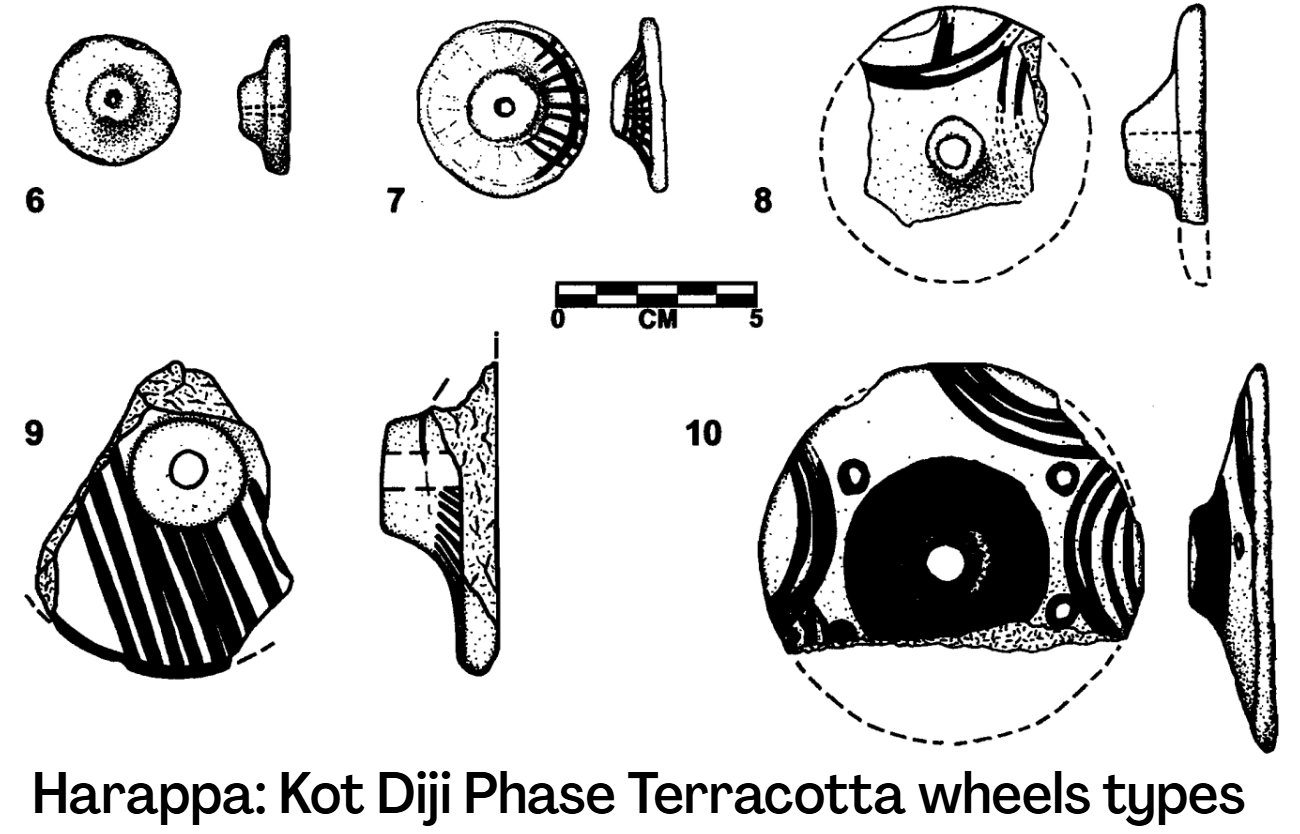
In his excavations at Harappa between 1920–21 and 1933–34, M.S. Vats published a picture of wheel like object with eleven equidistant spokes painted on it (Vats 1940, Vol. I: 314–315 and Vol. II: Pl. LXXXII). Though the author categorised the object as a pedestal, one may safely recognise the object as a specimen toy cart wheel as well (Plate 4). In a 1943 publication Ernest J.H. Mackay reported a terracotta toy wheel which was, according to him, a ‘prototype’ of a spoked wheel from Chanhu-daro (Mackay 1943: 162–163, 164 and PI. LVIII, 20). In the very same publication we have noticed a ram figurine with two wheels (LVIII, 12). A clearer picture of the material was published by J.M. Kenoyer (2004: 228, cat. no. 161). In this picture one can easily notice a terracotta wheel with spokes in low relief (Plate 5). Kenoyer has published a picture of a wheel with painted spokes in one of his recent articles. (Kenoyer 2011: 10, Fig. 5, №7) (Plate 6). What is most significant here is that the material was recovered from the Early-Harappan Kot-Diji level of Harappa. A very interesting material in this connection was reported from Mehrgarh recently (Thoury et.al 2016). A wheel-shaped amulet with six spokes made of copper was recovered from the site. The lost-wax technique was applied in producing the object (Plate 7). The object was collected in 1985 from MR2 site of Mehrgarh. As MR2 belonged to the Mehrgarh period III, the material was dated between 4500 and 3600 BCE. But the debate about its actual identity is not yet resolved. In Gujarat region we have more evidences of the spoked wheels reported from the mature Harappan levels of Kuntasi, Lothal and Dholavira. M.K. Dhavalikar has published a picture of terracotta wheel with painted spokes from Kuntasi (Dhavalikar 1997: 297) (Plate 8). From the Harappan level of Lothal, S.R. Rao, the excavator of the site has reported a terracotta wheel with four painted spokes (Rao 1985: 505, P1. CCXXIIB, 1) (Plate 9). But a fairly good number of terracotta wheel with white painted spokes were unearthed from the mature Harappan level of Dholavira (Bisht 2015: 553–555) (Plate 10). The level was dated 2500–2100 ВСЕ.
The region adjacent to the lost Sarasvati river has produced a large number of terracotta wheels with painted spokes. In several cases the spokes are depicted in low-relief. From late Harappan level of Rupar and Mitathal spoked wheels have been reported (Dhavalikar 1997: 298). Two terracotta spoked wheels were unearthed from the mature Harappan level of Banawali. In these instances the spokes were depicted in low-relief (Lal 2002:74) (Plate 11). Terracotta spoked wheels were reported from Rakhigarhi (Plate 12) and Kalibangan (Plate 13) also (Lal 2002: 74). A significant finding was reported by R.C. Agrawal from the site of Ganeshwar. (Rajasthan) of Ganeshwar-Jodhpura culture (Rao 2007: 246) (Fig. 2). It was a copper cast wheel having thick spokes. In this connection one may recall the specimen unearthed from Mehrgarh, which I have mentioned earlier. But the most startling discovery in this regard was made by L.S. Rao from the site of Bhirrana. A fairly large number of terracotta wheels with painted and low relief spokes have been discovered by the excavators there (Fig. 3, Plate 14). Almost all the specimens belong to the Mature Harappan period and a few are from the early-mature Harappan level, which was dated from 4500 BCE to 3000 BCE (Rao 2006: 59–67) (Plate 15). In an early Harappan pottery sherd from Kunal a depiction of spoked wheel has been noticed (Kumar 2018: 44, Pl. 9) (Plate 16). Present author has recently noticed some terracotta wheels with painted and impressed spokes from Kunal (Plate 17). These depiction and the specimens from the early Harappan level of Kunal together with the early mature Bhirrana ones, will surely strengthen the case for an early Harappan origin of the spoked wheel technology, indigenously in South Asia.


Source:- PURATATIVA Number 49, 2019, Invention and Development of Spoked Wheel: A Harappan Perspective Krishnendu Das


Source:- PURATATIVA Number 49, 2019, Invention and Development of Spoked Wheel: A Harappan Perspective Krishnendu Das
one may easily gauge the wide reach of the technology chronologically and spatially ranging from pre/early Harappan to the late phases of the civilisation and right from Mehrgarh of Baluchistan in the west to the Sarasvati region of Haryana in the east and as far south as Gujarat. If the technology was not popular the spread of the specimens of the spoked wheels could not be so overwhelmingly abundant in this region. In this regard I will like to attract the reader’s attention to a special specimen as was done earlier by L.S. Rao (Plate 18). Its spokes were painted just as a modern day bicycle. It shows the serious interest the Harappans took in the use and development of the spokes. This specimen was an absolutely unique piece in the contemporary ancient world.
— Source:- PURATATIVA Number 49, 2019, Invention and Development of Spoked Wheel: A Harappan Perspective Krishnendu Das

Source:- PURATATIVA Number 49, 2019, Invention and Development of Spoked Wheel: A Harappan Perspective Krishnendu Das


https://ignca.gov.in/Asi_data/88670.pdf

Plano convex molded tablet showing a female deity battling two tigers and standing above an elephant. A single Indus script depicting a spoked wheel is above the head of the deity. 2600–2000 BCE
Indus script sequence in Dholavira. Spoked Wheel-like characters occupy 4 out of 10 letters (read left to right here): CARTWHEEL / HAMMER / LEAF (?) / CARTWHEEL / DIAMOND / CHEVRON / (?) / DOUBLE CARTWHEELS / CRAB

Example of Common Symbols in Indus Script The Wheel like Symbol is one of most common

A Pot from Indus Valley Civilization with a Wheel like depiction. This pot was found in the cemetery in the city of Harappa.
A Mehrgarh amulet (4500–3600 BCE) — wheel-shaped and catalogued as inventory number MR.85.03.00.01 — was collected in 1985 at the MR2 site of Mehrgarh during the excavations of the Mission Archéologique de l’Indus (directed by Jean-François Jarrige). It most probably resembles a representation of a spoked wheel, and the reason is simple: the same type of design occurs on the Hasanlu gold bowl as a clear spoked wheel, and it also appears on BMAC seals. This design reappears in Harappa seals (2600–2000 BCE). The motif of six-spoked wheels is also present in the Vedic corpus — for instance, Ṛgveda 1.164.12 states: — “They speak of the father [= the Moon] with five feet [= the seasons] and twelve forms [= the months], the overflowing one in the upper half of heaven. But these others speak of the far-gazing one [= the Sun] in the nearer (half) fixed on (the chariot) with seven wheels [= the Sun, Moon, and visible planets] and six spokes [= the seasons, in a different reckoning].” (translation by Jamison and Brereton). Even in the Praśna Upaniṣad, the term ṣaḍara (six-spoked) occurs, on which Ādi Śaṅkarācārya glosses as ṣaḍ-ṛtu-mat — “having six seasons.” Although the amulet is very early, it could still carry symbolic meaning or represent a wheel. (I am not proclaiming with full certainty that it is a spoked wheel, but the design strongly resembles one.)
Kenoyer (2004), in Wheeled Vehicles of the Indus Valley Civilization of Pakistan and India, notes: “At Harappa we find evidence for the use of terracotta model carts as early as 3500 BC during the Ravi Phase at Harappa […] No carts or wheels dating to this early time period have been reported from any sites in Afghanistan or Central Asia, or even from sites such as Mehrgarh and Nausharo that are located at the edge of the Indus plain. […] It is now possible to say that, on the basis of the currently available archaeological evidence, the development of Indus wheeled carts appears to be the result of indigenous processes occurring out in the alluvium and not the result of diffusion from mountainous regions to the west.”
David Anthony, however, states in his book (p. 69) that the Baden culture ceramic wagon models dated to 3300–3100 BCE are “the oldest well-dated three-dimensional models of wheeled vehicles,” thereby ignoring the earlier wheeled vehicle evidence from Harappa.
By contrast, M. Ivanova, in The Black Sea and the Early Civilizations of Europe, the Near East and Asia (pp. 121–122), presents a more balanced account. She notes the remains of two wooden wheels at Novokorsunskaja, similar in size to Catacomb-culture wheels. The presence of a hub suggests a vehicle with rotating wheels and a fixed axle. She writes that this vehicle may have been a two-axle wagon like the roughly contemporary wagon from Koldyri on the Lower Don, but it is also possible that the Novokorsunskaja find belonged to a two-wheeled cart. Clay models of two-wheeled carts with rotating wheels attest to the use of such vehicles in Central Asia and the Indus Valley in the late fourth millennium BCE. At Altyn-depe in south Turkmenistan, such models appear in the second half of the fourth millennium (Namazga III period) and become more common in the early third millennium. Cattle figurines with holes for yoke attachment were recovered from Kara-depe. Comparable models appear in the Indus Valley around 3500–3300 BCE, during the Ravi Phase at Harappa (Kenoyer 2004, 90f., Fig. 2). Unlike David Anthony, Ivanova does not ignore the Harappan wheeled vehicle evidence.
The Indus-Saraswati Civilization has long been recognized as a significant center for the rise of cities and urban society during the mid-third millennium BCE. Since wood rarely survives at Indus sites and no graphic depictions of carts have been discovered, most evidence for wheeled vehicles comes from terracotta and bronze model carts and wheels dating to the Harappan Phase (circa 2600–1900 BCE), along with rare examples of streets bearing cart tracks (Dales and Kenoyer 1991). Terracotta model yokes, closely resembling modern neck yokes, have also been found at the site of Nausharo from Harappan Phase occupations (Period III). During the Harappan Period (2600–1900 BCE), there was a dramatic increase in terracotta cart and wheel types at Harappa and other sites throughout the Indus region. The remarkable diversity of carts and wheels — including depictions of spoked wheels — during this phase of urban expansion and long-distance trade suggests that wheeled transport was already a sophisticated and versatile technology within the Indus Civilization. These variations likely reflect different functional requirements as well as stylistic and cultural preferences tied to local traditions. The unique forms of these vehicles, along with their early and widespread appearance, strongly indicate that they were the product of indigenous technological development rather than a borrowed innovation from West or Central Asia. Early excavators of Indus sites were deeply interested in discovering the origins of wheeled transport. Yet, while they did not abandon the hope of finding early carts in the region, they often fell victim to colonial biases about cultural complexity and the simplistic diffusion models that dominated early 20th-century archaeology. Unfortunately, both problems still linger in the field today. The quest for Indo-Aryan horse-drawn chariots with spoked wheels in the mid-second millennium BCE has overshadowed the obvious evidence of both heavy and light wheeled vehicles pulled by bullocks discovered at Mohenjo-daro, Harappa, and Chanhu-daro. This distortion has reinforced the colonial Aryan Migration model while ignoring the clear technological achievements of the Harappans themselves. Moreover, no carts or wheels dating to this early period have been reported from Afghanistan, Central Asia, or even from sites such as Mehrgarh and Nausharo located on the fringes of the Indus plain. Following the early premonition of Sir John Marshall, it is now possible to affirm — based on currently available archaeological evidence — that the development of Indus wheeled carts was the outcome of indigenous innovation within the fertile alluvium of the Indus-Saraswati region, and not the result of diffusion from mountainous zones to the west. Taken together, the evidence is unambiguous: the knowledge of wheeled transport, including both heavy carts and lighter, more mobile vehicles, was already well established in the Indus-Saraswati Civilization long before the supposed “Aryan migration.” Rather than being imported from outside, wheeled vehicles and proto-chariots in Harappan culture reflect a deep, continuous, and indigenous technological tradition.
Examples of Unspoked, Solid-Wheel Depictions in Indian Rock Art From the Chalcolithic Period (c. 3000–1500 BCE)
( source of below pictures — Chariots in the Chalcolithic Rock Art of Indian by Neumayer Erwin CLAYMAN ARCHIVE)

12 / C 12a Chhatur Bhoj Nath Nulla; Chalcolithic; Red and traces of black; Length of the animals 10 cm Chariot drawn by two horses and unspoked-solid wheels. The chariots crew consists of three persons, one armed with a battle axe an other with a spear

Chalcolithic; Red; Length of the lower draught animal 30 cm Chariot with two bovids(?). The charioteer is drawn from the axle backwards. He holds a bow(?) in hand. Some of the paintings seem to have been laid on a clay-white foundation, which in most cases has weathered away, leaving the paintings very fragmentary on.

C 42 Narsinghgarh-Kotra IIIA — 9; Chalcolithic(?); Red; Length of the cart 25 cm Bullock cart(?) with a spacious platform for loading goods. The wheels are obviously not spoked, which indicates a full plank wheel for heavy duty vehicles. The second pair of wheels are a later(?) addition.


chalcolithic Length of the cart 30 cm. The depiction of a chariot equipped for four draught animals. The chariot rock art is part of a composition in the hills close to the city of Fatehpur Sikri.

Koppagallu Hill; Chalcolithic, Bruising; Height 45 cm. Bruising of a cart on a granite surface. Depictions of chariots in the southern Deccan are extremely rare. This cart gives a detailed rendering of technical features. Since there are no spokes indicated on the wheel it has to be taken as plank-wheels, the nave of which are indicated in the centre. The body of the cart rests on the axle and the pole and two more struts extend up to the yoke. The constructional details go very well with cart models known from the chalcolithic period. But it also should be mentioned that such carts are still in use in many parts of India.
Chariot from Tilwara Site- 2000 BCE

Nearly 4,000-year-old royal burials and a war chariot have been unearthed at Tilwara, Meerut — revealing a cultural horizon strikingly similar to Sinauli. Located just 10 km from the famous Sinauli site in Uttar Pradesh, Tilwara has quietly emerged as one of the most important archaeological discoveries in recent years. For months, the Archaeological Survey of India (ASI) has been excavating this mound, and the material emerging from the trenches closely echoes the Sinauli findings funerary vehicles with solid wheels, copper-associated artifacts, and elite burials. Tilwara appears to be a Copper Age burial site, approximately 4,000–4,500 years old, containing rare and significant features: a war chariot, a royal coffin-like structure, and associated grave goods. Perhaps most importantly, the findings underline a truth often overshadowed by narratives centered solely on the Indus Valley Civilization: ancient India was home to multiple advanced, coexisting cultures, each contributing to the subcontinent’s technological and cultural landscape. Sites like Sinauli and now Tilwara show that powerful, complex societies flourished far beyond the Indus urban centers, and we are only beginning to rediscover them. A second trench revealed the most spectacular discoveries: a war chariot, a royal coffin, an axe, vessels, small pots, human remains, and other items remarkably similar to those from Sinauli. The chariot’s axle features intricate carvings, including iron elements, while the coffin is entirely wooden, flanked by large earthen pots at its four corners and accompanied by small pitcher-like vessels. The craftsmanship displayed in the chariot and coffin clearly reflects a high degree of skill and ceremonial importance.
As summarized by Senior Historian Dr. Amit Rao Jain:
“The civilization and culture uncovered in Tilwara closely resemble those of Sinauli. The discovery of a war chariot and royal coffin suggests that a similar era of civilization existed in this region as well.”
Like Sinauli, the chariot and coffin at Tilwara were found in closely associated positions, strongly indicating a ritualized elite burial tradition rather than an ordinary interment. The recovered materials are currently being catalogued and prepared for deeper analysis, including upcoming carbon-dating and related laboratory examinations that are expected to refine, and possibly revise, the established chronology of this cultural phase. As with Sinauli, further study will almost certainly push our understanding of dates, technology, and cultural continuity even deeper into the past. Taken together, the Tilwara discovery and the Sinauli chariot complex significantly strengthen the emerging picture of a broader Copper Age, chariot-using cultural horizon spread across the Ganga–Yamuna Doaban indigenous, technologically sophisticated tradition far older, more complex, and more advanced than previously assumed.
Sinauli Chariot— 2000 BCE


displayed at the National Gallery of Modern Art

Reconstructed 3D model chariot

Because the Sinauli chariot wheels were reinforced with copper sheets arranged in a triangular pattern, their structure was preserved far better than ordinary wooden wheels. This metal covering allows archaeologists to reconstruct the wheel’s exact design something impossible with purely wooden wheels, which decay completely and leave only faint, unreliable soil imprints. The survival of these copper fittings directly reflects the advanced metallurgical skill of the Sinauli artisans, who engineered wheels far more sophisticated than those of cultures relying solely on wood.

Reconstruction Image of Wheel

In 2018 at Sanauli, Uttar Pradesh, in the Ganga Yamuna Doab north of Delhi, a groundbreaking chariot burial the first ever discovered in the Indian subcontinent was unearthed, yielding copper ‘antenna’ swords, helmets, shields, copper-covered anthropomorphic figures, pottery, and three sophisticated chariots with wooden wheels reinforced by copper triangles, dated by excavation director Sanjay Manjul to around 1900 BCE (C14 dates: 3815 and 3500±130). The burial orientation from north-west to south-east corresponds to the Harappan ritual described in the Śatapatha Brāhmaṇa (XIII.8.1.5), while the pottery and metal objects reflect the OCP culture, showing continuity as well as regional variation. The Sinauli chariot, dating to the Copper–Bronze Age (2000–1800 BCE), features a pole positioned at the front for the rider to steady themselves, and the most important component the wheels are solid but technologically advanced due to the copper triangular reinforcements which act like ārā (a form of proto-spoke), adding tremendous structural durability and enabling high-speed movement. Claiming that “solid-wheel means not a chariot” is baseless, for it would also invalidate the solid-wheel war chariots of Mesopotamia depicted in the Standard of Ur. Furthermore, the absence of horse bones proves nothing, because neither ox nor bull bones were found so to argue that it wasn’t horse-drawn makes no sense unless one believes humans were pulling it like a rickshaw, as only male burials were discovered. Numerous war-related artifacts swords, daggers, shields, helmets — strongly indicate a martial context, and comparing Sinauli to the primitive 3000–2500 BCE solid-wheel Mesopotamian carts is an injustice, for Sinauli’s engineering is far more advanced. The carriage is too small for luggage, constructed for standing, not sitting, making it unsuitable for long-distance transport but ideal for warfare and rapid maneuvering. Its long yoke allows greater distance between the carriage and the animal, enabling sharp turns and fast movement, characteristics unnecessary for transport carts but essential for war chariots. Stuart Piggott’s reconstruction of the ancient Ratha resembles the Sinauli chariots closely, with the key difference being Sinauli’s solid wheels versus later spoked wheels. As for the “bull-drawn” theory, the geometry disproves it completely: a vehicle’s turning radius depends on wheelbase, steering mechanics, and yoke length; the Sinauli yoke measures 230 cm (2.3 m), while a zebu bull averages only 1.5–1.8 m in length (rarely touching 2 m), and horses are about 50 cm longer, closer to 2 m.

Designing a long yoke for a shorter animal ruins maneuverability and contradicts ancient engineering logic. In bull carts, the yoke rests on the hump, which is directly above the front legs, meaning only 30% of the body lies ahead so having a yoke nearly twice the required length is absurd. If the yoke sat over a bull’s hump, the chariot would tilt backward, throwing the rider off. Ox-drawn vehicles require a short yoke but long yoke-arm to accommodate two oxen; horse chariots require a long yoke and short yoke-arm. The Sinauli design aligns perfectly with a horse-drawn chariot, not an ox-cart. The “spoked wheel” objection is equally flawed: the early depictions people cite are not even from the regions they claim, and Sinauli’s copper-triangle reinforced wheels are technologically superior to any contemporaneous Near Eastern examples. To use a modern analogy, the old Mesopotamian carts are the 2000s Telephone, while the Sinauli chariot is the Modern Smart Phone, still solid-wheeled, but fundamentally more advanced, engineered, and purpose-built for warfare.
The identification of the Sinauli vehicle as a chariot is supported by leading archaeologists, including Dr. S.K. Manjul the director of the excavation and Dr. Vinay Kumar Gupta, who explicitly referred to it as a chariot in a peer-reviewed archaeological journal.
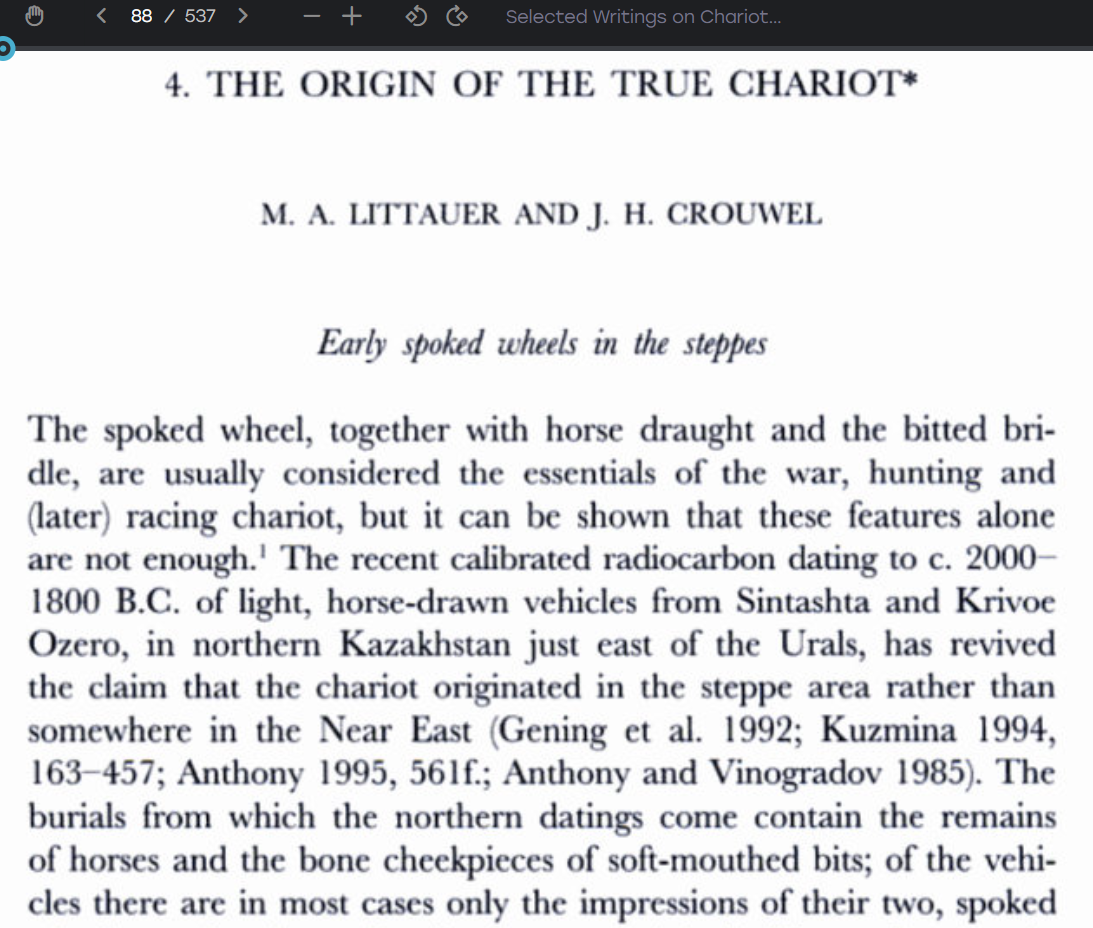
A common objection is based on the definition proposed by Littauer and Crouwel (1979), which classifies a chariot strictly as a two-wheeled, horse-drawn vehicle equipped with spoked wheels. According to this criterion, the Sinauli vehicle’s solid wheels would exclude it from being considered a chariot. However, this objection fails to account for the broader archaeological and historical record. Solid-wheeled chariots are well-attested in ancient Mesopotamia particularly in Sumer and Early Dynastic Ur where they were deployed in warfare and served as effective mobile platforms for archers. These vehicles, despite lacking spoked wheels, are universally acknowledged as chariots within Near Eastern archaeology. Their existence demonstrates that early chariot forms varied significantly across cultures, shaped by local technological traditions and material constraints. Thus, restricting the term “chariot” exclusively to spoked-wheel, horse-drawn models is both historically inaccurate and conceptually narrow. The Sinauli vehicle fits within the broader, archaeologically grounded definition of early chariots, which encompasses solid-wheeled, combat-capable vehicles used for speed, mobility, and martial purposes in multiple ancient civilizations.
A second argument proposes that the Sinauli vehicle was not a chariot but a bullock cart or a war cart drawn by bulls. This interpretation, however, is contradicted by the vehicle’s geometry particularly the yoke length which provides strong biomechanical and structural evidence for horse traction rather than bovine. The turning capacity of any vehicle, whether for transport or warfare, is determined by fundamental principles of steering geometry. These include Ackermann steering angle, front–rear wheel distance, the vehicle’s wheelbase, and any mechanisms allowing dual-wheel steering. A low turning radius is universally desirable, as it allows manoeuvrability across varied terrain, narrow passages, and architectural constraints. Crucially, longer vehicles inherently require larger turning radii unless compensated by sophisticated steering mechanisms. The Sinauli chariot’s yoke measures approximately 230 cm (2.3 m). This dimension is inconsistent with the physical proportions of zebu bulls, whose average body length ranges from 1.5 to 1.8 m, with rare individuals approaching 2.0 m. In contrast, an average horse is significantly longer approximately 2.0 m, with high-quality breeds reaching or exceeding 2.3 m. Designing a yoke substantially longer than the animal pulling it would unnecessarily increase the turning radius, rendering the vehicle inefficient and impractical. Hence, the long yoke of the Sinauli vehicle strongly indicates that it was intended for an animal of greater body length namely, a horse.

Additional structural considerations also undermine the bullock-cart hypothesis. Ox-drawn carts require a shorter yoke and a wider, longer yoke-arm to accommodate the hump and distribute traction across two yoked oxen. Conversely, horse-drawn chariots employ a long yoke paired with short yoke-arms, reflecting the horse’s neck-based harnessing system rather than a hump-support mechanism. The Sinauli vehicle conforms precisely to this latter configuration: a long yoke and short yoke-arms, matching the standard biomechanics of horse traction rather than bovine traction. Therefore, based on vehicle geometry, animal biomechanics, and yoke architecture, the Sinauli vehicle aligns with the design principles of horse-drawn chariots. The hypothesis of it being a bullock cart is incompatible with these technical and anatomical parameters.
Rigvedic Interpretation of the Sinauli Chariot (source)
The Rigveda refers not only to horse-drawn chariots but also to chariots drawn by oxen, indicating that both forms of traction coexisted during the Rigvedic period. One verse describes “the golden-hued, swift horses yoked for the morning chariot and for the evening chariot,” reflecting a symbolic as well as practical use of equids in ritual and mobility contexts. The Rigveda also clearly speaks of wooden chariots, though naturally the wooden components of ancient vehicles such as those at Sinauli have decomposed over time. In fact, certain hymns specify the preferred types of wood used for constructing different parts of the chariot, demonstrating the technical knowledge embedded in Vedic tradition. At Sinauli, however, the original wooden elements of the vehicles no longer survive, making it impossible to determine which species of wood were used. The surviving components mainly copper reinforcements, wheels, and metal fittings allow for reconstruction of the vehicle’s design but not the exact timber choices employed by the ancient craftsmen.

Rigveda, VI.47.26. Ed. Rupesh Thakur Prasad Prakashan, Varanasi.
Moreover, the Rigveda explicitly mentions the types of wood preferred for constructing chariots, indicating an advanced understanding of suitable materials and their functional properties. Unfortunately, in the case of the Sinauli vehicles, the wooden components have completely decomposed, making it impossible to identify the specific timber species originally used.

Rigveda, X.85.20
According to the above Rigvedic verse, chariots of the early Vedic period were constructed using the wood of Bombax ceiba (शल्मलि, Śalmali), commonly known as Semal, a tree widely distributed across present-day Uttar Pradesh. Other verses also refer to the use of Dalbergia sissoo (Indian rosewood or Shisham) a species native to Bhārat (India) for manufacturing chariot parts. It is therefore plausible that such locally available hardwoods were used in the construction of the Sinauli vehicles as well, although no scientific analysis has yet been conducted due to the complete decomposition of the wooden components. While the Mahābhārata and other later Hindu texts describe elaborate chariots, it is the Rigvedic descriptions that most closely parallel the features of the Sinauli finds. The chariots recovered from Burial Nos. 3 and 6 at Sinauli are two-wheeled, and significantly, the Rigveda also mentions two-wheeled chariots, marking another point of convergence. A striking detail is the triangular copper inlay adorning the wheel, pole, and yoke of the Sinauli chariot. The Rigveda contains a verse describing chariots decorated in a manner that evokes the rays of the sun. At Sinauli, the copper triangles arranged in circular sequences on both the inner and outer faces of the wheels radiate outward exactly like stylized solar rays, offering a remarkable material parallel to the poetic imagery preserved in the Rigveda.

Rigveda, VI.47.27.

Sinauli chariot wheel as it was found on left side and the reconstructed imagery on right side. Wheel of the chariot with copper inlay similar like rays of sun, as described in Rigveda.
According to ASI data, the Sinauli vehicle’s yoke measured only 95 cm in total length (about 42.5 cm on each side). In contrast, the average body width of a zebu bull ranges between 57–71 cm. This makes it physically impossible for a zebu bull to fit within the Sinauli yoke its width is simply too great, and the yoke is far too narrow. Bull-drawn vehicles also require much wider yokes, because bulls do not pull from the neck but from the hump, which pushes the yoke forward. The Sinauli yoke’s dimensions therefore cannot match bovine traction requirements. Despite this, some argue that the yoke is “too heavy” for an equid spine an objection that is meaningless, since no published data on the yoke’s weight exists. In reality, equid yokes were common, and around 2000 BCE, equids were typically controlled using a yoke saddle, with each animal fitted with a cheekpiece connected to a harness. Nearly all equid-drawn vehicles of this period were equipped with yokes, making the Sinauli vehicle’s design fully consistent with equid traction and completely inconsistent with bull traction.

Reconstructed Image
The following are several arguments that strongly support classifying the Sinauli wagon as a chariot.
- The carriage of the Sinauli wagon is small and designed in such a way that the occupant must stand rather than sit. Clearly, this mode of conveyance is unsuitable for travelling long distances.
- The lack of space on the carriage also indicates that it was not intended for the transport of goods. Since this design is unsuitable for the transport of either humans or goods, the most plausible remaining purpose is that it served as a war machine.
- The individuals buried with the vehicles were interred with weapons, indicating that they were warriors. This further strengthens the argument that the Sinauli wagons were used in battle.
- The long length of the yoke allows for greater distance between the carriage and the animal, facilitating quick and unhindered movement, including the ability to make sharp turns. A fast-moving, highly manoeuvrable vehicle is much more consistent with warfare than with ordinary transport.
- The overall layout of the Sinauli wagon — especially the carriage with a dashboard in front — is identical in size and design to the later Bronze Age lightweight chariots known from the Near East and, centuries later, from Iron Age Europe. Considering the points above, it appears likely that the Sinauli wagon was designed as a fast-moving, lightweight war vehicle.
- Both the horse and the spoked wheel were well known in north-west India during the Harappan period. If horses were already familiar, it is reasonable to expect that the Harappans recognized that horses could easily outrun bulls; therefore, their use in pulling the Sinauli wagon is highly probable. This argument is further validated by the striking resemblance between the Sinauli wagon/chariot and the design of later horse-drawn chariots known from archaeological evidence. It is unlikely that a vehicle originally designed to be pulled by bulls could simply be switched and used by horses for centuries without major structural redesign.
- The primary objection raised is the absence of spoked wheels. However, as the earliest known chariot specimen, it is entirely plausible that the Sinauli example reflects an early experimental phase in which both solid and spoked wheels were used, prior to the later standardisation of the spoked wheel. Additionally, the wheels symbolically represent the radiating Sun, and the chariot functioned as a solar symbol during the Vedic period. This symbolic aspect, together with the burial rites at Sinauli, connects the Sinauli people with the Vedic belief system. This also implies that the Mitanni Indo-Aryans in Syria who invoked Vedic deities and are believed to have introduced chariots into the Near East may have been related to the Vedic population represented at Sinauli.
Given the cumulative weight of these points, there are no substantial grounds to deny the assertion that the Sinauli wagon represents the earliest known specimen of the Bronze Age chariot.

(Book:- the-spirited-horse-equidhuman-relations-in-the-bronze-age-near-east) The Near East shows a well-established technological sequence in which early warfare relied on heavy, solid-wheeled, equid-drawn vehicles before the later emergence of lightweight, two-spoked chariots. The Sinauli chariot fits perfectly into this broader evolutionary trajectory. Its solid wheels, copper reinforcements, and clear martial context parallel the early Near Eastern war vehicles that were also pulled by equids and used exclusively in combat. This suggests that Sinauli represents an indigenous, Bronze Age stage in the same technological continuum — an early war-car advancing toward the later spoked-wheel chariot tradition. Far from being an outlier, the Sinauli vehicle demonstrates that such innovations were not limited to the Near East but were developing in parallel within the Indian subcontinent.
Iconographies —

This Tablet depicting 4 Equid drawn chariots (tho the appearance of the Equids appers close to a Wild Ass or some onager hybrid due to the large Face, which closely rather then any steppe related breed as mentioned in Rigveda) the tablet was authenticated by Oxford Authentication using thermoluminescence dating method on May 14th, 2019. The result of authentication confirmed that the date was between 2,300 and 3,600 years ago, that is, 1,600 BCE to 300 BCE.
Chariots in the Rigveda — Textual, Archaeological & Metaphorical Context

Below Information is taken from this paper
The “Pre-1500 BCE vs. Post-1500 BCE” Problem
Mainstream scholars historically rejected evidence for horses or chariots before 1500 BCE in South Asia (i.e., before the supposed Aryan arrival), but accepted identical evidence after 1500 BCE, often authored by the same experts (Danino, in press-b). Yet, they have never demonstrated any significant increase in horse/chariot remains or depictions after 1500 BCE.
Exaggerated Horse Numbers in Rigvedic Hymns
In RV 2.18.4–6, Indra is invoked with 2, 4, 6, 8, 10 … up to 100 horses. This cannot realistically describe actual teams of yoked horses.
Rudolf von Roth understood this clearly: —
“The Veda does not know the Steppe’s herds of horses; the horse is a rare and valuable animal … owned and given away not by the hundreds and thousands, but in single pairs or at least in moderate numbers.” (Roth 1881: 686)
Thus, Rigvedic emphasis on horses/chariots does not reflect a horse-rich steppe society, but rather suggests that horses were rare, elite-status symbols (Leach 1990: 240).
Dasyus and Panis with Aśvas and chariot in the Rigveda.
Rigvedic passages show unmistakably that Dasyus and Panis also possess both aśvas and rathas, challenging the assumption that horses and horse-drawn chariots were exclusive markers of “Aryan” identity. Indra–Soma, acting “by means of the truth (eva satyam),” shatters the stable where the Dasyus were keeping “horses and cows” (aśvyam goh, 4.28.5). In another hymn, Indra’s human allies recover the Pani’s wealth: “the Paṇi’s herds of horses and cows” (1.83.4). This directly contradicts claims that only Indo-Aryans possessed these animals or technologies.
Even invasionist interpretations become self-defeating here: if we apply the same literal colonial reading historically imposed on the Vedas, we would be forced to admit that Dasyus and Panis had their own horses — which would completely negate the idea that the animal (or the chariot) was introduced by incoming Aryans. Instead, the Vedic landscape appears overcrowded with aśvas and rathas, far removed from the simplistic “Aryans vs. horse-less natives” narrative.
Leach (1990: 240) correctly notes that Rigvedic emphasis on horses and chariots does not resemble a horse-rich steppe culture. Rather, the pattern suggests rare, high-status elite symbols, sometimes literal, sometimes allegorical. In this symbolic dimension — emphasized by Sri Aurobindo — Dasyus and Panis possess cows (lights) and horses (powers/energies) but hoard them selfishly, violating ṛtam, the cosmic order.
The Rigveda explicitly presents these “treasures” as cosmic powers to be released, not as livestock in tribal raids. The final verse of the Sarama–Pani dialogue states: “Let out the cows which, hidden, infringe the Order!” — a clear reference to ritam, not to stolen animals in a cave. Hence Indra is entitled to seize the treasures “by means of the truth,” not as a marauding chief expanding pastureland, but as the deity who restores cosmic balance.
Yet even when read literally, the text remains incompatible with AIT assumptions. After slaying two Dāsas, Indra distributes spoils including “ten horses, ten casks, ten garments … ten chariots with side-horses, a hundred cows” (6.47.23–24). He repeatedly “gains possession of the sun and horses … and the cow of plenty” (3.34.9), boasts of “winning cows and horses” (10.48.4), and is invoked to “break open cattle and horses in their thousands” (8.34.14) and “split apart the enclosure of the cow and the horse” (8.32.5). He “found the cattle, found the horses” (1.103.5), is “the best winner of horses” (1.175.5), and “finder of horses” (9.61.3). But if the Aryans supposedly brought horses into India, why does Indra need to find, win, or recover them from others?
The Sarama–Pani dialogue (1.108.7) makes the ownership unambiguous: the Panis boast of a treasury “replete with cows and horses and treasures (gobhir aśvebhir vasubhir)”. Not once does Sarama accuse them of stealing from Aryans; she openly states she comes in search of their treasures (10.108.2), yet asserts Indra’s rightful claim over them.
Two conclusions follow: —
- The notion that Dasyus or Panis stole cattle or horses from Aryans is a colonial-era fabrication, one of the many “sub-myths” generated to support the invasion narrative.
- The Rigveda itself presents a world where multiple groups possess aśvas, cattle, and even chariot wealth, rendering the “Aryan importation” thesis inconsistent with the textual evidence.
By restoring symbolic depth and acknowledging literal inconsistencies, the simplistic invasion model collapses — revealing a far richer Rigvedic vision in which rathas and aśvas are shared cultural motifs, not ethnic markers.
What Exactly Was the Rigvedic Ratha?
Basic Description
The RV clearly describes a vehicle with:
- usually two wheels (Also sometimes more),
- a central pole,
- room for two people (sometimes up to eight).
Scholarly Attempts at Reconstruction
Scholars diverge heavily: —
- Most imagine a “small, exceedingly light” chariot (Chakravarti 1941: 27).
- Others argue for a large, more substantial vehicle (Sparreboom 1985: 11–12).
Even Sparreboom admits: —
“The reconstructed picture of the Vedic ratha is not yet complete … technical terms are not fully or not at all understood.”
Kazanas summarizes the contradictions: —
- ratha is described as pṛthu (“broad”), bṛhat (“tall”),
- variṣṭha vandhura (“widest seating space”),
- trivandhura (“three-seated”),
- aṣṭavandhura (“eight-seated”).
The only real-life ratha described in action (RV 10.102) is drawn by oxen, not horses. Across the 1,000 hymns, there is not a single unequivocal reference to a real horse-drawn chariot in an actual battle.
Kazanas concludes: —
Scholars projected Greek–Roman “chariots” onto the RV; the notion stuck (Kazanas n.d.: 2).
4. The Ratha as Metaphor, Allegory, and Ritual Symbol
4.1 Solar and Dawn Imagery
The chariot of Uṣas (Dawn) or the Sun is clearly metaphoric. Yet Dawn is also said to shower:
- cattle
- horses
- chariots
Here horses = energy/light, cattle = abundance, and chariots = ritual potency.
4. Chariots in Poetic Comparisons
Poets compare: —
- rivers to chariots (1.130.5, 10.75.8),
- the composition of a hymn to chariot-making (1.130.6).
4. Chariots Standing for Ritual and Poetry
Sparreboom notes: —
“The chariot stands for the word, the well-composed hymn, the ritual ceremony or sacrifice as a whole.” (1985: 20)
Jamison & Brereton (2014: 24) similarly state that the ritual itself is frequently identified with a chariot.
5. Cosmic & Theological Symbolism
Indra props heaven and earth apart as an axle holds two wheels (Sparreboom 1985: 25). The Aśvins’ chariot: —
- is “threefold,”
- swifter than thought (RV 1.118.1),
- drawn by bulls, buffaloes, horses, birds, geese, falcons,
- travels heaven, earth, mountains, plants, seas (Jamison & Brereton 2014: 48).
This imagery becomes the basis for later vāhanas (Gonda 1965: 71 ff.).
6. The Ratha as War-Chariot? A Misreading
Vedicists frequently translate ratha as war-chariot: —
- Jamison & Brereton: “battle-chariot” (6.26.4)
- Geldner: “Kriegswagen” (7.74.6)
- Doniger, Renou, Bloomfield, Sarva D. Singh also assume war-usage.
But the Sanskrit term never inherently means “war chariot.”
Karen Thomson argues: —
In all nine RV passages containing √vah, ratha, and aśva, the rathas are imaginary, heavenly vehicles. (Thomson 2009a: 35)
Thus calling them war chariots is misleading.
7. Chariots of Truth, Mind, and Consciousness
- ṛathasya rathaḥ — “chariot of Truth” (2.23.3)
- rathīr ṛtasya — the deity is “charioteer of truth” (Agni, Pūṣan)
- Agni as “charioteer of the Wondrous” (1.77.3)
8. Manas-yoked (mind-yoked) horses and chariots
references describe: — “mind-yoked horses” (5.75.6). “mind-yoked chariot” (8.5.2). Agni’s 99 mind-yoked horses (1.14.6). Vāyu’s mind-yoked team (4.48.4)
8. Chariots Made of Mind: Deepest Symbolism
Frits Staal analyses: — Poet building “the high seat of the chariot in his mind” (7.64.4). Sūryā’s wedding hymn: she travels in a “chariot of mind” (10.85). The enigmatic “new chariot without wheels made by the mind” (10.135). Staal suggests Indo-Aryans brought the concept of the spoked chariot mentally. But this contradicts the overwhelmingly symbolic and metaphysical nature of Vedic chariot imagery.
9. Chariot as Vehicle of Thought, Sacrifice, and the Path to Heaven
Jeanine Miller gives the most coherent interpretation:
The rite is often a ‘ship’ or ‘chariot’; it bridges the two shores of terrestrial and divine realms. (Miller 1985: 214)
This explains metaphors such as:
- cows yoked to chariots (8.94.1),
- Dawn yoking “ruddy cows” (1.124.11).
Grotesque physically, but meaningful symbolically: the mind (chariot) is guided by light (cow).
Conclusion
Across the Rigveda:
- horses are rare, elite markers — not steppe-like abundance.
- chariots are overwhelmingly symbolic, cosmic, ritual, poetic — not battlefield vehicles.
- ratha ≠ war chariot, nor even always a physical vehicle.
- Chariot imagery bridges ritual, cosmology, poetic craft, metaphysics, and consciousness.
The RV’s chariot is primarily a vehicle of truth, mind, thought, light, and ritual power, not an archaeological record of invading steppe warriors.
The Spoked Wheel in the Rigveda ?

Karen Thomson directly questions the assumption that the Vedic people moved about in spoked-wheel chariots. She stresses that nothing in the Rigvedic poems supports this idea. According to her, Rigvedic “chariots” are overwhelmingly divine vehicles, with one to seven wheels, travelling in the sky, often accompanied by winged horses or birds. In other words, these “chariots” are mythic, cosmic, and symbolic, not physical war-vehicles.
Translation Issue: The Word aratí
Thomson criticizes Jamison & Brereton’s (J&B) new translation for repeatedly rendering aratí as “spoked wheel” — a choice appearing twenty-two times — even though the term was traditionally understood to mean “servant,” “messenger,” or “attendant.” Louis Renou endorsed “messenger.” Earlier translators such as: —
- Griffith – “messenger,”
- Sri Aurobindo – “Traveller,”
- Oldenberg – “steward” (though “approximative and conjectural”), all avoided linking aratí to wheels.
Thomson therefore calls J&B’s translation “strange” and suggests that introducing “spoked wheel” into the Rigveda may even be “irresponsible” given the “current frantic search” for spoked-wheel evidence in the Indus Valley (2016:4).
Consequences of the “Spoked Wheel” Mis-Translation
If aratí means messenger, then several famous J&B passages become misleading. Agni is repeatedly called: —
- the “spoked wheel of the two world halves,”
- the “spoked wheel of earth,”
- the “spoked wheel of heaven,”
- the “spoked wheel of the gods,”
- the “spoked wheel of the sacrifice,”
- the “spoked wheel of the descendants of Manu.”
But these make no contextual sense. In each case, Agni is actually functioning as: —
- messenger of the two world-halves,
- messenger of earth to heaven,
- messenger of the gods,
- messenger of humankind,
- messenger of the sacrifice.
This reading matches explicit verses describing Agni with the common term dūta (“messenger”) — e.g., RV 1.12.1, 4.9.2 — and follows Macdonell’s explanation: — “Agni is characteristically a messenger as an intermediary between heaven and earth.” (1917/1976:102) Thus aratí and dūta lie in the same semantic field, differing only by nuance.
Are There Any True “Spokes” in the Rigveda?
The Actual Word for Spoke: ara
The legitimate word for “spoke” is ara, which occurs only 11 times in the entire Rigveda — and always in metaphorical contexts. Examples include: —
- Indra encompassing all peoples like a rim encompasses spokes (1.32.15).
- The same rim–spoke imagery used twice for Agni (1.141.9, 5.13.6).
- Indra hammering two demons as one hammers spokes into a nave (8.77.3).
- The Maruts being innumerable, like spokes of a wheel (5.58.5; 8.20.14).
Crucially, ara occurs only once alongside chakra (“wheel”) (RV 1.164.11–13), in the famous allegorical hymn describing: —
- a twelve-spoked wheel of truth,
- 720 sons in pairs (360 days + 360 nights),
- the cosmic “Father” with five feet and twelve forms,
- a being “mounted on seven wheels and six spokes.”
This hymn is universally understood as describing the cosmic wheel of time—not a real, physical wheel.
The Only “Spokes of a Chariot” in the Entire Rigveda
The spoke appears one single time with a chariot (10.78.4), but even there:
- the context is entirely metaphorical, and the “spokes of chariots” lack any wheel!
This means not a single Rigvedic passage ever presents a real chariot with real spoked wheels.
The Absence of Real Spoked-Wheel Chariots
When all evidence is examined carefully, a striking pattern emerges
Key Findings
- The Rigveda never once describes: —
- a realistic chariot,
- with spoked wheels,
- drawn by horses,
- on earth,
- in any concrete, practical situation.
- References to wheels, spokes, chariots, or horses occur, but: —
- almost always separately,
- almost always allegorically,
- almost never in a way that forms a coherent real-world image.
- The text repeatedly frustrates expectations: “The closer we look, the further they fade.”
Thus the Rigveda does not provide evidence for the historical use of physical, horse-drawn, spoked-wheel chariots.
Implication
Under these conditions, Witzel’s confident claim about:
“the use of the horse-drawn chariot in sport and war during the RV” (2001: §21)
has no textual foundation, because the Rigveda itself never describes such a vehicle.
Summary
- Thomson rejects the idea of Vedic spoked-wheel chariots; Rigvedic “chariots” are divine, symbolic, often airborne.
- The word aratí was mistranslated by J&B as “spoked wheel,” despite long scholarly tradition translating it as “messenger.”
- This mistranslation distorts many key Agni passages; Agni is consistently a messenger, not a wheel.
- The genuine word for spoke, ara, appears 11 times, always metaphorically.
- Only one verse mentions “spokes of chariots,” and even there no wheel is present.
- The famous “twelve-spoked wheel” hymn (RV 1.164) is a cosmic allegory, not mechanical description.
- Not once does the Rigveda combine chariot + spoke + wheel + horse in a realistic earthly context.
- Therefore, the Rigveda cannot be used as evidence for horse-drawn, spoked-wheel war chariots.
Is ratha = spoked-wheel chariot?
Sanskrit cakrá, In RV 1,164,48, the year is compared to the (solid disk) wheel (cakrá). AIT supporters argue that the “Aryans” entered India from the Ukraine steppes with spoked-wheel chariots identified with the word ratha. According to Hock (1999a:12–13), “those familiar with Indo-European linguistic paleontology and with the archeological evidence in Eurasia agree that the use of the domesticated horse spread out of the steppes of the Ukraine, and so did the horse-drawn two-wheeled battle chariot… these features spread into India along with the migration of Indo-Aryan speakers.” Witzel (2000a:§15) similarly claims that “linguistic and textual studies confirm the presence of an outside, Indo-Aryan speaking element, whose language and spiritual culture has definitely been introduced, along with the horse and the spoked wheel chariot, via the BMAC area into northwestern South Asia.”
Leaving aside the problems that (a) such spoked-wheel chariots could not have crossed the mountainous regions between Ukraine and Punjab, and (b) no such chariot belonging to the so-called migrating Indo-Aryans has ever been found anywhere, the word ratha itself originally — and for a long time even after the invention of the spoked wheel — meant simply a “wheeled vehicle,” not specifically a “two-spoked-wheel horse-chariot.” Cognate words in other IE branches confirm this: Celtic rath, Latin rota, German Rad, and Lithuanian ratas all mean “wheel” or “cart.” Only later in Sanskrit does ratha narrow to the meaning “chariot.”
In the Old Rigveda, there is no separate word for “cart”: ratha itself means “cart.” Later, in the New Rigveda, the term anas appears and is contrasted by philologists with ratha, with anas referring specifically to a “cart.” The word anas appears only three times in the Old Rigveda — twice (II.15.6; IV.30.10–11) referring to the divine vehicle of Uṣas (Dawn), derived from the root an- (“to breathe”), connected to the rising sun, and once in III.33.9–10, where it is paired with ratha to show its extended meaning of “cart.” In the New Rigveda, anas appears ten times: eight with the clear meaning “cart,” and two again as the divine vehicle of Dawn.
Talageri notes that the Rigveda contains no reference to spokes (ará) in the older strata of the text. These references appear exclusively in the newer books, confirming that the technology of spoked wheels — developed sometime during 2500–2200 BCE — was unknown to the composers of the Old Rigveda (Books 2–4, 6–7) and enters only in the New Rigveda (Books 1, 5, 8–10). This implies that the Old Rigveda predates the invention of spokes. While a single lexical item cannot, by itself, establish a chronology, Talageri’s systematic investigation into new words began in 2001 during an online debate on spoked wheels (involving Witzel and Farmer on one side and a group of NRIs on the other). This inquiry developed into his analysis of Mitanni name-types, common Rigvedic–Avestan names and vocabulary, and later into his book The Rigveda and the Avesta — The Final Evidence (2008), followed by his article The Chronological Gulf Between the Old Rigveda and the New Rigveda (2020). These studies now culminate in his forthcoming article The New Words and Other New Elements in the Rigveda. Taken together, this large body of linguistic and textual data places the Old Rigveda far back beyond 2500 BCE, composed in the region east of the Sarasvati in modern-day Haryana.
Talageri argues that this cumulative evidence has left the AIT establishment without substantive counter-arguments, leading instead to stonewalling, repetition, and circular restatement of earlier assumptions in so-called peer-reviewed publications. In recent years, however, a more concerning academic pattern has emerged: the initiation of large-scale disinformation campaigns aimed at undermining key pieces of evidence that contradict the AIT. For example, after over two centuries of firm academic consensus identifying the Rigvedic Sarasvati with the Ghaggar–Hakra system of Haryana, Western scholars have abruptly reversed their position and now campaign to deny this identification. Johanna Nichols, who previously argued that the diffusion of Indo-European languages proceeded westward from the Bactria-Margiana region, has been compelled to issue a written retraction reminiscent of ideological recantations from the Stalinist era. Similarly, W. E. Clark has recently argued in an academic paper that the Mitanni rulers possessed no Indo-Aryan affiliations whatsoever. In this context, Stephanie Jamison has attempted to challenge the linguistic evidence on spokes by asserting that references to spoked wheels occur not only in the New Rigvedic books but throughout the entire Rigveda. In her translation, she renders all occurrences of ará as “spokes,” which is correct, but she further proposes that the Rigveda contains several references to “spoked wheels” themselves. She identifies the word arati as meaning “spoked wheel,” citing a series of verses (I.59.2; 1.128.6, 1.128.8; II.2.2–3, 4.2; III.17.4; IV.1.1, 2.1; V.2.1; VI.3.5, 7.1, 12.3, 15.4, 49.2; VII.5.1, 10.3, 16.1; VIII.19.1, 21; X.3.1–2, 6–7, 61.20). However, standard Sanskrit dictionaries do not support this interpretation. Monier-Williams glosses arati as “moving quickly; a servant, assistant, manager,” while Cappeller lists meanings such as “assistant, minister, disposer; discomfort, uneasiness.” When examining the translations of established Western scholars Griffith, Wilson, Grassmann, and Geldner in the verse I.59.2 (mūrdhā divo nābhir agnir pṛthivyā athābhavad aratī rodasyoh), none translate arati as “spoked wheel.” Instead, they render it as “messenger,” “ruler,” “servant,” or “manager,” consistent with the dictionary definitions. This undermines the claim that the Rigveda contains widespread references to spoked wheels, reinforcing Talageri’s conclusion that such technology was unknown in the earlier layers and appears only in the later strata.
Ratha as attested in the RgVeda doesn’t always mean a chariot even David Anthony and Mallory and Adams have used both chariot and wagons for Ratha. In RgVeda 1.34.9 a mention of Ratha is there drawn by assess (rāsabha) and in RgVeda 10.102.6 the bull is yoked. Even Maharshi Patanjali makes mention do different Rathas pulled by bulls, camels and donkeys apart from horses.


Ratha Chariot/Wagon/


Proto-Indo-European oxford
Associate chariot or rátha with Indo-European culture based on usage in Rig Veda. The definition of the term “Ratha” has been changed to suit some Indologists needs. The only real life event which uses the word ratha in Rig Veda is for a bull pulled ‘ratha’. Somehow ratha meaning changed to exclusively denote spoked wheel horse pulled ‘truest’ war chariot. It is incorrectly assumed that only horse-pulled spoked wheeled vehicles are markers of Indo Iranian culture. Rig Veda mentions a race in which the bull pulled chariot of the Mudgala-Mudgalini duo is the victor of the race. As per Kazanas, this is the only real-life chariot event in Rig Veda. Proof that RV also used the word ‘ratha’ for a bull pulled vehicle :-
10.102.1 starts describing Mudgala’s race
प्र ते॒ रथं॑ मिथू॒कृत॒मिन्द्रो॑ऽवतु धृष्णु॒या । अ॒स्मिन्ना॒जौ पु॑रुहूत श्र॒वाय्ये॑ धनभ॒क्षेषु॑ नोऽव ॥ प्र ते रथं मिथूकृतमिन्द्रोऽवतु धृष्णुया । अस्मिन्नाजौ पुरुहूत श्रवाय्ये धनभक्षेषु नोऽव ॥ “May (Indra) by his prowess protect your cart (mudgala) that has no companion, defend us, O invoked of many, in this memorable conflict in the recovery of our wealth.”
(translation by H. H. Wilson). Commentary by Sāyaṇa: Ṛgveda-bhāṣya Legend: the oxen of mudgala were carried offclub in front of him. It conducted him to the robbers, and he got back his cattle. Rig Veda 10.102.2 — “The wind raised her vesture when she won a thousand cart-loads. Mudgalānī was the charioteer in the quest of the cattle, the army of Indra recovered (the spoil) taken in battle.”
A bull pulled vehicle, made Mudgala win the race and cattle in prize. Rig Veda 10.102.5 “Approaching the bull, they made him roar in the midst of the battle. I, Mudgala, have thereby gained in war hundreds and thousands of cattle well-pastured.” Victory of the bull pulled vehicle. Rig Veda 10.102.10 “Who has thus beheld the evils near at hand? The (bull) which they yoke, they stop; to him they bring neither fodder nor water. Being above (the bull) he bears the chariot-pole announcing (victory to his lord).” To end it. Rig Veda 10.102.11 “As a wife who has been abandoned rejoices to find her husband, as a cloud expanding when pouring forth rain with the aid of the earth’s disc; with her eager (to recover the cattle) for our charioteer, may we win (the prize), may good fortune, together with food, be given to us.” [#Note:- H.H. Wilson translation u find “cart” instead of charriot for the term “Ratha” which is in the original Sanskrit verse, but not only Wilson even Griffith translation of the whole Sukta 10.102 where a bull pulled ‘ratha’ wins the race for the rathi who are mudgalani and mudgala. Wonder why Griffith transalted ratha into ‘car’ for this sukta.] The solidification of what defines a ‘ratha’ happened only after the spoked wheel vehicle discovery in Sintashta Arkaim complex. So the bull pulled ‘ratha’ in Mudgalini’s race in RV is suddenly not a ‘ratha’ anymore by Indologist’s standard, whereas RV explicitly mentions it is. Indo-Europeanists JP Mallory and DQ Adams had written that the Sanskrit word ratha can mean wagons, apart from chariots. Even David Anthony who had written up many notes on the chariot warriors of bronze steppes had noted that ratha can mean wagons. This seems to be the correct perspective, since in Rig Veda 10.102.6, the ratha is pulled by bulls, in RV 1.34.9 the 3 seated ratha is pulled by donkeys, in RV 10.53.7 there is reference to even 8 seated ratha. All these may not refer to war chariots obviously. Patanjali makes mention of different ratha pulled by bulls, camels and donkeys, apart from horses. All these indicate that ratha did not exclusively refer to horse-drawn war chariots. Hence, there’s no reason to assume that the Sintashta ‘chariot’ culture (this view is not endorsed by all archaeologists) represent the earliest stage of Indo-Iranians. The war-chariots may very well have been a later innovation among the undivided Indo-Iranians and the Indo-Iranian unity may itself date much earlier prior to the innovation of actual war-chariots. Further, in this context nothing stops one from considering the Sinauli chariot of Uttar Pradesh associated with copper-hoard culture (which has indigenous origin) as proper ratha.
Rigvedic Ratha (Chariot/Car/Cart/wagon)
Understanding Vedic Metaphors and Misinterpretations Without grasping the symbolic language of the Rigveda, modern readers may wrongly accuse Vedic poets of using “hopelessly mixed metaphors” (Bergaigne 1936: 61). Bergaigne complained about “the cacophony of the [hymns’] discordant metaphors”: for example, the Aśvins are invoked to take supplicants across to the “far shore” in a “ship”, yet are simultaneously asked to keep their chariot ready (1.46.7–8). This seems contradictory unless we recognize the symbolism: it is the “ship of our prayers” (1.46.7), and the only path to the other shore is the “path of the truth” (1.46.11). (Bergaigne in Danino 2019; Bergaigne 1935–36, Annals of the BORI 17(1): 61–83.)
Does ratha Always Mean a Physical Chariot? The term ratha cannot automatically be assumed to indicate an actual, physical war-chariot. While Dawn and the Sun clearly have symbolic chariots in their cosmic roles, Dawn also bestows “cattle, horses and chariots” (7.77.5), representing symbolic gifts such as light and energy. The meaning of “chariots” in such verses is therefore metaphorical, not literal. (Danino 2019.)
Evidence of Chariots: AIT vs. Indigenous Interpretation A major debate relates to the presence of horse-drawn chariots in the Rigveda. AIT supporters claim that because archaeological finds of such chariots allegedly “do not predate the 2nd millennium BCE,” the Rigveda must be younger than 2000 BCE. But several contradictions undermine this — No actual war-chariots have been excavated from Andronovo, BMAC, or post-Harappan “Indo-Iranian” sites — contradicting AIT expectations. Talageri argues that spoked-wheel chariots appear only in the youngest parts of the Rigveda, while the older layers describe carts with four solid wheels. The development of spoked wheels occurs within the Rigvedic period, meaning earlier layers predate this innovation. (K. Elst 2018, Still No Trace of an Aryan Invasion.)
Metaphorical Chariots in Later Indian Tradition The Vedic metaphor continues into later Indian thought. B.K.S. Iyengar writes: “The consciousness is like a chariot yoked to a team of powerful horses. One of them is breath (prāṇa), the other is desire (vāsanā)” (Iyengar 2001(2): 47). This reflects continuity of Vedic symbolic vehicles. (Iyengar in Danino 2019.)
Kazanas on Ratha: Not a Slim, Light War-Chariot Kazanas repeatedly argues that the Rigvedic ratha is not a narrow, two-wheeled, NE (Near Eastern)–style war-chariot but a larger cart for multiple passengers. (Kazanas in Elst 2018.) Kazanas (2002) explains that the ratha of the Rigveda differs fundamentally from 2nd-millennium Near Eastern chariots. Numerous verses describe large, broad, tall vehicles unsuitable for rapid battlefield maneuvering.
Vedic Chariots Were Made of Native Indian Wood The Rigveda explicitly states that chariots were made from Indian trees such as khadira and siṃśapā (3.53.19), and kiṃśuka and śalmali (10.85.20). Since these include early Mandala references, Vedic people were building chariots using local timber “right from the start” — contradicting the AIT claim that chariots were brought in from Central Asia. (Kazanas, Indigenism and the Collapse of the AIT, Adyar Library Bulletin 2014–15.)
Size and Structure: Broad, Tall, Wide, Multi-Passenger Unlike lightweight NE/Egyptian war-chariots: — prthu “broad” (1.123.1) bṛhat “tall, big” (6.61.13) variṣṭha “widest box/seating area” (6.47.9) trivandhura “three-seated” (1.41.2; 7.71.4) aṣṭāvandhura “eight-seated” (10.53.7) These descriptions prove that Rigvedic vehicles were large multi-seat carts, not battlefield chariots. (Kazanas, Indigenism and Collapse of AIT.)
Harappan Spoked Wheels and Seal 3357 Seal №3357 shows a human figure standing on two six-spoked wheels. Parpola (though AIT-leaning) identifies them as spoked wheels and acknowledges that war-chariots appear later. This seal contradicts the idea that spoked wheels were introduced by incoming Aryans. (Kazanas 1999, Annals of BORI.)
Summary on Rigvedic Ratha —
Kazanas concludes that Rigvedic ratha is broad, tall, wide, multi-seated, sometimes drawn by oxen (10.102), and never used in any real battle scene. No hymn mentions a single real horse-drawn war chariot in combat. The 19th-century “war-chariot” translation was a projection of Greek/Roman imagery. (Kazanas in Danino 2019.) Archaeological Evidence for Indigenous Chariots and Horses — B.B. Lal documents the presence of horses in several Harappan sites and terracotta models of spoked wheels, contradicting the AIT narrative. (B.B. Lal cited in Elst 2018.) Symbolic Meaning: Chariot and Ship as Ritual Vehicles — Jeanine Miller interprets Vedic ritual as a vehicle bridging this world and the divine: “The rite is often considered a ‘ship’ or a ‘chariot’… a means of communication between the two shores.” (Miller 1985: 214; cited in Danino 2019.) Early Vehicle Spread: Rhine to Indus by 3000 BCE — Piggott establishes the presence of sophisticated vehicles with wheel-axle technology “from the Rhine to the Indus by around 3000 BCE” (Piggott 1992: 18). This predates the proposed AIT influx and shows wheel technology was widespread independently. (Quoted in Kazanas 2009.) Harappan Spoked Wheels from Lothal — S.R. Rao found terracotta wheels at Lothal “with diagonal lines suggesting spokes.” This supports indigenous development or early presence of the spoked wheel within Harappan India itself. (Rao 1973:124; cited in Kazanas 2003.) Sparreboom: Vedic Chariot = Metaphor for Hymns, Rituals — Sparreboom admits technical terms remain unclear but notes that countless verses use ratha metaphorically to represent hymns, sacrifice, ritual ceremony. (Sparreboom 1985: 11–12, 20; in Danino 2019.)Staal’s Three Mental Chariots — Frits Staal highlights three verses describing mental or metaphorical chariots: — The poet constructs “the high seat of the chariot in his mind” (7.64.4). Sūryā travels in a manas-made chariot (10.85). A mystical “new chariot without wheels” made by the mind traveling in all directions (10.135). (Staal in Danino 2019.) Karen Thomson’s Rebuttal to Parpola’s “War-Chariot” Interpretation — Thomson shows that in all nine Rigvedic verses where √vah, ratha, and aśva occur together: — the chariots are imaginary/heavenly drawn by heavenly horses never instruments of war (Thomson 2009a: 35.) She emphasizes that Br̥haspati’s chariot is “a figurative chariot… a chariot of Truth” (ṛtasya rathaḥ, 2.23.3). Pusan is rathir ṛtasya (6.55.1); Agni is charioteer of the “vast truth” (3.2.8, 4.10.2). (Thomson 2009b: 84.) Danino agrees: Vedic chariots are mostly “imaginary, heavenly vehicles.” (Danino 2019.) Thomson on the Non-Existence of Vedic War Chariots — Thomson further argues: — No evidence that Vedic people moved around in spoked-wheel war-chariots. “Chariots” belong to gods; wheels vary from 1–7. They fly in the sky, drawn by birds or winged horses. She criticizes Jamison & Brereton for inserting “spoked wheels” 22 times by misinterpreting aratí. Earlier translators rightly rendered it as “messenger,” “steward,” or “traveller.” She concludes the new translation is “irresponsible” given the “frantic search for spoked wheels” in Harappan archaeology. (Thomson 2016: 4.) Final Note on Aratí — “Spoked wheel” is contextually meaningless in the hymns; “messenger” fits. Oldenberg, Griffith, and Sri Aurobindo support this reading. This invalidates attempts to force spoked wheels into Rigvedic contexts.
Early Indian Iron Wheel Rim (2140 — 1940 BCE)
One of the most decisive pieces of evidence against the Steppe-first/Kurgan model of technological diffusion is the iron wheel rim discovered at Brahmagiri, Karnataka. Earlier excavations by Mortimer Wheeler dated the site’s “Megalithic Culture” to around 1000 BCE, but modern absolute radiocarbon dating has radically pushed its antiquity back. Morrison (2005) demonstrated that Layer 6, the very layer Wheeler identified as “Megalithic,” actually dates between 2140–1940 BCE, directly contradicting the belief that iron and advanced wheel technology came to India only after 1200 BCE through Indo-Aryan “steppe migrants.” Crucially, all iron artefacts — including the iron wheel rim — come exclusively from this Layer 6, with no iron found in layers above or below (Anitha 2009). This eliminates the possibility of later intrusion. The iron rim itself (Sudyka 2010) is unmistakably part of a spoked wheel, a technology long claimed by Kurganists to be a steppe innovation of c. 2000–1800 BCE that supposedly spread eastward into India only after 1500 BCE. Yet Brahmagiri independently shows a spoked wheel with an iron rim in India by 2000 BCE, contemporary with — or earlier than — their earliest attestation in the Near East and the Eurasian steppe. Iron rims were a technological improvement over wooden or bronze-banded wheels because they provided greater durability and shock resistance, indicating a sophisticated wheel-crafting tradition.

The Brahmagiri rim therefore pushes back both Indian iron metallurgy and Indian wheel/chariot development by several centuries, contradicting the Steppe → India diffusion narrative at multiple levels. This discovery aligns with a broader pattern of pre-second-millennium advanced wheel technology in India: the Sinauli solid-wheel copper-fitted chariots (c. 2000–1800 BCE), early terracotta wheel models from Harappa, and pre-Iron Age copper/wood vehicle components recovered across the subcontinent. Together, these finds indicate an independent and sophisticated native tradition of wheeled vehicles and chariotry, fully formed long before the supposed “Aryan” arrival from the steppes. Brahmagiri’s iron spoked-wheel rim is thus not an isolated anomaly — it is part of a systemic archaeological pattern that eliminates the need for external steppe explanations. Rather than India borrowing chariot technology from Central Asia, the evidence shows a parallel or earlier Indian development, consistent with an indigenous Indo-Aryan cultural horizon and contradictory to the Kurgan hypothesis.
Ratha Chakra Chiti

It is noteworthy that ancient Vedic fire altars (citi) used in Yajñas were constructed in shapes explicitly modeled on two different types of wheels:
Pradhiyukta Rathacakra Citi — shaped like a solid wheel of a chariot or wagon.
Sārā Rathacakra Citi — shaped like a spoked wheel of a chariot or wagon.
Vedic fire altars used for ancient Vedic Yajnas, we find fire altars based on two types of wheel: 1. Pradhiyukta Rathacakra Citi, in the shape of a solid wheel of chariot/ wagon and 2. Sārā Rathacakra Citi, in the shape of a spoked wheel of chariot/ wagon. Which can mean use of both types of wheel for chariots and wagons was normal for ancient aryas. Also in Harappan civilization and in late Harappan period cultures, use of both types of wheel were likely present.
A tumulus or ‘kurgan’ in shape of a spoked wheel discovered from Harappan city of Dholavira in Gujarat. Archaeologist RS Bisht connects it with rathachakrachiti or fire altars in shape of spoked wheels mentioned in ritualistic texts. Though he tries to connect the altars in general with funerary mounds, there is still no direct relation between rathachakrachiti & funerary monuments. Though it is still possible that later day designs of stupa bases evolved from such mounds.
The existence of both altar types strongly suggests that the ancient Āryas were familiar with — and made regular use of — both solid-wheel and spoked-wheel vehicles, whether for chariots or wagons. This also aligns with archaeological evidence from the Harappan and Late Harappan cultural horizon, where both solid wheels and early spoked-wheel prototypes are attested or implied. Thus, the Vedic tradition was not at all ignorant of solid-wheel technology. The Pradhiyuktā Rathacakra Citi itself is explicitly a solid-wheel–shaped altar, demonstrating clearly that the Vedic ritualists knew, used, and symbolically encoded solid-wheel chariot or wagon forms. This reinforces the broader conclusion that the technological repertoire of early Vedic society included multiple wheel types, paralleling the archaeological diversity found in the subcontinent
Piggott’s reconstruction- 1950s

The Sinauli chariot aligns remarkably closely with the form fit function model proposed by Stuart Piggott. Working only with Vedic textual descriptions, Piggott reconstructed ( The book Prehistoric India to 1000 B.C. by Stuart Piggott was first published in 1950) the Vedic ratha particularly the vipatha type without any archaeological specimen to guide him. The striking correspondence between his purely text-based reconstruction and the actual Sinauli chariot uncovered millennia later is extraordinary, and underscores how accurately the Vedic corpus preserves the technological details of ancient vehicular design.
Piggott’s reconstruction proposes wheels approximately 2½ to 3 feet in diameter comparable in gauge to later Bronze Age examples at roughly 1.5 meters. The wheels are mounted on fixed axles with metal-sleeved nave hubs, consistent with early Indo-Aryan descriptions where the smoothly turning wheel symbolized stability in Vedic language. The chariot body (koṣa, garbha, garta) is envisaged as a U-shaped platform with walls rising from it; his suggestion of hide or leather walls is reasonable, as Jātaka panels show stitch marks and Gupta terracottas show woven strap patterns. The structure would have risen no more than 4½ feet above ground and weighed around forty pounds light enough to be carried by a single person. The reconstruction of the ratha by Stuart Piggott matches closely with the Sinauli chariots, the major difference being the solid wheels in Sinauli chariots and the spoked wheels in later spoked-wheel traditions. The Sinauli chariot aligns remarkably closely with the form-fit-function model proposed by Piggott. Working solely with Vedic textual descriptions, Piggott reconstructed the Vedic ratha, particularly the vipatha type, without any archaeological specimen to guide him. The striking correspondence between his purely text-based reconstruction and the actual Sinauli chariot uncovered millennia later is extraordinary, demonstrating how faithfully the Vedic corpus preserved the technological details of ancient vehicle design. Chariot agility depended critically on effective yoking systems. Although popular imagination romanticizes four-horse teams, historical and textual evidence overwhelmingly supports two-horse war chariots. Four-horse examples from elsewhere — like certain Chinese burials — were likely not practical combat vehicles. Greek depictions generally show racing chariots where the outer pair served as outriders. Indian depictions of four-horse chariots usually avoid angles that reveal their harnessing, and in the Mahābhārata, mentions of caturyuga appear mainly in ceremonial or didactic contexts; actual battle scenes show two-horse teams. Early Near Eastern yokes used heavy throat-collars that forced animals to pull against their windpipes. South Asian depictions suggest a more efficient method in which horses were strapped at the girth, not the throat, with straps attached to a rising pole. Near the pole’s end was an articulated crossbar that absorbed turns, acceleration, and braking without causing the horses to pull each other. Horses used in these chariots were smaller, compact, and suitable for giving the crew an unobstructed front view. Structurally, the draft-pole could not have been fixed only at the front of the chariot body. Power transfer to the axle required that the pole run beneath the body to the rear where the axle was fixed; the koṣa was a superstructure atop this frame. Placing the axle further back prevented the harness from dragging the horses and maintained forward-pressing balance. In this configuration, the Vedic chariot — especially the vipatha — is a technically refined vehicle. While not yet physically reconstructed, textual and iconographic evidence supports a light, stable, maneuverable design. Egyptian chariots of the late second millennium BCE represent another efficient model with resilient six-spoke wheels and saddle-yokes resting on the withers. Greek chariots, known from vase paintings, seem sparse and likely served racing or ritual functions suited to Greece’s terrain. Constructing a Bronze Age chariot required immense labor, making chariots valuable military assets. Wheels were metal-clad, spokes reinforced, and vehicles carefully stored with relieved weight. Chariot warfare varied widely from “battle-taxi” styles to sweeping manoeuvres in the Near East and more compact formations implied in Indian texts. As specialist charioteers rose across South Asia, Persia, China, Assyria, and the Mediterranean, chariots became elaborate and ceremonial. Texts associate the vipatha with the Vrātya, who retained lighter chariots while settled elites adopted heavier, more ornate forms. Eventually, cavalry superseded chariots altogether, relegating them first to command platforms and then to obsolescence.
The spoked-wheel in Rigveda ?
The spoked-wheel chariot clearly originated after the different Indo-European branches had already separated, since there is no shared word for “spokes” in any two of the twelve branches. As Trippett writes in The First Horsemen (Time-Life Books, 1974): “Just where the spoked-wheel originated no-one knows.” However, the Rigveda is the only text in the world that clearly distinguishes between two chronological phases: an earlier era without spokes and a later era with spokes. This shows that the spoked wheel developed during the Rigvedic period and within its geographical area, though not necessarily by the Pūrus alone. Spoked-wheel chariots appear only in the New Rigveda and mark a new cultural phase in Vedic society. Spokes (ara) are mentioned only in New Rigvedic hymns: V.13.6; V.58.5; I.32.15; I.141.9; I.164.11,12,13,48; VIII.20.14; VIII.77.3; X.78.4. The Bhṛgus (IV.16.20) and the Anus (V.31.4) are credited with inventing the chariot for Indra, indicating the direction of technological innovation regarding the horse and chariot. Names containing aśva and ratha appear among Rigvedic composers only in the books of the New Rigveda, showing the sudden rise in importance of horses and horse-drawn chariots during this later period. These names occur in the composers of: V.47, 52–61, 81–82 (13 hymns); I.100 (1 hymn); VIII.14–15, 23–26, 35–38, 46 (11 hymns); IX.32, 101 (2 hymns); X.102, 103, 134 (3 hymns). Names containing aśva and ratha also occur within the hymns only in the New Rigveda (and one Redacted Hymn): IV.30.18 (redacted); V.27.4–6; 33.9; 36.6; 52.1; 61.5,10,18–19; 79.2 (6 hymns, 11 verses); I.36.18; 100.16–17; 112.10,15; 116.6,16; 117.17,18; 122.7 (6 hymns, 10 verses); VIII.1.30,32; 9.10; 23.16,23–24; 24.14,22–23,28–29; 26.9,11; 35.19–21; 36.7; 37.7; 38.8; 46.21,23; 68.15,16 (11 hymns, Spoked-wheel chariots appear in West Asia around 1800 BCE — precisely when the Mitanni, the elephant, Indian zebu cattle, and the peacock also appear in the region. The Mitanni left India during the New Rigveda period, when horse-racing was common but war-chariots were not yet dominant. Appropriately, the Mitanni are best known for Kikkuli’s manual on horse-training for racing. It is entirely possible that the spoked-wheel vehicles they were familiar with — used for racing — were introduced into West Asia by the Mitanni themselves.
To Sum Up Here — Carts were independently invented in the Harappan region, and spoked-wheel chariots developed during the New Rigveda period within the northwestern geographical horizon of the text. Horses and spoked-wheel chariots become prominent features of Rigvedic culture only in the New Layers of Rigveda, not the Old. Therefore, the horse-chariot argument is invalid as evidence for the Aryan Invasion/Migration Theory.
The Rigveda is not a text belonging to a single historical moment, but a vast, multilayered corpus composed over several centuries, with older “family books” (2–7) representing an earlier linguistic and cultural horizon and later books (1, 8, 9, 10) (Check Talegiri Dating of Rigveda) reflecting subsequent developments in ritual, technology, and social organization. Because the text spans such a long chronological arc, it is neither logical nor methodologically sound to impose a single, fixed technological model such as the fully developed, spoked-wheel, horse-drawn war chariot onto all references to ratha. The word ratha itself is semantically broad, referring not only to true chariots but also to carts, wagons, ritual vehicles, and symbolic conveyances, and the Rigvedic context often makes these categories fluid. In the wider ancient world, early vehicle technology shows similar diversity. In Mesopotamia, for example, solid-wheeled battle carts were extensively used in warfare as effective mobile archery platforms, even though they lacked spoked wheels and did not fit the later definition of the “light chariot.” Archaeological materials from sites such as Kish, Ur, and Lagash (ca. 2800–2500 BCE) show four-wheeled and two-wheeled vehicles with massive solid wheels, heavy yokes, neck-straps that restricted the breathing of equids, awkward draught-pole placements, and other mechanical imperfections ( Work of Mary A. Littauer Peter Raulwing, Katheryn M. Linduff and Joost H. Crouwel for Reference) yet they are universally recognized by Near Eastern scholars as genuine early war vehicles. Their shortcomings do not invalidate them; rather, they illustrate the natural technological evolution occurring within that region across centuries. Applying a harsher standard only to the Indian evidence is therefore inconsistent. Viewed through this broader comparative lens, the Sinauli chariot from ca. 2000–1800 BCE stands out as a more advanced stage of solid-wheel vehicle development. Unlike the heavy, rudimentary Mesopotamian war carts, the Sinauli vehicle exhibits a refined design: the pole is positioned at the front of the chassis to stabilize the rider during rapid movement; the wheels, though solid, are strengthened with copper-clad triangular reinforcements that function as proto-spokes (ārā) by distributing stress and improving durability; and the vehicle displays careful metallurgical workmanship absent in earlier Sumerian examples. Categorizing Sinauli merely as “another solid-wheel chariot” equates technologies separated by nearly a millennium of innovation and vastly different engineering sophistication. A more accurate analogy is the difference between an early 2000s feature phone and a modern smartphone: both are “phones,” but one represents an embryonic form of the technology and the other a far more integrated, efficient, and specialized system. In this evolutionary continuum, the Mesopotamian war carts are the basic prototypes, while the Sinauli vehicle represents a later, regionally refined form approaching true chariot-level functionality even if it does not yet employ the full spoked-wheel system. Thus, evaluating Vedic or archaeological evidence of ancient Indian vehicles requires an appreciation of technological gradation rather than an anachronistic expectation of fully developed chariots at every stage.
Scholarly Issues in Translating Ratha and “Chariot” in the Rigveda —
Regarding the Jamison–Brereton translation, Thompson offers an important critique in “Speak for Itself.” She notes: —
“The introduction of a ‘wheel’ in a human context… depends on another textual change… Strangely, though, ‘spoked wheels’ have been introduced twenty-two times into this translation as a new interpretation of the word aratí. This epithet of the fire god was previously understood to mean ‘servant’ or ‘messenger’… Given the current frantic search for evidence of ‘spoked wheels’ in the remains of the Indus Valley Civilization, the translation could even be considered irresponsible.”
More broadly, on the issue of chariots in the Rigveda, Thompson writes in “A Still Undeciphered Text”: —
“The verb √vah is never used in the Rigveda to describe men driving in ráthas. Like its Latin cognate veho, the use of √vah is most often transitive: ‘convey, bring’, usually gods or their gifts to men… In the total of nine passages in which √vah, rátha, and áśva occur together, the ráthas are imaginary, heavenly vehicles drawn by imaginary, heavenly áśvás. Parpola’s specific translation ‘war-chariot’ for rátha is misleading. In none of these passages is the rátha a vehicle of war; all but three of them describe Dawn and her attendant deities.”
Given these observations — and her similar points in other publications — it is reasonable to say that the translation may at times reflect the translators’ presuppositions. For that reason, I would approach certain interpretive choices with caution.
It is also relevant that ratha does not appear in verse 9, and there is no description of a two-wheeled chariot or horses yoked to such a vehicle. In the nearby verse 5, Indra sits in a chariot with Kutsa to “win the sun,” which is likely symbolic rather than literal. Additionally, although not directly about verse 9 but concerning an adjacent verse, Talageri points out that VI.20.10 was singled out by Hopkins (Prāgāthinī — I, 1896: 72–73) as the only verse in the “Old Books” that appears to contain “interesting marks of lateness,” despite the hymn not being considered part of the Redacted Hymns.
Given all this, I agree with your assessment: the line between mythic imagery and real-world description in the Rigveda is extremely fluid, and the data regarding ratha is ultimately inconclusive.
More generally, terms such as aśva (horse), rátha (chariot), and even go (cow) — all central in Rigvedic thought — are frequently used symbolically. For example, the horse often signifies energy, and the cow represents light or illumination. In some passages these refer to real animals or vehicles, but in many others they clearly operate on a metaphorical level. There are far fewer literal horses and chariots in the Rigveda than is commonly assumed from translations. As far as current scholarship knows, the Rigveda does not describe horse-riding, nor does it contain any unequivocal reference to real battles fought using horse-drawn rathas.
Furthermore, references to chariots with spoked wheels occur only in the later mandalas. Talageri notes: —
“The following are the only verses in the Rigveda that refer to ara or spoked wheels: V.13.6; V.58.5; I.32.15; I.141.9; I.164.11–13, 48; VIII.20.14; VIII.77.3; X.78.4. They are all in the late Rigveda.”
He also observes that personal names containing aśva or ratha appear among composers only in the books of the New Rigveda. This aligns with your point that the Younger Avesta refers to warriors as rathaēštar (“charioteers”), whereas in the Gathas they are simply called nar (“man”). Talageri (2008) dates the Late Rigveda to roughly 2200–1400 BCE, which fits well with the recognized archaeological timeline for the emergence of true chariots.
Anthony’s Wheel Argument Refutation —
The entire thesis that kwekwlos retained the semantic value of “wheel” depends on the assumption that Indic/Iranic had no contact with Norse. However, Indo-Iranian groups did spread across much of Northern Eurasia and very likely had some degree of interaction with the ancestors of the Germanic peoples. Thus, the assumption that Old Indic and Old Norse existed in hermetically sealed linguistic spheres is historically weak.
On Anthony’s Claim About kwekwlos Meaning “Wheel”
Anthony writes:
“Five of the eight kéklos cognates have ‘wheel’ or ‘wheels’ as an attested meaning… Old Indic and Avestan… had no known contact with Old Norse or Old English. The meaning ‘wheel’ is unlikely to have been borrowed into Old Norse from Old Indic, or vice versa.”
This reasoning ignores the well-attested phenomenon of synecdoche — both pars pro toto (part representing whole) and totum pro parte (whole representing part). Everyday examples include:
– “John Hancock” meaning “signature” — “Xerox” meaning any photocopier
Anthony acknowledges this phenomenon only superficially and then applies it selectively.
Anthony’s Argument on Semantic Shift
Anthony further writes: —
“It is common to name a whole (‘vehicle’) after one of its characteristic parts (‘wheels’)… A shift in the other direction… is much less probable.”
This is not consistent with documented linguistic behavior. Moreover, while European branches reconstruct (s)ker- or kwel- to mean “turn,” the earliest meaning of the Sanskrit root kṛ (from which cakra ultimately derives through reduplication) is “to do,” not “to turn.” The root kwel- is a later reconstruction based on attested forms; it does NOT prove that PIE speakers conceptualized kwekwlos as “the thing that turns.”
Anthony’s kwekwlos Etymology
His statement: —
“It was a word created from the root kwel-, ‘to turn’… kwékwlos meant ‘the thing that turns.’”
But kwel- is a reconstructed form, not an attested one. The reconstruction itself is dependent on later sound changes. If languages had evolved differently, the reconstruction would also look different. Anthony conflates reconstruction with attestation and treats reconstructed forms as empirical data.
Logical Inconsistency About Technological Dating
Anthony elsewhere argues: —
“If PIE has a word for horse, then the first domesticators of the horse likely spoke PIE.”
Yet by this logic, because Sumerians invented the earliest wagons, Sumerians should be PIE speakers — an absurd conclusion. The logic works only when it supports the steppe model.
Chariots and Bulls in Chalcolithic India
Chalcolithic Indian cave art shows wheeled carts drawn by both Bos indicus cattle and equids. In some depictions, the charioteer holds axes in both hands, suggesting war chariots far earlier than the supposed “steppe introduction” of horses and chariots into South Asia. This is inconvenient for the narrative that claims the steppes introduced these technologies into a region that already had them millennia earlier.
The Vocabulary Problem
Anthony dismisses Renfrew by arguing that if PIE were earlier, wagon-vocabulary would not be shared. Yet this is precisely the issue: most IE branches do NOT share the full wagon vocabulary, which contradicts the idea that the invention coincided with the immediate dispersal of PIE speakers.
Anthony writes:
“…by 3500 BCE… the Indo-European family should have been three thousand years old, well past a period of sharing common vocabulary.”
But because the distribution of wagon-terms is highly uneven, this does not support the late PIE model — it actually undermines it.
Gray & Atkinson
Anthony summarizes their proposal:
“Pre-Anatolian detached about 6700 BCE… pre-Tocharian around 5900 BCE… pre-Indo-Iranian around 4900 BCE.”
Gray and Atkinson’s results resolve long-standing chronological issues within Indian literature, but Anthony dismisses them because they conflict with his wagon-terminology framework. The uneven distribution of wagon terms far more plausibly supports Gray & Atkinson’s sequence than Anthony’s.
Reconstructed vs Attested Forms
Anthony also states: —
“The Proto-Indo-European pronunciations of kwel- would not have survived unchanged… They could not have been available frozen in their Proto-Indo-European phonetic forms…”
This is ironic, given he simultaneously treats reconstructed forms as though they were frozen, verifiable entities. Reconstructed forms are theoretical constructs, not historical facts. Anthony’s argument misuses negative evidence and inflates reconstructions into empirical data.
Anthony’s Vocabulary Constraint: Why It Cannot Make Yamnaya the PIE “Filter”
His logic: — PIE has a full wagon vocabulary. Wheeled vehicles appear around 3500 BCE. Earliest wheels (according to him) are in the North Caucasus. Yamnaya (3300–2600 BCE) is the first IE-like culture after wheel invention. Therefore, Yamnaya = PIE filter.
This chain collapses once earlier wheel cultures are included.
Maykop Predates Yamnaya With Full Wagon Technology
Maykop (3700–3000 BCE) predates Yamnaya by centuries. Archaeology shows: — Maykop wagon models, Maykop wooden wheels, Maykop wagon burials, All older than the oldest Yamnaya wheels. Anthony’s own peers (Reinhold, Hansen, Burmeister, Trifonov, Korenevskiy) identify Maykop as the earliest steppe-Caucasus horizon with developed wagon technology.
Thus: — If PIE must be younger than the earliest wheels, and Maykop is earlier than Yamnaya, then Maykop fits Anthony’s own rule better. Yet he excludes Maykop.
Indus Valley Civilization Has Wheel Evidence Older Than Yamnaya
Ravi Phase Harappa (3500–3300 BCE) (Kenoyer 2004) — Terracotta cart models, Rotating wheels, Axles. Contemporaneous with, or earlier than, the earliest steppe wheels. Mehrgarh (4500–3600 BCE) — Metal amulet with 6-spoked wheel motif, Wheel-shaped artifacts, Even if symbolic, this predates all steppe evidence by nearly a millennium. Shahr-i Sokhta (2750–2200 BCE) — Terracotta wheels, Early cart depictions, Part of the Helmand–Indus cultural sphere. Bhirrana (Rao 2005–06) — Terracotta wheels with marked spokes, Secure stratigraphy Anthony cites Sharakhalsun (3336–3105 BCE) but never cites: — Ravi Phase wheels, Early Harappan carts, Shahr-i Sokhta wheels, Mehrgarh spoked-wheel imagery
This omission is not accidental: including these would break the Yamnaya “filter.”
Wheel Vocabulary Only Requires Wheels Not Yamnaya
A shared vocabulary does not indicate: — who invented the technology, or where the speech community lived, or whether it adopted vocabulary from neighbors. It only indicates that PIE speakers knew wheel technology. The constraint gives a terminus post quem — after 3500 BCE — but not a homeland. Anthony abuses a linguistic constraint to force an archaeological conclusion.
Indo-Iranian Preserves the Richest, Most Conservative Wheel Terminology
Indo-Iranian retains all major PIE wheel-terms: —
- cakra < kwekwlo-
- ara (spoke)
- akṣa (axle) < h₂aks-
- nābhī (nave) < h₃nobh-
- pratoda (goad)
- ratha (chariot) — earliest attested chariot term anywhere
With Avestan parallels. If wheel-vocabulary proximity reflects PIE conservatism, then Indo-Iranian is closest to PIE, not the late steppe cultures. This contradicts the Yamnaya → Europe → Indo-Iranian model entirely.

Indo-Iranian retains all major PIE wheel-terms
Anthony argues: —
- Wheel terms → PIE must be late.
- PIE is late → steppe must be PIE.
- Steppe is PIE → wheel origins must be steppe.
But this assumes: —
- steppe invented wheels (false),
- steppe is earliest wheel zone (false),
- PIE must be where wheels are earliest (not required),
- wheel vocabulary = geographic origin (false).
It is circular:
Start with “PIE = steppe.” Select wheel evidence that fits. Ignore contradicting evidence. Conclude “PIE = steppe.”
If PIE must be younger than the earliest wheels, then:
- Maykop (3700–3000 BCE) predates Yamnaya with full wagon technology.
- Indus Civilization (3500 BCE) has wheels as early as the Caucasus.
- Mehrgarh (4500–3600 BCE) has even earlier wheel symbolism.
Thus —
- Yamnaya is not uniquely privileged by wheel vocabulary.
- Linguistic data do not indicate a steppe homeland.
- Uneven wagon terminology contradicts the late PIE model.
- Indo-Iranian preserves the most conservative wheel lexicon.
Therefore the eastern Iranian–BMAC–Helmand–Indus region fits the linguistic data far better than Yamnaya as the locus of late PIE development.
“Chariots” of the Rigveda —
Michael Witzel famously wrote: “The first appearance of thundering chariots must have stricken the local population with a terror, similar to that experienced by the Aztecs and Incas upon the arrival of the ironclad, horse-riding Spaniards.” This dramatic comparison reflects the common assumption that the ratha — defined by Witzel as a spoked-wheel, horse-drawn war chariot — was the decisive military technology that enabled the “Aryas” to dominate South-Central Asia. Parpola similarly argues that the Dasas first took over the BMAC before the invention of the spoked-wheel chariot by the incoming Aryans, who then defeated them. However, the Rigveda itself contradicts this neat model. In Book 6 (6.47.22–25), the war booty taken from the Dasas consists of ten chariots and horses, implying the Dasas already possessed such vehicles. Elsewhere (X.102), Mugdalani and Mugdala race in a bull-drawn ratha, which resonates with the Altyn Depe bull carts and BMAC bull-racing traditions discussed by Parpola (2015).
Even more striking is that the Rigveda contains explicit references to donkey-drawn chariots. Jamison & Brereton’s (2014) translation of III.53.5 reads: —
“Where there is a resting place for your lofty chariot and unhitching for your prizewinning donkey.”
Similarly, the Aśvins — ostensibly Indo-European “divine twins” — are repeatedly associated with the donkey, not the horse: —
- “When is the yoking of the prizewinning donkey…?” (I.34.9)
- “Hitch the donkey to the chariot whose parts are solid…” (VIII.85.7)
- “The prizewinning horse has taken his place at the chariot-pole of the donkey.” (I.162.21)
Their agricultural association (I.117.21) is also noteworthy for deities supposedly tied to an elite warrior ethos. Parpola (2015) even suggests the divine twins are not Proto-Indo-European, but later spread with Sintashta chariotry — while their rejection in the Iranian tradition raises further questions. Onomastics also undermines the claim that the Vedic world was heavily chariot-focused. Across 10,552 verses, ratha-based personal names are extremely sparse: Srutaratha, Priyaratha (Book 1); Svanadratha (Book 8); Bhajeratha (Book 10); and only a handful in Book 5 (Srutaratha, Rathaviti, Saucadratha) and one in a redacted hymn in Book 4 (Citraratha). The Younger Avesta likewise preserves only six such names — whereas the Mitanni Indo-Aryans, as Parpola notes, had a naming culture overwhelmingly dominated by horses and chariots.
Parpola writes: “The culture and proper names of the Mitanni Indo-Aryans were dominated by the horse and the chariot… the prime motors in the introduction of chariotry into West Asian warfare around 1500 BCE.”
In contrast, the Rigveda’s ratha is highly variable: it may refer to a solid-wheel ox cart, a Mesopotamian-style donkey cart, a Hissar IIIB proto-chariot, a spoked-wheel chariot, or even mythic vehicles with no fixed form (including multi-wheeled or wheel-less rathas). Because myth, allegory, and reality overlap heavily in the text, the semantic range of ratha remains fluid and context-dependent. Given this variability and ambiguity, the Rigvedic evidence for “chariots” is simply inconclusive and cannot be reliably used to hard-date the Rigveda or to reconstruct specific technological stages — despite frequent attempts to do so.
the Chronology of Horses, Carts, and Chariots in South Central Asia: — Evidence Beyond the Steppe Narrative
The dating of Indo-Aryan attestations, and the emergence of horses and chariots in South Central Asia, remains entangled in circular assumptions within mainstream Indo-European studies. Even after calibrated dates became available, several scholars continued to deny or down-date evidence to preserve traditional linguistic chronologies — particularly the preferred 1000 BCE date for Zarathustra. Sarianidi’s forced compression of Gonur (1500–1200 BCE) despite his own radiocarbon samples (Lamberg-Karlovsky 2002) is a striking example. Witzel’s assertion (2003) that “we cannot expect Zoroastrian rituals in the BMAC in 2000 BCE but only around 1000 BCE” exemplifies such circular reasoning: since linguists assume Zoroaster must be late, earlier fire altars “cannot” be Zoroastrian. This logic resembles earlier philological inventions such as the arbitrary correction of Xanthus of Lydia’s 6000-year chronology to a convenient “600 years,” placing Zoroaster neatly around their preferred date. What originally distinguished Andronovo in these debates was neither culture nor ritual, but the early appearance of horses and chariots at a time when the chronology of Indo-Iranian sites was still unclear. While there is no firm evidence as per the Kurganist (kurgan Hypothesis) early Proto-Indo-Europeans used the horse for anything beyond meat or milk, But the Avesta and Rigveda clearly reveal a world in which domesticated horses and wheeled vehicles were already known. Yet proponents of the steppe hypothesis often deny even the prehistoric presence of wild horses south of Kazakhstan, using the éḱwos argument to erase the horses of Iran, Bactria, and the Indus region. Contrary to Witzel’s claim (2003) that BMAC shows “absence” of horses, horse furniture, chariots, or depictions of horses in stratified layers, the evidence shows that South Central Asia had horses long before BMAC, and BMAC itself had both horses and chariots. Mashkour (2003) documents a wild horse from north-central Iran dated to the late Neolithic, and two domesticated horses from Godin Tepe dated to ca. 3500 BCE and 3000 BCE. Littauer & Crouwel (1979) confirm DOM2 horses in southeastern Iran (Tal-i Iblis, levels I and IV). Bonora, citing Bökönyi & Bartosiewicz (2000), similarly notes evidence from Shahr-i Sokhta (3000 BCE), concluding that earlier claims denying early Iranian horses (e.g., Meadow) can no longer be sustained. Tosi also confirms that the Surkotada horses were domesticated, identifiable by the characteristic wear on the lower teeth caused exclusively by stable-fed domestic horses. As Watkins (2004) observes, the horse is not an ethnic marker of Indo-Europeans anyway — Greek and Anatolian variants of the aśvamedha sacrifice feature a donkey. Chariot evidence is equally decisive. Kuzmina (1983) shows that during the Namazga VI period, BMAC saw major innovations in wheeled transport, including spoked wheels used in light vehicles and horse-drawn chariots.

Chronology of South Central Asia, Source: Lyonnet & Dubova (2020)
Painted wheel models from Namazga-depe (four spokes), Tekkem-depe (six spokes), and Elken-depe (fingernail-impressed spokes) reveal a clear technological progression. A clay horse’s head at Namazga-depe and the earliest confirmed horse bones at Kelleli I, Tekkem-depe, Namazga-depe, and Takhirbai 3 further confirm the association of horses with these wheel innovations. Lyonnet & Dubova (2020) provide the regional chronology, and Bonora (2020) reports a Gonur horse dated to 2250 BCE — a century and a half older than the earliest Sintashta horses — buried with a four-wheeled cart with solid wheels. This raises the same question posed by Sanauli — were these four-wheeled carts horse-drawn (as in Mesopotamia, where other equids were used), or were they ceremonial precursors while the actual horse-drawn vehicles used crossbar or spoked wheels? Either way, the archaeological record of Iran and the Indus is chronologically earlier than the steppe material. The relatively poor preservation conditions of Greater Iran and India compared to the open steppes only amplify how significant these early finds are. These discoveries support the older Littauer & Crouwel model: the true chariot developed independently from the “proto-chariot” of Hissar IIIB (2500–2200 BCE), which had crossbar wheels. Parpola (1995) confirms horses in nearby Shah Tepe, where horse bones appear in layers II and III — possibly predating BMAC. Tepe Damghani likewise suggests early horse presence: a distal tibia, more compatible with horse measurements, may belong to late Namazga IV (Francfort et al. 2008). Parpola (2015) further situates the earliest horse imagery on ceremonial weapons from Bactria. Taken together, the evidence demonstrates a south-central-Eurasian developmental sequence for carts and chariots, not a unidirectional steppe import. Early solid-wheeled carts (Altyn-Tepe, 3000–2500 BCE), proto-chariots (Hissar, 2500–2200 BCE), the advent of spoked wheels (2200–2000 BCE), and the dispersal of true chariots (2000–1800 BCE), all precede or parallel steppe developments. Even the Indus Valley Civilization shows early cart innovations, now reinforced by the Sanauli burial. As Kenoyer (2004) notes, Harappan cart diversity and early wheel forms point to indigenous technological development, not diffusion from the west or north. The most plausible model is a regional interaction sphere in which northeastern Iran and southwestern Turkmenistan served as the earliest centres of cart and horse technology, drawing ultimately on Transcaucasian DOM2 horses. As Anthony (2007) proposed, early horses may have entered Iran through the Caucasus before 3000 BCE, though the earliest DOM2 horses post-date these initial finds. Thus the weight of evidence contradicts the assumption that steppe migrations introduced horses or chariots into South Asia. At best, horses and technologies circulated through trade; at worst, the steppe-centric model ignores a substantial body of earlier Near-Eastern and Iranian material. The archaeological sequence — from Hissar to Namazga to Gonur to the Indus — demonstrates that the South Central Asian sphere was already developing carts, horses, and early chariots long before any hypothesised steppe intrusion, rendering the AIT-based technological chronology untenable.
Near Eastern Indo-Aryans, Chariot-Elites, and the East-to-West Movement (Against the Kurgan Model)
The most important evidence for an early Indo-Aryan presence outside India is found in the Near East. The Indo-Aryan elements in Mitanni — especially in the elite warrior class — demonstrate a fully formed chariot-using aristocracy already operating in West Asia long before the Kurgan model places Indo-Aryans anywhere near the region. Early scholars once considered Mitanni Indo-Aryan to contain Iranian elements, but it is now accepted as Old Indo-Aryan, possibly even proto-Indo-Aryan. Witzel attempts to argue that the Mitanni language is older than Rigvedic based on ai/au sound developments, yet Thieme (1960) already noted that such phonetic arguments in oral poetic traditions are inconclusive, as sounds rendered as “e/o” in later Vedic recitation may still have been pronounced ai/au in earlier speech. Similarly, attempts to prove the relative age of Rigvedic vs. Mitanni by citing sapta > satta are weak. Witzel (2001) accepts that Hurrian orthography may have distorted Indo-Aryan forms (ša-at-ta instead of *ša-ap-ta), but this change also appears among the Sindoi — supposedly preserving Proto-Indo-Aryan traits. If so, attributing everything to Hurrian spelling is insufficient.
Early East-to-West Indo-Aryan Movements (Not Steppe → India)
A crucial anti-Kurgan point is that Indo-Aryan elements appear in the Near East well before any alleged “steppe migration into India”. Harmatta argued that Indo-Aryans may have influenced the Hurrians as early as 2300 BCE, and although the earliest “Aryan names” from that period are now doubted, the presence of Indo-Iranian loanwords (such as PII *kura- ‘god’; cf. OInd sura-) is acknowledged. More importantly, scholars from Ghirshman to Parpola place eastern Iranian Indo-Aryan activity in the 3000–1700 BCE window — long before the Kurgan hypothesis allows Indo-Iranians to exist at all. Roiter (2013) even identifies Gutian names such as Indaššu as Indo-Aryan (“son of Indra”), suggesting the Indo-Aryan storm-god tradition predates Mitanni and was already embedded among Zagros elites. Witzel opposes Harmatta’s early dating but concedes that mountain groups like Guti, Lullubi, and Kassites (2250–1750 BCE) show Indo-Iranian cultural influence moving from the Iranian plateau westward — the opposite direction of the Kurgan invasion model.
A Realistic Date: Indo-Aryan Chariot Elites by ~1800 BCE
The strongest evidence is Wilhelm’s (1989) conclusion — supported by the Tell Leilan letter — that Indo-Aryans were active in upper Mesopotamia and northern Syria around 1760–1700 BCE, participating as maryannu-style aristocratic warriors. These eastern-origin soldiers appear in texts from Mari, Bismaya, and elsewhere, consistently described as coming from Iran and the Zagros, not from the steppe.
Van Koppen and others propose variants of this model, but all point to (1) a chariot-riding Indo-Aryan elite, (2) already active in the Near East by the early 2nd millennium BCE, and (3) originating east of Mesopotamia, not from steppe groups.
The Indo-Aryan Elite Class (maryannu) Was Not a “Steppe Chariot Corps”
A key misconception repeated in Kurgan narratives is that “maryannu” equals a specialized chariot-warrior term. Von Dassow (2014) makes it explicit: —
maryannu simply derives from Indo-Aryan marya “(young) man” with a Hurrian suffix; it originally meant ‘nobleman’, not ‘charioteer’.
The association with chariots emerged later, because this elite class adopted the chariot as their principal military platform. This means the elite Indo-Aryan social category already existed before chariot warfare, undermining the “chariot-driven steppe expansion” narrative.
The Core Pattern
Across third- and early second-millennium sources, a consistent pattern emerges: —
- Indo-Aryan names, deities, and elite titles appear in the Zagros and northern Iran.
- These groups participate in warfare and elite service for Mesopotamian polities.
- The earliest unambiguous Indo-Aryan deity attested in history is Indra during the Ur III period (Blazek 2003; Roiter 2013).
- Early 2nd-millennium texts record individuals with unmistakably Indo-Aryan theophoric names in Gutium, Shimashki, and Hurrian contexts.
- The technological and elite-status use of chariots in Mitanni emerges after Indo-Aryans had already established themselves as a noble class — meaning they did not arrive as a “chariot package people” from the steppe.
Conclusion
The Near Eastern evidence shows multiple Indo-Aryan groups moving westward from Iran long before the Kurgan/Steppe model allows Indo-Iranians to exist. These Indo-Aryans included noble warrior classes who later adopted chariotry, but were not defined by it. Their presence in the Near East by 1800 BCE — supported by textual, linguistic, and elite military evidence — demonstrates that: —
- Indo-Aryan movements originated east of Mesopotamia, not from the steppe.
- The “steppe → India → Iran → Near East” linear migration is historically impossible.
- The early Indo-Aryan chariot aristocracy fits an Iran-to-Mesopotamia trajectory, not a Kurgan dispersal model.
Origin of Early Wheel and Wheel Vehicles
The earliest evidence for wheeled vehicles appears around 3500 BCE in Southwest Asia, especially in Mesopotamia. In the late Uruk period, pictographs and images representing four-wheeled wagons appear on clay tablets. Models of solid wheels, carved from limestone or modeled in clay, have been recovered from Syria and Turkey, at sites dated approximately a century or two later. Although long-standing tradition credits southern Mesopotamia with the invention of wheeled vehicles, scholars continue to debate whether the technology spread rapidly or emerged independently in nearby regions of the Near East and Middle East. The earliest wheels were single-piece solid discs, thicker in the middle and thinning at the edges. In the Near East, the axle was typically fixed and straight, allowing the wheels to turn independently an important innovation that allowed easier maneuvering without dragging the outer wheel. Two wagon pictographs are known from the Eanna precinct at Uruk (Iraq), dated to ca. 2815 ± 85 BCE, and another from Tell Uqair (Iraq). These are among the earliest secure Mesopotamian depictions of wheeled transport, showing that both two- and four-wheeled vehicles were already understood by the mid–4th millennium BCE. Miniature wagon models appear across the Near East and have cultural significance as explicit, information-bearing artifacts. A wheel model carved out of chalk was found at Jebel Aruda in Syria, a late Uruk site. This asymmetrical disc, about 8 cm in diameter, includes hubs on both sides. A second wheel model was discovered at Arslantepe (Malatya, Turkey). Made of clay, 7.5 cm in diameter, it has a central perforation where the axle would have been inserted. Arslantepe also yielded wheel-thrown pottery imitating late Uruk forms — evidence of cultural and technological interaction between Mesopotamia and Anatolia during this period. These finds reinforce that the Near East Mesopotamia, Syria, and Anatolia was the core zone where the earliest wheels, wagons, and related technologies emerged and spread

Palaeohistoria 47/48

PREHISTORIC INNOVATIONS: WHEELS AND WHEELED VEHICLES MÁRIA BONDÁR

PREHISTORIC INNOVATIONS: WHEELS AND WHEELED VEHICLES MÁRIA BONDÁR


Late Uruk signs for Wheeled Vehicle from Uruk-Eanna IVa ( 3699 BCE — 3363 BCE )

( 3699 BCE — 3363 BCE )

Mesopotamian pictograms From ( 3699 BCE — 3363 BCE ) Depicting a Wheeled Vehicle

3699–3200 BCE


Dating of Wheeled Artefact and Pictographs found in these sites

Pictogram from “The Archaic texts” These documents originate from the Late Uruk Period and date to the second half of the 4th millennium BCE. Within them, a distinctive group of signs has been interpreted as depictions of sledges with runners curving upward at one end. On several tablets, round impressions appear beneath the runners, which may represent either captive rollers or solid disk wheels. If the latter interpretation is accepted, the signs would indicate the presence of wagons rather than simple sledges. These pictograms have traditionally been classified as GURUŠₐ (sledge) and GURUŠᵦ (wagon), forming the basis of scholarly discussions on early wheel imagery and the arguments developed since Falkenstein’s seminal 1936 publication.

PREHISTORIC INNOVATIONS: WHEELS AND WHEELED VEHICLES MÁRIA BONDÁR

PREHISTORIC INNOVATIONS: WHEELS AND WHEELED VEHICLES MÁRIA BONDÁR

PREHISTORIC INNOVATIONS: WHEELS AND WHEELED VEHICLES MÁRIA BONDÁR

This crude piece of work, 8 cm in diameter and 3 cm thick (fig. 3) appears to be a model of a disc wheel with integral naves on both sides. It is asym-metrical with oversized nave platforms and was ap-parently discarded before the carving was completed and the polishing would begin. 3333–3099 BCE

A clay wheel model from Arslantepe-Malatya, Eastern Turkey (Frangipane & Palmieri, 1983: p. 407 and 409, fig. 64: 4), with a bi-facial, perforated nave and a diameter of c. 7.5 cm. The authors stress that the shape ‘differs significantly from the usual plano-convex form of known spindle-whorls’ A score of radiocarbon age determinations are available, 3100/3000–2900 cal BC (Alessio et al., 1983: pp. 575–580).

https://ugp.rug.nl/Palaeohistoria/article/view/25139/22593


3rd Millienium BCE

Reconstructed Image

A- Modern day Reconstruction of Sumerian chariot Wheel / B- Sumerian Chariot wheel as depicted in standard of Ur 2550 BC


Reconstructed images of early wheels from ancient Near Eastern and Mesopotamian chariots and other wheeled vehicles consistently show solid, plank-built wooden wheels often reinforced with metal components. These wheels were engineered for durability, stability, and strength, using multiple fitted wooden segments secured together to create a heavy but resilient structure capable of supporting war carts, processional vehicles, and load-bearing wagons across varied terrain. This form of solid-wheel construction closely parallels the wheels discovered at Sinauli, where copper-reinforced solid wooden wheels were used rather than spoked ones. The technological logic in both cases reflects a shared emphasis on robustness, structural integrity, and long-term use, making the Sinauli wheels notably comparable to the earliest Mesopotamian and Near Eastern solid-wheel traditions.
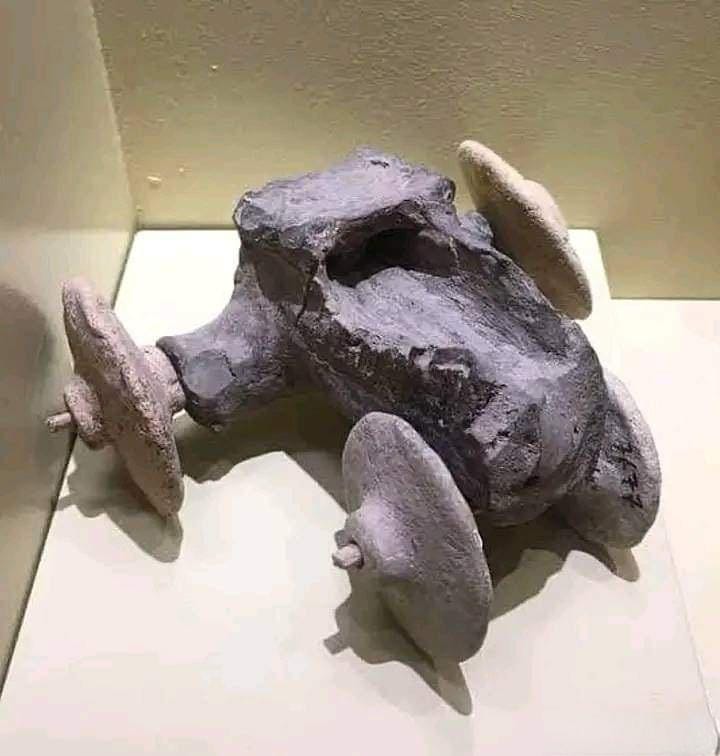
A toy car made of baked clay was discovered during surface searches at mound sites in the Kızıltepe District of Mardin (northern Kurdistan). It is the world’s oldest surviving toy, dating back to around 5500–3000 BCE. Currently, this oldest toy car in the world is exhibited at the Mardin Museum in Turkey. Anatolia was part of Ancient Near east showcasing Development of Wheel within that region. which later Spread into Europe and steppe.

PREHISTORIC INNOVATIONS: WHEELS AND WHEELED VEHICLES MÁRIA BONDÁR

“The small number of early cuneiform tablets with wagon depictions provide evidence that the Mesopotamian city states in the 4th millennium BCE belonged to those societies that used wheeled vehicles from the earliest time.” — Equids and Wheeled Vehicles in the Ancient World, Essays in Memory of Mary A. Littauer, Edited by Peter Raulwing, Katheryn M. Linduff and Joost H. Crouwel, Page no-67.

https://austriaca.at/0xc1aa5572%200x003e31cb.pdf
Archaeological and technological research strongly indicates that the earliest wheeled vehicles and wheel-based innovations originated in Mesopotamia and the broader Near Eastern sphere before spreading outward. Early evidence — including wagon remains, artistic depictions, and wheel models from Sumer and southwestern Iran in the early 3rd millennium BCE — shows the use of solid wooden wheels often reinforced with bronze, typically linked to elite burials and high-status activities, underscoring both technological sophistication and social importance. Rotational technologies such as spindle whorls and potter’s wheels are also well documented in the southern Levant and Mesopotamia, where the potter’s wheel emerged independently but was closely tied to rising social complexity. Iconographic records from the 4th and 3rd millennia BCE further demonstrate that wheeled vehicles were already in use in the Near East long before similar developments appear in Europe or Central Asia. From this early core region, the technology diffused widely, as seen in comparable wheel constructions and vehicle types across the Balkans, Aegean, and Central Asia. The swift spread of spoked-wheel chariots from Syria or northern Mesopotamia in the early 2nd millennium BCE likewise highlights the Near East as the primary technological center from which wheeled transport radiated outward.
Below Bids from Kish (Sumerian Site, 3rd Millennium BC) probably depicting Wheel


https://ia801508.us.archive.org/30/items/sumerianpalaceac12mack/sumerianpalaceac12mack.pdf
Origin of Rotational technology

Yashuv T, Grosman L (2024) 12,000-year-old spindle whorls and the innovation of wheeled rotational technologies. PLoS ONE 19(11): e0312007. https://doi.org/10.1371/journal.pone.0312007
The origin of rotational technology extends far deeper than the invention of the wheel itself. One of the earliest known examples is the 12,000-year-old limestone spindle whorl-like “pedals” discovered in Israel, which demonstrates that humans were already experimenting with controlled circular motion long before wheeled vehicles appeared. This artifact shows that rotational mechanics using circular components to perform repeated, efficient motion was already understood in the Epipaleolithic–Neolithic transition. Such early devices laid the conceptual groundwork for later innovations like the potter’s wheel, the solid wooden wheel, and eventually the war chariot. The evolution from simple rotational tools to full mechanical wheels highlights a long, continuous technological tradition in the Near East.
12,000-year-old spindle whorls and the innovation of wheeled rotational technologies. NEG’s perforated stones characteristics compared to functional interpretations. (a) beads, (b) fishing weights, © loom weights, (d) mace heads, (e) spindle whorls. https://doi.org/10.1371/journal.pone.0312007.g005
The Lexical Evidence

Lexical lists from the Uruk IV and Uruk III periods in southern Mesopotamia contain the earliest logographic signs referring to wheeled vehicles. Three key signs — PU₂/GIGIR, GURUŠ, and MAR — indicate different types of early transport devices. The sign PU₂/GIGIR, attested from Uruk III (3100–2900 BCE), becomes distinguishable as GIGIR “wagon/cart” in later texts and is interpreted as a pictogram of a solid wheel with an axle. The sign GURUŠ, appearing in Uruk IV, depicts a sledge or the upper part of a vehicle and is sometimes marked with two circular impressions representing wheels; it therefore likely denotes a sledge or a sledge on wheels. Its lexical context confirms it as an animal-drawn vehicle and the earliest clear attestation of a wheeled conveyance. The sign MAR, originally a pictogram of a shovel, later appears in the Early Dynastic period (ca. 2450 BCE) as a term for a four-wheeled transport vehicle, probably derived from an ox-drawn carrier resembling a shovel. Together, these signs provide the earliest textual evidence for sledges, wheeled sledges, and wagons in the Late Uruk and Early Dynastic periods, demonstrating that Mesopotamia possessed a diverse vocabulary and conceptual system for wheeled transport from the very beginning of writing.


THE CROSS-BAR WHEEL (Proto-Spoke Wheel)

A Cross-Bar Wheel
Cross-bar (or “cross-bar”) wheels — a construction in which radial timbers or a solid disk are relieved by inserted cross-bars — are best understood as a technological intermediate stage between solid disk wheels and fully developed spoked wheels, providing a way to reduce weight while retaining strength. Evidence from northern Iran (notably Tepe Hissar) and neighbouring Near Eastern contexts attests cross-bar/early spoke representations in the late 3rd millennium BCE, and Tepe Hissar remains one of the earliest secure iconographic loci for this innovation. Archaeological and iconographic studies therefore treat cross-bar wheels as part of a local Near Eastern sequence that plausibly transmitted lighter wheel technologies westward and northward, rather than originating first on the steppe. Importantly, variants of cross-bar or thickened-spoke constructions continued in use even after true spoked wheels appear spoked wheels are documented later in Europe and the steppe showing that older, robust solutions persisted alongside newer, lighter designs for specific functional needs. In short, cross-bar (proto-spoke) wheels form a credible developmental stage toward full spoked wheels, are attested earliest in Near Eastern contexts (with Tepe Hissar, the oldest depictions), and appear to have diffused from that Near Eastern technological core into Europe and beyond.


https://brill.com/display/book/edcoll/9789004494169/B9789004494169_s026.xml

Cross-Bar Wheel used in War Chariots in Europe — https://www.sciencedirect.com/science/article/abs/pii/S2352409X17301931


Etruscan stone sarcophagi, From 4th-3rd century BCE. Showing a Chariot-Cart with Cross-Bar Spoked Wheel.

this is earliest known representation of a Chariot with the spoked wheels, A seal from Tepe Hissar in Iran in the second half of the 3rd millennium cal BCE, This image of spoked wheels in the south are dated to an earlier time than in the steppe.


Spoked Wheel


The Evolution of the Double-horse Chariots From the Bronze Age to the Hellenistic Times


The Earliest Near Eastern Spoked Wheels and their Chronology P. R. S. Moorey


WHEELED VEHICLES AND RIDDEN ANIMALS IN THE ANCIENT NEAR EAST BY M. A. LITTAUER AND J. H. CROUWEL

The emergence of the light, horse-drawn chariot in the Near-East c. 2000–1500 B,C, P, R. S. Moorey*

NOTE- The Term Indo-European in this context is denoting to the Steppe in the consideration of Kurgan Hypothesis. Tho steppe being indo-Iranian is factually flawed statement but the statement is about no Impact of steppe in Invention of spoked wheel and chariot which independently emerged from Near East. (Snippet -Equids and Wheeled Vehicles in the Ancient World)


3rd Millennium BCE


A spoked wheel on display at the National Museum of Iran, in Tehran. The wheel is dated to the 2nd millennium BCE and was excavated at Choqa Zanbil

https://sino-platonic.org/complete/spp344_chariot_to_carriage_in_ancient_china.pdf

This seal from Tepe Hissar in northern Iran, dating to the second half of the 3rd millennium BCE, provides one of the earliest known depictions of a spoked wheel. This evidence predates the earliest securely identified spoked-wheel imagery from the Eurasian steppe, showing that the earliest visual representations of spoked-wheel technology appear in the southern Near Eastern–Iranian sphere, not in the steppe.

this 6,000-year-old amulet from Mehrgarh, an early site of the Indus Valley Civilization, features a three-dimensional depiction of a spoked wheel, making it the oldest known 3D representation of a spoked wheel. This early Amulet artifact demonstrates that the conceptualization of spoked-wheel technology in South Asia emerged far earlier than traditionally assumed.
Early Equid–Human Transformations
The Bronze Age Near East stands out as the earliest region where major transformations in human–equid relations can be clearly traced. This is because the Near East developed an unusually rich combination of written records and iconographic evidence at precisely the time when horses, donkeys, and hybrids began to reshape warfare, transport, and statecraft. Unlike other regions where equid use must be reconstructed only from bones or later textual memory the Near East gives us direct, datable documentation of training practices, harnessing methods, breeding strategies, and ceremonial uses. This dense record allows scholars to identify the Near East as the primary developmental center for early equid management, technological innovation (including early chariotry), and the social institutions built around horse-based elites.

the-spirited-horse-equidhuman-relations-in-the-bronze-age-near-east

the-spirited-horse-equidhuman-relations-in-the-bronze-age-near-east


The passage is saying that both equids (horses, donkeys, onagers, etc.) and wheeled vehicles were already known by the early 3rd millennium BCE. Because these ideas and technologies were already present, the later changes in horse-use, vehicle design, and harness systems were not sudden, alien, or revolutionary. Instead, they were natural, local developments that evolved gradually over time. In other words, nothing in the progression of horse-training or vehicle technology was so strange or advanced that it requires explanation through outside contact or foreign influence. The Near Eastern societies already had the knowledge base necessary for these innovations.
Yoke

https://sino-platonic.org/complete/spp344_chariot_to_carriage_in_ancient_china.pdf

Chinese Chariots
Early Chariot Evolution — War Wagons and Proto-Chariot (from Near East)

Diagram of the development of a wheeled vehicle: 1. cylinder; 2. sled; 3. sled on a cylinder; 4. sled on a cylinder, grooved through use; 5. wheel and axle in one piece, axle fixed with pins; 6. wheels connected to the axle, axle fixed in a rough bearing (source: https://storiesofworld.com)


Evolution of chariot Technology from Origin to advancement in the near east


Chariot Model from Early Dynastic Period (c. 2900–2300 BC). (https://ia801508.us.archive.org/30/items/sumerianpalaceac12mack/sumerianpalaceac12mack.pdf)

A Mazzù et al 2020, Dynamical and structural analysis of a Bronze Age war chariot.


Battle-Car 2700–2000 BCE


Below is a copper model of a Mesopotamian wheeled vehicle from Tell Agrab, Iraq, dating to the 3rd millennium BCE (c. 2800 BCE). This finely crafted model shows a two-wheeled vehicle with solid, unspoked wheels and a team of four equids used for traction. Its construction reflects the advanced metallurgical and vehicular technology of Early Dynastic Mesopotamia. The model is strikingly comparable to the Sinauli chariots from the Indian subcontinent, as both feature solid wheels reinforced for strength and durability, demonstrating a shared technological stage in the evolution of early wheeled vehicles before the widespread adoption of spoked wheels.


Copper model of a Mesopotamian welded vehicle, Tell Agrab, Iraq (2800 BC) (Frankfort, 1943 and Dowson, 1979)

https://sino-platonic.org/complete/spp344_chariot_to_carriage_in_ancient_china.pdf

3000–2500 BCE

Rare chariot composed of two stationary horses pulling a two-wheeled solid-wheeled chariot on which stands a man. He carries the carcass of an animal on his lap and a game bag on his back, to which a dog clings. The whole rests on a rectangular frame with a crossbar. Some losses. Red and green patina. Early Dynastic period, 3rd millennium BC. 12.5 x 18 cm. Ref.: H. Frankfort, The Art and Architecture of the Ancient Orient, Middlesex, 1954. An Early Dynastic copper chariot with two horses and driver. Ca. 2600 BC


Sumerian Chariots — 3000 BCE–2000 BCE


https://ia801508.us.archive.org/30/items/sumerianpalaceac12mack/sumerianpalaceac12mack.pdf


Solid Wheeled Chariot from 3rd Millennium BCE

War Wagons-Chariots, As Depicted on ‘Standard of Ur’ 2550 BCE


four Wheeled Sumerian Chariot being pulled by 4 equids, this was commonly used in 3000 BCE Sumeria

A clear Depiction from Standard of Ur found in Iraq Belonging to 2550 BCE


from Iraq. 2600–2500BCE. This votive limestone plaque carved in low relief is one of the earliest representations of equids used as draft animals. Here, apparently four equids are shown under one yoke, pulling a cart with two solid wheels. The driver walks behind the vehicle. source-Pen museum

Elamite Chariot, 2500 BCE, Reconstructed Imagery
Reconstructed image of Sumerian 2 Wheeled Chariot

Reconstructed Image of Sumerian 4 Wheeled Chariot

HORSEBACK RIDING IN MESOPOTAMIA IN THE THIRD MILLENNIUM B.C.

HORSEBACK RIDING IN MESOPOTAMIA IN THE THIRD MILLENNIUM B.C.
CHARIOT TERRACOTTA MODELS FROM TELL ARBID( Ancient Near East archaeological site in the Khabur River Basin region of Al-Hasakah Governorate, Syria)

http://www.tellarbid.uw.edu.pl/files/pdf/terracottta_chariots.pdf

3rd and 2nd Millennium BCE .

3rd and 2nd Millennium BCE .

3rd and 2nd Millennium BCE .

The Early Dynastic III (ED III) period (c. 2600–2350 BCE)


The terracotta chariot models from Tell Arbid provide strong evidence that the Near East possessed deep, indigenous roots in the development of wheeled vehicles and chariot technology, long before any putative Steppe diffusion models are invoked. More than 50% of all chariot models from Tell Arbid date to the first half of the 3rd millennium BCE, with a pronounced concentration in the Early Dynastic III (ED III) period, c. 2600–2350 BCE. The second half of the 3rd millennium BCE and the first half of the 2nd millennium BCE each account for only about 20%, indicating that the technological and symbolic peak of chariot development at the site clearly belongs to the ED III horizon. Six distinct chariot types have been identified at Tell Arbid, ranging from two-wheeled platform and box bodies (Types I–III) to four-wheeled platform, box, and covered vehicles (Types IV–VI). The most numerous types — Type III (two-wheeled platform with footboard) and Type V (four-wheeled box body) — are widely attested across Near Eastern sites, demonstrating a shared technological tradition within Mesopotamia and adjacent regions. Type II models also show numerous parallels, reinforcing this broader Near Eastern continuum. In contrast, Type VI (four-wheeled covered vehicles) appears to be a regional innovation, confined largely to northern Mesopotamia and southern Anatolia, while Types I and IV are rare and context-specific, likely locally produced for cultic or restricted ritual use. Chronologically, the oldest models (Type I) belong to the Ninevite V period, predating ED III, while the remaining types emerge and diversify during ED III, a phase that coincides with the widespread appearance of chariot imagery in glyptic art and the large-scale diffusion of full-sized wheeled vehicles. This convergence of archaeological, iconographic, and typological evidence points to in-situ experimentation, adaptation, and standardization, rather than sudden technological intrusion. Taken together, the Tell Arbid assemblage demonstrates that chariot and wheeled-vehicle technologies evolved organically within the Near Eastern cultural sphere, through incremental innovation across centuries. The density, diversity, and early dating of these models strongly support a Near Eastern developmental trajectory, undermining Steppe-centric or Kurgan diffusionist narratives and reinforcing the view that the Near East was a primary center for early chariot and vehicle innovation.

( https://pcma.uw.edu.pl/wp-content/uploads/pam/PAM_2009_XXI/PAM21_Raccidi.pdf- )The terracotta chariot models from Tell Arbid provide strong evidence that the Near East possessed deep, indigenous roots in the development of wheeled vehicles and chariot technology, long before any putative Steppe diffusion models are invoked. More than 50% of all chariot models from Tell Arbid date to the first half of the 3rd millennium BCE, with a pronounced concentration in the Early Dynastic III (ED III) period, c. 2600–2350 BCE. The second half of the 3rd millennium BCE and the first half of the 2nd millennium BCE each account for only about 20%, indicating that the technological and symbolic peak of chariot development at the site clearly belongs to the ED III horizon.

https://pcma.uw.edu.pl/wp-content/uploads/pam/PAM_2009_XXI/PAM21_Raccidi.pdf
Depictions of Chariots


Two Wheeled Chariot Terracotta from Uruk 2000 BCE

3rd Millennium BCE

Chariot Model from 18–17th Century BCE, Iraq

2 wheeled Chariot model from mesopotomia 18th Century BCE

FOUR SOLID WHEELED TERRACOTTA MODEL OF A CHARIOT DEPICTS THE TYPE OF VEHICLE USED IN THE 3000–2500 BCE

chariot model with 2 solid Wheel from cyprus 600–480 BCE


Two Solid Wheeled Syro-Hittite Terracotta Chariot, ca. 1500 to 1000 BCE.

Two Solid Wheeled Syro-Hittite Terracotta chariot 2000 BCE
Rare Sumerian Two Solid Wheeled Chariot Figurine, 3rd-2nd ML BC, A ceramic model of a chariot comprising an advancing horse with bridle and reins, a small two-wheeled vehicle with lobes to the wheels and yoke, female rider with a full skirt and carefully dressed hair.

Seal impressions from Tell Beydar, Palace area; 2c, d: Seal impressions from Nagar, SS area, depicting unspoked Chariot pulled by equids in a procession . 3rd millennium BCE.

Akkadian war-chariot trampling enemies; cylinder seal from Nagar (Tell Brak, Syria) 2250 BCE

cylinder seal VA 2952, after Lippert 2016, CC-BY-NC-SA 3.0 DE, depicting Chariot, 3rd millennium BCE.

The ‘‘Stele of the Vultures’’, king Eanatum of Lagash, Sumer 2475 BCE
Depicting Four Solid Wheeled Chariots Pulled by Four Equids, Iraq, 3rd millennium BCE.


Four Solid Wheeled Chariot from 2350–2000 BCE

Akkadian cylinder seal, Chariot from 2375–2000 BCE

Syrian Seal Impression 2 Spoked Wheeled Chariot 1800 BCE

2000BCE-1900BCE

2nd Millennium BCE

2nd Millennium BCE

the first evidence for the use of the bow from a vehicle, here in a hunting setting. Spoke–wheeled two–wheelers with a variety of body forms and drawn by teams of two equids from Syria 1800 BCE.

Chariot Depiction from Babylonia second millennium BCE

Chariot Pulled by equids, second millennium BCE

1950 BCE to 1835 BCE.

SECOND MILLENNIUM BCE (2000–1600 BCE)

SECOND MILLENNIUM BCE (2000–1600 BCE)

SECOND MILLENNIUM BCE (2000–1600 BCE)

Natural Philosophy and the Development of Mechanics and Engineering from the 5th century B.C. to Middle-Ages- Thomas G. Chondros
3,500 year-old Mycenaean (Greek) terracotta chariot.

6th Century BCE, Teracota chariot model with Solid Wheels

These two chariot models from Cyprus, dating to the 8th–7th centuries BCE, offer an important window into the technological diversity and coexistence of wheel types in the ancient Mediterranean. Model A depicts a four-equid chariot equipped with clearly rendered spoked wheels, illustrating a fully developed light chariot tradition typical of the Iron Age Near East and Eastern Mediterranean. The craftsmanship shows the spokes radiating from a central hub, indicating both artistic awareness and technological familiarity with advanced wheel construction. In contrast, Model B, from the same region and roughly the same time period, portrays a chariot also drawn by equids, yet fitted with solid, unspoked wheels. These wheels resemble earlier Bronze Age wheel technology, suggesting that solid-wheel vehicles continued to be used alongside spoked-wheel chariots for specific functions, cultural preferences, or regional traditions. Together, these models highlight that even in a single cultural zone and period, different wheel technologies coexisted, reflecting varied uses, technological transitions, and local adaptations in ancient Cypriot and broader Near Eastern vehicular culture.

Solid unspoked Wheel Chariot model

Solid Wheel Chariot models from Cyrpus 8th-7th Century BCE

Greek statuettes of a chariot shown with solid wheels, 8th century BC

Parade chariot with two figures, painted limestone, ca. 450–400 BC, from Amathus, Cyprus (solid wheels)
Iberian votive offerings of two horses and a chariot. The three votive offerings are made of bronze and come from the sanctuary of Collado de los Jardines (Santa Elena, Jaén). 4th-1st centuries BC. National Archaeological Museum of Spain. solid wheel chariot.
Two Ancient Roman Patinated Bronze Horse Drawn Chariots. 4 solid wheeled chariot.

4 spoked wheel chariot on a vase of Attic LG Ib style

Homeric Chariots — arly greek warfare horsemen and chariots in the homeric and archaic ages

arly greek warfare horsemen and chariots in the homeric and archaic ages

BMAC
Models of two-wheeled carts from c. 3000 BC found at Altyn-Depe are the earliest complete evidence of wheeled transport in Central Asia. Judging by the type of harness, carts were initially pulled by oxen, or a bull. However camels were domesticated within the BMAC. A model of a four-wheeled wagon drawn by a camel of c. 2200 BC was found at Altyn-Depe

Overview of the evidence on early wheeled vehicles and wheels.


ADMIN IS BUSY RIGHT NOW THIS ARTICLE IS NOT COMPLETE YET.
— @thehistoropill
메타데이터
- post_id
- cd6d19e0951b
- slug
- the-south-and-west-asian-foundations-of-chariot-technology-a-critical-reappraisal-of-the-cd6d19e0951b
- url
- https://medium.com/@thehistoropill/the-south-and-west-asian-foundations-of-chariot-technology-a-critical-reappraisal-of-the-cd6d19e0951b
- canonical_url
- https://medium.com/@thehistoropill/the-south-and-west-asian-foundations-of-chariot-technology-a-critical-reappraisal-of-the-cd6d19e0951b
- author_url
- https://medium.com/@thehistoropill
- status
- ok
- fetched_at
- 2026-08-09 23:34:40