Planned Parenthood Wants to Be Your Botox Injector
But Is That a Good Thing?
Planned Parenthood Wants to Be Your Botox Injector
But Is That a Good Thing?
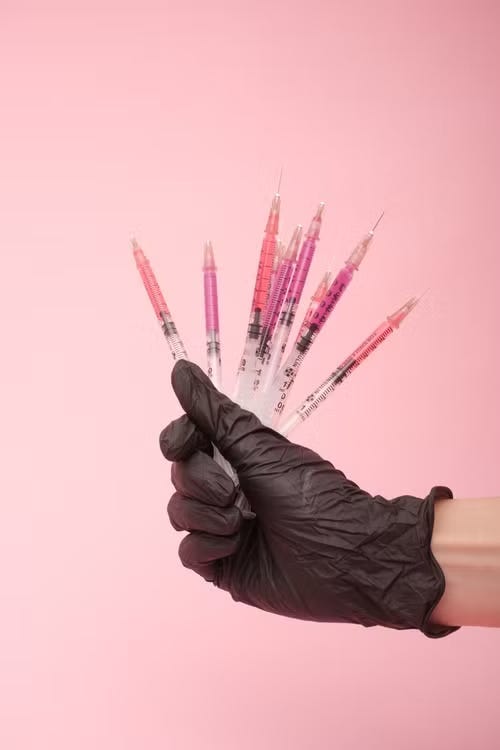
After being defunded by the 2025 One Big Beautiful Bill Act, the organization is getting creative to bridge the financial gap. But not everyone agrees that’s the right move.
In October 1916, the country’s first birth control clinic opened on Amboy Street in Brownsville, Brooklyn.¹ This fall, that clinic, now globally known as Planned Parenthood, turns 110 years old, with nearly 600 health centers nationwide and a legacy of fighting for women’s reproductive health that has since reckoned with the eugenicist and abelist ideology of its founder.¹ It has also been cut off from federal funding and is piloting new ways to bridge the gap, perhaps shifting the perception of what belongs under the umbrella of women’s healthcare in the process by offering Botox to its patients.
You can picture the scene NPR reported from a Sacramento clinic: a woman in her early fifties, settled into the exam chair, asking for a little work on the elevens between her brows. She isn’t new to injectables, but it’s her first time getting them here — at the same organization she once relied on for birth control.² The clinic belongs to Planned Parenthood Mar Monte, the largest affiliate in the country, which now offers everything from Botox to IV hydration, all paid for in cash.² While the form of payment and new procedures might have caused alarm, the decision isn’t so much a rebrand as a triage solution to an impossible problem tracing back to a single law.
On July 4, 2025, President Trump signed the One Big Beautiful Bill Act (H.R.1), a sweeping budget package that, among some other cuts and changes to healthcare enrollment requirements, barred Planned Parenthood from billing Medicaid for any service, not just abortion, but the cancer screenings, STI testing, and contraceptive care that make up the overwhelming majority of what it does.³ Planned Parenthood sued and briefly won a temporary pause, but on January 30, 2026, a federal court dismissed Planned Parenthood Federation of America v. Kennedy, and the defunding stood.³ Because more than half of its patients rely on Medicaid — at Mar Monte, as many as 80 percent — the consequences were immediate: the affiliate has closed five clinics, and nationally more than fifty have shut their doors.² ³ ⁴
That is the hole the Botox, and soon other offerings, are meant to fill (a budget gap of roughly $100 million).⁵ At $9 per unit, Mar Monte’s injections undercut the commercial medspas by 25 to 50 percent, and the model is openly cross-subsidizing: the cash a patient spends smoothing fine lines and wrinkles, or relaxing jaw tension, helps fund the Pap smear the clinic can no longer bill to Medi-Cal (CA State Medicaid).² Mar Monte’s chief medical operating officer frames the aesthetic services themselves as an extension of the organization’s mission, another way for patients to exercise bodily autonomy.²
It’s a tidy line, and it’s also where the argument tends to fracture its base of supporters.
The objection is intuitive and plausible. There is real dissonance in one of the country’s most recognizable symbols of reproductive autonomy selling a product whose market depends on fear of aging and patriarchal beauty standards — a product that is, culturally, the signature of an industry more comfortable with women frozen than women older. To watch a feminist institution take up the needle reads, to many, as mission drift at best. Yet the strongest version of that critique smuggles in a premise worth refusing: that a woman choosing Botox is necessarily capitulating to the patriarchy. That framing quietly revokes the agency it claims to protect. Some women get injectables under the weight of an impossible standard; others look in the mirror, decide they’d rather not have the elevens, and spend their own money accordingly and the analysis ends there. Bodily autonomy can’t be a principle that applies only to the choices we’d personally endorse, and an institution built on the premise that women decide what happens to their own bodies is, if anything, a coherent place to make that decision.
The more durable problem isn’t the patient in the chair but the supply chain behind the vial. That’s where Jessica DeFino’s reporting for FLESH WORLD reframes the whole story. Botox is owned by Allergan Aesthetics, a subsidiary of the pharmaceutical giant AbbVie, and reviewing Federal Election Commission disbursements, DeFino found that within a single year, AbbVie’s political action committee (PAC) donated more than $135,000 to Republican members of Congress who voted to pass the One Big Beautiful Bill Act, the very law that defunded Planned Parenthood.⁵

From Jessica DeFino, FLESH WORD, Planned Parenthood Offers Botox Now. The Makers Of Botox Donated Over $135,000 To Politicians Who Defunded It
Trace the loop and it almost reads as satire: Congress defunds the clinic, the clinic begins selling a product to survive, and the company that makes that product helped finance the campaigns of the lawmakers who defunded the clinic to begin with. Every unit injected to keep the lights on sends a fraction of profit back toward the political apparatus that switched them off.
DeFino’s formulation is precise — for the makers of Botox, bodily autonomy is marketing, not mission — and her point is rock solid. Allergan sells “empowerment” and “owning your look” in its campaigns while its parent company’s PAC backs legislators working to restrict abortion and contraception.⁵ Republicans and the right, however, located a different culprit entirely, with Senator Marsha Blackburn writing to the IRS to question whether a 501(c)(3) selling elective cosmetic procedures has strayed from its tax-exempt charitable purpose, a notable sequence from lawmakers who voted to defund the organization in the first place, then raised the alarm when it improvised to survive.⁶
The answer isn’t to adjudicate which of these critiques is most correct, because what they share is more revealing than where they diverge. DeFino is right that the entanglement is grotesque, and Blackburn’s letter, however cynical, isn’t wrong that something has shifted in what a reproductive health non-profit now does for money. But both arguments treat Planned Parenthood as the agent in the story when it is plainly the object — the thing being acted upon by a budget, a PAC, and a court ruling, none of which it controls. The ridiculous part isn’t that a clinic is selling Botox; it’s that we have built a system in which healthcare access and political donation flow through the same narrow channels, where the money that funds women’s care and the money that dismantles it can originate from the same balance sheet. That’s not a Planned Parenthood problem. That’s the architecture of American healthcare, and the clinic is just the place where you can finally see it and the impact in real time.
Which brings the story back to where it began, with a little more conviction. Supporting the workaround is not the same as mistaking it for a solution, and this is unmistakably a survival tactic, the kind that hardens into a permanent fixture precisely when no one keeps calling it an emergency. But it is not a betrayal of feminism, and it is not a clinic quietly selling youth back to women one Pap smear at a time. Nobody is getting ten units of tox stapled to a cancer screening. What’s happening is narrower and more honest than the discourse around it: an organization that has been deliberately starved is trying new revenue services — one of the most popular cosmetic offerings in the country to keep treating the patients, in the sociopolitical turmoil moment we are currently living in. This does not mean what Planned Parenthood sells is beyond scrutiny. An organization that stands for women’s autonomy is fair to question what it puts its name behind. But that’s not the real question in a post-Roe country. Clinics nationwide are closing. If they disappear, no one will ask why Planned Parenthood sold Botox — they’ll ask why so few of the people with the power to step in and fund it never bothered to.
Alexandra Thompson is a Staff Writer at Cabin Fever Magazine. She writes about media epidemiology, reframing media consumption and production into public health data.
References
- Planned Parenthood Federation of America. Our history. Accessed June 8, 2026. https://www.plannedparenthood.org/about-us/who-we-are/our-history
- Fitzgerald L. Trump and Congress cut funding for Planned Parenthood. Can Botox keep it afloat? NPR. April 25, 2026. Accessed June 8, 2026. https://www.npr.org/2026/04/25/nx-s1-5763797/planned-parenthood-botox-medcaid-trump-congress
- Community Action Fund of Planned Parenthood of Orange and San Bernardino Counties. Planned Parenthood is defunded: what does this mean, and where do we go from here? Accessed June 8, 2026. https://www.plannedparenthoodaction.org/community-action-fund-planned-parenthood-orange-and-san-bernardi/get-involved/defunding
- Bell MM. Sen. Marsha Blackburn questions Planned Parenthood’s tax-exempt status after it offers Botox. The Washington Times. Published April 3, 2026. Accessed June 8, 2026. https://www.washingtontimes.com/news/2026/apr/3/sen-marsha-blackburn-questions-planned-parenthoods-tax-exempt-status/
- DeFino J. Planned Parenthood offers Botox now. The makers of Botox donated over $135,000 to politicians who defunded it. FLESH WORLD by Jessica DeFino. Published March 9, 2026. Accessed June 8, 2026. https://jessicadefino.substack.com/p/planned-parenthood-offers-botox-now
- Blackburn M. Blackburn sounds the alarm on Planned Parenthood offering cosmetic injections and procedures as a tax-exempt organization. Office of U.S. Senator Marsha Blackburn. Published April 3, 2026. Accessed June 8, 2026. https://www.blackburn.senate.gov/2026/4/health%20care/pro%20life/blackburn-sounds-the-alarm-on-planned-parenthood-offering-cosmetic-injections-and-procedures-as-a-tax-exempt-organization
메타데이터
- post_id
- cd7af2cd9452
- slug
- planned-parenthood-wants-to-be-your-botox-injector-cd7af2cd9452
- url
- https://medium.com/cabin-fever-magazine/planned-parenthood-wants-to-be-your-botox-injector-cd7af2cd9452
- canonical_url
- https://medium.com/cabin-fever-magazine/planned-parenthood-wants-to-be-your-botox-injector-cd7af2cd9452
- author_url
- https://medium.com/@athompsonwrites99
- status
- ok
- fetched_at
- 2026-06-20 20:29:01