Object-Oriented Programming is DEAD — Here’s What Killed It
Classes, inheritance, and polymorphism once ruled the world. Now, they’re holding us back.
Object-Oriented Programming is DEAD — Here’s What Killed It
Classes, inheritance, and polymorphism once ruled the world. Now, they’re holding us back.
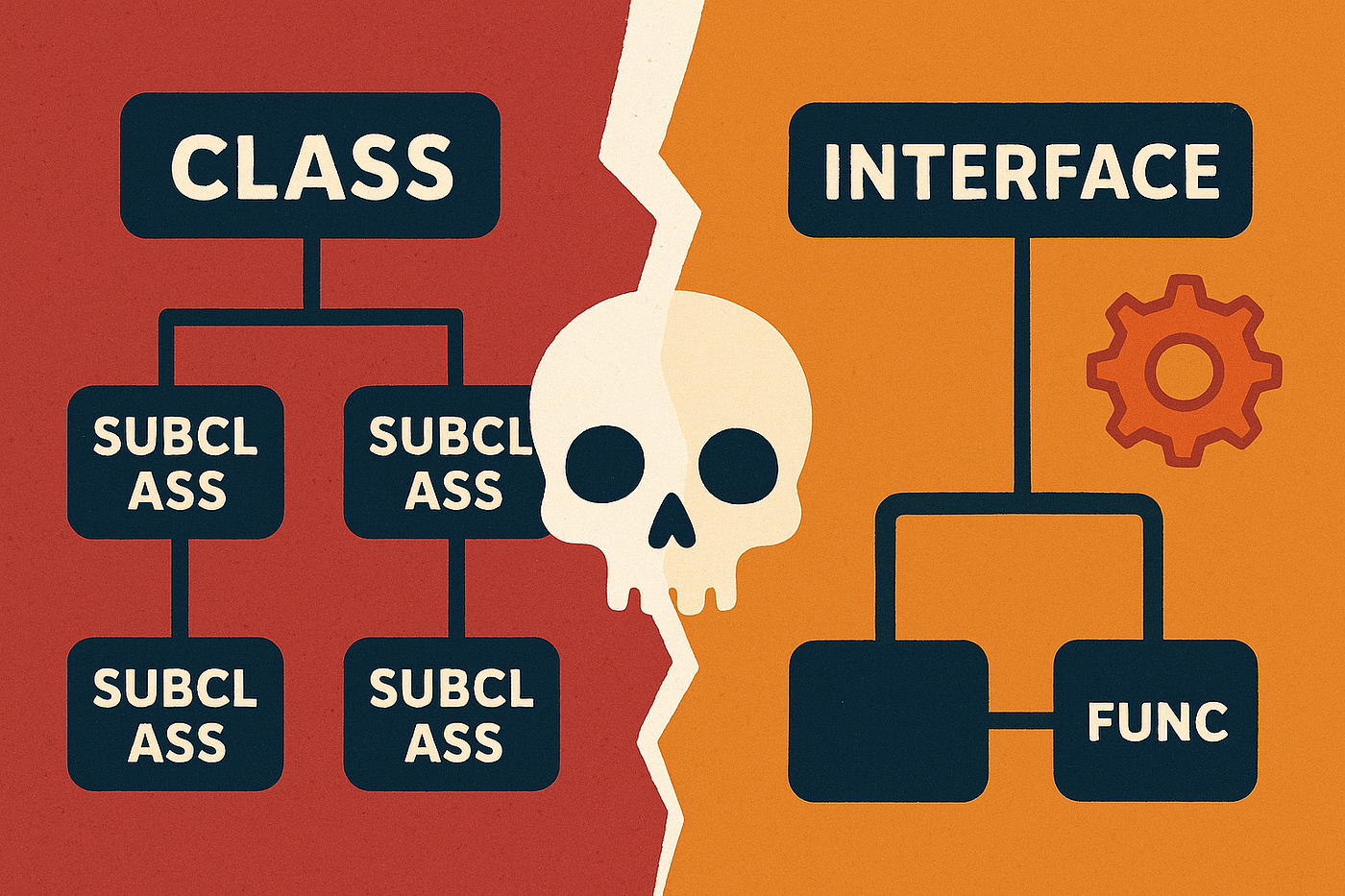
image by ai
The Rise (and Fall) of OOP
For decades, Object-Oriented Programming (OOP) was the default religion of software engineering.
Java, C++, C#, Python — they all sold us the dream: model your world with objects, build hierarchies, inherit behaviors, override when needed. Software would be clean, modular, and “just like the real world.”
But look around in 2025
- Startups are shipping entire backends in functional Rust.
- Go ditched inheritance completely and ate the cloud.
- Even JavaScript is mostly written in functional-reactive style now.
Something happened. OOP didn’t just fall out of fashion. It died.
The Original Promise
OOP was supposed to help us reason about complexity. The sales pitch was always:
- Encapsulation (hide details)
- Inheritance (reuse behavior)
- Polymorphism (treat things the same way)
Take a simple banking system:
class Account {
    double balance;

void deposit(double amount) {
        balance += amount;
    }
    void withdraw(double amount) {
        balance -= amount;
    }
}
class SavingsAccount extends Account {
    double interestRate;
    void addInterest() {
        balance += balance * interestRate;
    }
Beautiful on paper. You model the “real world.” But in reality? Inheritance hierarchies turned into nightmares.
What Actually Killed OOP
OOP didn’t die from one bullet. It was death by a thousand cuts.
1. Inheritance Hell
You start with Account → SavingsAccount → PremiumSavingsAccount → ???. Suddenly, a bug fix in the parent class breaks everything downstream.
2. The “God Object” Problem
Instead of clean modularity, OOP often created objects that knew too much. Your User object now handles auth, logging, billing, and pizza delivery.
3. Testing Pain
Unit testing OOP code means faking half the world. Want to test a method? You have to mock Database → Repository → Service → Manager → Controller.
4. Concurrency
OOP was never designed for today’s parallel, distributed, async world. Shared mutable state is the default. That’s poison in a system with 1000 goroutines or async tasks.
Who Killed OOP?
The executioners are already here:
- Go killed inheritance. Interfaces are implicit. You implement methods → you satisfy the interface.
- Rust killed the object tree. Traits replace classes, and data + behavior are deliberately decoupled.
- Functional programming snuck into mainstream dev. Even Java devs are using streams and lambdas instead of 12-level hierarchies.
- ECS (Entity Component Systems) in game dev ditched OOP altogether: behavior = systems, state = data, no inheritance.
A Tale of Two Designs
Let’s take the same problem — a payment processor — and see how OOP vs modern style looks.
OOP Way (Java)
abstract class Payment {
    abstract void process(double amount);
}

class CreditCardPayment extends Payment {
    void process(double amount) {
        // process credit card
    }
}

class PayPalPayment extends Payment {
    void process(double amount) {
        // process PayPal
    }
}
You add 5 payment types → 5 classes. Then someone asks for crypto, then Apple Pay. The tree explodes.
Trait/Interface Way (Rust/Go)
Rust:
trait Payment {
    fn process(&self, amount: f64);
}

struct CreditCard;
impl Payment for CreditCard {
    fn process(&self, amount: f64) {
        println!("Processing credit card: {}", amount);
    }
}
struct PayPal;
impl Payment for PayPal {
    fn process(&self, amount: f64) {
        println!("Processing PayPal: {}", amount);
    }
}
Go:
type Payment interface {
    Process(amount float64)
}

type CreditCard struct{}
func (CreditCard) Process(amount float64) {
    fmt.Println("Processing credit card:", amount)
}

type PayPal struct{}
func (PayPal) Process(amount float64) {
    fmt.Println("Processing PayPal:", amount)
}
Instead of inheritance, you compose behaviors. Add a new type? Just implement the interface/trait. No fragile trees.
The Architectural Shift
Here’s how software design has shifted:
OOP World (1990s–2010s)
-----------------------
[Big Class Hierarchy]
      |
      v
[Services]
      |
      v
[Database]

Post-OOP World (2020s+)
-----------------------
[Data Structures] <--> [Traits/Interfaces] <--> [Systems/Functions]
      |
      v
[Services / APIs]
      |
      v
[Database]
In the new world:
- Data is plain structs.
- Behavior is traits/systems.
- Composition replaces inheritance.
The Emotional Truth: Why Devs Revolted
Developers didn’t just walk away from OOP because of performance. They walked away because OOP made us miserable.
- We spent more time fighting class hierarchies than shipping features.
- Every refactor felt like pulling a thread on a sweater — the whole thing unraveled.
- “Senior engineers” were measured by how complex their inheritance trees were, not by how easy their code was to maintain.
At some point, we snapped.
Lessons Learned
- Objects aren’t the problem. Hierarchies are. Data + behavior is fine. Inheritance chains are not.
- Composition wins. Favor small, composable pieces over giant classes.
- Functional + data-oriented styles scale better in concurrency-heavy systems.
- ECS, traits, interfaces are the new OOP — but flatter, simpler, more honest.
Closing
Object-Oriented Programming isn’t just “less popular.” It’s dead as the default way of building systems.
We don’t live in a world of desktop apps and UML diagrams anymore. We live in a world of distributed systems, async pipelines, and thousands of concurrent connections.
OOP couldn’t survive that world. Composition did. Traits did. Functional programming did.
The dream of OOP — modeling the world in code — didn’t die because it was wrong. It died because it didn’t scale.
And in software, if it doesn’t scale, it doesn’t survive.
메타데이터
- post_id
- cd83d7867683
- slug
- object-oriented-programming-is-dead-heres-what-killed-it-cd83d7867683
- url
- https://medium.com/@theopinionatedev/object-oriented-programming-is-dead-heres-what-killed-it-cd83d7867683
- canonical_url
- https://medium.com/@theopinionatedev/object-oriented-programming-is-dead-heres-what-killed-it-cd83d7867683
- author_url
- https://medium.com/@theopinionatedev
- status
- ok
- fetched_at
- 2026-07-17 18:58:55