Uranium Stocks in India 2026: List, Nuclear Sector Overview and Key Players
Last Updated: Augest 2026
Uranium Stocks in India 2026: List, Nuclear Sector Overview and Key Players
Last Updated: Augest 2026

Uranium Stocks in India 2026
India does not have a listed, pure-play uranium stock. Uranium Corporation of India Limited (UCIL), the sole uranium miner, is 100% government-owned and not traded on NSE or BSE. Investors researching “uranium stocks” in India are typically looking at listed companies across the nuclear power value chain, such as L&T, NTPC, BHEL, and Tata Power, which build, operate, or supply components for nuclear infrastructure.
Key Takeaways
- UCIL, India’s only uranium miner, is unlisted and 100% government-owned. No exchange-traded pure uranium play exists in India.
- The SHANTI Act, passed by Parliament in December 2025, opens India’s nuclear power sector to private and foreign investment for the first time.
- Six private companies, including Tata Power, Reliance Industries, and Adani Power, have submitted proposals for nuclear plant sites.
- India targets 100 GW of nuclear capacity by 2047, up from roughly 8.8 GW today.
- No domestic uranium ETF currently exists in India.
What Are Uranium Stocks and Why India Has No Pure Uranium Miner
When people search for uranium stocks in India, they are usually not looking for a mining company whose revenue comes directly from selling uranium ore. That company does not exist on Indian exchanges. UCIL operates the country’s uranium mines at Jaduguda and Turamdih in Jharkhand and Tummalapalle in Andhra Pradesh, but it functions as a unit under the Department of Atomic Energy and has never listed shares publicly.
What investors actually track under this keyword are companies with exposure to India’s nuclear power value chain. This spans reactor construction, heavy equipment manufacturing, specialty metals used in reactor components, and power generation from nuclear plants. These companies are publicly listed and report regular financial results, unlike UCIL. To understand how thematic sector plays like this fit into your research process, see our guide on sector analysis before picking stocks.
India’s Uranium Reserves and Nuclear Fuel Supply
India’s uranium oxide reserves are estimated at roughly 4.3 lakh tonnes, spread across 47 deposits in states including Andhra Pradesh, Jharkhand, Telangana, Meghalaya, and Rajasthan. The Tummalapalle deposit in Andhra Pradesh is considered one of the largest in the world by tonnage, with estimates for the site alone ranging widely depending on ongoing exploration.
Despite these reserves, domestic uranium mining currently covers only a fraction of India’s nuclear fuel needs. A Ministry of Power committee estimated the country will need roughly 8,029 tonnes of natural uranium annually by 2047 to support its capacity expansion targets, a volume domestic mines cannot supply alone. India has diversified its uranium imports across Australia, Canada, and Kazakhstan since the Nuclear Suppliers Group granted it a waiver in 2008.
India’s Nuclear Power Push: The SHANTI Act and Private Sector Entry
This is the most significant recent development for anyone researching this sector, and it changes the investing landscape meaningfully.
In December 2025, Parliament passed the Sustainable Harnessing and Advancement of Nuclear Energy for Transforming India Act, known as the SHANTI Act. The law repeals the Atomic Energy Act of 1962 and the Civil Liability for Nuclear Damage Act of 2010, both of which had restricted nuclear power generation to state-owned entities for over six decades. For the first time, private and foreign companies can participate across the nuclear value chain, including mining, fuel fabrication, equipment manufacturing, and reactor construction under licensing conditions.
The government’s target is 100 GW of nuclear capacity by 2047, up from approximately 8.8 GW currently installed. Six companies, Hindalco Industries, Jindal Steel & Power, Tata Power, Reliance Industries, JSW Energy, and Adani Power, submitted documents identifying 16 prospective nuclear plant sites across six states, including Gujarat, Madhya Pradesh, and Odisha. This is the clearest signal yet of which listed companies are positioning for direct participation in India’s nuclear buildout, rather than just supplying components to it.
Important
The SHANTI Act had not been fully notified as of mid-2026, meaning specific provisions take effect on dates the government announces separately. Private participation is legally permitted, but actual project timelines depend on further regulatory notifications.
Companies Linked to India’s Nuclear and Uranium Value Chain
The companies below are commonly grouped under this theme because of existing or upcoming involvement in nuclear infrastructure, equipment supply, or power generation. This is not a ranked or recommended list, and inclusion here does not suggest any company should be bought or sold.
Larsen & Toubro (L&T)
L&T is one of India’s largest engineering and construction conglomerates, with a heavy engineering division that manufactures components for nuclear reactors, including reactor pressure vessels and steam generators for NPCIL projects. L&T also holds interests across defence, infrastructure, and industrial technology, making nuclear one part of a much larger business.
NTPC
NTPC is India’s largest power generation company by installed capacity, with an 89,108 MW portfolio dominated by coal and gas. NTPC’s nuclear exposure comes through its role in the broader power generation ecosystem and its subsidiary structure, positioning it as a potential operator in future capacity expansion plans tied to the government’s 100 GW target.
Bharat Heavy Electricals (BHEL)
BHEL manufactures heavy electrical equipment, including components for nuclear power plants such as steam generators and turbines supplied to NPCIL. The company has historically been a key domestic supplier for India’s nuclear reactor construction program.
MTAR Technologies
MTAR Technologies is a precision engineering company supplying components for nuclear, space, and defence applications, including fuel machining heads and reactor subsystems. It is a smaller company relative to the PSU majors above, with correspondingly higher volatility.
Walchandnagar Industries
Walchandnagar Industries manufactures heavy engineering equipment and has historically supplied components for India’s nuclear and space programs, including work tied to pressurized heavy water reactors.
MIDHANI (Mishra Dhatu Nigam)
MIDHANI is a government-promoted specialty metals manufacturer producing titanium alloys and special steels used across aerospace, defence, and nuclear applications. It is the only manufacturer of titanium alloys in India and supplies materials used in reactor components.
Hindustan Construction Company (HCC)
HCC is an infrastructure and construction company that has worked on civil construction for nuclear power projects in India, including work related to the Kaiga and Kudankulam plants.
Tata Power
Tata Power is one of six private companies that submitted proposals under the government’s RFP process for nuclear plant sites following the SHANTI Act’s passage. This makes it one of the more direct private-sector entrants into nuclear generation, distinct from companies that only supply equipment.
Financial Snapshot: Key Metrics Comparison
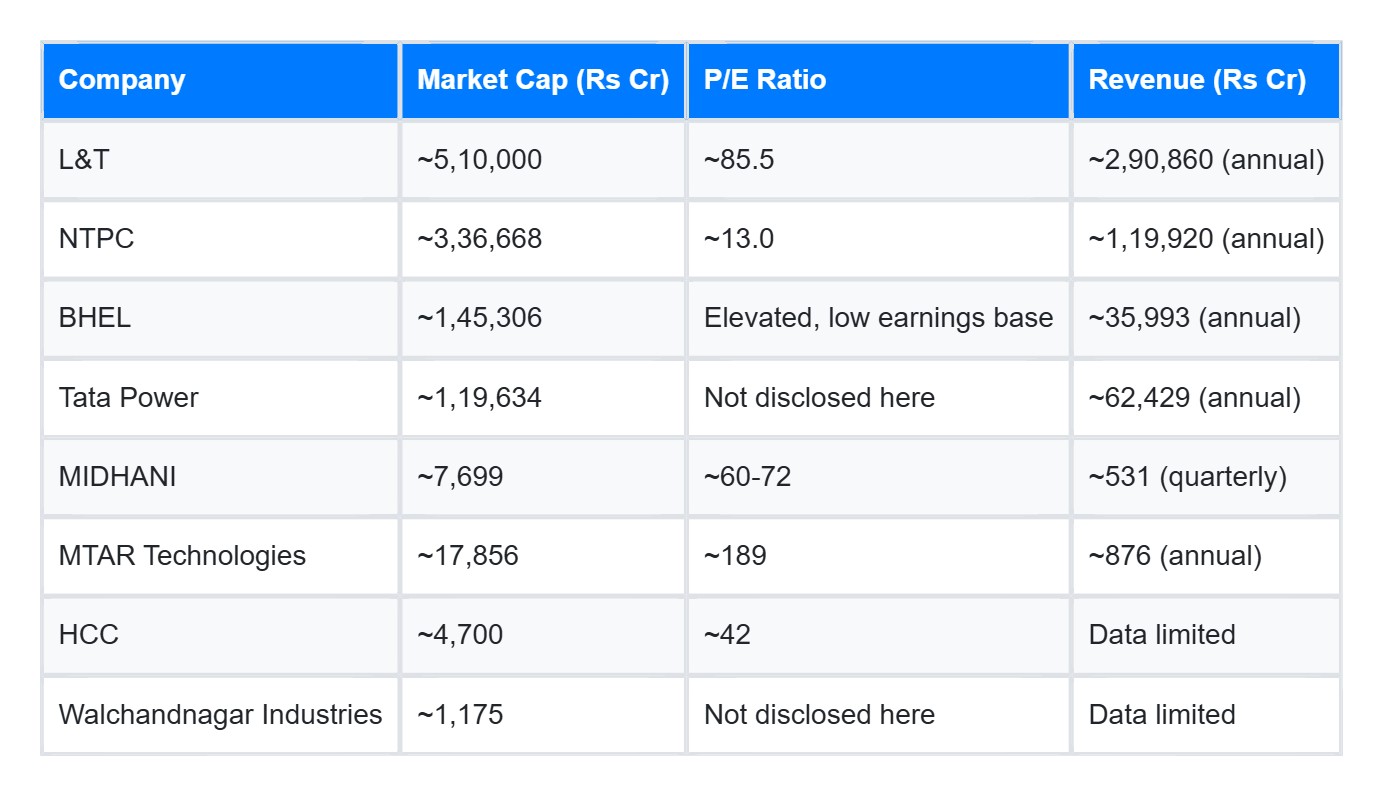
Data sourced from Screener.in, company filings, and Groww stock pages. Figures approximate as of July 2026 and subject to daily market movement.
Several of these companies, particularly MTAR Technologies and MIDHANI, trade at high P/E multiples relative to broader market averages, reflecting their smaller size and growth expectations tied to defence and nuclear order books rather than current earnings.
Is There a Uranium ETF in India?
No dedicated uranium ETF trades on NSE or BSE as of mid-2026. Investors looking for thematic exposure to nuclear energy in India currently rely on individual stock selection across the companies described above, since no fund product tracks a domestic uranium or nuclear power index yet. Some international uranium-focused ETFs exist on foreign exchanges, but these carry separate regulatory, currency, and tax considerations outside the scope of Indian retail investing. For a broader view of how ETFs work as a category, see our explainer on exchange-traded funds.
Factors to Consider Before Looking at Nuclear-Linked Stocks
- Policy execution risk: The SHANTI Act permits private participation, but specific rules, licensing timelines, and project approvals are still being notified in stages.
- Long project timelines: Nuclear plants take years to plan, license, and construct. Revenue from new private nuclear projects will not show up in company financials immediately.
- Import dependence: Domestic uranium mining covers only part of India’s fuel needs, so the sector remains sensitive to global uranium supply and pricing dynamics.
- Valuation levels: Several of these stocks, particularly smaller engineering names, already trade at high earnings multiples that price in future growth expectations.
- Diversified business models: Most companies on this list generate the bulk of their revenue from businesses unrelated to nuclear power, so their stock performance depends on many factors beyond this one theme.
Future Outlook for India’s Nuclear and Uranium Sector
The passage of the SHANTI Act marks the first structural opening of India’s nuclear sector in over sixty years. With a 100 GW target for 2047 and six major private companies already in the RFP process, the sector is moving from a purely PSU-driven model toward a mixed public-private structure. Execution will depend on how quickly the government notifies remaining provisions of the Act, how fast domestic uranium supply scales relative to demand, and how efficiently new capacity gets built against historically long nuclear project timelines in India.
FAQs
1. What is a uranium stock?
A uranium stock generally refers to a company involved in uranium mining, nuclear fuel supply, or nuclear power generation. In India, no listed company mines uranium directly, so the term is commonly used for companies across the broader nuclear power value chain.
2. Which companies are considered uranium stocks in India?
Companies commonly associated with this theme include L&T, NTPC, BHEL, MTAR Technologies, Walchandnagar Industries, MIDHANI, HCC, and Tata Power, based on their roles in nuclear construction, equipment supply, or power generation.
3. Is UCIL listed on the stock exchange?
No. Uranium Corporation of India Limited is 100% government-owned and operates under the Department of Atomic Energy. It does not have publicly traded shares on NSE or BSE.
4. What is the SHANTI Act and how does it affect uranium stocks?
The SHANTI Act, passed in December 2025, opens India’s civil nuclear sector to private and foreign investment for the first time, repealing the older Atomic Energy Act and Civil Liability for Nuclear Damage Act. It allows private companies to participate in nuclear power generation under licensing conditions.
5. What are India’s uranium reserves?
India’s uranium oxide reserves are estimated at around 4.3 lakh tonnes across 47 deposits, with major sites in Jharkhand and Andhra Pradesh, including Jaduguda and Tummalapalle.
메타데이터
- post_id
- cd84c68d8db2
- slug
- uranium-stocks-in-india-2026-list-nuclear-sector-overview-and-key-players-cd84c68d8db2
- url
- https://medium.com/@dipakbotify/uranium-stocks-in-india-2026-list-nuclear-sector-overview-and-key-players-cd84c68d8db2
- canonical_url
- https://medium.com/@dipakbotify/uranium-stocks-in-india-2026-list-nuclear-sector-overview-and-key-players-cd84c68d8db2
- author_url
- https://medium.com/@dipakbotify
- status
- ok
- fetched_at
- 2026-08-07 11:48:41