Lessons Learned from Editing 100+ Essays (Author Reflection)
Summary
Lessons Learned from Editing 100+ Essays (Author Reflection)
Summary
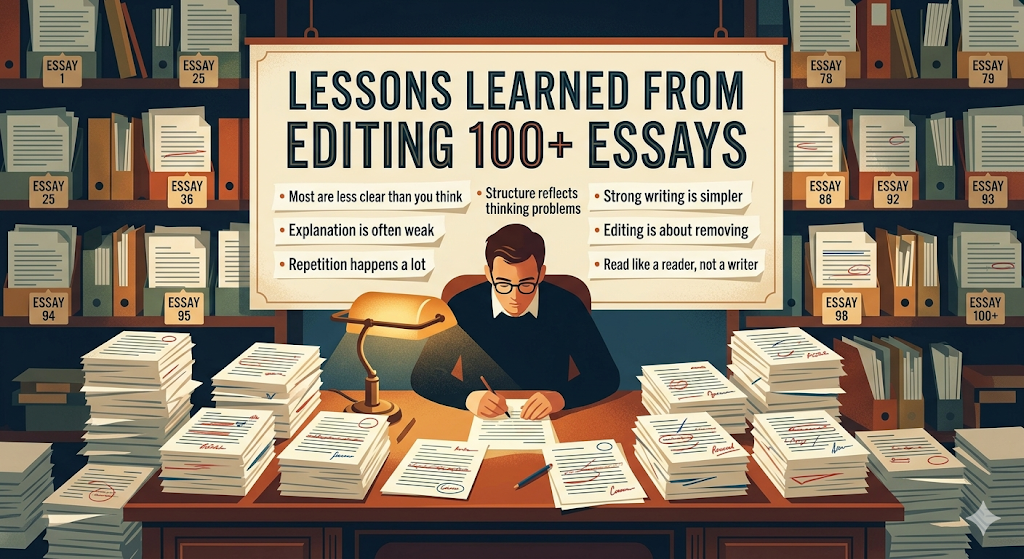
After editing a large number of essays, certain patterns start to repeat. Most issues are not unique to a topic or level; they show up in similar ways across different writers. Problems with clarity, weak explanations, and unnecessary repetition appear more often than major structural flaws. Over time, it becomes clear that improving an essay is less about adding more content and more about refining what is already there.
Key Takeaways
- Most essays are harder to understand than the writer expects
- Explanations are often missing or too brief after examples
- The same idea is often repeated in slightly different wording
- Structure problems usually come from unclear thinking
- Strong writing is usually simpler, not more complex
- Editing improves essays more by removing than by adding
After editing a large number of essays, I started noticing something unexpected.
The problems weren’t random.
Different topics, different students, different levels but the same issues kept appearing. Unclear points, weak explanations, repeated ideas. It didn’t matter whether the essay was short or long, simple or advanced.
That changed how I look at writing.
Most essays don’t struggle because of a lack of ideas. They struggle because those ideas aren’t clearly expressed or fully developed. And once you see that pattern, editing becomes less about fixing small mistakes and more about understanding how the writing actually works.
After seeing the same patterns again and again, a few specific lessons started to stand out.
Lesson 1 — Most Essays Are Not as Clear as the Writer Thinks
One of the most consistent patterns I noticed is the gap between what the writer understands and what the reader sees.
When someone writes an essay, the ideas already make sense to them. They know what they’re trying to say, so the writing feels clear from their side.
But when you read the same essay as an editor, it often doesn’t come across the same way.
What this looks like
- points that feel obvious to the writer but aren’t explained clearly
- sentences that assume the reader already understands the context
- arguments that are implied instead of stated directly
Why it happens
Writers read their own work with background knowledge. They fill in gaps without realizing it.
The reader doesn’t have that advantage.
What changes during editing
Once you start reading like a reader instead of a writer, these gaps become easier to spot. You begin to notice where the explanation stops too early or where a step in the argument is missing.
After noticing this pattern, another issue becomes easier to recognize, especially in how ideas are supported.
Lesson 2 — Explanation Is the Weakest Part of Most Essays
In many essays, the writer includes examples, quotes, or facts but stops short of explaining them.
On the surface, the paragraph looks complete. There’s a point, there’s evidence, and the structure seems fine.
But when you read it closely, something is missing.
What this looks like
- a quote followed by a short or vague explanation
- an example that isn’t clearly connected to the main point
- a paragraph that ends right after presenting evidence
Why it happens
Writers often assume the example is enough.
Since the meaning feels obvious to them, they expect the reader to make the connection on their own.
What editing reveals
When you read the same paragraph as an editor, the gap becomes clear:
The example is there, but the reasoning behind it isn’t fully explained.
That’s where the argument should be built but it’s often the part that gets the least attention.
What improves it
Adding a clear explanation after the example not just what it shows, but how it supports the point , makes a noticeable difference.
It turns a complete-looking paragraph into one that actually works.
Even when explanations are added, another pattern often appears, one that makes the writing feel longer without making it clearer.
Lesson 3 — Repetition Happens More Than Writers Realize
After going through many essays, one pattern kept appearing in different forms:
The same idea repeated more than once.
Not word-for-word. But close enough that it didn’t add anything new.
What this looks like
- restating the same point in the next sentence with slightly different wording
- repeating an idea in both the explanation and the conclusion of a paragraph
- adding extra lines that sound different but say the same thing
Why it happens
Writers often think they’re strengthening their argument by saying it again.
In reality, they’re not adding new information, they’re just extending the same idea.
What editing reveals
When you step back and read carefully, it becomes clear which sentences move the argument forward and which ones just repeat it.
Once those repeated parts are removed, the writing usually becomes clearer and more direct.
What improves it
Instead of repeating a point, it’s more effective to either:
- Add a new layer of explanation
- Or move to the next idea
If neither happens, the sentence probably isn’t needed.
After removing repetition, another issue becomes easier to see how the essay is actually structured.
Lesson 4 — Structure Problems Usually Start with Thinking Problems
When an essay feels disorganized, the first instinct is to fix the structure.
Rearrange paragraphs. Adjust the order. Add transitions.
Sometimes that helps. But often, it doesn’t solve the real issue.
What this looks like
- paragraphs that don’t fully connect
- ideas that feel out of place even after reordering
- sections that seem unclear no matter how they’re arranged
What’s actually happening
The structure reflects the clarity of the underlying idea.
If the main point of a paragraph isn’t fully clear, the paragraph itself won’t feel stable. Moving it around doesn’t fix that.
What editing reveals
When reviewing these essays, it becomes clear that the issue isn’t where the paragraph is placed; it’s what the paragraph is trying to say.
Once the idea is clarified, the structure usually improves on its own.
What helps
Instead of asking:
“Where should this go?”
It’s more useful to ask:
“What is this paragraph actually trying to prove?”
If that answer isn’t clear, structure adjustments won’t solve the problem.
Once the ideas are clear, another pattern becomes obvious: strong essays don’t rely on complicated writing.
Lesson 5 — Strong Essays Are Usually Simpler, Not More Complex
A common assumption is that better writing sounds more advanced.
After editing many essays, that doesn’t hold up.
The essays that work best are usually the ones that are easier to follow, not harder.
What this looks like
- clear sentences that don’t try to do too much
- direct wording instead of complicated phrasing
- ideas explained in a straightforward way
What weaker essays tend to do
- Use longer sentences to sound more formal
- Add extra words that don’t change the meaning
- Rely on phrasing that sounds polished but isn’t clear
What editing reveals
When complex sentences are simplified, the argument often becomes stronger.
Not because the ideas changed but because they’re easier to understand.
What helps
Instead of trying to make the writing sound more advanced, it’s more effective to make it easier to read.
That usually means:
- shortening sentences
- removing unnecessary wording
- keeping the focus on the idea itself
Once the writing becomes simpler, another shift in editing becomes clear, it’s not about adding more content.
Lesson 6 — Editing Is More About Removing Than Adding
When something feels off in an essay, the instinct is usually to add more.
Add another sentence. Add another example. Add more explanation.
After editing many essays, that approach rarely fixes the problem.
What this looks like
- Longer paragraphs that still feel unclear
- Repeated ideas instead of stronger ones
- Extra sentences that don’t move the argument forward
What’s actually happening
The issue is often not a lack of content, it’s too much of the wrong kind.
Unnecessary lines make it harder to see the main point. They slow the reader down and dilute the argument.
What editing reveals
When you remove those extra parts, the structure becomes clearer almost immediately.
The argument stands out more because there’s less noise around it.
What helps
Instead of asking:
“What can I add here?”
It’s more effective to ask:
“What can I remove without losing meaning?”
That question leads to stronger results.
Once you start editing this way, another change becomes important: how you read your own writing.
Lesson 7 — You Have to Read Like a Reader, Not a Writer
When you read your own essay, you’re not really reading it the way someone else will.
You already know what you meant, so your mind fills in gaps without noticing.
That’s why issues with clarity, explanation, or repetition often go unnoticed during writing.
What this looks like
- sentences that feel clear to you but confuse someone else
- missing steps in reasoning that you don’t notice
- parts that seem fine until someone else points them out
What editing changes
When you step back and read as a reader, the perspective shifts.
You start asking:
- “Does this make sense on its own?”
- “Is anything unclear without context?”
- “Would someone understand this without asking questions?”
That’s when the weak spots become easier to see.
What helps
Creating distance from your writing makes this easier.
Even a short break helps you come back with a clearer view. You’re less attached to the wording and more focused on how it reads.
After enough essays, this way of reading becomes more natural and it changes how you approach editing overall.
What Editing 100+ Essays Actually Changes
After working through a large number of essays, the process itself starts to shift.
You stop looking at writing sentence by sentence and start seeing patterns more quickly.
What changes in practice
- You notice clarity issues earlier
- You focus less on grammar at the start
- You identify weak paragraphs faster
Instead of scanning for small mistakes, you look for where the writing breaks down.
How the approach shifts
Early on, editing feels like fixing problems as they appear.
Over time, it becomes more selective. You know what to look for first, and you don’t spend as much time on things that don’t affect the overall quality.
What stays the same
The issues themselves don’t really change.
Different essays still struggle with:
- unclear points
- weak explanations
- repetition
The difference is how quickly you recognize them.
That shift doesn’t just affect how you edit, it also changes how you write.
How This Changed My Own Writing Process
Editing so many essays didn’t just change how I review writing, it changed how I write my own.
What I do differently now
- I don’t try to perfect the structure early I focus on getting the idea clear first, then shape it later
- I write more directly Instead of trying to sound formal, I focus on making the point clear
- I check explanations while writing Not after, so the paragraph is complete the first time
What I stopped doing
- overcomplicating sentences to make them sound stronger
- adding extra lines to “complete” a paragraph
- assuming the reader will understand implied ideas
What improved
The writing became easier to follow.
Not because the ideas changed, but because they were expressed more clearly from the start.
These changes aren’t complex. They come from noticing the same issues repeatedly and adjusting how you approach writing.
Conclusion (Clear Closing Thought)
After editing many essays, one thing becomes clear.
The problems don’t change much.
Different topics and writers, but the same issues keep appearing, unclear points, weak explanations, repetition, and a structure that doesn’t hold because the idea isn’t fully developed.
Once you recognize these patterns, editing becomes more focused. You stop looking for random mistakes and start addressing the parts that actually affect how the essay works.
That’s where most improvement comes from.
메타데이터
- post_id
- cd8b7427f9ba
- slug
- lessons-learned-from-editing-100-essays-author-reflection-cd8b7427f9ba
- url
- https://medium.com/@elowenrose/lessons-learned-from-editing-100-essays-author-reflection-cd8b7427f9ba
- canonical_url
- https://medium.com/@elowenrose/lessons-learned-from-editing-100-essays-author-reflection-cd8b7427f9ba
- author_url
- https://medium.com/@elowenrose
- status
- ok
- fetched_at
- 2026-06-26 03:39:16