Sleep Apnea and CPAP: What the Science Says
An honest look at how CPAP works, what the evidence shows, and why the machine is worth it.
Sleep Apnea and CPAP: What the Science Says
An honest look at how CPAP works, what the evidence shows, and why the machine is worth it.
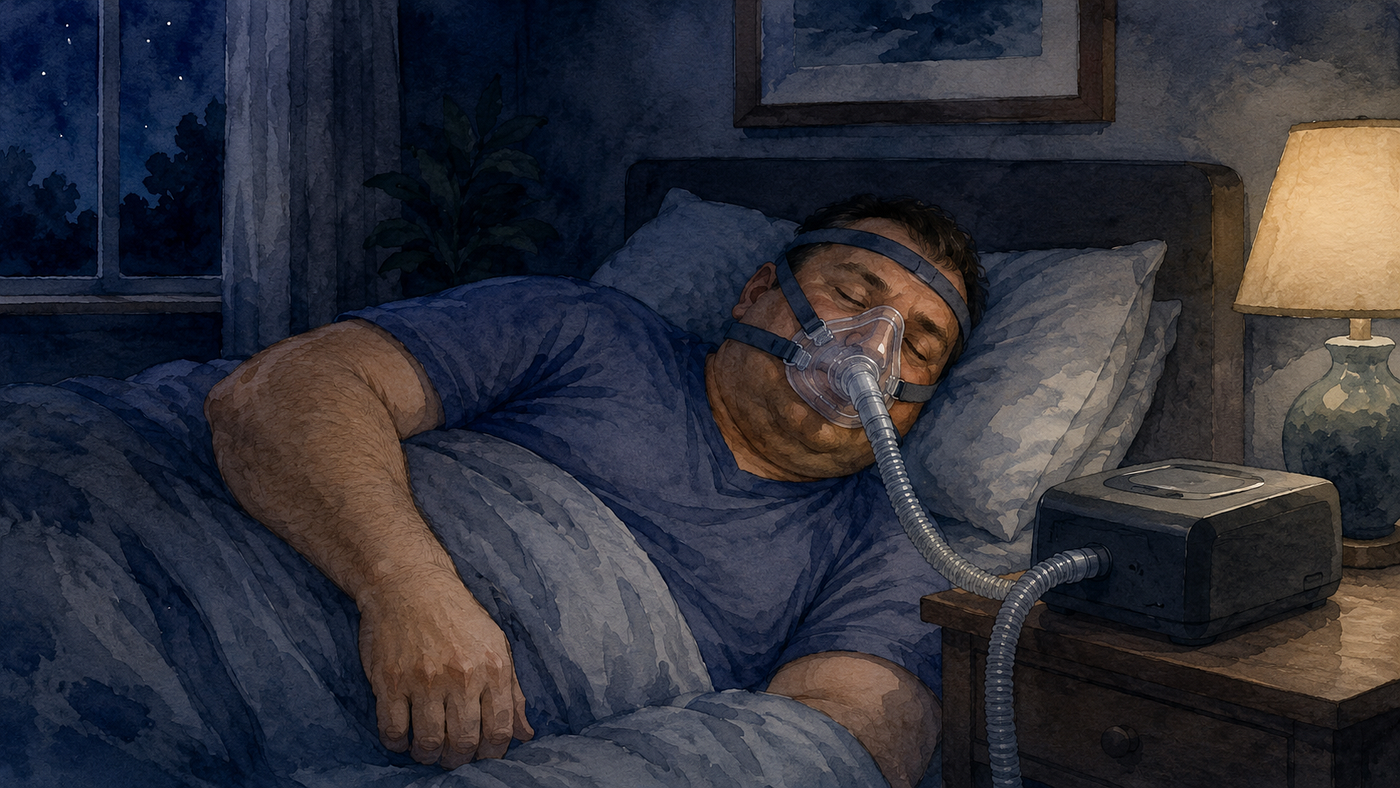
Image via OpenAI.
When I was in my mid-thirties, my heart decided to start freelancing. After a long trip to Buffalo and then Omaha, I got home with the strange sensation that it was skipping beats just to keep me humble. This was not one of those “maybe I’m imagining it” situations. My wife, who is a physician associate, listened to my chest and immediately asked which hospital I wanted to visit. Nothing says romance quite like “pick an ER, because something is wrong.”
After a night in the emergency department and some testing, I learned I had premature ventricular contractions (PVCs), something many people have, and that is often harmless. I was told to back off the caffeine, which was rough because I had been treating jet lag and travel fatigue with a lot of coffee and energy drinks. I also needed better sleep, of course. That advice sounded simple, the way “just relax” sounds simple before the dentist is about to pull out your tooth.
You see, I had gained a fair amount of weight from my mid-twenties into my early thirties, and somewhere along the way, sleep apnea arrived and settled in. My doctor asked my wife whether I snored. She said yes. Asked whether I stopped breathing, she basically had to shrug because she is a deep sleeper and, apparently, not running a nightly respiratory surveillance program on her full-grown adult husband.
One sleep study later, I had my diagnosis: obstructive sleep apnea. And like many stubborn men who assume problems will solve themselves if ignored hard enough, I did very little about it. I mostly took antihistamines and acted like the snoring was the main event, which is a bit like noticing smoke in your kitchen and deciding the real issue is the smell.
Then it happened again last year, and that finally got my attention. I was not getting younger, sleep apnea is not exactly a quirky personality trait, and my repeat sleep study showed I was stopping breathing for up to 90 seconds at a time, ten to fifteen times a night. That is a terrible hobby for a human body to have.
On top of losing weight, I was prescribed a CPAP machine to help me breathe while I sleep. I have lost 40 pounds since February, and that in itself will go a long way toward helping with the apnea. But the CPAP may be the single biggest improvement I have made for my health. So let me walk you through what sleep apnea is, how doctors tried to treat it before CPAP, and why the machine is far less awful than many people imagine. No, it is not glamorous. Yes, it is worth it.
What Is Sleep Apnea?
Sleep apnea is a disorder in which breathing repeatedly stops and starts during sleep. The most common form—obstructive sleep apnea (OSA)—happens when the muscles in the back of the throat relax too much, letting soft tissue collapse and block the airway. Your brain then gives you a little panic nudge, just enough to reopen the throat and get breathing started again. In other words, your body spends the night hitting its own reset button.
This can happen dozens or even hundreds of times a night, often without the sleeper remembering any of it. So yes, you can spend eight hours in bed and still wake up feeling like you spent the night wrestling raccoons. No restful sleep means daytime fatigue, brain fog, irritability, and the special joy of wondering why you feel exhausted before lunch.
There are two other types of sleep apnea worth knowing about. Central sleep apnea (CSA) happens when the brain fails to send the right signals to the breathing muscles. So there is no blockage; the message itself just does not get through. Then there is complex sleep apnea syndrome, where obstructive events are treated with PAP therapy, but central apneas still show up. Because apparently one type of sleep problem was not enough.
The go-to measurement in sleep medicine is the apnea-hypopnea index (AHI), the number of breathing disruptions per hour of sleep. An AHI of 5 to 15 is mild, 15 to 30 is moderate, and above 30 is severe. When I say my sleep study got my attention, this is why. Severe OSA means breathing interruptions can happen more than once a minute all night long. Over time, that is not just bad for your mood and productivity. It puts real strain on the heart, blood pressure, metabolism, and blood vessels.
Who Gets It and Why
OSA is common in the United States, and one of the most sobering things about it is how often it goes undiagnosed. A huge number of people likely have it and do not realize it until it has already started causing other problems. Even among people who are diagnosed, many stop treatment or never use it consistently enough for it to really help. This is not a niche problem. About 80% of people with OSA don’t know they have it, and among those who are diagnosed, more than half discontinue treatment or fail to meet adherence criteria. That is a huge gap between having a therapy and benefiting from it.
The condition develops from a mix of anatomy, physiology, and body composition, and it runs in families more than many people realize. Obesity is the strongest modifiable risk factor because extra tissue around the neck and upper airway can make collapse during sleep more likely. That part is straightforward enough.
But it is also more complicated than the usual lazy cultural script about body size. OSA-related sleep disruption can alter hormone regulation in ways that promote weight gain, creating a vicious cycle. And researchers have also identified shared genetic pathways between obesity and OSA. So no, this is not just a matter of people needing a better planner and more moral fiber.
And obesity is not the whole story anyway. The shape and size of the jaw, tongue, and soft palate matter too. Age, sex, alcohol use, sedatives, tonsils, and nasal congestion can all tilt the odds. Some people are basically built with an airway that is more likely to misbehave at night. Biology is rude like that.
How Medicine Treated Sleep Apnea Before CPAP Machines Came Along
One of the earliest recognizable descriptions of this condition came from Charles Dickens in The Pickwick Papers, where he wrote a character who was obese, constantly sleepy, and memorable enough to help inspire the old term Pickwickian syndrome. What is striking, in hindsight, is how long medicine and society treated this picture as laziness or weak character instead of physiology. We have always loved turning biology into a morality play.
I wrote more about that here, by the way: It’s not just willpower: how history, policy, culture, and biology made us fat. Go check it out. Improve your algorithm.
Anyway, for much of the 20th century, treatment options were blunt and unpleasant. The only reliably effective intervention was a permanent tracheostomy, in which surgeons created an opening in the trachea to bypass the upper airway obstruction entirely. It worked, but it was obviously a last-resort option, not the kind of thing anyone volunteered for because they felt a little sleepy during staff meetings.
Things changed in 1976 when Japanese surgeon Seiichiro Ikematsu described uvulopalatopharyngoplasty (UPPP), a surgery designed to reduce airway collapse by reshaping tissue in the soft palate and throat. It later came to the United States because UPPP was introduced there by Dr. Shiro Fujita in 1981 as an alternative to tracheostomy. But outcomes were inconsistent, and in many people, the apnea eventually returned. Removing tissue turned out not to be the same thing as solving the whole problem.
The Machine That Changed Everything
In 1981, Dr. Colin Sullivan and colleagues at the University of Sydney published a brief but landmark paper in The Lancet. Sullivan had been studying airway behavior during sleep and came up with a remarkably elegant idea: instead of surgery, why not keep the airway open with air pressure?
The first prototype was gloriously improvised, which is often how important inventions begin. It used a fiberglass nasal cast, rubber tubing, and a vacuum cleaner motor. So yes, the ancestor of the device I now sleep with was basically part medical equipment, part garage experiment, and probably not a great look on a bedside table.
Baxter International licensed the patent in 1987 and released the first commercial device in 1988. Soon after, ResMed was founded by Dr. Peter Farrell, specifically to help bring CPAP technology to scale. Since then, the machines have become smaller, quieter, smarter, and far less likely to make you look like you are preparing for a moon landing. The core idea, though, is still Sullivan’s.
How CPAP Works
CPAP is pneumatic splinting, which is a fancy way of saying that pressurized air keeps the airway open. Think of it as an internal air brace for your throat. It does not breathe for you. It just makes it much harder for your airway to collapse in the first place, which turns out to be exactly what many of us need.
The pressure is not one-size-fits-all. A sleep physician can determine it during a lab titration study or, increasingly, through home-based automatic titration. The goal is to use enough pressure to prevent obstruction without making the experience so uncomfortable that you rip the mask off at 2 a.m. and throw it across the room like you did that spider that fell from the ceiling that one time.
Modern CPAP machines also collect data. They record how long you use them, whether the mask leaks, and what your residual AHI looks like from night to night. That information can be transmitted to healthcare providers and insurers, which is useful medically (and mildly dystopian emotionally). Still, if you are going to be surveilled, it might as well be for oxygen.

And you know I like my data. (Screen capture from my CPAP machine’s iPhone app.)
The CPAP Family: BiPAP, APAP, and ASV
CPAP is just one member of a larger positive airway pressure family. Three related devices show up often in sleep medicine, and the alphabet soup can make people’s eyes glaze over, so let me translate.
APAP, or auto-titrating PAP, adjusts pressure within a prescribed range during the night based on changes in airflow resistance. It is the device equivalent of someone constantly nudging the settings so you do not have to.
BiPAP, or bilevel PAP, delivers a higher pressure when you inhale and a lower pressure when you exhale. That can make breathing feel more natural for people who struggle with straight CPAP or who have other respiratory issues layered on top of OSA.
ASV, or adaptive servo-ventilation, is the most sophisticated of the bunch. It monitors breathing patterns breath by breath and adjusts support dynamically, which makes it especially useful for some forms of central or complex sleep apnea. In other words, this is the overachiever of the family.
Beyond the Mask: Other Treatments in the Modern Toolkit
CPAP is still the first-line treatment for moderate to severe OSA, but it is not the only option, and it is not the best fit for every patient. Sleep medicine is not a one-mask-fits-all enterprise, and that is a good thing.
Oral appliances, particularly mandibular advancement devices (MADs), work by holding the lower jaw slightly forward to open the airway. They can be effective for mild to moderate OSA and, importantly, some patients find them much easier to live with than CPAP. A meta-analysis of 14 RCTs found that CPAP reduced AHI more, but oral appliances often performed similarly on subjective sleepiness and may be easier for some people to stick with. A treatment you actually use beats one that is theoretically perfect but gathers dust on your nightstand.
[embed]
Positional therapy can help people whose apnea is much worse when they sleep on their back. This is exactly what it sounds like: a collection of methods and devices designed to keep you from rolling onto your back at night. Not elegant, perhaps, but neither is repeatedly forgetting to breathe.
Hypoglossal nerve stimulation (HNS), sold as the Inspire device, is one of the more interesting newer developments. A small implanted system monitors breathing and stimulates the hypoglossal nerve so the tongue moves forward during inhalation instead of helping block the airway. For selected patients who cannot tolerate CPAP, it can work very well. And a 2024 systematic review and meta-analysis found meaningful reductions in AHI along with high adherence and satisfaction. The future, apparently, includes a tiny internal coach telling your tongue to get out of the way.
[embed]
Lifestyle modification matters too, especially weight loss, when excess body weight is part of the picture. It can meaningfully reduce AHI and improve symptoms, though it is not always enough by itself for moderate or severe disease. Still, it helps, and I say that as someone who has seen the difference firsthand.
What the Evidence Actually Shows for CPAP
This is where the conversation gets more nuanced, and frankly more interesting. Patients deserve more than salesmanship. We deserve the truth, even when the truth is a little messy and refuses to fit on a bumper sticker.
For symptom relief, the evidence is strong. CPAP improves daytime sleepiness, sleep quality, snoring, and quality of life in people with moderate to severe OSA. A 1999 randomized controlled trial helped establish that people using CPAP were far more likely to experience meaningful symptom improvement than people receiving conservative treatment alone. On the question, “Will this help me feel less wrecked?” the answer is often yes.
For mild OSA, the evidence is less dramatic. A 2002 randomized crossover trial in patients with mild OSA found improvement in symptoms such as snoring and restless sleep without clear improvement in every objective measure that researchers care about. That is a useful reminder that sleep medicine includes both physiology and perception. There is no lab value for “I no longer feel like a haunted Victorian child by 3 p.m.,” but it still matters.
For blood pressure, the evidence is solid but modest. A meta-analysis of 10 RCTs in patients with resistant hypertension and OSA found clinically meaningful reductions in systolic and diastolic pressure. No, it is not magic. But in a high-risk population, modest reductions are still real wins.
For hard cardiovascular outcomes like heart attack, stroke, and cardiovascular death, the evidence has been more contested. The SAVE trial, a very large randomized study, did not find a broad reduction in recurrent cardiovascular events across all enrolled patients. That disappointed a lot of people, mostly because everyone loves a clean story and biology keeps refusing to provide one.
But more detailed analyses suggest the story is not “CPAP does nothing.” A 2023 individual-participant meta-analysis pooling ISAACC, RICCADSA, and SAVE found better outcomes among patients who actually used CPAP enough. And a 2025 multi-trial analysis published in the European Heart Journal pushed that further, suggesting cardiovascular benefit is concentrated in higher-risk patients with heavier physiological burden.
That pattern makes sense. A therapy designed to reduce nighttime airway collapse and oxygen drops would be most likely to help the people who have enough physiological burden to benefit and who use the device consistently enough for it to do its job. This is less a surprise than a reminder that treatment adherence is not a boring footnote. Actually, it is often the whole plot.
The Compliance Problem
The gap between what CPAP can do in theory and what it does in real life comes down mainly to one thing: many people stop using it. Masks can feel awkward, dry air can irritate the nose (and eyes, if the air is leaking), the pressure can feel strange at first, and some people simply hate the experience. None of that is imaginary. A CPAP machine is not a candle, a weighted blanket, or any other wellness product pretending to be your friend.
But the adherence issue also helps explain why the research can look mixed. A trial where many people wear CPAP only a few hours a night is not really testing the full benefit of CPAP. It is testing the benefit of partial treatment, which is a different thing entirely. Medicine is annoyingly literal that way.
That has been true for me too. At first, the mask was uncomfortable, and the whole setup felt like I was preparing for lift-off instead of bedtime. But after some adjustments to the fit and position, it became much easier to tolerate. Now I sleep better, feel better, and wake up feeling like a person rather than a big piece of dough, all out of shape and going nowhere. (But, as you can see from the app image above, I still have some days where I take it off without realizing it.)
What Should You Take Away From All of This?
Sleep apnea is common, underdiagnosed, and serious enough to deserve attention. If you wake up exhausted despite adequate time in bed, snore heavily, gasp in your sleep, or carry risk factors like obesity, high blood pressure, or heart arrhythmias, it is worth talking to a healthcare professional. You do not get extra points for white-knuckling your way through exhaustion. That whole “I’m fine” thing is a lie when you don’t sleep, and everyone knows it.
If you are diagnosed, the treatment options are better than they used to be. CPAP remains the standard first-line therapy for moderate to severe OSA, and there are now better masks, better machines, better data, and better alternatives for people who cannot tolerate it. Sleep medicine is no longer stuck in the era of “Well, we could cut a hole in your neck.”
The most honest summary is this: CPAP has strong evidence for improving the things it was originally meant to improve, especially symptoms and nighttime breathing. Its longer-term cardiovascular benefits appear to depend heavily on who uses it and how consistently. That is not a weakness of the treatment so much as a reminder that real bodies and real lives are complicated.
So yes, your mileage may vary. But in my case, this weird little air-pushing machine has made me healthier, more rested, and considerably less likely to spend the night trying to cosplay as a CPR dummy or the day self-medicating with expensive coffee.
메타데이터
- post_id
- cd96f5cb02f1
- slug
- sleep-apnea-and-cpap-what-the-science-says-cd96f5cb02f1
- url
- https://thequantasticjournal.com/sleep-apnea-and-cpap-what-the-science-says-cd96f5cb02f1
- canonical_url
- https://thequantasticjournal.com/sleep-apnea-and-cpap-what-the-science-says-cd96f5cb02f1
- author_url
- https://medium.com/@epiren
- status
- ok
- fetched_at
- 2026-07-10 03:02:36