Democrats Aren’t Waiting Out Trump — They’re Replacing Their Own Voters
How a party that once claimed to stand for the poor and minorities became an elite machine betting on immigration, dependency, and…
The Great Replacement (Vote)
Democrats Aren’t Waiting Out Trump — They’re Replacing Their Own Voters
How a party that once claimed to stand for the poor and minorities became an elite machine betting on immigration, dependency, and anti‑Trump fear to survive
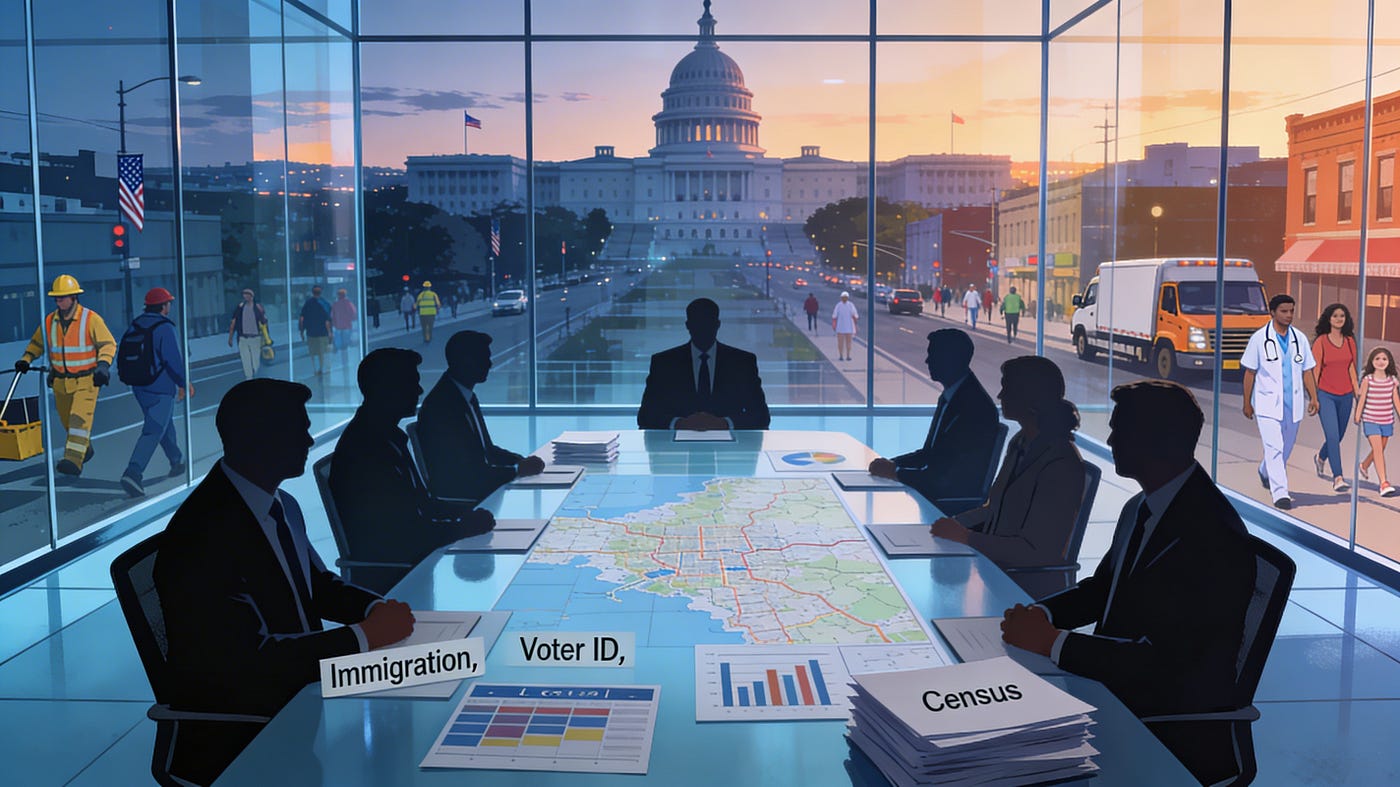
Distant party elites strategize in a D.C. boardroom while the working Americans they depend on stand far below. Illustration by Perplexity, powered by GPT‑5.1.
Democrats say they defend the people, but their actions betray a different agenda
The Democratic Party keeps telling us it is still the party of “the people.” Its actions in 2026 expose something very different: a party run by corporate‑friendly elites, increasingly hostile to its own working‑class and minority base, and banking on immigration, dependency, and anti‑Trump hysteria to hold onto power rather than earning anyone’s trust.
For years, Democrats have insisted that voter ID is “racist,” even as roughly 80 percent of Americans support requiring identification at the polls, including strong majorities of Democrats, Black voters, and Hispanics. Recent polling shows about 84 percent of Americans back photo ID to vote, and around 70 percent support proof‑of‑citizenship requirements for federal elections, with Democratic voters nearly evenly split on the latter even as their leaders in Washington fight it tooth and nail (Wisconsin Watch; Cygnal; Yahoo News). What are you supposed to conclude when a party that claims to represent you dismisses a policy you support as bigotry and ignorance? To me, it looks like they do not trust their own voters and are terrified of anything that might restrain the way they manage elections.
Voter ID exposes how far party leaders have drifted from their own base
The same pattern shows up even more starkly on immigration. When Barack Obama enjoyed overwhelming loyalty among minority voters, he could afford to talk and act tough on enforcement. His administration set record deportation numbers, with over 438,000 removals in 2013 alone and more than 2 million in his first five years, earning him the nickname “deporter‑in‑chief” from immigrant advocates (PBS; Pew Research). That posture did not threaten his coalition because Black, Hispanic, and other minority voters were still locked in as automatic Democrats.
Once those groups started bleeding away, first slowly after 2016 and then dramatically by 2024, the party’s stance flipped. In 2024, Trump cut Democrats’ margin among Hispanic voters from a 25‑point Biden win in 2020 to just 3 points, and his share of the Black vote nearly doubled to about 15 percent, which is unheard of for a modern Republican (Pew Research). Analyses of the 2024 and 2025 electorate show growing defection among non‑college Black voters, Hispanic men, and working‑class young people of all races, driven by cost of living, crime, and cultural disconnect, not just accusations of “racism” (Brookings; Navigator Research; Harvard Ash Center). At precisely the moment their old base began to question them, Democrats moved from record deportations and “secure the border” language to open‑arms rhetoric, sanctuary posturing, and reflexive opposition to enforcement‑first deals.
The immigration flip from Obama’s deportations to today’s open‑arms posture reveals a deeper strategy
That shift makes sense if you assume one thing: Democratic leadership decided it was easier to replace disillusioned voters than to win them back. Legal and policy analyses show how the party has evolved toward expansive legal pathways, broader protections from deportation, and resistance to many enforcement compromises, counting on the fact that immigrants and their U.S.‑born children currently lean Democratic at the ballot box (University of Miami Law Review; Brookings). At the same time, Democrats insist that everyone living in a state, citizen or not, be counted for congressional apportionment and electoral votes, which boosts representation for high‑immigrant, heavily Democratic areas regardless of who can legally vote (CUNY Graduate Center). When you put these pieces together with their hostility to proof‑of‑citizenship voter‑ID requirements, it is hard not to see a long‑term strategy: import a new bloc of poorer, more dependent residents, secure funding and representation based on their presence, then gradually turn them into a loyal voting class.
Benefits for newcomers look less like compassion and more like a long‑term political investment
Meanwhile, everyday Americans watch migrants receive visible, immediate support that many citizens struggle to access. Under federal rules, undocumented immigrants are generally excluded from core benefits like SNAP and TANF. Once someone is admitted as a refugee or granted asylum, however, they become eligible, if they meet income thresholds, for programs like SNAP, Medicaid or ACA subsidies, Refugee Medical Assistance, and Refugee Cash Assistance, which are designed to cover housing, food, and other basics for up to a year (KFF; CWS).
On top of that, many blue‑run cities add their own shelter, voucher, and local cash programs targeted at newcomers (KFF). From the perspective of working‑class citizens, especially those being priced out of housing or denied help for technicalities, this does not look like compassion. It looks like a bribery pipeline: come here, we will take care of you, and someday you and your kids will help keep us in office.
If Democrats were truly the party of the middle class and the poor in 2026, their priorities would look entirely different. They would be cutting wasteful federal spending, attacking the cost of living, confronting crime in the cities they run, and making it easier, not harder, for working families to get ahead. Instead, their national brand is raising taxes, expanding bureaucratic programs, and finding new ways to regulate and micromanage while leaving the core burdens, like rent, groceries, energy, and taxes, largely untouched. The result is a party that treats its historic base as used up and expendable, focused on importing a fresh block of bodies and selling them the same old grift of dependency dressed up as justice.
Anti‑Trump panic is a substitute for a real vision that helps working people
The only thing keeping this machine running is Donald Trump. Democratic operatives have turned Trump into both a scapegoat and a security blanket. Their message has been: ignore your bills, ignore the border, ignore the schools; all that matters is “saving democracy” from this one man. Analyses of 2024 messaging show how heavily Democrats leaned on existential fear of Trump and January 6, while large numbers of young and working‑class voters rolled their eyes because their real concerns were wages, housing, and basic order (NPR; Vox; Harvard Ash Center). Commentators have pointed out that “saving democracy” is a failing argument if the same elites making that plea are also presiding over stagnation, corruption, and policies that obviously favor donors and NGOs over ordinary people (The Hill; Boston Review).
Democrats seem convinced that once Trump is gone, once his second term ends, they can snap back to “normal.” In their minds, Trump is an anomaly, a cult of personality like Obama was for the left, and all they have to do is endure him. The data suggest something deeper is happening. Studies of the 2024 and 2025 youth vote show not a temporary tantrum but a broader rightward drift among young men and non‑college youth, accompanied by growing apathy about voting at all and profound distrust that Democrats, in particular, are on their side (Tufts CIRCLE; PBS/AP‑NORC; Vox). At the same time, survey work and think‑tank analysis highlight how the Republican coalition has become more working‑class and down‑market, while Democrats concentrate among affluent professionals, managers, and the nonprofit‑industrial complex (Manhattan Institute; Boston Review).
Post‑Trump politics will punish Democrats if they cling to business as usual
Looking toward 2028, that trend gives conservatives a huge opportunity. Early polling shows Republican figures like J.D. Vance with a strong base inside the GOP, while Democrats float names like Gavin Newsom, who, fairly or not, has become a national symbol of slick, donor‑class liberalism that presides over homelessness, high costs, and dysfunction at home (The Hill; Newsweek). If Republicans can put forward a competent conservative who keeps Trump’s populist instincts on economics and anti‑elite criticism but avoids some of his chaos, Democrats may learn the hard way that there is no automatic “reversion to the mean” after Trump. They may be facing, instead, a long season of punishment for choosing globalization, bureaucracy, and imported dependency over the very people who gave them power in the first place.
From where I sit, a vote for today’s Democratic Party is no longer a vote for the poor, the working class, or even for American minorities. It is a vote for an entrenched elite that sees citizens as interchangeable units to be managed, swapped out, and bought off, whether they were born here or just arrived yesterday. Once enough people see that clearly, no amount of Trump‑based fearmongering will be enough to drag them back.
메타데이터
- post_id
- cd96fa548ec3
- slug
- democrats-arent-waiting-out-trump-they-re-replacing-their-own-voters-cd96fa548ec3
- url
- https://medium.com/reason-and-rant/democrats-arent-waiting-out-trump-they-re-replacing-their-own-voters-cd96fa548ec3
- canonical_url
- https://medium.com/reason-and-rant/democrats-arent-waiting-out-trump-they-re-replacing-their-own-voters-cd96fa548ec3
- author_url
- https://medium.com/@ReasonandRant
- status
- ok
- fetched_at
- 2026-06-13 00:25:45