The Agentic Shift: Why 2026 is the Year “Using” AI Isn’t Enough
A Survival Guide for the UK Workforce: From Vibe Coding to GreenOps.
The Agentic Shift: Why 2026 is the Year “Using” AI Isn’t Enough
A Survival Guide for the UK Workforce: From Vibe Coding to GreenOps.
We need to have a real conversation about where we are.
It’s no secret I love to tinker with tech; I was very curious as a child. When my toys broke, I was that child who always had the urge to take a screwdriver to it, open it up; just to see the gears turn. For many of us, those were important moment, the realisation that understanding a system means being willing to break it. In the 1990s, it would often get me in trouble but now, in 2026 that same energy is the only thing standing between a thriving career and professional stagnation.
For the last three years, we’ve been living in the “Playground Phase” of Artificial Intelligence. We’ve all played with the chatbots and seen the same advice on “How to write prompts to save hours of work!”. Although I am passionate about tech, it honestly felt like magic! But as we move through early 2026, it’s closing time at the playground. The “magic” is being replaced by engineering. [4]
I recorded a podcast recently with my good colleagues Sean Rafter and Jacob Reilly-Cooper; in it, we discussed Agents. We are currently navigating what I call “The Agentic Shift”. This isn’t a like a subtle upgrade from ChatGPT-4 to ChatGPT-5. It is a fundamental pivot in how humans and computers interact. We are moving from Generative AI (systems that talk) to Agentic AI, autonomous systems capable of reasoning, planning, and executing complex workflows with minimal human input. [4] If 2024 was about “Chatting,” 2026 is about “Orchestration”. And if you aren’t prepared to move from being a “User” to being an “Architect,” you’re going to find the “Digital Edge” a very uncomfortable place to be. [6]
**Listen to our episode here**
A Closer Look: The Rules Have Actually Changed
Before we look at the skills, we have to look at the law and the national strategy. The landscape has shifted under our feet.
The Legislative Stick: The CSRB
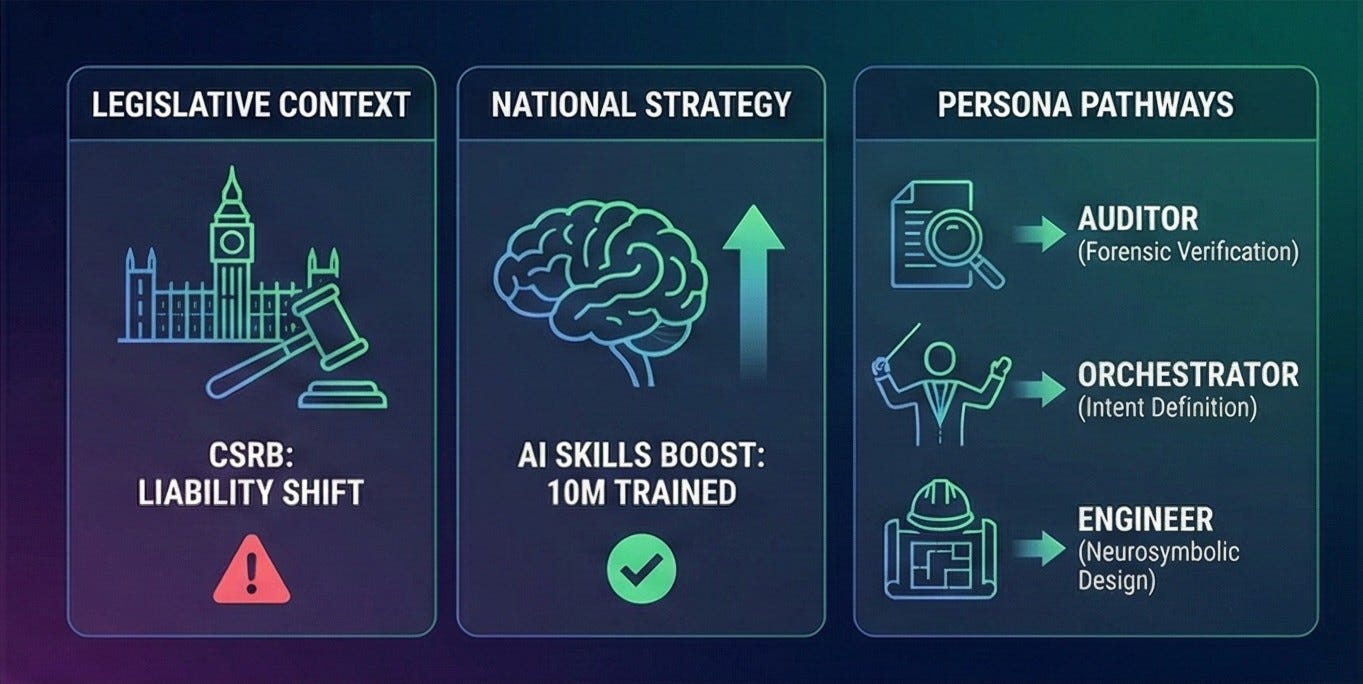
In late 2025, the UK Government introduced the Cyber Security and Resilience Bill (CSRB). [1] This wasn’t just another dry piece of legislation; it was a wake-up call for every board member in the country. The CSRB shifted the liability, expanding regulatory scope to include managed service providers, data centers, and critical digital supply chains. [1] If an autonomous agent makes a decision that leaks sensitive data or breaches a regulation, “The AI did it” is no longer a legal defense. The penalties are eye-watering: up to £17 million or 4% of global turnover for serious breaches. [1] Reliability is no longer a goal; it is a legal mandate.
The National Carrot: 10 Million AI-Ready Workers
To balance this strict regulation, the government just announced a massive expansion of its “AI Skills Boost” program. [2] The target has been raised from 7.5 million to 10 million UK adults to be trained in practical AI skills by 2030. [2] This isn’t an academic study; it’s free, online, “Skills England” benchmarked training designed to build a national baseline of AI-enabled work. [5] From NHS staff to local government workers, the goal is to ensure people have the confidence to “work with AI” safely. [2]
But there’s a catch. The government is also launching a new “AI and the Future of Work Unit”. [3] Why? Because they know this is a “once-in-a-generation transformation” and they are determined to avoid the mistakes of past industrial transitions. They are researching how AI re-bundles jobs and where the “systemic lag” in traditional education is failing our workers. [3]
The Roadmap: Three Personas for 2026
To survive this shift, you have to identify which “lane” you’re in. Whether you’re a casual computer user or a deep-stack developer, your job description has just been rewritten.
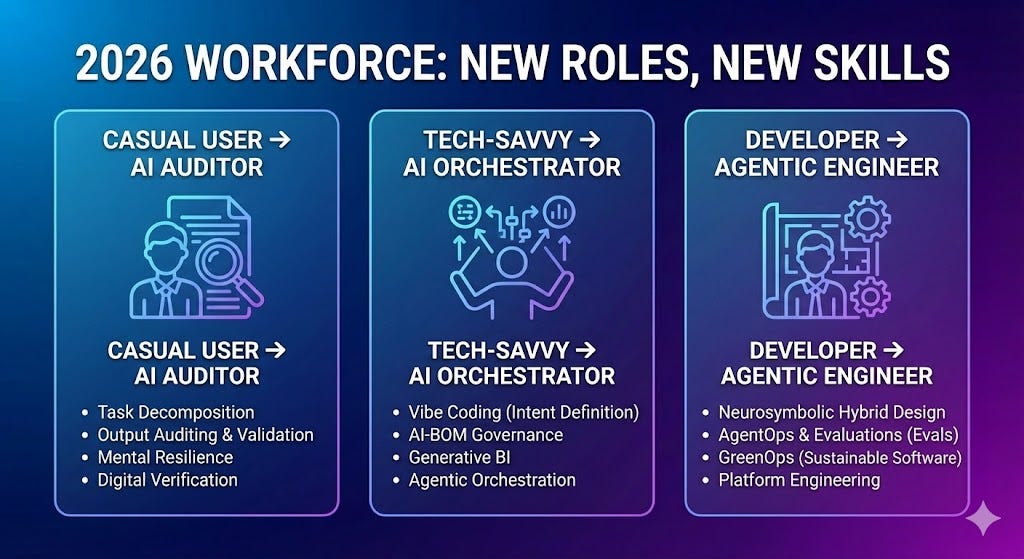
Level 1: The Casual User → The AI Auditor
The Foundational Mindset: Forensic over Functional.
In the taxonomy of 2026, the term “Casual User” is a misnomer. You are the majority of the workforce, administrative staff, coordinators, and frontline workers who are now the pilots and directors of powerful agentic systems.
- Task Decomposition: The ability to break a vague business goal into a deterministic sequence of steps that an agent can follow.
- Output Auditing & Validation: You need a “forensic” mindset to trace AI claims back to source documents and identify “hallucinations”.
- Mental Resilience: Managing the “Cognitive Load” of directing multiple agents while performing deep work is now a technical requirement for performance.
- Digital Verification: In an age of endemic deepfakes, “Zero Trust” is a survival skill. [11] You must verify every unusual request through secondary, trusted channels.
The Training Pathway: This is exactly why we’ve overhauled the Level 3 Data Essentials and Digital Support apprenticeships at Estio. We aren’t teaching people how to “prompt”; we’re teaching them how to audit. We’re building the “human-in-the-loop” that the modern economy requires. [10]
Level 2: The Tech-Savvy Individual → The AI Orchestrator
The Foundational Mindset: Intent over Implementation.
This is the middle tier, the managers, the analysts, and the “Business Technologists”. Your value no longer comes from being a “Power User” of software; it comes from being an Architect of Flows.
- “Vibe Coding” (Intent Definition): Perhaps a very debatable essential skill, this is one I’ve pondered on for some time. As a traditional developer myself, I’ve come to the realisation this is a game changing shift. But if you are not familiar, this is the shift where you describe the desired outcome (the intent) to an AI system, which then generates the underlying code. You don’t need to be a syntax master but you must understand algorithmic logic, conditionals, loops, and data structures to guide the AI effectively. This I believe is the clear distinction between those who will thrive and those who won’t.
- AI-BOM (Bill of Materials) Governance: You need to know exactly which agents are doing what and what data they access to comply with the CSRB.
- Generative BI: Stop reading dashboards. Start interrogating them with natural language to find strategic insights.
- Agentic Orchestration: Managing teams of autonomous agents, defining their personas, and setting “handoff protocols”.
The Training Pathway: Moving from consumer to orchestrator is the heart of the Level 4 Data Analyst programs at Firebrand and Estio. It’s also a core pillar of BPP’s MSc in Applied Data Analytics. [10]
Level 3: The Developer → The Agentic Engineer
The Foundational Mindset: Architecture over Syntax.
This is where it gets controversial for some and let’s be blunt: if your primary value is “I can write Python code,” you are in trouble. AI coding assistants have made syntax generation a commodity. In 2026, the developer’s value proposition has shifted to Agentic Engineering, the design of resilient, autonomous cognitive systems.
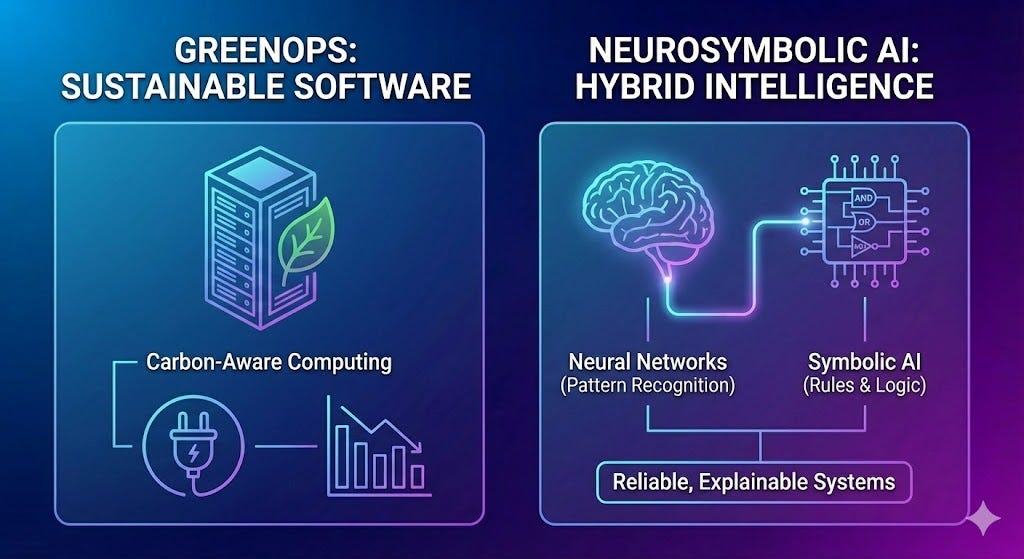
- Neurosymbolic Hybrid Design: This is the “Holy Grail.” It’s fusing Neural Networks with Symbolic AI to ensure critical business rules are never “hallucinated” away. [8]
- AgentOps & Evaluations (Evals): You don’t “test” code the old way; you run evaluations using superior LLMs to grade the safety of other models.
- GreenOps (Sustainable Software Engineering): Good engineers use “Carbon-Aware Computing,” scheduling heavy AI tasks for when the UK energy grid is at its greenest. [9]
- Platform Engineering: Orchestrating AI workloads on Kubernetes (K8s) and managing compute costs through “GPU slicing”.
The Training Pathway: This architectural shift is why BPP’s Level 6 Digital & Technology Solutions Degree Apprenticeship has moved away from “syntax-first” learning. We are teaching Systems Thinking and Cognitive Modeling. Again, we covered this on our podcast last year with our very own Dr Tagliaferri. [10]
Pathways to Proficiency: The Power of Three
The skills gap is widening, but the solution isn’t “one size fits all”. That is why the BPP, Estio, and Firebrand Alliance exists , to provide the right depth of training for the right level of risk. [10]
- For Speed (Firebrand): Accelerated, deep-immersion sprints to get technical teams certified in Agentic Security and GreenOps.
- For Scale (Estio): Level 3 & 4 apprenticeships to build a pipeline of AI Auditors and Orchestrators across your entire organization.
- For Depth (BPP University): Degree Apprenticeships and Master’s programs providing the long-term academic rigor for the future CTOs designing Neurosymbolic systems.
Final Thoughts: Enough Thinking. Start Doing.
The curiosity to take things apart to understand how they work is more valuable now than it has ever been. In 2026, you can’t afford to be a passive consumer of tech, but technical grit is only half the battle. The “Digital Edge” belongs to the curious, the resilient, and the “Auditors” who refuse to take an AI’s word at face value.
It also belongs to the human-centric skills that no machine can replicate: personality, empathy, and strategic communication. These aren’t just “soft skills” anymore, they are the most valuable tools in your kit, the bridge between raw AI execution and real meaningful human impact.
The shift is here. The agents are running. The question is: Who is orchestrating them?
If you’d like to learn more about Lyceum Education Group and what we do, please check us out here: https://www.lyceum.education/
My LinkedIn https://www.linkedin.com/in/idris-fabiyi-1494a238/
Sources :
- https://www.gov.uk/government/publications/cyber-security-and-resilience-network-and-information-systems-bill-factsheets
- https://www.insidetechlaw.com/blog/2025/12/uk-cyber-security-and-resilience-bill-headlines-for-the-data-centre-sector
- https://www.fladgate.com/insights/uk-introduces-new-cyber-security-and-resilience-bill
- https://www.gov.uk/government/news/free-ai-training-for-all-as-government-and-industry-programme-expands-to-provide-10-million-workers-with-key-ai-skills-by-2030
- https://www.gov.uk/government/news/free-ai-training-for-all-as-government-and-industry-programme-expands-to-provide-10-million-workers-with-key-ai-skills-by-2030
- https://www.localgov.co.uk/AI-skills-push-aims-to-equip-10m-workers-by-2030/63773
- https://aisera.com/blog/ai-agent-vs-chatbot-differences/
- https://skillsengland.blog.gov.uk/2026/01/27/ai-skills-boost-skills-englands-ai-foundation-skills-for-work-benchmark-supports-free-ai-training/
- https://www.gov.uk/government/publications/ai-skills-for-the-uk-workforce/ai-skills-tools-package
- https://dev.to/dumebii/the-ultimate-prompt-strategy-how-to-vibe-code-production-ready-websites-4e9
- https://en.wikipedia.org/wiki/Neuro-symbolic_AI
- https://msftstories.thesourcemediaassets.com/sites/418/2023/01/carbon_aware_computing_whitepaper.pdf
- https://www.bpp.com/ai
- https://www.ncsc.gov.uk/collection/zero-trust-architecture (NCSC Zero Trust collection — UK)
메타데이터
- post_id
- cd9d31ec6726
- slug
- the-agentic-shift-why-2026-is-the-year-using-ai-isnt-enough-cd9d31ec6726
- url
- https://medium.com/bpp-digital-edge/the-agentic-shift-why-2026-is-the-year-using-ai-isnt-enough-cd9d31ec6726
- canonical_url
- https://medium.com/bpp-digital-edge/the-agentic-shift-why-2026-is-the-year-using-ai-isnt-enough-cd9d31ec6726
- author_url
- https://medium.com/@idrisfabiyi
- status
- ok
- fetched_at
- 2026-06-13 07:35:29