Trade Republic Vs DEGIRO Vs Interactive Brokers Vs Scalable Capital
Trade Republic — The One I Recommend to Almost Everyone Starting Out
Trade Republic Vs DEGIRO Vs Interactive Brokers Vs Scalable Capital
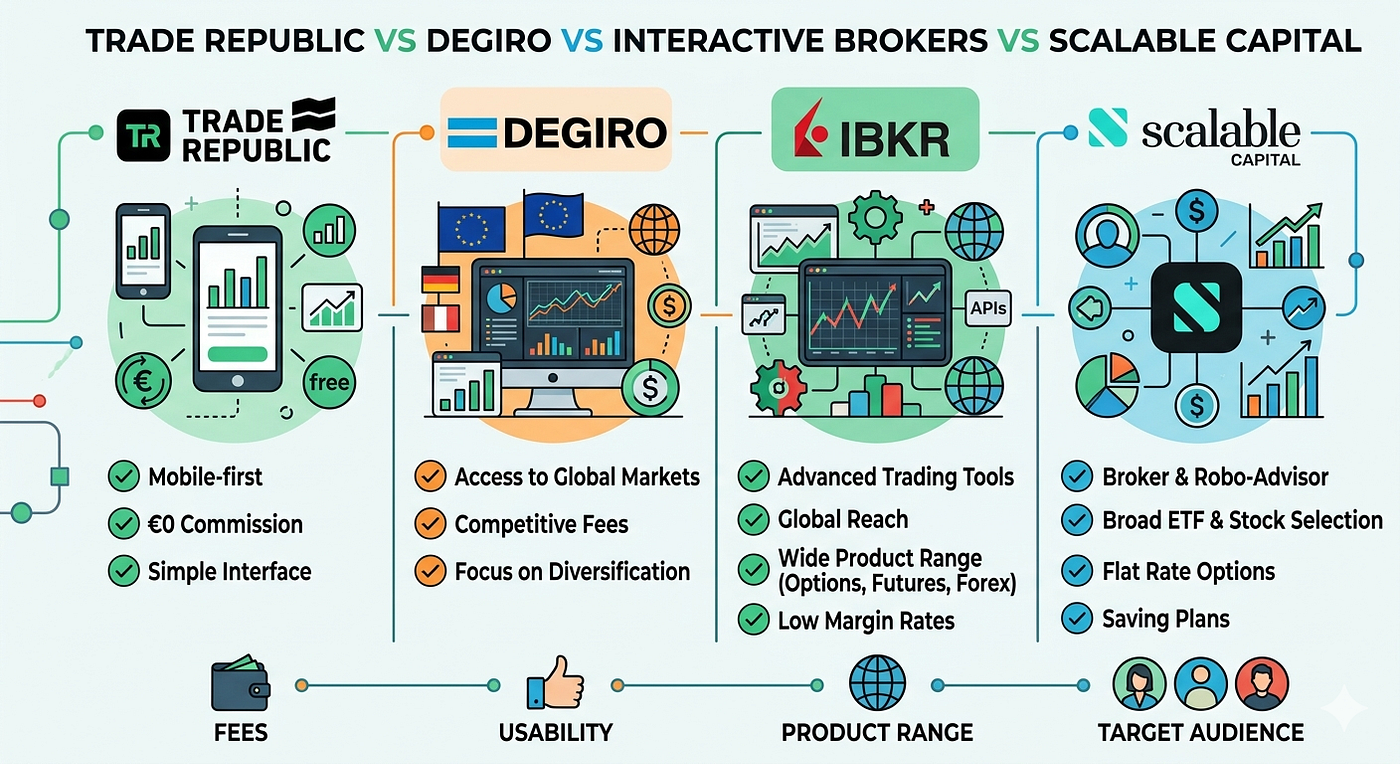
Trade Republic — The One I Recommend to Almost Everyone Starting Out
I’ll be straightforward: if you’ve never invested before and you’re reading this in Europe right now, Trade Republic is probably where you should open your first account.
I say “probably” because nothing is universal. But here’s why it gets my first recommendation almost every time.
The app is genuinely beautiful. I don’t mean that in a superficial way, I mean the design actively reduces the anxiety that comes with investing for the first time. It doesn’t throw forty charts and indicators at you the moment you log in. It shows you your portfolio, your savings plan, and a clean search bar. That’s it. For someone who spent three weeks paralysed by information overload, this mattered more than I expected.
The savings plan feature changed how I think about investing. You set a fixed amount — say €100 — and pick the ETFs you want. Every month, on a date you choose, Trade Republic automatically buys fractional shares of those ETFs with zero commission. You don’t have to think about it. You don’t have to log in. The money moves, the shares are purchased, your portfolio grows.
I know that sounds simple. But simple is the point. The single biggest mistake new investors make isn’t picking the wrong ETF, it’s failing to invest consistently because the process feels too complicated. Trade Republic removes that friction almost entirely.
What it’s less good at: The desktop experience is limited compared to the app. If you’re someone who likes analysing things on a big screen with multiple windows open, you’ll find it slightly restrictive. And the range of available securities, while more than sufficient for most investors, is narrower than platforms like IBKR. If you ever want to trade more obscure stocks or markets, you’ll eventually outgrow it.
The verdict: Perfect for beginners and consistent monthly investors. Free for ETF savings plans. Regulated in Germany. Available across most EU countries.
DEGIRO — The One That Made Me Feel Like a Real Investor
There was a specific moment with DEGIRO that I still remember.
I was sitting at my desk, searching for a specific UCITS ETF — VWCE, if you’re curious, which I’d read about obsessively for two weeks before finally deciding it was what I wanted. I typed it into DEGIRO’s search, found it in about four seconds, and bought a single share. The whole transaction took maybe ninety seconds.
It felt different from Trade Republic. More deliberate somehow. Like I’d made a conscious decision rather than set up an automatic process.
That’s actually the best way I can describe the difference between the two: Trade Republic is automated investing. DEGIRO is active investing. Both are valid. They suit different personalities.
DEGIRO’s fees are impressively low. For ETFs specifically, DEGIRO offers one free trade per ETF per month as part of their core selection, a rotating list of popular UCITS ETFs that covers essentially everything a long-term investor needs. Outside that free trade, fees are around €1–3 per transaction. For the volume most individual investors trade at, this is effectively negligible.
The interface takes an hour to learn. I’ll be honest, DEGIRO’s platform is not as immediately intuitive as Trade Republic. When I first logged in, I felt a momentary wave of “what am I looking at.” But within an hour of clicking around, it made sense. It’s not complicated, just denser. More information on screen, more options available.
One thing that surprised me: DEGIRO holds your investments through a separate entity called SPV (Special Purpose Vehicle), which is different from how most brokers structure asset custody. It’s legal, regulated, and used widely, but it’s worth understanding before you invest large sums. I’d recommend reading their custody model explanation on their website before committing significant capital.
The verdict: Excellent for investors who want low fees, manual control over their trades, and a wider selection than Trade Republic. Slightly steeper learning curve. Dutch-regulated, available across Europe.
Interactive Brokers — The One I Didn’t Expect to Like This Much
I’ll be honest with you: I approached Interactive Brokers with low expectations.
Everything I’d heard painted it as a platform for professionals, complex, intimidating, designed for people who trade futures contracts for a living and not for someone like me trying to sensibly invest a portion of their salary every month.
That reputation is partially deserved and mostly outdated.
IBKR has quietly become one of the best platforms for serious long-term investors in Europe. Their Lite account tier (called IBKR Lite in the US, though Europeans use a slightly different structure) offers remarkably competitive fees. For large portfolio sizes, generally anything above €50,000 the fee structure is genuinely hard to beat.
The global access is unmatched. With IBKR, you can invest in European ETFs, bonds, US stocks (for non-US persons there are still some restrictions to be aware of), commodity ETFs, and a wider range of international securities than any other platform on this list. If your investing ambitions ever grow beyond a two-ETF portfolio, IBKR gives you room to grow without switching platforms.
The interface, though. There are two: Trader Workstation, which is the full desktop platform and is genuinely overwhelming at first, and the web portal/mobile app, which is much more manageable. My advice: ignore Trader Workstation entirely to start with. Use the app. It’s clear, functional, and shows you everything you actually need.
One practical note for Luxembourg residents: IBKR is particularly useful if you deal with multiple currencies or cross-border financial situations, something that’s quite common for people living in Luxembourg who earn in EUR but have financial ties to other countries. The currency conversion fees at IBKR are among the lowest available anywhere.
The verdict: Best for larger portfolios (€50,000+), investors who want global market access, and anyone dealing with multi-currency situations. Slight learning curve on the interface but absolutely manageable. Highly regulated, US-listed company with EU entity.
Scalable Capital — The One Worth Mentioning Honestly
Scalable Capital doesn’t get as much attention outside Germany and Austria, which I think is slightly unfair.
Their prime subscription (€4.99/month) makes all ETF trades completely free — unlimited. For someone who trades frequently or wants to rebalance their portfolio regularly, this model actually works out cheaper than per-trade fee structures at higher volumes.
The interface is clean, the selection is solid, and they’re German-regulated which carries real weight in terms of investor trust. They also integrate directly with several European banks for seamless transfers.
Why it’s not higher on my list: The €4.99/month fee is fine if you’re investing meaningful amounts regularly. But for someone just starting out with €100–200/month, paying a monthly platform fee before you’ve built any momentum feels psychologically backward. Start free, then consider Scalable once your investing habit is established and consistent.
Follow me for updates, Thank you!
메타데이터
- post_id
- cd9ec49771b8
- slug
- trade-republic-vs-degiro-vs-interactive-brokers-vs-scalable-capital-cd9ec49771b8
- url
- https://medium.com/@mindsetdailyofficial25/trade-republic-vs-degiro-vs-interactive-brokers-vs-scalable-capital-cd9ec49771b8
- canonical_url
- https://medium.com/@mindsetdailyofficial25/trade-republic-vs-degiro-vs-interactive-brokers-vs-scalable-capital-cd9ec49771b8
- author_url
- https://medium.com/@mindsetdailyofficial25
- status
- ok
- fetched_at
- 2026-06-17 15:18:21