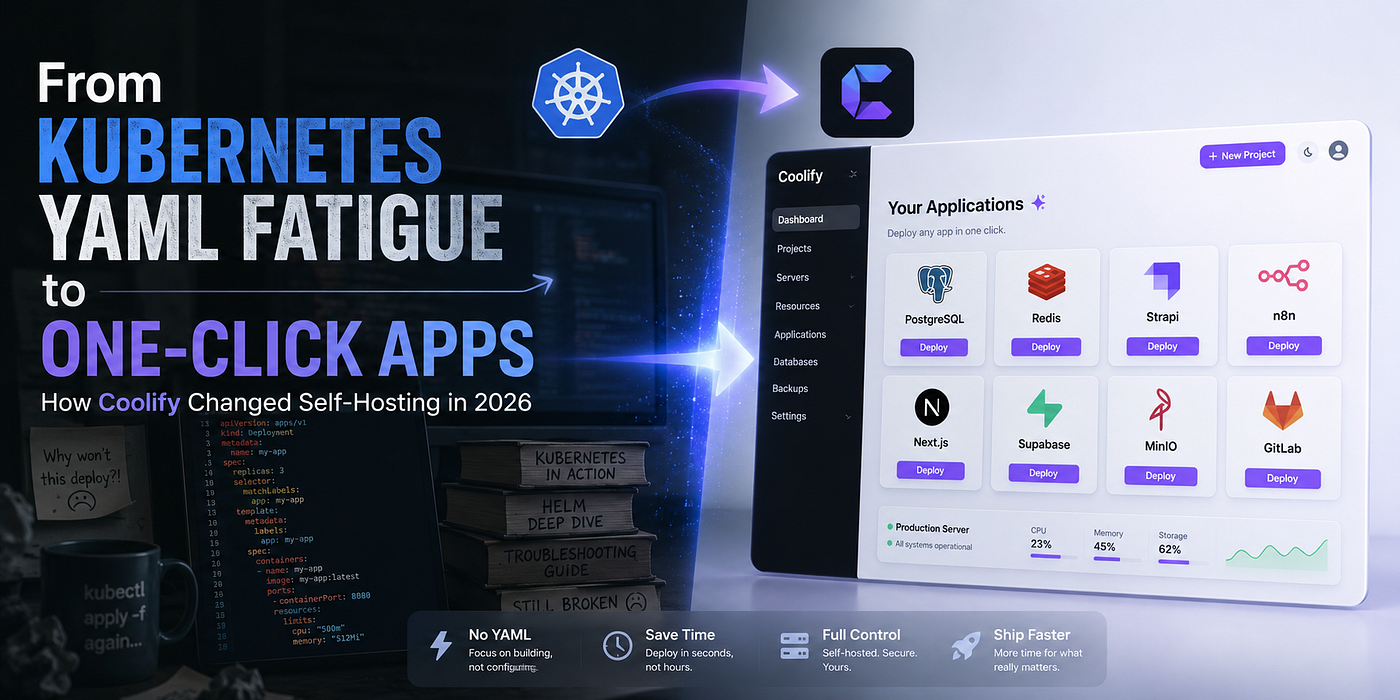
From Kubernetes YAML Fatigue to One-Click Apps: How Coolify Changed Self-Hosting in 2026
In 2022, setting up a self-hosted app stack felt like earning a Kubernetes certification accidentally.
From Kubernetes YAML Fatigue to One-Click Apps: How Coolify Changed Self-Hosting in 2026
In 2022, setting up a self-hosted app stack felt like earning a Kubernetes certification accidentally.
You didn’t “install Nextcloud.”
You installed:
- K3s
- Ingress controllers
- Persistent volumes
- Helm charts
- TLS issuers
- Storage classes
- Secrets
- DNS mappings
- Backup jobs
- CRDs you barely understood
And after all that?
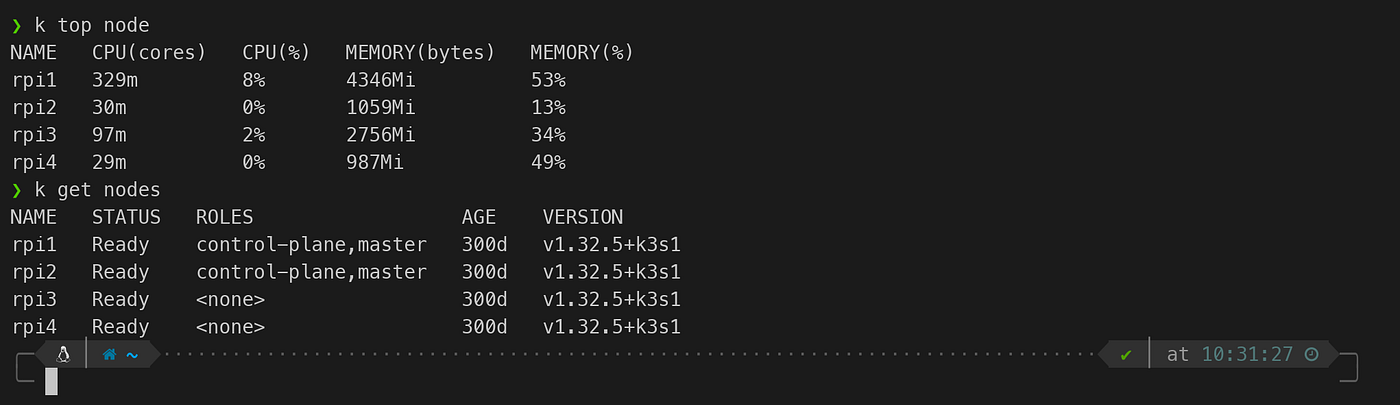
You still had to debug why your ingress returned 404 at 2 AM. I know this because I lived through it. Back then, I wrote about deploying Nextcloud on K3S and the endless post-installation tweaks that followed. What looked simple on paper quickly became a long trail of:
- cert-manager fixes
- ingress rewrites
- PVC troubleshooting
- DNS adjustments
- storage headaches
- upgrade anxiety
Kubernetes promised cloud-native elegance. What many homelab users and indie developers actually got was operational exhaustion. By 2026, something fundamentally changed. Not Kubernetes itself. The abstraction layer above it. And for many self-hosters, that abstraction became Coolify.
The 2022 Reality: Kubernetes Everywhere
In the early self-hosting wave, Kubernetes became the default answer to everything. Need high availability? Kubernetes. Need self-healing? Kubernetes. Need one app? Somehow still Kubernetes.
The ecosystem exploded with:
- Helm charts
- Operators
- GitOps pipelines
- service meshes
- YAML generators
- ingress ecosystems
But most personal servers and startup workloads never needed that level of orchestration.
What they needed was:
- deploy app
- attach domain
- enable SSL
- persist storage
- update safely
- sleep peacefully
Instead, we normalized complexity. A “simple deployment” looked like this:
kubectl apply -f deployment.yaml
kubectl apply -f ingress.yaml
kubectl apply -f pvc.yaml
kubectl apply -f secret.yaml
Then came:
- Traefik debugging
- MetalLB conflicts
- cert-manager renewals
- broken Helm upgrades
- persistent volume corruption
- etcd backup paranoia
The worst part wasn’t setup. It was maintenance. Kubernetes is excellent at orchestrating distributed infrastructure. It is terrible at being “simple.”
“the simplicity that comes from conquering complexities, not ignoring them”
The Maintenance Tax Nobody Talks About
The real cost of Kubernetes was never CPU or RAM.
It was cognitive overhead. Every upgrade became risk management. Every new app meant:
- another Helm repository
- another CRD
- another ingress rule
- another compatibility issue
Even experienced engineers quietly accumulated infrastructure debt.
At some point, many self-hosters realized:
“I spend more time maintaining the platform than using the apps.”
That realization created the perfect opportunity for platforms like Coolify.
Enter Coolify: Self-Hosting Without Platform Engineering
**Coolify** changed the conversation by asking a simple question:
What if self-hosting felt like Heroku again?
Not enterprise Kubernetes. Not YAML archaeology.
Just:
- connect Git
- click deploy
- get HTTPS automatically
- move on with life
Coolify became an open-source self-hosted PaaS focused on operational simplicity. It supports:
- Git-based deployments
- Docker and Docker Compose
- automatic SSL
- databases
- backups
- pull-request deployments
- monitoring
- one-click applications
The biggest shift was psychological. For the first time in years, self-hosting started feeling lightweight again.
One-Click Apps Changed Everything
The killer feature in 2026 wasn’t Kubernetes support. It was the opposite. Not needing Kubernetes at all.
Coolify introduced a massive library of one-click services:
- Nextcloud
- n8n
- Vaultwarden
- PostgreSQL
- Redis
- Appwrite
- Plausible
- Supabase
- Uptime Kuma
- Ghost
- WordPress
- Gitea
and hundreds more.
What previously required:
- Helm charts
- ingress config
- persistent volume setup
- certificate management
- environment variable orchestration
now became:
- Click service
- Configure domain
- Deploy
Done. No YAML. No kubectl. No CRD incompatibility. No “why is Traefik not routing?”
The Real Innovation Wasn’t Docker
Docker already existed. Docker Compose already existed. The real innovation was workflow compression.
Coolify compressed:
- reverse proxy setup
- SSL provisioning
- Git webhooks
- container orchestration
- environment management
- backup handling
- deployment monitoring
into a UI that removed operational friction. Underneath, many one-click services are still Docker Compose templates. But that abstraction matters. Because most developers don’t actually want to become infrastructure operators. They want their applications running.
Kubernetes Became the New “Enterprise Java”
Something interesting happened by 2026. Kubernetes slowly became what enterprise Java was in the 2000s:
- powerful
- scalable
- battle-tested
- operationally expensive
- overkill for most smaller workloads
That doesn’t mean Kubernetes failed. It means its ideal use-case narrowed.
For:
- multi-region orchestration
- large-scale microservices
- advanced scheduling
- enterprise compliance
Kubernetes still dominates. But for:
- indie hackers
- startups
- homelabs
- internal tools
- side projects
- small SaaS deployments
the industry started moving toward simpler operational platforms. Coolify benefited massively from that shift.
The Hidden Advantage: Infrastructure Confidence
One underrated effect of simplified platforms is psychological safety. With Kubernetes, many deployments felt fragile. You were always one bad upgrade away from:
- ingress failure
- PVC corruption
- networking chaos
- cluster instability
Coolify changed that for many users because deployments became understandable again. You could reason about the stack.
Container. Proxy. Domain. Volume.
That’s it. Operational confidence matters more than people admit.
The Irony: Kubernetes Still Powers the Cloud
The funniest part? Most modern cloud platforms still run Kubernetes underneath. But users increasingly don’t want direct exposure to it.
That’s the future infrastructure pattern:
- Kubernetes underneath
- abstraction on top
- developer simplicity at the edge
Even Coolify itself positions Kubernetes as optional rather than mandatory. That’s a major philosophical shift from the “Kubernetes everywhere” era.
🎬 From YAML Chaos to Production in Minutes — Watch Coolify + Nextcloud in Action
In this hands-on demo, I walk through how a modern self-hosting stack can go from infrastructure headache to production-ready deployment in just a few clicks.
Using Coolify, I deploy and manage a fully self-hosted Nextcloud instance without touching endless Kubernetes manifests, Helm charts, or complex ingress configurations. What once required hours of YAML debugging and DevOps plumbing now feels closer to installing an app from an app store — but with complete ownership and control.
This demo showcases:
- One-click application deployment
- Automated SSL and reverse proxy setup
- Persistent storage configuration
- Simplified container orchestration
- Self-hosting without Kubernetes fatigue
If you’ve ever spent weekends debugging broken YAML files or chasing Kubernetes networking issues, this video might feel strangely therapeutic.
[embed]
Self-Hosting Finally Became Fun Again
The best infrastructure tools disappear into the background. That’s what made Coolify important in 2026. Not because it introduced revolutionary technology. But because it removed unnecessary operational suffering.
In 2022:
- deploying apps meant learning infrastructure
In 2026:
- deploying apps became the easy part again
And honestly? That may be the biggest infrastructure improvement of the decade.
References
https://vinaysit.wordpress.com/2022/11/16/nextcloud-on-k3s-post-install-steps/
메타데이터
- post_id
- cda8ad1555f4
- slug
- from-kubernetes-yaml-fatigue-to-one-click-apps-how-coolify-changed-self-hosting-in-2026-cda8ad1555f4
- url
- https://medium.com/tech-learners-journal/from-kubernetes-yaml-fatigue-to-one-click-apps-how-coolify-changed-self-hosting-in-2026-cda8ad1555f4
- canonical_url
- https://medium.com/tech-learners-journal/from-kubernetes-yaml-fatigue-to-one-click-apps-how-coolify-changed-self-hosting-in-2026-cda8ad1555f4
- author_url
- https://medium.com/@VinayUmesh
- status
- ok
- fetched_at
- 2026-06-15 20:49:13