Down The Rabbit Hole: My IEM Journey So Far
A layman’s descent into trying out, comparing and learning to love In-Ear Monitors across an ever-growing price range.
Down The Rabbit Hole: My IEM Journey So Far
A layman’s descent into trying out, comparing and learning to love In-Ear Monitors across an ever-growing price range.
Note: This is both a collection of reviews and a narrative piece detailing my experiences with IEMs as a hobby and field of interest and the discoveries I made and things I learnt while trying out different sets. If you don’t care about all the fluff feel free to simply jump straight to the review sections. As my journey continues and my expertise grows I plan to move on to more fully featured review formats, but in this piece I will focus on providing very casual perspectives and impressions of someone who appreciates musical detail and is of a generally curious nature but is not deeply enfranchised in the technical background (yet) and has pretty strict spending limits.
Batch 0: Where I Come From
First of all, who am I? As of writing this I’m a 29 year old German woman who loves music, both playing and listening, and grew up with the privilege of enjoying some high grade gear as early as four years old, courtesy of my father and his passion for Hifi. While music has played an immensely important role throughout all my life, it has only been very recently that my own gear started becoming a point of interest. I was happily using a crummy old Logitech 5.1 system plugged directly into my PC and a “cheap” pair of Sennheisers (HD559) that I loved very dearly and still consider a good value for its price.
But as disposable income grew and I was looking for a topic to reconnect with my father over my mind quickly found itself mulling over the pretty turn table I had received as a gift when moving into my current apartment years ago, a Pro-Ject T1. I did not own an amplifier, much less a phono preamp, and thus my small but treasured vinyl connection had been sitting largely untouched, and I wanted to change that. Long story short, a few months later I was all decked out with a T+A R1280R receiver, a pair of Polk Audio XT60 floor speakers, a Topping DX5 II DAC/Amp and a nice pair of Hifiman Sundara to go along with it. Finally, I could not only enjoy my vinyls again but even hook my TV and PC up to my gorgeous new speakers, and I even dug my old PS1 out of some dusty, old box as a makeshift CD player; with this I had access to my entire collection of media, digital and analogue, and the drivers to do it justice.
Most of my purchases so far were bought used, open box or on a generous discount, after much deliberation, discussions online and in person and thorough testing of whatever I had access to. This was part out of necessity, as I’m still not exactly swimming in money, and part principle — I wanted my purchases to feel like a smart, long-term use of my money that I didn’t need to regret or replace anytime soon. Soon I found myself hunting for the last upgrade in the chain, a replacement for my PC speakers. I allocated a budget of about 120€ and started scouring online marketplace listings, both used and new, for a pair of active bookshelf speakers since I wanted to avoid having to add more devices to the chain in form of another amp. As some of those reading will know, Edifier has some solid offerings in that price range and when I finally decided on a pair of MR4 I was fortunate enough to stumble across an open box pair for 65€, tax and shipping included. So that was that — and I was left with a saving of nearly 60€, just sitting there begging to be blown on something new and exciting.
So this is where the IEMs finally come into play. Well, not exactly — rather, this is where my first entry level DAP comes into play. But what good is a DAP without a way to listen to them on the tram or bus, and I sure as hell wasn’t gonna bring my Sennis or Sundaras… So, before I could talk myself out of it I dropped a Fiio SnowSky Echo Mini into my online shopping basket, resolving myself to finding a pair of IEMs around that same price point of 60€ to match. And THIS is where that journey finally truly began.
Batch 1: Careful First Steps
So, where to start? I could’ve just stuck with the ultra budget segment of sub 30€, or the popular and highly contested sub 100€ bracket, but I (initially, anyways…) held firm in my intention to stay in the 50–60€ range to complete my mini Hifi setup on the go for a 100 to 120€ total. After the for me typical drawn out period of deliberation, consulting audiophile Discord servers I joined for past buying decisions and a slew of YouTube videos, I narrowed it down to just one set that felt like a relatively safe blind buy, albeit at a slightly high price of 66€ (new) — the Moondrop Lan II POP, follow-up to the highly regarded value champ Moondrop Lan, which at the time was unfortunately not easily available for purchase in my country anymore.
Calling just one purchase a batch obviously makes no sense, but little did I know at the time that my cursory interest in the topic would lead to the full-blown obsession it has since become — from here on out I would always buy several pairs at once with the intent to compare and contrast them as I found myself chasing the perfect tuning and fit. Most of the purchases done after the first two batches were thus open box with free returns, so I could safely test a wide range of IEMs without going entirely broke.
Moondrop Lan II POP
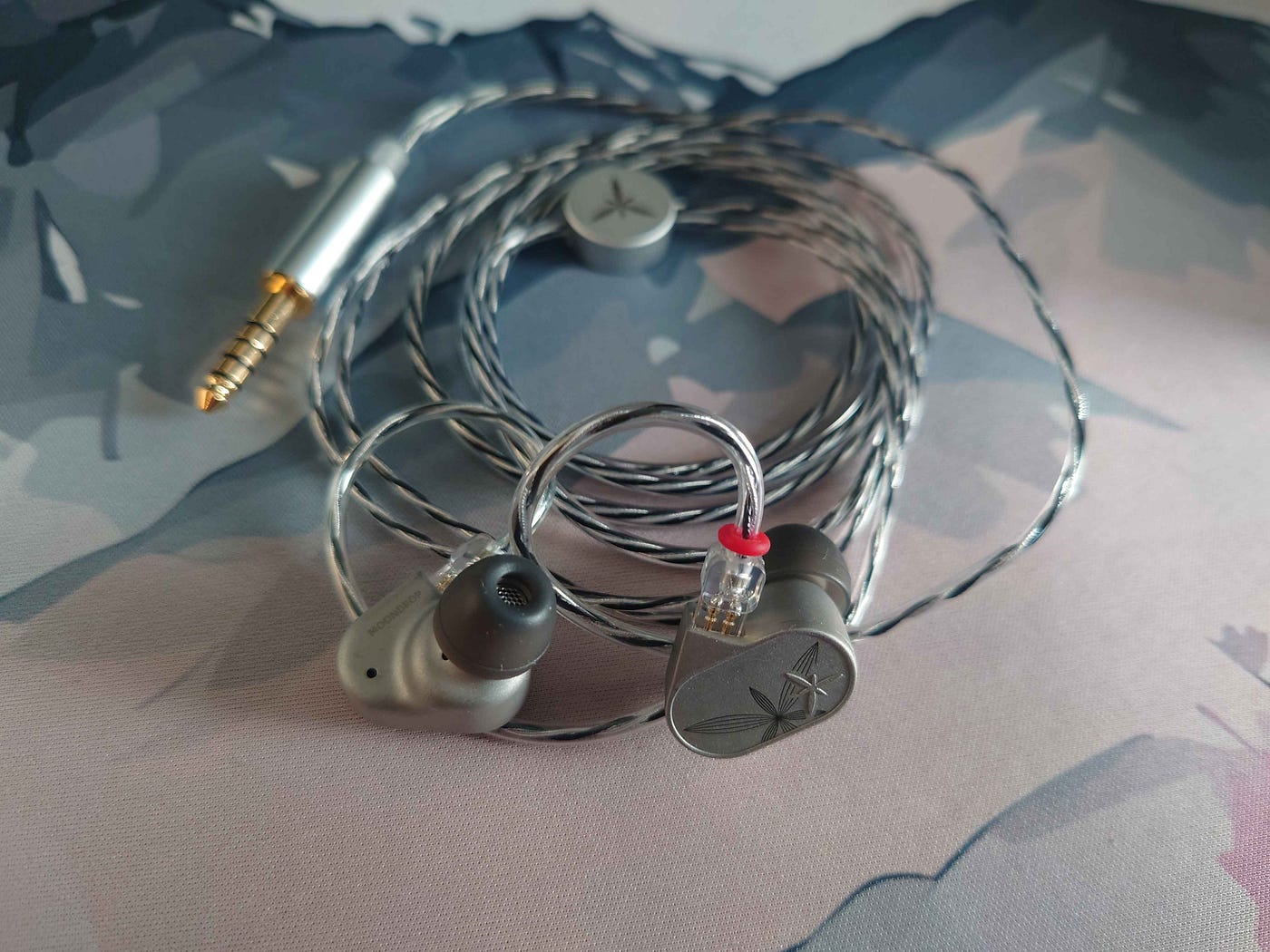
Anticipation when I finally held this set in my hands was sky high; the unboxing alone already left quite the impression, with the anime art, QC card and soft carrying bag included. The build of the Lan II was an immediate highlight with its small, light and sturdy metal shell and the by all accounts pretty nice cable; not overly tangly but also not too memory prone. Comfort and fit itself turned out to be better than I knew to give it credit for at the time; getting a good seal was effortless and the IEMs stayed in my ear well, even on rattly trams or during long walks. I mostly credit the very small and slim shell design with this and it is something I started to miss more and more as I begun daily driving other sets.
First impressions of the actual sound were a little mixed, however. While I appreciated the overall smooth tuning and solid bass I also noticed a clear lack of detail when songs got very busy with fast electric guitars especially. I wouldn’t necessarily say that I was disappointed, I was well aware that I wasn’t spending the big bucks after all, but I was still hoping for just a little more “fidelity”. The bass was just more than I needed and I would have been happy to sacrifice some of that low end focus for a less muddy presentation overall. Further weaknesses revealed themselves in a pretty notable lack of soundstage and separation.
Overall, the Lan II POP may lack somewhat in technical ability but isn’t a bad choice for someone who is just looking for a relaxed but unspectacular tuning with a slight bias towards bass in a very small, sturdy and (at least for me) supremely comfortable shell. Tuning aside this set does a lot right for me, although I’m not sure I can easily recommend it for the amount I spent on it (66€). Closer to 50€ it becomes a very good deal, however. And as much as I deemed it lacking while in my hands, in hindsight it is the set I have most often considered repurchasing and actually keeping because it is just so easy to like and daily drive.

TLDR: A beautiful, comfortable set that delivers a solid performance for relaxed, smooth daily listening and a solid bass presentation at the expense of detail, precision and soundstage. However, it doesn’t quite justify the increase in price compared to its predecessor.
Conclusion
In hindsight, judging the Lan II POP fairly and by “objective” measures is very difficult for me; I have a major soft spot for it as my very first set, and my love for its design and fit has only grown after trying out more, but it was also clearly lacking the “wow” factor I was dreaming of and is most likely just a solid set that would be amazing value for a few bucks less. But by then I also hadn’t yet learned to properly judge or find the words for what I was hearing (arguably I’m still far from it, but progress is being made), not to mention the fact that a fair amount of time has passed between my testing it and doing this write-up so please take those ratings with a grain of salt. Going forward I’ll try to refer to the more detailed notes I started taking while listening to newer sets and I may even throw in some of the big, fancy audiophile words I learned while researching and discussing the hobby.
Batch 2: The Sub 100 Plunge
Where to go from here, then? Based on the price of the Lan II POP a very obvious rival was Truthear’s Zero line-up, of which I ended up choosing the Zero2:Blue (which was most likely a mistake as you will shortly see; however, neither the original Zero nor the Zero:Red would have been likely to provide better ergonomics). During my research I also got more and more curious about the Lan II REF, a differently tuned version of the otherwise identical product. It was described as something with a more neutral and “boring” sound, and intuitively I felt that might be more up my alley since I appreciate detail and don’t particularly care for bass. And lastly I decided to go big and spend significantly more money than originally intended on the praise-showered Truthear Hexa; a benchmark under 100€ from what I heard (and with a price of 99€ it just barely came in under that magical line for me).
What the Moondrop Lan II POP taught me above anything was, that judging IEMs based on online reviews and frequency response graphs was pretty much impossible for me for now. I didn’t have or understand the necessary vocabulary to grasp finer details of how a set behaves just through mere words, and at this point I was far too inexperienced to translate a graph to an actual, reliable idea of what sound was gonna be like. These were the main reasons I decided to just go all in and order several sets at once to compare directly and just keep the one that felt right for me. Free returns through Amazon made this approach feasible, although I hadn’t clued into the fact that I should be buying used and open box stock to not unnecessarily lower the value of an item I was never intending to keep. In my defence though, I genuinely believed I was going to be done after this round and had the honest intention of keeping and treasuring one of the tested sets. Needless to say, that is not how this played out in the slightest…
Moondrop Lan II REF

Since the unboxing, accessories, design and fit (and subsequently, its price) are identical to the POP version I shall not go over the same details again; however, I want to talk about expectations and preconceived notions about taste. My expectation for the REF was that I would easily like it more than the POP, as I don’t consider myself a basshead and had this idea in my mind that I would prefer something “neutral”. Whenever I listen to my music, I thought, I just want to hear it “as is”; I didn’t really understand the appeal of a U shaped or V shaped frequency response graph or why one would want to tune an IEM to be more “exciting”, as all the reviewers loved to put it.
What I didn’t expect, however, was to get an IEM that has basically all the same technical limitations when it comes to perceived detail and resolution as the POP but sounding a lot thinner and more lifeless nearly across the board. This was especially noticeable with vocals, which lacked the proper weight and fullness, but in general listening to the Lan II REF just wasn’t a joyful music experience for me; in some moments they felt downright hissy. I don’t necessarily believe that this set is quite as bad as I’m making it sound, it’s just that I had certain expectations and were let down — if nothing else I’d like to think I learnt a lesson here.

TLDR: A set equally beautifully and comfortable to its POP variant that foregoes the relaxed, bassy tuning for a more neutral approach which unfortunately ends up coming out mostly thin and lifeless while not delivering a meaningful increase in perceived fidelity.
Truthear x Crinacle Zero:Blue2

This set I was also extremely excited about, but for different reasons — simply put I just fell for the hype. Fairly well praised by a range of reviewers and with the star power of a beloved community figure attached as a collaborator for the tuning of this budget set of 71€, what could go wrong? Well, the shape for one. Not only does it feature a seriously bulky shell, the nozzle is also quite wide, and these factors combined with the ergonomics of a somewhat rounded — but not quite shaped to ear like contortions — body meant that the fit was, put lightly, challenging for me at best and painful at worst. In hindsight I don’t even think I achieved a proper seal but at the time I was less aware of the importance of this, so please keep that in mind as my description of the sound profile may ring inaccurate.
Considering all those caveats I will still do my best to briefly go over the sound impressions. The standout characteristic of this set is, without a doubt, the bass. And honestly, this is already where it loses me. It is simply too much bass. At least this set very easily solidified my assumption that I am not a basshead, a notion that will come up again later and impact my rating of otherwise much, much better IEMs. At least I found the bass to be pleasantly detailed and textured for the price point, and it didn’t completely ruin the feeling of separation for me either. But where this set truly falls apart for me is the treble and the vocal presentation; both come across as airy, even downright thin at times and ultimately lead to a sound profile I just don’t find any joy in overall.

TLDR: A set that misses on nearly all fronts for me. Bassy, muddy, bulky, uncomfortable and the presentation of the Mids and Vocals especially feels airy and neither weighty nor natural.
Truthear Hexa

Now here’s a true legend, a superstar that is worthy of its reverence — the Truthear Hexa, often hailed as the benchmark for a clean, neutral tuning in the sub-100 segment, and in practice even punching well above its weight on those metrics. As you might have gathered from just this short introduction, I like this set, and it has gone on to become the yardstick that every other set I try has to be measured against. For the price (99€ in my case) there really doesn’t seem to be anything else that will reveal so much fine detail and nuanced separation in such clarity, but I’m getting ahead of myself a little here.
Let’s talk first impressions. As much as the detailed anime art is a nice touch, even if not directly to my liking, I wasn’t particularly charmed by the way the Hexa presents itself initially. It’s a pretty low-key, unassuming, maybe slightly industrial leaning design, with clear angles and flat surfaces dominating the faceplate. Over time, however, I’ve come to really appreciate this minimalist aesthetic that, alongside the translucent black shell, oozes a vibe I can only describe as “functional elegance”. Its lightweight nature and low profile complete a package that I found myself happily taking out of its case to bring with me wherever I went.
When it comes to sound, however, the Hexa immediately won me over, and easily so. In fact, it downright wow’ed me, causing a moment of true audiophile joy. I finally found something that didn’t just feel like a fair performer for its price but a product that was so far beyond my expectations that it felt like a downright impossible value. Right from the get-go, the quality that defines the Hexa is crystal clarity, a wonderful sense of detail and separation with no part of the tuning ever getting over-powering. Bass might feel a little lacking for some but for me it was just the right amount, with a solidly tight punch to it as well. Vocals are all presented clear and appropriately present, but not too in your face either. The treble continues the trend and presents itself cleanly and detailed feeling.
Unfortunately, here’s where some of its flaws revealed itself for me; while I liked what I was hearing, I eventually noticed that it could get a little fatiguing, especially during vocals focused acoustic tracks. I wasn’t quite able to isolate the exact frequency peaks that were causing this for me, and I suspect it may have just been the fact that the Hexa features a very tame and subdued tuning across the whole spectrum which makes part of the treble just stand out a tad too much. Another related flaw is a somewhat crammed soundstage; furthermore, some might argue that it is overall too thin sounding, an impression I occasionally shared when swapping back and forth between this and warmer/more bass focused sets, but two tracks in and that feeling was blown away again and awe at how much the Hexa were able to reveal took over once more.
If it had just been that I may have called it good enough though and ended my search here, but unfortunately as I started daily driving the Hexa I experienced some minor comfort issues in my right ear during longer listening sessions. At this point I had started learning a little bit more about the importance of ear tips, not just for seal but also comfort, and the fact that my left and right ear actually required different sizes or types of tips depending on the IEM I was using. Regrettably I remained unable to find a definitive fix for the discomfort during my time with the Hexa, but they are definitely an easy recommendation for anyone who wants to attain the best neutral, clean presentation and technical ability under 100€ and doesn’t mind a bit of a potential “shoutiness”. They just weren’t quite perfect enough for me to make them my forever set.

TLDR: The Hexa is an amazing set that delivers stunning, possibly even unrivaled amounts of clean detail and separation for its price. Potential drawbacks are Highs that can get fatiguing, flawed comfort and a presentation that is on the slightly thin and cramped side in direct comparison to more exciting tunings, especially when it comes to the amount of bass. However, the technical strengths more than make up for it.
Conclusion
While the average of this batch may look rather unimpressive at first glance, it still was absolutely instrumental in sparking the fire that would push me further and further down the eponymous rabbit hole. The Truthear Hexa showed me what was possible — far more than I bargained for, really, and it made me hopeful that the perfect IEM for me was going to be attainable. I had finally tasted blood and I simply HAD to acquire whatever set could replicate this feeling the Hexa gave me while fixing its comparatively minor issues. Meanwhile, the Zero2:Blue and Lan II REF showed me that for the same price as the Lan II POP I could easily find sets that didn’t just fail to impress but actively made me not want to listen to them. An endless gulf had suddenly opened up beneath me, and I knew I had to put a lot more work into researching and understanding which qualities mattered in the world of IEMs before spending my money.
Batch 3: This Should Be It, Right?
If you read about the issues I had with the Hexa, there may be an obvious solution that immediately sprung to your mind — what about its younger sibling, the Truthear Pure? Featuring a very similar design and the same driver setup but targeting an overall more relaxed tuning profile, this indeed sounded like the perfect fit. In fact, I ordered it with the assumption that my journey would just end right then and there. This round’s other contender, the Tangzu x HBB XuanNv, was only thrown in there because I really liked the design and all the positive chatter about it made me somewhat curious. And honestly, that’s all the accumulated thought that went into this selection.
Truthear Pure

So this was going to be it — the “fixed” Hexa. As much as I wanted to believe that it was about to solve all my issues and be the last pair of IEMs I ever needed, initial impressions were not great. Not only is the included cable a downgrade in both quality and aesthetics, the new faceplate design was also not exactly to my liking. But, as long as the sound delivered, none of this should matter, right? Well, unfortunately the small changes from the Hexa’s design included a taller, bulkier shell as well as a reworked nozzle angle. And THIS did matter to the listening experience beyond simple comfort. Not only did I have immense difficulties inserting the Pure into my ears properly, it also left me with moderate pain in my right ear after a short while; basically, it exacerbated the minor issues already present in the Hexa for me.
I didn’t want to give up on this promising contender so easily, but after an entire evening spent fiddling with insertion angles and tiprolling to achieve an acceptable seal, I found myself straight up unable to reproduce that result the next day. Now, I’m not saying it would have been impossible, but I was quickly running out of patience, especially since all the playing around with the IEM while inserted in my ear and the constant taking it out and putting it back in was just worsening the pain and discomfort I was experiencing. Ultimately, I decided to give up there — yes, the Pure will not get a fair shot on the sound rating as I only actually used it for maybe two hours with a more or less sufficient seal, but if a set is causing pain and frustration over multiple days and hours while just attempting to get an okay fit it is NOT worth the trouble in my book.
That being said, I will still briefly go over the perceived sound characteristics of the Pure, mainly in form of comparison to the Hexa, which is not only closely related but had also become my baseline for testing at this point in time. One very obvious difference is the boost in lower frequencies; something that doesn’t sacrifice objective quality but also doesn’t flatter the overall profile in my opinion. Detail and resolution across mids and treble can still somewhat compete with the technical excellence of the Hexa, but some vocals came across a fair bit flat and hollow. To the Pure’s credit, the treble indeed seems a bit less shouty and peaky, but from the impressions I was able to collect it wasn’t the gamechanger I had hoped for. Lastly, the soundstage — already not a strong suite of the Hexa — felt even more cramped.

TLDR: The Pure is a set that should be a golden ticket in theory but is unfortunately let down by further exacerbating the mild comfort issues in the Hexa while delivering a tuning that, while striving for a more smooth and relaxed performance, mostly ends up coming across weightless and airy, especially in the vocal presentation.
Tangzu x HBB XuanNv

Now here’s a more pleasant surprise: I actually liked the XuanNv. Not enough to keep them, but certainly more than I expected. Half of the reason I even bought this set was the faceplate design and in this area it does not disappoint. And while the glossy plastic surface may not feel as premium as the looks suggest, the comfort is actually the opposite: as big and bulky as this set looks it actually fit into my ears snugly and never caused any pain, irritation or fatigue. If you like the visual design and don’t mind a chunky package, the XuanNv makes for a striking fashion accessory; although I recommend picking up a matching cable to complete the look. The included one doesn’t look terrible but it feels cheap and rubbery and loves to bunch up.
Ok yes we get it, you love the looks. But what about the sound, then? And luckily, the good news for the XuanNv continue here. It sounds entirely solid and pleasant. Yes, that’s not a ringing endorsement, but a relaxed, easy to like sound profile makes this set easy to recommend. The bass is hefty, but not entirely too much, and the treble does its job to an acceptable extent. The weak points are to be found in the mids, which can easily get overwhelmed by everything else going on and the vocal presentation, which is not very forward.
The way I first classified the XuanNv based on these impression was as a slightly upgraded Lan II POP: easy to like, competent tuning that prioritizes a warm sound and highlighted bass and treble without ever getting shouty or muddy. And while the technical performance is a small step up from that set — especially when it comes to subbass performance — it is still nothing to write home about; detail, resolution and separation are fine at best and sometimes feel lacking. But as I was starting to understand, that comes with the territory for this style of tuning and if that’s what you’re looking for — easy listening comfort and pleasure over raw fidelity — you won’t be disappointed.

TLDR: The XuanNv is aesthetically beautiful, comfortable to wear and easy to listen to. It shares its broad strengths and weaknesses with the Lan II POP — namely a relaxed, smooth, bassy tuning that is very easy to like but sacrifices detail and imaging especially in the Mids. It is a slight upgrade over the aforementioned set when it comes to technicalities but still feels a little too expensive for what it delivers.
Conclusion
So, this was a bit of a bust. And honestly, it left me feeling a little directionless — the Pure was supposed to be a no-brainer but instead it just left me feeling disappointed and even frustrated. Through all this testing I had held onto the Hexa, still unsure if I really wanted to return them, and so far nothing had come even close to it. Furthermore, a lot of the sets I was considering or was getting recommended as alternatives at this point were not readily available in my region. Resigning myself to the fact that the perfect IEM for me might just not exist under 100€ I thus decided to bite the bullet and push on into the next price segment.
Batch 4: Fuck It, We’re Going Big
The story of how I picked the contenders for this batch is pretty darn simple once more: I looked at the best open box deals on IEMs below 200€ and ordered them, just to see what that kind of money would get me; in this case that turned out to be the Simgot SuperMix 4 and the Kiwi Ears KE 4. And for good measure I threw the Moondrop Aria 2 in there as well, because I already knew I liked Moondrop’s shell designs and was expecting with a similarly easy-going tuning as the Lan II POP but maybe a bit more of that resolution I was looking for, to match the higher price point.
Moondrop Aria 2

The Moondrop Aria 2 were the first set that I spent over 100€ on and I can happily report that the overall experience matches that price point: the art is gorgeous, the shells are solid and hefty and the remaining accessories also got bumped up a bit. Actually, the ear tip selection remains sparse; but the upgraded case looks and feels premium with its faux leather aesthetic, tasteful brown color and embossed logo and visible stitches on top. Instead of being a pill-shaped case or soft pouch it’s a tall circular design with right angles on the top and bottom edges and a nice inner lining. The cable follows suite with look and feel, but as a tradeoff it turned out a little too thick, stiff and heavy for my taste. Still, as a customer I feel like this should be the unboxing experience I deserve for the sort of money I’m spending here.
As far as sound goes, however, the Aria 2 remain largely unexciting. Now, that doesn’t necessarily need to be a bad thing; it’s a tuning that is easy to like and comes with very few rough edges. Its biggest weakness remains fidelity; the overall bassy and warm leaning profile with very tame trebles muddles everything together in a similar way to the Lan II POP, so finer details are easily lost. In this sense the Hexa absolutely runs circles around the Aria 2, and at a lower price to boot, but in turn it is more shouty, potentially fatiguing and a whole lot less comfortable.
Just saying “it’s kinda like the Lan II POP” and leaving it at that doesn’t feel entirely fair though; the overall improvement may not be huge but noticeable nonetheless. To me at least the mids were just a smidge cleaner and clearer and the more polite bass feels less overpowering, but still fairly punchy. Still, it’s hard to not lump them in together when it comes to overall tuning style, alongside the aforementioned Tangzu XuanNv; they all feel like similar flavors of the same concept. Go with the Aria 2 if you want a little extra across the board, from sound to accessories, but for the budget conscious buyer it is hard to not recommend the Lan II POP as the better value or the XuanNv if you prefer its design and appreciate hefty subbass.

TLDR: The Aria 2 are beautiful, comfortable, and easy to listen to, much like their cheaper sibling in the Lan II POP, to which they present a fair but ultimately unimpressive step up. The musical performance may not fully justify the significantly higher asking price on account of still lacking detail and coming across slightly muddy, but the luxurious feeling presentation and accessory package very well might if you value those things.
Simgot SuperMix 4
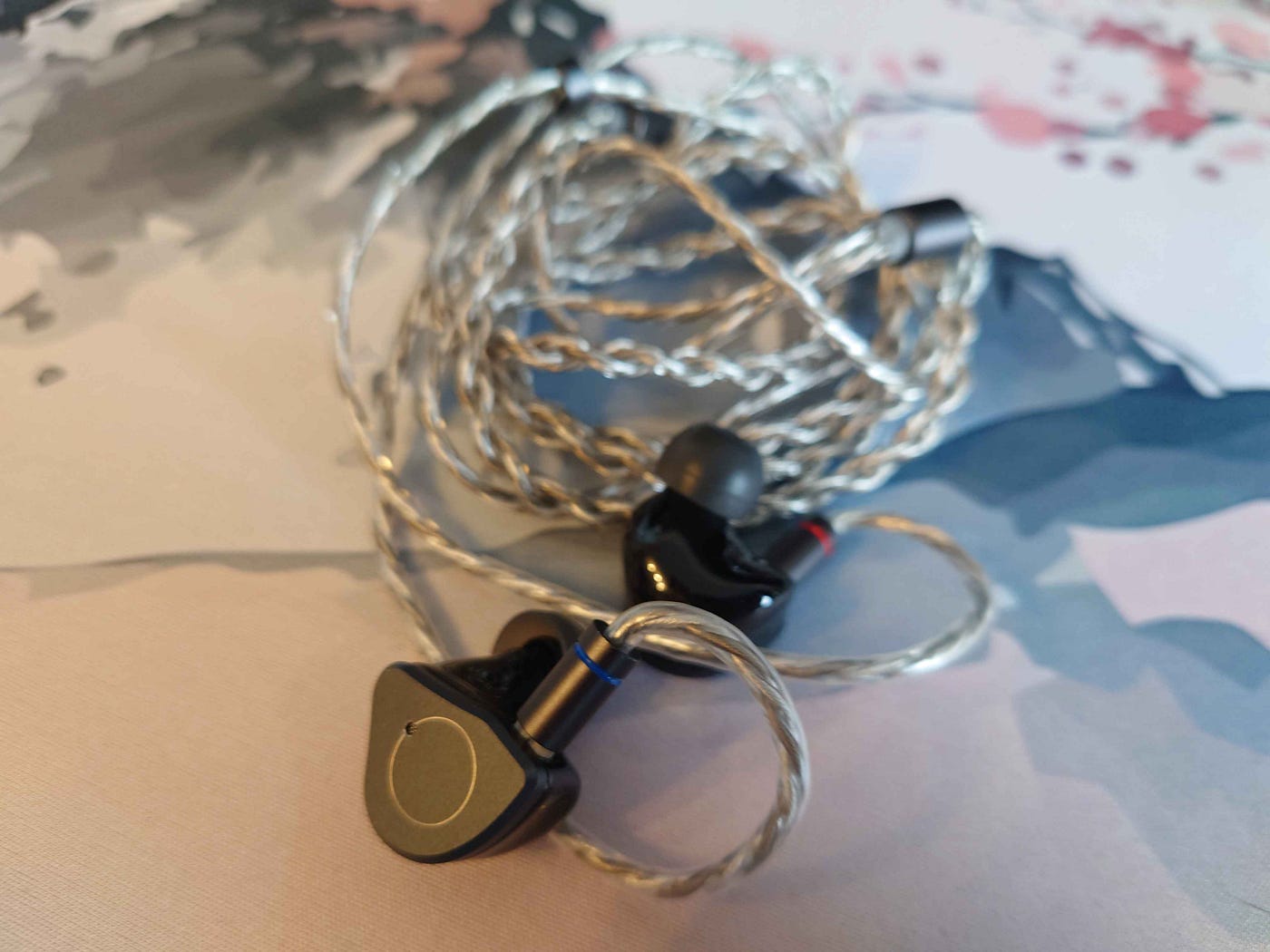
I came into this set with nothing but a hefty dose of curiosity. Despite its significantly higher price point I cannot sing any praises for accessories or overall feel compared to the Aria 2; the shell design while fairly elegant in a minimalist way is largely fine but can get slightly uncomfortable and the cable feels cheap and is unbearably tangly. Case and eartips are standard fare but overall I expected a bit more from a set that would’ve cost me over 180€ if I didn’t get a good open box deal.
Going into the actual listening experiences, first impressions were generally positive; well highlighted treble and a very hefty subbass make some songs pop rather nicely. Some female vocals and strings especially come to life here; however, the tradeoffs are not insignificant. Not only is there some concern about potential fatigue (although it didn’t personally affect me as much as with the Hexa did) but the soundstage also suffers; most things feel either overtly in the foreground or the background with not much spaciousness between those two.
What really killed this set for me was listening to music that strongly highlighted the very thin mids; the overall tonal balance just goes out of the window when there’s so much bass and so much treble right in your ear while other aspects of a song all but disappear in comparison. Shouty tracks get very shouty and while detail across the frequency range is technically there, too many parts of the mids are quiet and distant. Even ignoring the fact that this much bass is just more than I personally need, the Hexa present a much more well-rounded bright and clean tuning.
I truly don’t understand the point of such a polarized sound profile, as it works well enough to highlight some tracks on one hand and then just feels completely inadequate for others. Overall, listening to music on this set often failed to feel natural or organic, let alone joyful. If I had to break it down to one non-technical term I’d wanna call the SuperMix 4 “dry” and at times strangely lifeless. I want to stress once more that this is clearly not a technically weak set — the bass presentation especially is excellent — and the flaws I’m describing may not even show themselves depending on the track. But ultimately it did not provide me with a broadly enjoyable listening experience, especially considering the price. Outside the domain of lower frequencies the Hexa present an infinitely better deal for any detail lovers.

TLDR: The SuperMix 4 may have significant technical chops, especially in its highly impressive Bass performance and great detail, but largely squanders those positive feats with Mids that are simply too thin and weak and vocals that are too lifeless to fully tie this set together to a coherent whole.
Kiwi Ears KE 4

The Kiwi Ears KE 4 turned out to be a bit of a curious case for me; I don’t particularly care for the design, and especially the very bulky shell is the opposite of what I’d usually prefer. Furthermore, the accessories were about as spartan as it gets; one set of ear tips (S, M and L) and a kinda flimsy case. At least the cable wins this batch hands down by virtue of being light-weight without feeling cheap or tangling super easily. It’s a passable first impression, but far below some of its 100€ competitors, let alone the expectations that come with a price tag of over 200€.
Despite their appearance the KE 4 turned out to be supremely comfortable and sit in my ears very well. Part of that comes from the included Flex Ear Tips that are short and feature a very soft core and a mesh filter, but impressions of comfort remained great across the whole range of tips I tested with them. I’m still not exactly in love with the design but I was at least forced to rethink my stance on bulky shells; while all the Truthear designs ranged from uncomfortable to unusable for me the KE 4 effortlessly demonstrated that this doesn’t have to be a fundamental issue of size or bulk, and going forward I am not going to outright dismiss IEMs based on shell size or shape.
When it comes to sound, however, I am forced to admit that this set absolutely knocks it out of the park for me. Despite its more than generous bass, which admittedly goes too far for me personally, it doesn’t really exhibit any of the grave flaws other bass heavy sets did for me so far. It never feels like the KE 4 get overly muddy or weak in other frequencies and after getting used to it I even found the bass to be quite fun with the appropriate tracks; still, if you consider yourself a bass hater you should probably steer away from this one.
And that’s pretty much where the negatives end. Not only are the mids satisfyingly present, weighty and well resolving, but the treble is what really elevates this set — precise and detailed without ever feeling shouty or overpowering. In combination this creates excellent vocal presentation, especially of female vocalists. And while the set can still be classified as somewhat warm leaning, especially in the upper mids, it never feels like it sacrifices that sense of fidelity and clarity. Another standout is the soundstage; a somewhat contentious topic when it comes to IEMs as it is generally accepted that they are very physically limited on what they can deliver here compared to over ear headphones, but I still found the KE 4 to create a much more impressive sense of spaciousness and depth than all other test I had tested so far.
Altogether, this was a true eye opening moment for me; previously, I had only really tested sets that sacrificed a lot of perceived detail for a soft and relaxed listening experience or that came with a certain amount of sharpness, potentially shoutiness in the upper ranges or thin mids to achieve a clear presentation. The KE 4 demonstrated quite effectively that it is very possible to balance the two, to sound generally pleasant and easy to listen to while still coming across extremely detail rich, and to deliver massive bass performance without compromising mids and trebles. Top that off with great sound stage and simply spectacular female vocals and you got a winner on your hands,
Now, naturally this set also has its flaws; definitely if you don’t love bass, but potentially also if your tuning preference is more bright leaning. It may sacrifice some strict precision to deliver a more engaging listening and experience, but it does land on a tuning that just hits all the right notes for me personally, and it never starts sounding artificial or implausible. I’m looking forward to eventually testing some sets that show me further improvements are possible over the KE 4, but for now it firmly cements itself at the top and genuinely feels like it delivers on the premise set by its hefty price tag; a listening experience far less compromised than what I was able to found in the low 100€ price tier.
However, this still isn’t where my journey ends. As much as I unexpectedly fell in love with the sound of this set and noticed myself picking it up over and over again despite having five other sets at hand for testing, it simply isn’t what I’m looking for in shape, design and bass profile. If you are a bass head and itching to get an impression of what can be had in the 200+€ range I can wholeheartedly recommend the Kiwi Ears KE 4, but if I am spending this much money I might as well continue hunting for a similar tuning in a more pleasant form factor. Still, I am grateful to this set for expanding my perspective on what’s possible in pricier IEMs, and it gave me a much better idea what kind of tuning I should be striving for.

TLDR: The KE4 are a wonderful, impressive set that earns its asking price. It convinced me nearly across the board with how it manages to be both sufficiently smooth for relaxed listening and highly detailed at the same time. Despite initial skepticism of the design and size they are very comfortable; I would only advise you to steer clear are if you just cannot stomach hefty bass or want a fancy accessory experience for the admittedly high price.
Conclusion
All in all, this batch strongly represented the whole field in much more interesting ways than previous ones did for me; we got something that clearly has technical chops and some merits but just doesn’t work for me whatsoever, we got a very strong mid field contender that elevates the by now well tread “solid” easy listening experience to something just a smidge more detailed and immersive (and premium feeling), and lastly we got something that on paper doesn’t even fit my own preferences all that much but delivers such an overall convincing, well-rounded sound profile that I can’t help but sing its praises.
Picking out the next batch was getting increasingly difficult as I was moving further and further beyond my initial target budget and I was running out of options that I could test risk free that seemed to present something significantly different than what I had already experienced. So I decided to collect my thoughts for a while, do more research and in the meantime focus on finding some sets to make permanent parts of my collection for future comparisons without going completely broke in the process.
Accordingly, I intend to continue testing IEMs in a different format outside of this loose collection of surface level impressions in the future; as my understanding and knowledge grows and I experience more products I aim to make sure to give each one an appropriately detailed and fleshed out review in their own article, as well as potentially writing further breakdowns of head-to-head lineups and general musings on the hobby and my journey through it in separate pieces.
메타데이터
- post_id
- cdaaf359c94c
- slug
- down-the-rabbit-hole-my-iem-journey-so-far-cdaaf359c94c
- url
- https://medium.com/@chelseainspace/down-the-rabbit-hole-my-iem-journey-so-far-cdaaf359c94c
- canonical_url
- https://medium.com/@chelseainspace/down-the-rabbit-hole-my-iem-journey-so-far-cdaaf359c94c
- author_url
- https://medium.com/@chelseainspace
- status
- ok
- fetched_at
- 2026-06-24 18:57:25




