‘Backrooms’ — You Are Your F*#%ing Brain
Yellow Walls
‘Backrooms’ — You Are Your F*#%ing Brain
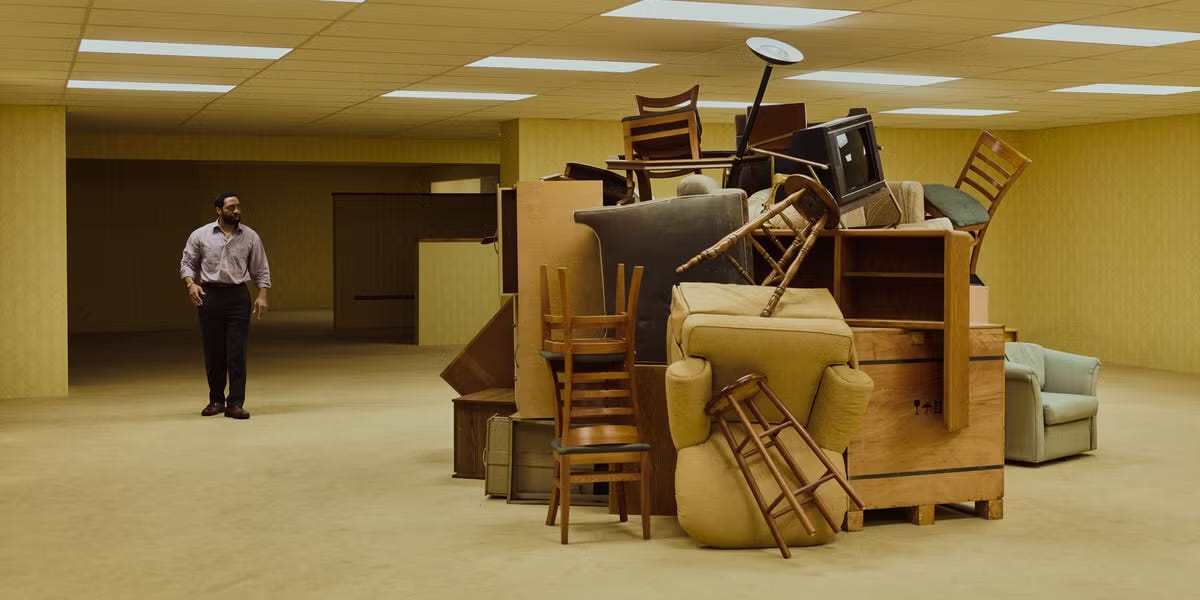
Chiwetel Ejiofor in “Backrooms” (A24)
Yellow Walls
All it took was a seemingly ordinary photo inside a furniture store to spawn one of the internet’s most unsettling horror concepts, the Backrooms. As its lore and world emerged, Kane Parsons (aka Kane Pixels) began creating and uploading his own YouTube anthology series in early 2022. At the age of 16, he combined 3D graphics from Blender and the magic of video editing to create “found-footage” following a group of wanderers and researchers who “no-clip” into the Backrooms and explore its liminal spaces. Not long after, the viral internet folklore was brought to life with a 30,000-square-foot set built for a full-length A24 film with Parsons attached as its director, as reported by Deadline on February 6, 2023.
The science-fiction horror movie was a huge success, earning more than twenty times its $10 million budget and becoming A24’s first film to surpass $200 million at the global box office. The internet’s reaction was equally outsized, with much of the online discourse circling back to Parsons’ age. As chat rooms flood with speculation and internet rumors, it’s difficult to square the film’s scale with the fact that its director is only 20 years old.
The Cycle of Violence
The film centers around two characters whose stories poignantly intertwine. Clark (Chiwetel Ejiofor), a divorced man haunted by the fallout of his marriage, plays a pivotal role in the Backrooms and what it thematically represents. Beyond being the sole discoverer of this realm hidden beneath his furniture store, he represents the repressed parts of human life: the yearning to move from the past while constantly reliving the same painful experiences.
Ejiofor’s character serves as a strong vehicle for both the film’s plot and its central themes. Trapped in his own past, he hits rock bottom while grieving his abandoned dreams of becoming an architect. Instead, he finds himself stuck in survival mode, managing the day-to-day operations of his furniture store. Sound familiar? Unable to cope with his stagnant lifestyle, Clark not only lashes out at the dismissive reactions of those around him but also resorts to violence as a form of catharsis.
This internal conflict is reflected throughout Clark’s character arc. He claims that he hurts everyone around him, yet he doesn’t know how to stop. After all, he suggests that “it’s just the way [he’s] wired.” This push-and-pull reveals that, while Clark is a dangerous man, he is at least aware of his own destructive tendencies and appears to experience some degree of guilt and regret in their aftermath. However, self-awareness alone does little to curb his behavior. Time and time again, Clark harms or places the lives of those around him in serious danger after experiencing their rejection. The tragedy of his character lies in this contradiction; he recognizes the damage he causes, yet remains unable, or unwilling, to break free from the cycle.
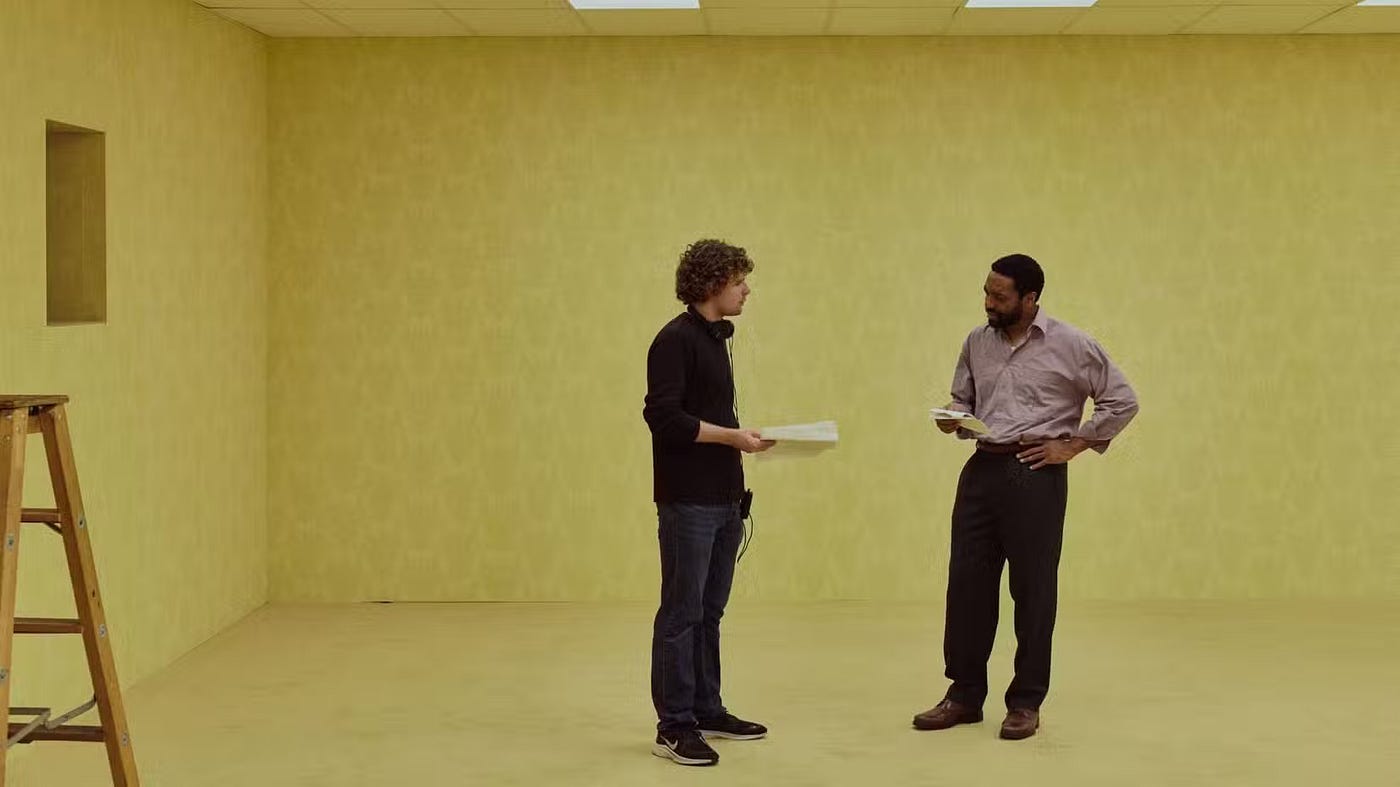
Director Kane Parsons and Chiwetel Ejiofor on set of “Backrooms” (A24)
At his core, Clark possesses a tit-for-tat mentality toward those who have “wronged” him, believing that people owe him an apology for the way they mistreat him. It’s why many viewers theorize that he had malicious intentions when bringing Kat and Bobby to the Backrooms after they stood there and joked once the filming of his commercial took a turn. It’s why he stormed out of his last therapy session with Mary, expecting an apology before choking and tying her up. It’s also why the still life copy of his ex-wife is first introduced to us stumbling through the darkness, clutching the side of her head and groaning in pain.
These moments reveal a pattern in Clark’s behavior. This is the same man who slams the television when it doesn’t work and flips every power switch out of frustration, the one who discovers that the still lifes cannot feel pain by stabbing them and referring to them as nothing more than furniture. To Clark, anything that fails to validate his worldview becomes something to be punished, controlled or discarded.
In the Backrooms, no one can judge or challenge him to confront the consequences of his actions. It makes perfect sense for Clark to feel most at home in a realm that enables his worst impulses. But perhaps for the first time, Clark acknowledges his role in the collapse of his marriage there. He also realizes that finding peace does not necessarily require changing who he fundamentally is. More than anything, Clark’s goal was never to become a different person; it was to have his pain understood and justified. His moment of enlightenment, however, does not bode well for his still life counterpart, Pirate Clark, who immediately resorts to the same violent behavior. In the end, they are reflections of the same person, or rather, their worst versions. After all, it’s just the way he’s wired.
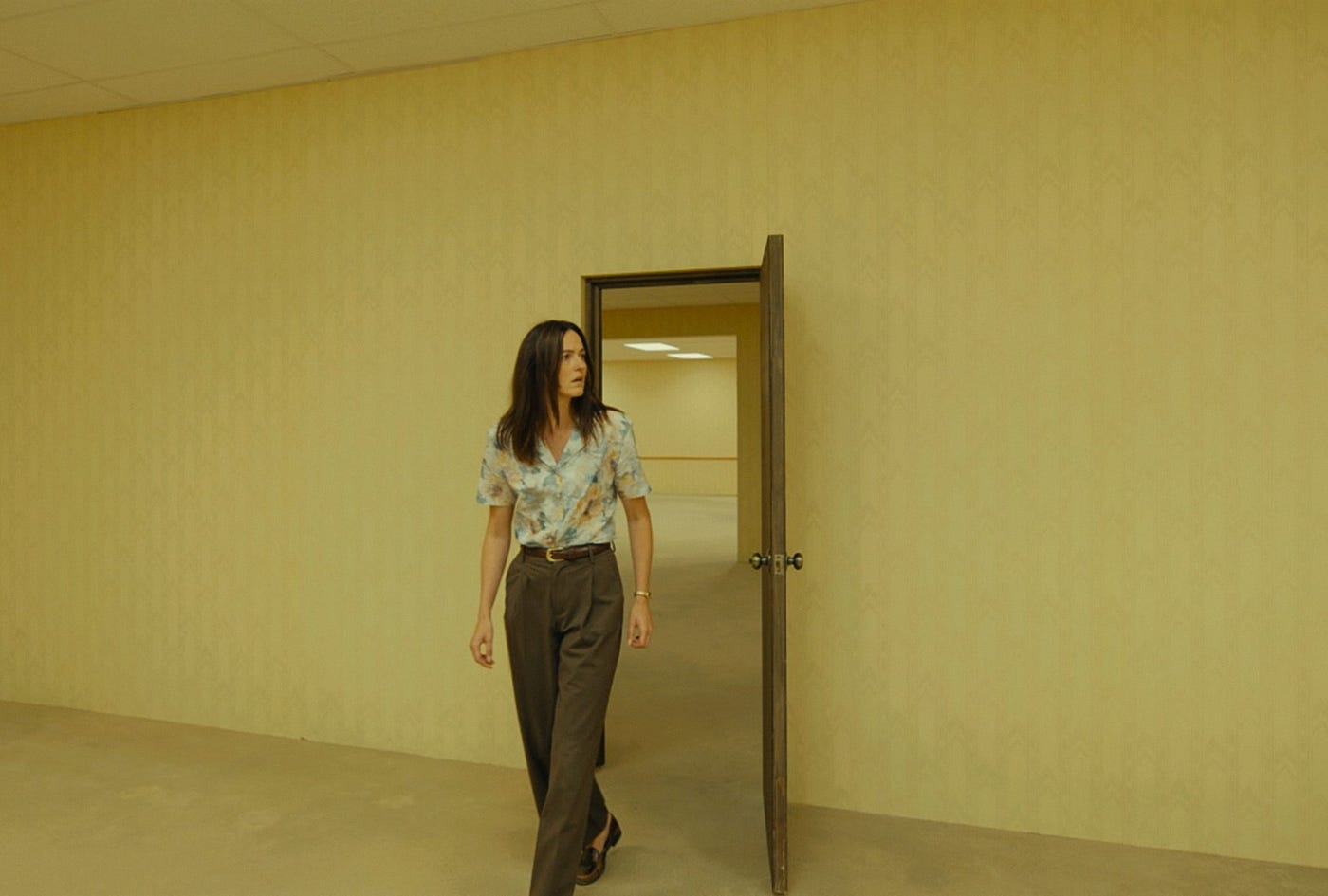
Renate Reinsve in “Backrooms” (A24)
Look Out the Window
His therapist, Mary Kline (Renate Reinsve), recognizes this pattern of repetition compulsion early on. She encourages a roleplaying exercise to better understand his responses. Clark is initially hesitant but eventually gives in, becoming increasingly frustrated as he vents about his ex-wife. Later in the film, he forces Mary to reenact the same exercise in the Backrooms, a place that physically roleplays and mimics reality itself. Yet within this artificial world, these two people who are profoundly out of touch with their own lives find a rare moment of understanding.
Mary experiences a breakthrough of her own in this moment. Throughout the film, we’re given glimpses of her turbulent childhood, shaped by an over-controlling mother who struggled with severe schizophrenia and paranoia. Raised in a home where newspapers covered the windows, Mary later publishes a self-help book encouraging readers to “look out the window.” This contradiction lies at the very heart of her character. Driven by a deep need to help people, Mary’s credibility as a therapist is called into question when her commitment to others exceeds her commitment to understanding herself. Despite Clark’s visible frustration during their final session, a revisited shot of him appearing calm and defeated during their last session implies that Mary’s memory of their encounter is more empathetic than it initially appears.
Her altruism becomes both her greatest strength and her greatest weakness in the Backrooms. As she grapples with feelings of imposter syndrome, she later realizes that no amount of helping others can undo the grief she carries over not being able to help her mother. Perhaps the solution was always to look inward for the answer rather than outward. Like Clark, however, Mary’s revelation offers little comfort, and her fate is a dark one. Surrounded by one-way windows in an interrogation room with ASYNC, Mary silently concludes the possibility that she might never truly escape the Backrooms at all.
The More It Remembers, the Less It Does
As many have noted, the Backrooms aren’t limited to any single concrete interpretation or definition. Its liminal spaces and environmental design lend themselves to its ambiguous, mysterious nature. Still, director Parsons strikes a balance between introducing newcomers to the lore and preserving room for interpretation.
“The Backrooms, to me, has felt aligned with what happens when someone goes through sensory deprivation on the individual level — and you go out in an empty room — and the body, the nervous system needs stimulation so badly [when] it’s deprived of it,” Parsons told The Hollywood Reporter. “It starts to find noise and information in the pattern of the walls and starts to take that noise more seriously than it normally would. It opens its threshold of what it’s willing to accept.”
The film capitalizes on this idea by showing how the Backrooms mimic and reconstruct fragments of reality at their source. Like a twisted game of telephone, the realm operates as an echo chamber, materializing rooms, furniture, objects and even people (still lifes) to occupy its vast spaces.
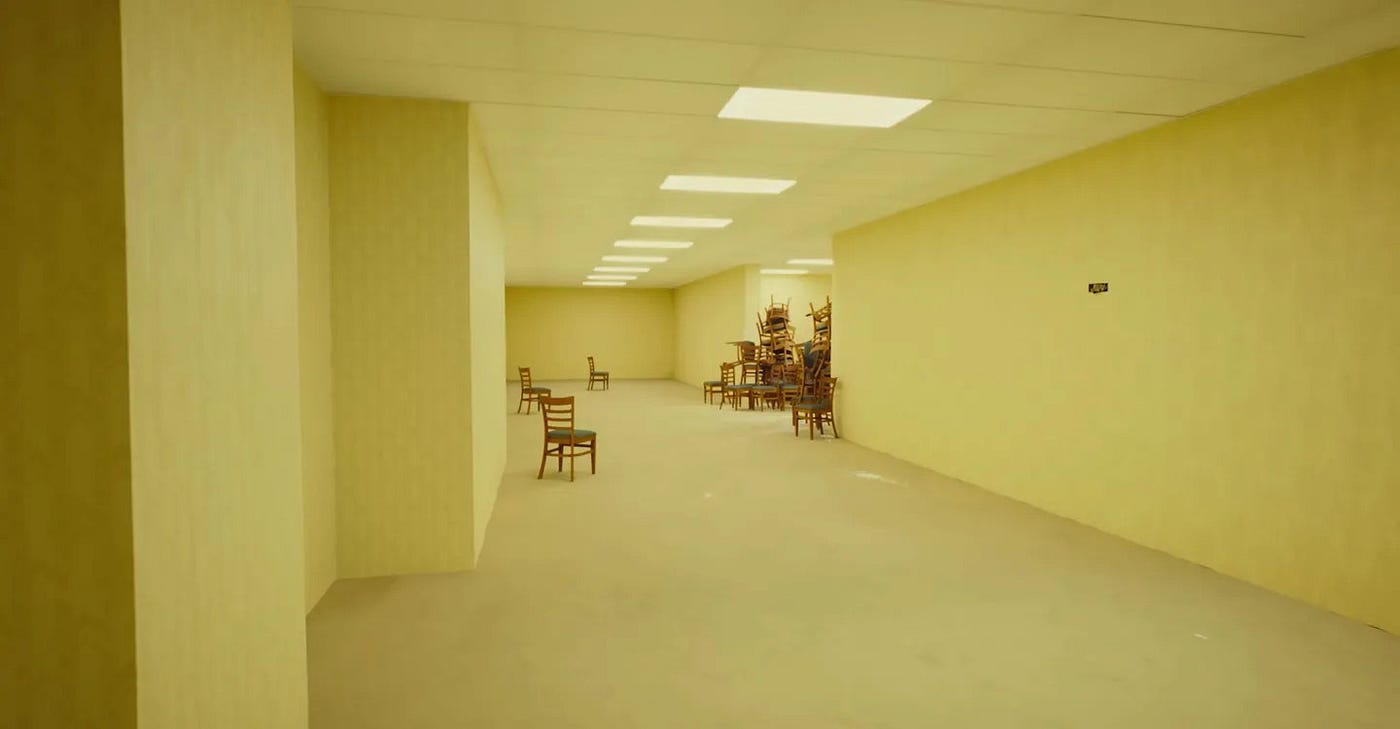
Official still from “Backrooms” (A24)
Similar to an MRI scan, it takes only a fragmented “snapshot” of one’s psyche or memory, latching onto moments of raw vulnerability — stripped of ego, pride, context or perspective. Combined with one’s physical appearance, it renders an amalgamated form of a human being. These forms are known as still lifes: pseudo-representations that are structurally informed by real people and their emotions but often fail to accurately preserve their details, much like generative AI.
The original lore of the Backrooms framed the realm as a place for discarding excess. The film’s interpretation, however, views it as a place that generates and stores what one wishes to discard, but ultimately cannot.
With the success of the “Backrooms,” new doors for film adaptation have been opened, extending beyond the industry’s dependence on reboots and remakes. Rather than drawing from a long-established franchise, its development suggests that studios may be increasingly open to adapting unconventional forms of storytelling born in digital culture.
메타데이터
- post_id
- cdab3ebca7e4
- slug
- backrooms-you-are-your-f-ing-brain-cdab3ebca7e4
- url
- https://medium.com/@myghostwriter/backrooms-you-are-your-f-ing-brain-cdab3ebca7e4
- canonical_url
- https://medium.com/@myghostwriter/backrooms-you-are-your-f-ing-brain-cdab3ebca7e4
- author_url
- https://medium.com/@myghostwriter
- status
- ok
- fetched_at
- 2026-06-22 05:41:33