Inside an IEP Meeting: When the System Talks to Itself for the First Time
We just had another IEP meeting for my daughter. It was the first one after a long, independent evaluation, and I walked in hoping this…
Inside an IEP Meeting: When the System Talks to Itself for the First Time
We just had another IEP meeting for my daughter. It was the first one after a long, independent evaluation, and I walked in hoping this would finally feel different.
It didn’t.
I want to share what actually happens in these rooms — not the legal language on the papers, but what it feels like when you’re a parent watching professionals talk about your child as if they’re all meeting her for the first time.
No names, no school identifiers. Just what it’s like.
1. The meeting where everyone is “updating” everyone else
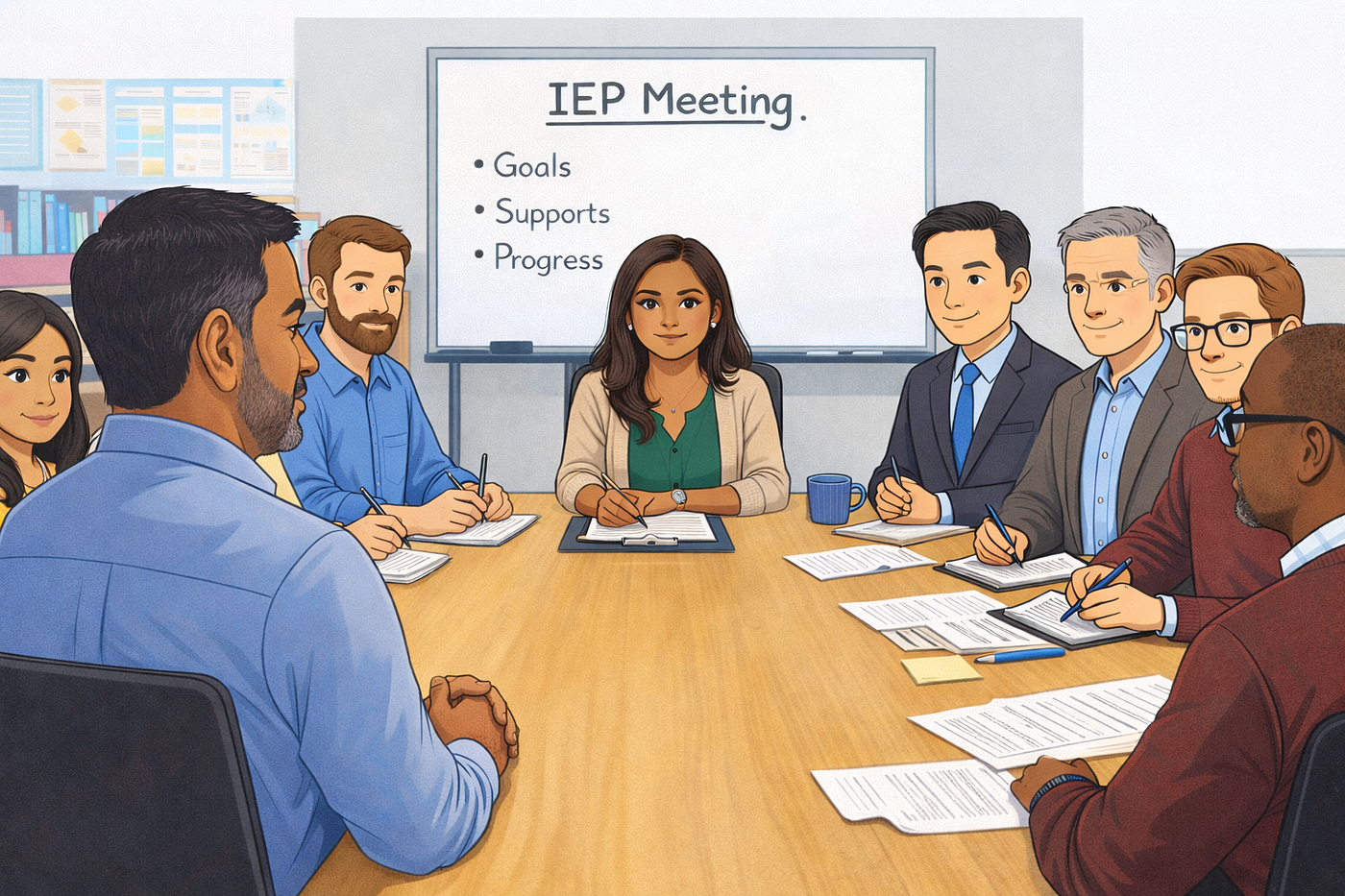
If you’ve never been in one of these meetings, imagine this: a table of educators, therapists, and administrators. Each one takes a turn giving an update about how your child is doing in their class or service.
On the surface, that sounds good — lots of input, lots of data.
What struck me this time, though, was that these updates were clearly news to each other, not just to us. You could see teachers genuinely surprised by what another teacher was saying about the exact same child, in the exact same building, during the exact same school year.
- One class report sounds positive: engaged, participating, making progress.
- Another class, same child, sounds like a completely different student: struggling, lost, constantly needing support.
You watch faces around the table as they realize they’re hearing this contrast for the first time too. As a parent, it feels like you’re watching the school meet your child in real time — in front of you — instead of in their day‑to‑day work.
If the only time your child’s team really hears a full picture of her is in an annual IEP meeting, that’s not a “team.” That’s a group of separate silos reading into a microphone once a year.
2. Progress in one class, invisible in another
We heard the familiar story: “She’s doing well here,” “She’s making progress,” “She works so hard.”
In one subject, we heard a lot of positives — she participates, she asks for help, she does the work with support. In another subject, sometimes just a few doors down the hall, the picture is: she doesn’t retain what was taught yesterday, she gets lost in the text, she can’t independently answer open‑ended questions without heavy prompting.
Both can be true. But what’s missing is a system that notices those contradictions and does something about them.
If a student is “doing great” in one class only because the teacher is scaffolding every step, but can’t show any of that independence in another subject, that isn’t real progress. That’s fragile progress living inside one classroom’s personal workaround.
From a parent’s view, it looks like this:
- Progress is happening inside particular rooms, based on individual teachers’ effort and creativity.
- There is almost no evidence that the system is taking what works in one room and making sure it shows up everywhere else.
An IEP is supposed to be the bridge that carries what works across the whole day. What we saw was more like a set of islands.
3. When “self‑advocacy” is a talking point, not a plan
Every year, self‑advocacy and executive functioning show up in the conversation:
“She needs to advocate for herself more.” “We’re really focusing on executive functioning this year.”
And every year, when we ask how, the answers are fuzzy.
What are the actual tools you’re teaching her? Where is that written down? How will we know it’s working?
You hear generic phrases — “we encourage her,” “we remind her,” “we’re working on it” — but not a concrete, shared method. Different teachers seem to be improvising their own version of “self‑advocacy” and “EF” instead of working from a common approach.
When you’ve heard the same themes for multiple years, with the same gaps between talk and practice, you start to realize: the problem isn’t that your child isn’t “advocating.” The problem is that the adults haven’t agreed on what that actually looks like for her and how to build those skills step by step.
4. The orchestra moment: “All kids get disappointed”
One of the most painful parts of the meeting had nothing to do with reading scores or math levels. It was about orchestra.
My daughter loves orchestra. She practices at home. For her, music is one of the rare times she can feel “in the mix” with other kids, not just as “the special ed student.”
Instead, she’s been spending orchestra time practicing alone in a separate room, on an iPad, because she’s “behind” on individual skills. No clear goals. No clear plan to get her back with the group. No written objectives in the IEP for what success looks like in the spring concert.
When we raised how isolating this feels for her, the response from leadership boiled down to: kids get disappointed; that happens to everyone.
Yes, all kids get disappointed sometimes. But not all kids spend their so‑called inclusion time physically separated from the group, with no documented goals for how they’ll ever get out of that room.
For a child who is already painfully aware of being different, “everyone gets disappointed” doesn’t answer:
- Why is she alone when this could be a supported inclusion moment?
- What exactly are we working toward in orchestra, and how will we know she’s progressing?
- Why is there still nothing on paper that protects her from being quietly sidelined like this again?
5. The LLD program they couldn’t really explain
The district’s main solution at this meeting was to move her more fully into their “Language and Learning Disabilities” (LLD) classes for core academics.
On paper, it sounds promising: smaller classes, slower pace, more structure, more review. Those are all things she needs.
But when we asked very basic questions — about peer group, about how social‑emotional needs would be addressed, about how this program is different from what has already failed to close the gap — we didn’t get clear answers.
- What is the range of students in that class academically and cognitively?
- How will this program protect her confidence when she sees her former classmates in the hallway going to different classes?
- Where, in this model, is the intentional work on friendship, belonging, and self‑esteem?
- How does this program fix the disconnect we keep seeing between classes, instead of just moving the disconnect into a different hallway?
Instead, the explanation kept circling back to the same points: smaller group, slower pace, more repetition.
It felt like they had taken the language from the independent evaluation about small classes and structure and poured it over an existing program, without really grappling with the social‑emotional and system‑wide changes our daughter actually needs.
6. An IEP that still doesn’t answer the “how”
By the end of the meeting, we had:
- More promises that the program would be “more structured” and “more supportive.”
- More reassurance that she’s a pleasure to have in class and works very hard.
- More talk about how disappointed all kids can be.
What we didn’t have was:
- A clear, shared picture among the staff of who she is across subjects.
- Specific, cross‑class strategies for building self‑advocacy and executive functioning.
- Written, concrete plans for how she will be socially included in the parts of school that matter most to her.
- A convincing explanation of why this particular LLD setup, in this particular building, is the right place for her to rebuild confidence and connection.
For me, that was the headline of the meeting: a lot of words, not a lot of “how.”
7. Why I’m writing this
I’m writing this for any parent who has ever walked out of an IEP meeting thinking:
- “How can my child be ‘doing well’ and still be so far behind?”
- “Why am I the one connecting the dots between classes?”
- “Why does it feel like the first time these adults are really hearing about my child as a whole person is in front of me, once a year?”
My last article was about the independent evaluation — about getting a clear picture from the outside. This one is about what happens when you take that clarity into a system that isn’t built to change quickly.
If you’re in this place too, you are not alone. You’re allowed to question programs that sound good on paper but don’t add up when you look at your child’s actual day. You’re allowed to ask, “Where are the goals? Where is the plan? Who is responsible for making sure what works in one room doesn’t die at the doorway?”
And you’re allowed to decide that your child needs something different, even when the district insists their latest version of “more of the same” is enough.
If you want to share your own IEP meeting stories, or you’re just trying to untangle what you’ve lived through, my inbox on Medium is open.
메타데이터
- post_id
- cdc05864e69b
- slug
- inside-an-iep-meeting-when-the-system-talks-to-itself-for-the-first-time-cdc05864e69b
- url
- https://medium.com/@dheeraj.achra/inside-an-iep-meeting-when-the-system-talks-to-itself-for-the-first-time-cdc05864e69b
- canonical_url
- https://medium.com/@dheeraj.achra/inside-an-iep-meeting-when-the-system-talks-to-itself-for-the-first-time-cdc05864e69b
- author_url
- https://medium.com/@dheeraj.achra
- status
- ok
- fetched_at
- 2026-06-11 16:11:38