On the Inalienable Right to Communicate — However You Can
My Step-Mom’s Aphasia
On the Inalienable Right to Communicate — However You Can
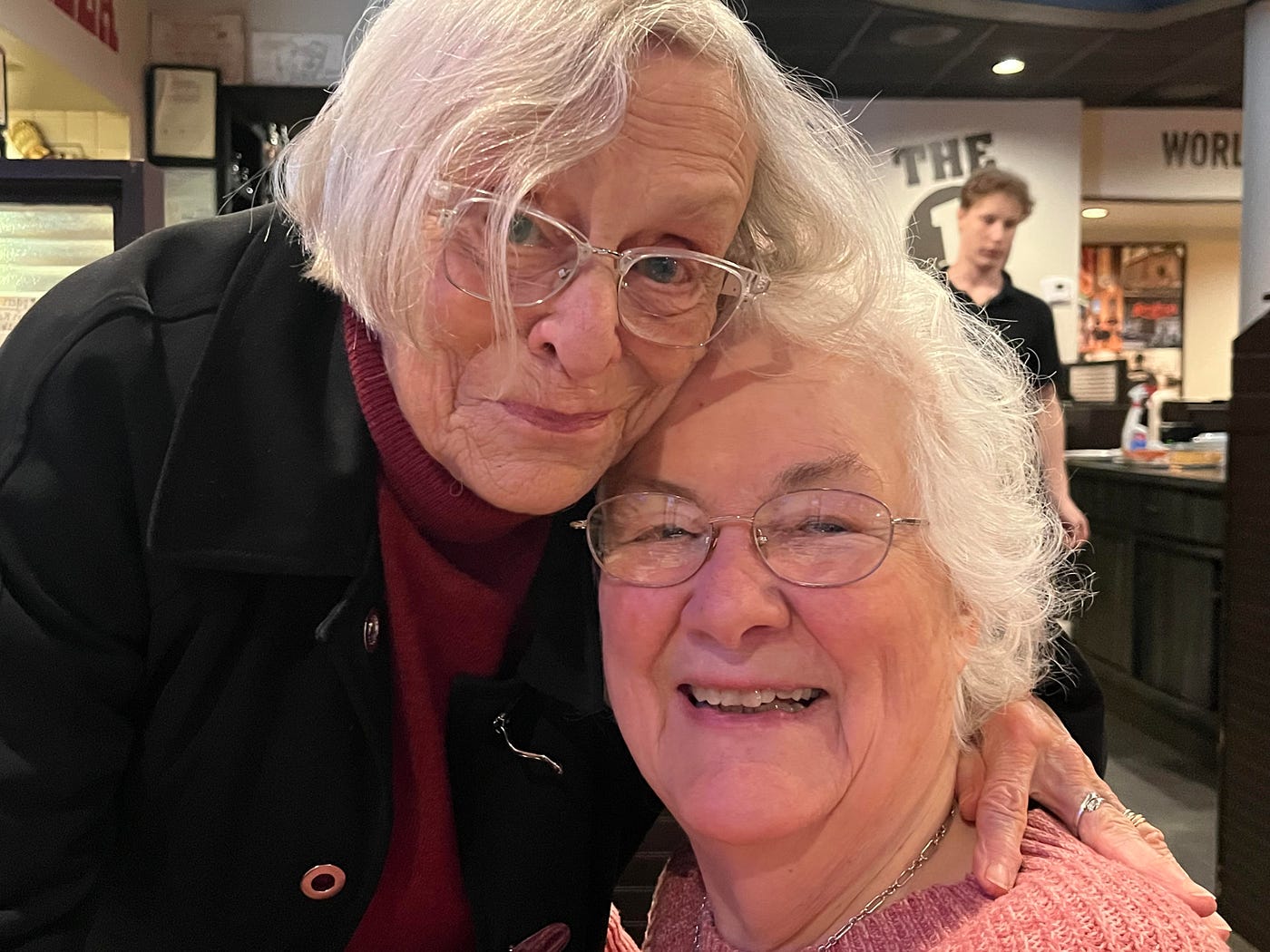
My step-mom (left) and mom (right) at a recent family dinner at Giordano’s in Chicago (shout-out!)
- My Step-Mom’s Aphasia
I’ve just returned home from Chicago, where I stayed with my moms who are in their late 80s. My step-mom (Karen) has had multiple brain injuries and now has expressive aphasia (she has great difficulty speaking). She spent her life as a psychoanalyst and a teacher at the Chicago Institute for Psychoanalysis. The big message she has taught her whole life is that real healing in any therapeutic intervention is about authentic connection.
To this point, I recorded a private conversation between us before she became aphasic (about 6 years ago), in which she eloquently describes the importance of connection in helping people heal. She has allowed me to post the conversation publicly, and is gratified that people can see her communicating her important ideas so well.
Last Saturday at dinner, my mom and I spent about 30 minutes trying to figure out what Karen was trying to say to us about what she wanted to watch on TV. Karen was animated and agitated — but instead of giving up, she kept trying to communicate. She had gotten out “Reader’s Digest. Publications. Presidential Debates. Comedy.” My mom decided she wanted to watch Saturday Night Live. But Karen pushed — no. Not that.
Finally, she made some movements with her hand — like writing. My mom has macular degeneration in both eyes, so she could not see that Karen was making these movements…but I could. Yet I still misinterpreted her sign language. I thought she wanted me to get out her letterboard — like the kind that some autistic nonspeakers use. It can help jog her memory for words. She tried it a bit, but then made the same wriggling movement with her hand again.
This time I got it. Duh. She wanted a pen and paper so she could try to write down words.
She sloppily wrote down “White House.” “Publications.” “Book.” There were some other words that weren’t legible. I still didn’t know what she meant, so I just put the legible words into Google search, and the first topical response was “White House Correspondents’ Dinner — live streaming.” When I read the search result out loud, Karen yelled “YES!” and we high-fived.
My mom joined in, and we got ourselves ready to watch the program live. Of course, the events afterwards ended up being very concerning. But the primary good was that we all recognized the gratifying feeling of a successful communication within the context of a profound desire for connection.
When my mother and I took the time to really understand what Karen meant, all three of us felt delighted that the connection among us had been reinforced with successful communication. Obviously Karen had the thoughts, ideas and language inside of her for the whole 30 minutes, but when we finally understood this, we felt the power that comes when people rise above the communication difficulties that threaten to disconnect and disempower us.
- An Echo in Non-Speaking Autism
Yesterday, I received a reminder of a similar threat of disempowerment, played out in a more public way. The New York Times published a guest essay titled “Profound Autism is Difficult Enough Without This Debunked Method” (gift link to article). In the essay, the author describes her own beliefs, experiences, and research about using letterboards and keyboards to communicate with autistic people who do not speak as a primary form of communication (they call themselves “nonspeakers” or “spellers”). Her opinion on spelling/typing approaches is not favorable, and she mentions that her opinion is shared by those at the American Speech-Language-Hearing Association, (ASHA) among other organizations.
What she doesn’t do is explain how she communicates with her son, whom she says is cognitively impaired. There is no doubt she communicates with him in some way, and that is a way that provides some form of connection and unity. It’s clear she loves him. While she does not communicate with him using letterboards or keyboards, sometimes there can be other ways of communication that allow parents to connect authentically. It is likely she uses a mixture of these methods, and that her connection with him is at times powerful and life-affirming, like when my mom and I finally understood what Karen wanted to say.
The essayist also cites some reasonable but incomplete research about spelling/typing methods, but I wouldn’t expect a non-scientist to be aware of more recent developments in the field. However, I’m a scientist in the field — or at least newly in this field. My PhD in Communication Sciences and Disorders from Northwestern was focused on psychoacoustics (the psychology of sound perception), and my postdoc in Cognitive Neuroscience at Northwestern was focused on auditory-visual synchrony and perceptual timing. So field-adjacent, I guess.
However, because I have since then very publicly pursued rigorous research in what I call “exceptional human performance” and others call “psychic stuff” — like precognition and telepathy — my background could easily be dismissed.
That’s okay.
I am still a rigorously trained world-class cognitive neuroscientist with a year of research experience trying to understand the minds of nonspeaking students, and several years of personal experience trying to understand how my previously eloquent step-mom’s body no longer allows her to show us what is going on inside of her.
So even though it may do no good because people who are uninformed about the rigor behind my work can just say “she studies psychic stuff” (a la a minority of responses to a recent interview with Julian Dorey), I feel like the essay in the Times has presented me with a moral obligation to speak up about the fact that there is more to the minds of some autistic nonspeaking people, and we are just at the beginning of understanding them.
I just can’t wait until our team’s scientific publications are submitted and they go through the necessary peer review. Here I’ll provide some pre-peer-review personal stories and up-to-date observations about how scientific opinion on this issue is shifting, a shift I suspect is primarily driven by the public attention resulting from The Telepathy Tapes podcast.
3. “Message Passing” vs. “Mind Discovery”
As the NY Times essay describes, the standard test to determine whether an autistic nonspeaker is expressing their own thoughts is — ironically — to ask them to express someone else’s thoughts. It’s called a “message-passing” test.
Put a card in front of the nonspeaker that says the word “cat.” Give a card that says “dog” to their communication partner. Separate the two of them with a partition or blindfold (but the communication partner still holds the letterboard). Then ask the nonspeaker to spell on theletterboard what they are seeing. The nonspeaker spells “dog” or something else entirely, not “cat.”
The non-scientific (but oft-repeated) conclusion? The nonspeaker is being influenced by subtle unconscious cues from the communication partner, and the nonspeaker is not cognitively capable of their own thoughts.
The more scientific conclusion? For some reason that we don’t understand, many nonspeakers don’t consistently spell out what they are shown.
When I first heard about the message-passing test I laughed out loud, because the conclusions are beyond unwarranted. They are just scientifically and ethically irresponsible. It’s not so difficult to recognize that there could be many broken links in the communication chain, and it is only reasonable to first establish these links aren’t broken before making far-reaching conclusions about minds you don’t understand.
Here are just a few potentially broken links that are not usually addressed by message-passing tests.
-
There is difficulty focusing on the stimulus at this particular moment (many nonspeakers have trouble sustaining eye gaze in an intentional way, which is part of why they need the communication partner [CP] in the first place).
-
There is poor retention of or memory for the task (many nonspeakers have attention wandering issues, which is part of why they need a CP).
-
Anxiety is introduced by researcher expectations and the gravity of the meaning of not passing the test (many nonspeakers are emotionally-socially highly sensitive and seem to sense the expectations of others in the room, which is part of why they need a CP).
-
Boring stimuli (like single-word retention) provide low motivation (many nonspeakers spell on letterboards about things that happened in school that day and how they were treated as if they were idiots, which is part of why they need a CP).
-
It’s a “bad spelling day” and the nonspeaker just can’t control their body well (beyond commonly being diagnosed with speech apraxia, many nonspeakers have dyspraxia — difficulty controlling motor movements — which is part of why they need a CP).
These problems with the message-passing test have been exhaustively covered by Guilia Pavon, PhD, who addressed them with a new form of message-passing test that does not isolate the communication partner from the nonspeaker, but instead isolates the information to be communicated from the communication partner. She went on to find that many spellers could pass her adapted test, which was in fact more scientifically rigorous than many previous tests.
But part of the problem with scientific and clinical recognition of these kinds of results is that almost all of the prior “message-passing” research has not been done by people who investigate the complex interplay between perception, attention, motivation, language, and motor function. Generally it’s been done by speech-language pathologists, occupational therapists, and clinical autism researchers. These are highly-trained professionals, but for most of them their training is to see message-passing as a recipe to determine authorship of messages. They tend not to look beyond it.
As neuroscientists, psychologists and developmental psychologists have become more involved in trying to understand nonspeaking autism, the approach is now changing. A great example is the Jaswal lab at University of Virginia. Vikram Jaswal, PhD was trained as a developmental psychologist and years ago turned his attention to understanding authentic communication, representation, and meaning among autistic people. Recently with his team he published a passionate and well-researched article explaining to other scientists why we need to better understand alternative communication methods like the spelling and typing methods used by some nonspeakers. He cites his own work and other scientific work indicating that many nonspeaking people show the same linguistic capacities and behaviors as neurotypicals (for instance, they tapped an iPad displaying words and letters in the same way that literate neurotypicals would).
Over the course of the past year, I have gotten to know six nonspeakers fairly well — they are the students whose parents gave informed consent (WCG IRB Protocol #20250367) to work with our research team on Applied Love Labs’ Supporting Nonspeakers project. Always working with either speech-language pathologist Maria Welch or communication partner (CP) and teacher Natalia Meehan, my co-investigator neuroscientist Dr. Jeff Tarrant and I used blinded protocols to better understand the minds of these six students over Zoom and in person. Jeff, Maria and I wrote about the “Mind-Discovery” protocol we used in this open-access article, and there is an explainer video about these protocols as well.
Both of the communications I linked to above can be dismissed by people who think that even investigating the possibility of telepathy is evidence of poor scientific thinking. So here I’ll briefly describe why the mind-discovery protocol is so important to the science of nonspeaking autism, without bringing in telepathy. We extend Pavon’s approach by using more interesting stimuli that our co-researchers (the nonspeakers themselves) have told us they would like to see.
TL,DR: We expose the nonspeaker to an interesting stimulus that they haven’t seen before — but the CP doesn’t know what it is. Yet the nonspeaker can spell what they experienced with their trusted CP (see Figure 1 and below).
Longer version. At first, everyone in the experiment meets together to listen to a recorded meditation on grounding (thanks to co-investigator Dr. Jeff Tarrant). This meditation clearly relaxes not only the nonspeaker (NS) who is being asked to show their skills in a particular trial, but the communication partner (CP) and the “storyteller” (ST) who are key personnel in the experiment. Then the CP goes to another room while the ST sits with the nonspeaker (NS), and there is another recorded meditation everyone listens to simultaneously via specialized software — this one about a love bubble surrounding the whole research team. This meditation is meant to link the NS with the CP psychologically, though the CP is in another room.
Then the ST and NS watch a randomly selected video or read a story on a computer screen. In the other room during this time and sound-proofed from the stimulus, the CP does not know what the stimulus is or actually what any stimulus could be. The CP has never seen the stimuli in the stimulus pool from which each stimulus is randomly selected using the software written by our teammate Polly Washburn and populated with stimuli by our other teammate Joseph Mossbridge. Once the communication partner returns to the room, the storyteller leaves and the nonspeaker attempts to describe what they thought about the target.
For ethical reasons, we do not deprive the nonspeaker of their usual connection with the communication partner, instead we deprive the communication partner of the knowledge of what the nonspeaker experienced (Figure 1).

Figure 1. Protocol for a mind-discovery trial. NS=nonspeaker, CP=communication partner, ST=storyteller.
At the end of the trial, everyone debriefs in a team meeting to discuss what went well and what didn’t. To score the trials, we use a specialized AI method co-investigator Dr. Damon Abraham and I developed in a previous work that calculates a quantitative similarity score to determine how similar the nonspeaker’s description of the stimulus was to the actual stimulus.
Our scientific articles are still in the preparation/editing pipeline, as I mentioned. In the meantime, I have permission from the research team to refer to our most crucial outcome here, prior to peer-review.
In one of our formal studies, three of the nonspeakers (the three oldest), each performed only a single video-stimulus trial. Their results showed clearly defensible independent authorship of their messages. Two of them showed independently statistically significant results related to the target stimuli they were presented. The third instead ignored the stimulus he was shown entirely and proceeded to spell a long paragraph about a trip he had gone on to St. Thomas, the olive oil he really liked there, and the shop at which his family had bought the olive oil. Follow-up conversations with his family in which we asked them open-ended questions about their vacations revealed that he was describing a trip that none of the experimenters, the storyteller, or the communication partner had heard about. In other words, he re-wrote our mind-discovery stimulus, provided his own, and showed us how an even more impressive version of mind discovery could be done.
Those results are from just the formal video trials. Our team has submitted an abstract to ASHA outlining our two sets of formal trials for their fall conference, and we will make the abstract public here once the review process is complete. Overall, the results make it clear that “presuming competence” — assuming that a nonspeaking autistic person is competent in their own cognition until proven incorrect — is the only ethical path. And importantly, it’s a critical path to more discovery.
4. The History Behind the Resistance to Presuming Competence
There is some history behind the clinical resistance-to-change in this field. My mother, a learning disabilities specialist, used to work for the Orthogenic School at University of Chicago — directly working with its then-director Dr. Bruno Bettelheim. Bettelheim has since been accused of abuse, and my mother confirmed that to me recently, saying, “Yes, he was abusive to the staff, at least. Probably the students. But taking disabled children away from their parents and telling them that strangers could better help them is its own kind of abuse.” Bettelheim called this last part a “parentectomy” as he blamed mothers for their children’s autism.
At the same time as he committed this abuse, Bettelheim labeled another therapy, Applied Behavioral Analysis (ABA) as abusive. Today, ABA is the standard approach to support communication and behavior for autistic nonspeakers. Some supporters of spelling and typing methods have called ABA abusive, and some ABA advocates have called spelling methods abusive.
The fact is anything is abusive if it is done by someone who acts abusively, and of course there are instances of people using both ABA and spelling methods in abusive ways. It always comes down to the people using the technique. Always.
Many nonspeakers have been helped by compassionate and licensed ABA practitioners. In fact, one of the nonspeakers who showed clear authorship results on our mind-discovery trials had years of experience with ABA — but that’s not what allowed any of them to be heard.
What allowed them to be heard?
These older nonspeakers had years of help learning to spell out their own thoughts and feelings alongside a skilled communication partner (Maria Welch, M.S., CCC-SLP). Maria and our co-researcher Natalia Meehan have been trained to use prompts to help nonspeakers work toward independent communication. As a result of their decades of experience, grants to Applied Love Labs are able to support the two of them in creating a new holistic, online curriculum for friends, families, and allies of nonspeakers who wish to learn to support nonspeakers in independent communication using letterboards (Figure 2).

Figure 2. Natalia poses with one of The Bridge’s curriculum brainstorming boards.
5. “Go tell them!” and “Don’t hold back!”
Everything I’ve written here that’s not my own experience is science or history, and it doesn’t apply to every nonspeaker or every family’s experience. Neither will the intriguing and heart-wrenching stories that follow. Nonetheless, many of them will resonate, so I’m including them.
But in this set of stories I won’t promise to leave out telepathy, since the experience of telepathic communication seems to be at the center of the lives of so many spellers and their families. Wait for the two future papers to find out more on the scientific side when it comes to telepathy (preview: hard to document in rigorous trials, easy to document spontaneously).
Of the six nonspeakers participating in the mind-discovery research, Ryan was the first that I met. He knocked my intellectual socks off. I sat in Maria’s office, watching Ryan type the answer to Maria’s usual “Do you have a check-in today?” initiating question. She likes to find out how her students are feeling, and encourages them to use the keyboard as they type their thoughts if they can handle that (keyboards can be harder than letterboards for spellers, but some can learn to use keyboards).
Ryan spelled out some observation he had about their last lesson and things he wanted to improve (I was not yet in the habit of writing spellers’ words down so I can’t be precise). I heard the sentence and thought, “Oh, either Maria has carefully crafted her invisible and unconscious ideomotor cues that do not involve consistently moving a letterboard to make Ryan seem super insightful — or Ryan is really talking about how to improve their work together.” Then Ryan proceeded to spell that he was happy I was observing, because I studied precognition, which is important to him. So then I figured, “Oh, either Maria has carefully crafted her invisible and unconscious ideomotor cues that do not involve consistently moving a letterboard to help Ryan compliment me or Ryan really knows what I work on and is complimenting me.”
It took a few weeks, but I learned pretty quickly that Ryan was very often talking about his actual thoughts and feelings. I learned it through bits and pieces, but most dramatically through a demonstration of apparent telepathy, which turns out to be the way quite a few parents of nonspeakers become convinced that their spellers really are spelling their own thoughts.
After a few sessions observing Ryan, I had a dream about him. In the dream he handed me an orange, barely spinning sphere that was somewhat sparkly. Almost like a sun with sunspots. I wrote down the dream but told no one about it.
The next day I was recording a Zoom session with Maria and Ryan — they were in Illinois, I was in Virginia. I asked Ryan, “Last night I had a dream you gave me a shape. Can you spell what the shape was?” I wanted to see if he would come back with “sphere” or “ball” — verifying that he would make a good guess, or that he truly communicated with me.
He spelled “I sent you a pre-revolutionary orb with four stars on it. Slowly rotating.”
Okay then! I definitely presumed more than competence after that moment. More like giftedness.
A note on Ryan’s take about 9 months later: I asked Ryan’s mom this morning if she could check with Ryan that I could share this story in response to the NY Times essay — he spelled to her, “Go tell them!”
Another story: I met a mom helped by Maria’s work who recently saw her daughter spell on a letter board for the first time. She says her mouth flew wide open. She had no idea there could be communication from her daughter to that extent, or even that her daughter could reliably spell words. The mom rapidly learned how to do the letterboards and taught her whole family. And then she “heard” her daughter dismiss her for the first time using a letterboard (spelling “let me be”). Of course, she had mixed feelings — but at least she knew the message was her daughter’s own. “I wouldn’t say that to myself!” Here’s a video I recorded of a brief impromptu discussion with this particular mom.
Another story: Maria and Natalia are meeting this week to work on The Bridge curriculum, and Natalia asked her nonspeaking sister if she had any advice about their work, and ours. She spelled, “Don’t hold back.” We told her we aren’t.
Another story: Here’s an instance of independent thought and telepathy that I have permission to share on social media. It’s a video of a debrief after a mind-discovery trial investigating telepathy. Participant 4 (one of the independently-statistically-significant spellers) is trying to help us understand how to make the video stimulus in a telepathy mind-discovery trial stand out. He tells us to slam a beach ball on the ground before the sender “sends” the video.
Then later we meet with the next participant (P5, the other statistically-significant speller), and he checks in — telling us in no uncertain terms that Maria has to go now to the lobby and tell his mom that he wants to double-date with P4’s girlfriend and his own. Then he proceeds to mention we should slam a beach ball — which is what P4 told us to do (of course no one had mentioned this to P5). The key thing is, he spells this response with Natalia — a new communication partner with whom he had worked for maybe less than an hour (interrupted). The point is, there would have been no time for her to develop an ideomotor code with him.
That’s probably my favorite shareable story, especially with the double-date part — P4 had also mentioned he wanted a double-date with P5 and his girlfriend, a fact that we did not communicate to anyone until P5 asked for the same date. Dr. Jeff Tarrant is writing up all these spontaneous instances as the first author on our team’s scientific publication on spontaneous mind discovery and telepathy; that’ll be one of the two scientific peer-reviewed papers I mentioned above.
6. To Make a Change, Speak Up!
Overall, my experiences in the past year suggest that many, if not all, nonspeakers who successfully spell messages with letterboards/keyboards are doing this very hard and painstaking work because they are motivated to say what is on their own minds, not someone else’s. And rigorous science is beginning to support that conclusion, as I’ve described.
Generally people in the field are very excited about the positive work ASHA does in this area, but we want to be sure that they no longer issue warning statements about spelling methods based on old science and practice. My colleagues and I hope their new and revised statement will at least point out that for some nonspeakers, spelling methods can be a powerful way to gain connection, and a voice. That’s because ASHA has a lot of influence over what accommodations are made available in public schools for nonspeakers, so right now it is difficult for all but the most well-resourced nonspeakers to try to see if they can communicate with letterboards.
If you’re interested in helping ASHA recognize the new science and the clinical benefits supporting spelling methods, consider re-sending this public letter to the ASHA board. Our team and other researchers in the field sent the letter to ASHA after an unscientific talk minimizing the intellect of nonspeakers was presented at the ASHA conference last year (there’s a link to the talk slides in the letter).
Or maybe consider digging into the controversy around New York’s Right to Communicate Bill, or better yet — instigate a bill in your state with accommodations for spelling/typing methods. You can also fund the science that helps make the right to communicate inalienable and obvious by donating to the Applied Love Labs Supporting Nonspeakers project.
I want to close with a powerful text I received today from the father of Lily Sherwood, an adult speller who wrote a beautiful account of the process of revealing her voice in The Parlor. Her comment on yesterday’s NY Times essay was only completed after the Times comment section was closed (for many spellers, it takes a lot of time to get out even a sentence). Lily sent it to the Times but I am unsure it will be published as a Letter to the Editor, so I am publishing it here with her permission.
“I am appalled from the depths of my soul that Dr. Lutz is brazenly demeaning nonspeakers in this way. Spelled communication has been a lifeline for so many of us. Before spelling we lived in a cage of silence. Through hard work to control our bodies, many of us can now advocate for ourselves. Deep bias against nonspeakers from professionals who are supposed to be advocates for autistics is our biggest obstacle to progress. Today this must end. The voices and lived experiences of nonspeakers need to be most central in determining our needs.”
– Lily, 21 year-old apraxic nonspeaking autistic.
메타데이터
- post_id
- cdc8b1834656
- slug
- on-the-inalienable-right-to-communicate-however-you-can-cdc8b1834656
- url
- https://medium.com/@jmossbridge/on-the-inalienable-right-to-communicate-however-you-can-cdc8b1834656
- canonical_url
- https://medium.com/@jmossbridge/on-the-inalienable-right-to-communicate-however-you-can-cdc8b1834656
- author_url
- https://medium.com/@jmossbridge
- status
- ok
- fetched_at
- 2026-06-15 20:49:13