The Corporate “Telephone Game”: How Your Disconnected Tools Distort Reality
Almost all of us played the Telephone Game when we were kids. You sat in a circle with your friends. The first person whispered a sentence…
The Corporate “Telephone Game”: How Your Disconnected Tools Distort Reality
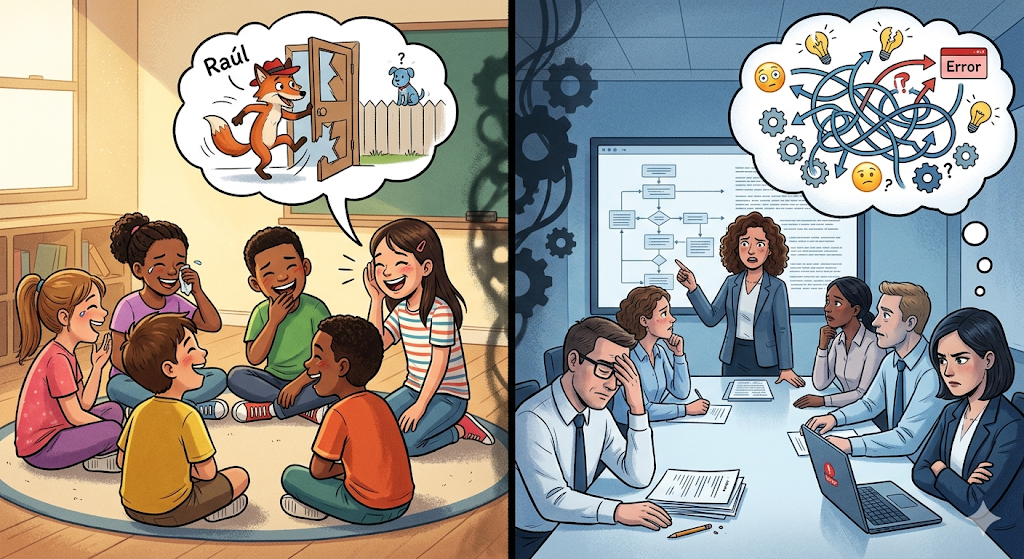
Almost all of us played the Telephone Game when we were kids. You sat in a circle with your friends. The first person whispered a sentence into the second person’s ear: “The blue dog jumped over the fence.” The second passed it on to the third.
By the time the message reached the tenth person and they said it out loud, the phrase had magically transformed into something like “Raul the fox broke the door.” Everyone burst out laughing. The distortion of the information was the whole point of the game — it’s what made it fun.
Today, as adults, we play a digital version of this same game every day in our companies. But nobody is laughing anymore.
When a strategic instruction from the CEO loses its original context and reaches the developer or designer as a confusing requirement, there are no laughs. There’s frustration, rework, angry clients, and thousands of dollars burned in the fire of inefficiency.
The problem is that in the Corporate Telephone Game, the players distorting the message are not your employees.
They’re your tools.
The “Best Tool for Every Department” Trap
Over the past decade, the software industry sold us a very seductive corporate lie: the Best-of-Breed philosophy.
We were told that the marketing department needed its own specialized task app. That the sales team should live inside its own complex CRM. That the product team required a ticketing system made specifically for developers, and that executives should manage everything through spreadsheets.
We bought the idea.
We filled our companies with subscriptions. We believed we were “empowering” each team by giving them their own ecosystem.
What we actually did was build concrete walls between them.
When a company’s knowledge is fragmented across six or seven different applications, the journey of an idea becomes a logistical nightmare. The director’s vision is born in an email, summarized in a presentation, debated in a chat channel, transformed into an Excel file, and finally lands in the designer’s application as a simple ticket that says: “Create banner by Friday.”
At every jump from one application to another, the original message erodes. The context — the strategic why, the customer emotion, the real urgency — gets trapped in the previous software.
Fragile Integrations: The Duct-Tape Bridge
Supporters of using multiple tools will say: “No problem — that’s what integrations and automations are for. We connect App A with App B and that solves everything.”
But trying to connect a marketing ecosystem with a product ecosystem using third-party bridges (like webhooks or automation tools) is like trying to repair a porcelain vase with duct tape.
Sure, you can make a file travel from one cloud to a chat, or duplicate a ticket across two different boards. But the bridges break. Software updates disconnect databases. And most importantly:
You can automate the transfer of data, but you cannot automate the transfer of context.
When a product leader leaves a comment on a requirement inside their tool, the marketing leader living in another application never sees it. Conversations split apart. Truths diverge.
The Illusion of Alignment and “Multiple Truths”
The clearest symptom that your company is playing the Telephone Game is the dreaded “data reconciliation meeting.”
Those are the Friday meetings where three department directors sit face-to-face and realize they’re not speaking the same language.
The account director looks at their tool and says: “The project is 100% complete.”
The design director looks at theirs and replies: “Impossible. Our system shows it’s been blocked since Tuesday.”
They’re not debating the actual work.
They’re debating which software is telling the truth.
When there is no Single Source of Truth, trust collapses. Teams start distrusting each other’s metrics. Corporate paranoia sets in, and managers begin asking for screenshots to prove that what someone says is real.
One Language, One Board
The only way to stop the game is to put all the players in the same room — speaking the same language and looking at the same scroll.
Companies that move with real agility have stopped buying dozens of fragmented applications and have migrated toward centralized models.
When the sales team, the creative team, leadership, and operations all coexist in the same digital ecosystem, information no longer needs to jump from one interface to another. The CEO’s original idea and the designer’s final file live in the same card, surrounded by the same communication thread.
The context becomes unbreakable. If something changes, everyone sees it in real time — without duct-tape bridges, without data transfers, and without translation losses.
Modern work is already complex enough.
Don’t let your technological tools add more layers of confusion.
If you’re ready to shut down the Corporate Telephone Game and want a workspace where strategy, execution, and context across all your departments live together in a single, unbreakable source of truth, we designed GGyess exactly for that.
The platform where your entire company finally speaks the same language.
메타데이터
- post_id
- cdca677fada1
- slug
- the-corporate-telephone-game-how-your-disconnected-tools-distort-reality-cdca677fada1
- url
- https://medium.com/@GGyess/the-corporate-telephone-game-how-your-disconnected-tools-distort-reality-cdca677fada1
- canonical_url
- https://medium.com/@GGyess/the-corporate-telephone-game-how-your-disconnected-tools-distort-reality-cdca677fada1
- author_url
- https://medium.com/@GGyess
- status
- ok
- fetched_at
- 2026-07-09 20:42:47