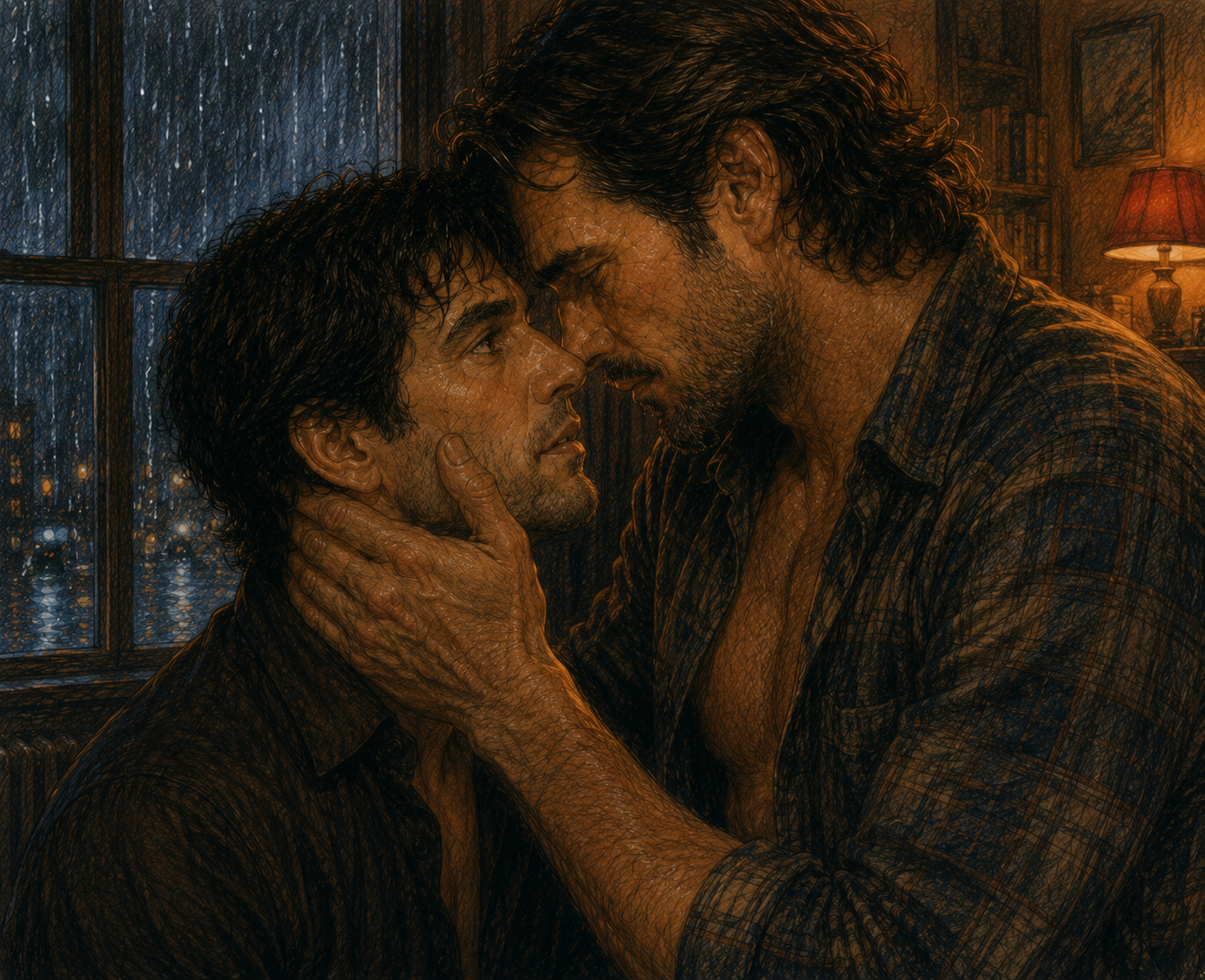
Before the Thunder Breaks (Part 1)
Two lonely men. One Tuesday barstool. One question brave enough to make them stay.
Before the Thunder Breaks (Part 1)
Two lonely men. One Tuesday barstool. One question brave enough to make them stay.
Mature audiences (18+)
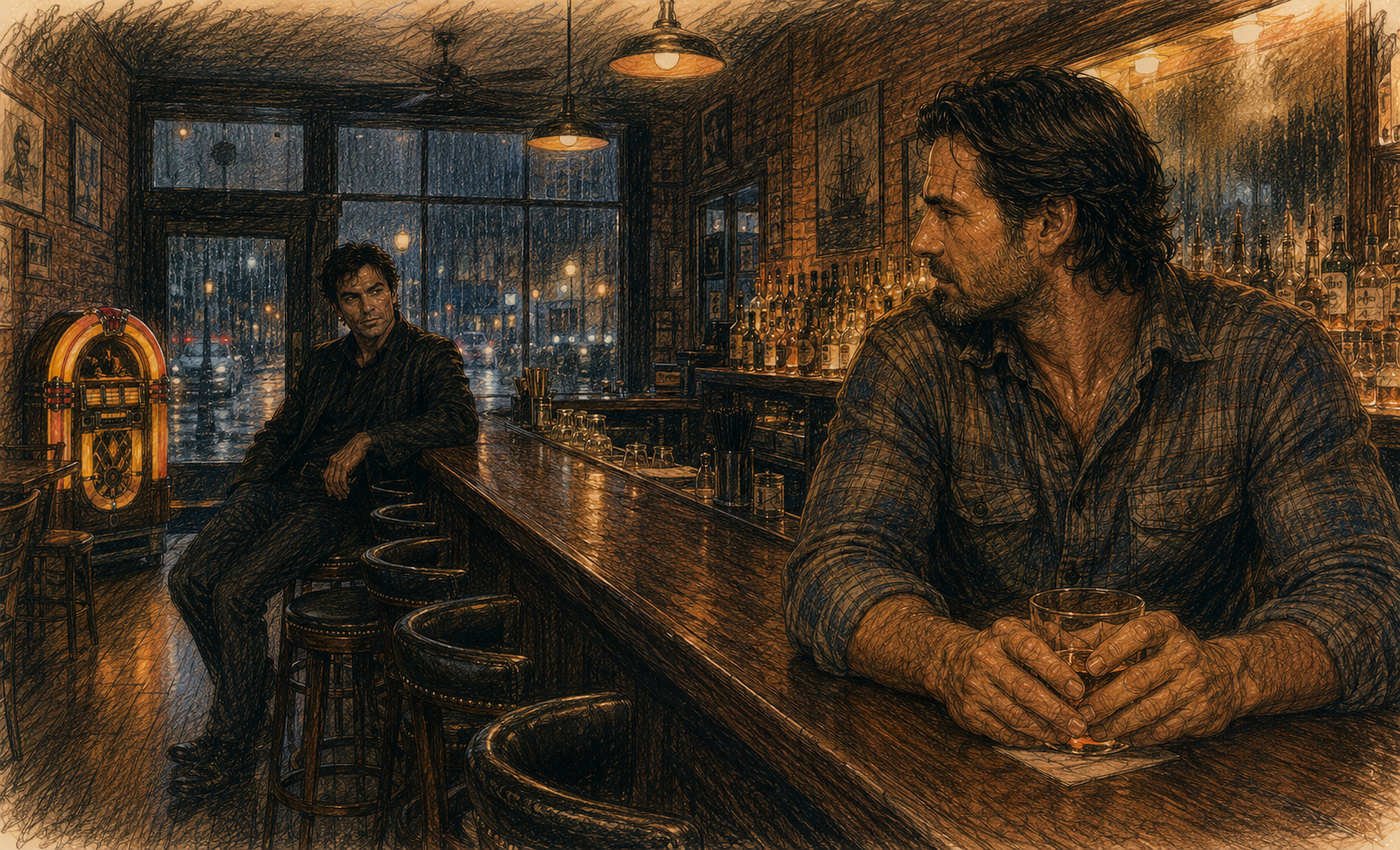
He writes other men’s desire for a living. He’s just forgotten how to live his own. A bar before the rain, a man who’s been on the same stool for eight months, and the first night in three weeks Eli Rowan doesn’t leave before he’s chosen.
The Bar Before Rain
Eli Rowan tasted endings before the first drop of rain hit the sidewalk.
They came metallic at the back of his tongue, the way weather sometimes announced itself before the sky bothered to darken. He paused outside McKenna’s with one hand on the door and the other in the pocket of a coat too warm for May, listening to the traffic hiss along wet pavement that was not wet yet.
Inside, the bar breathed amber light and old wood.
It was not trying to be charming. That was why it worked. Exposed brick held decades of smoke no city ordinance had ever fully removed. The mirror behind the bottles was fogged at the edges. The jukebox in the corner played the kind of song men pretended not to know until the second chorus took them by the throat. Glasses clinked. Low voices rose and fell. Somewhere near the back, someone laughed like he had earned it.
Eli almost left.
That had become his most reliable talent.
Leaving before he had to be chosen. Leaving before anyone asked what he wanted. Leaving before the answer could become visible on his face.
He wrote other men’s confessions for a living, or something close enough to it. Essays. Fiction. Ghostwritten fragments that arrived in his inbox at two in the morning from strangers who wanted their desire turned into something cleaner than memory. He had become very good at describing the moment a man surrendered to want.
He had become less good at surviving his own.
Three weeks in his apartment had proved that. Three weeks of takeout cooling beside a laptop, of writing bodies into rooms while his own forgot the uses of touch, of waking at four with one hand on the empty side of the bed and pretending he had reached there by accident.
So he stepped inside.
The man at the far end of the bar looked up.
That was all.
No smile. No invitation. No cinematic tilt of fate. Just a man lifting his eyes from a glass of whiskey and meeting Eli across forty feet of noise and low light.
Still, Eli stopped moving.
Pressure first. Then recognition.
Not of the man. He did not know him. But of the weather in him.
Dark hair, a little long at the collar. Broad shoulders under a flannel washed soft at the elbows. Stubble shadowing a sharp jaw. Hands wrapped around his glass like the whiskey was the only thing in the room prepared to stay.
A bruise of loneliness, already forming.
Eli took three steps toward the bar before his better judgment caught up.
Too late.
“You look like you’re thinking too hard,” the man said.
His voice carried without rising. Low. Rough at the edges. Not gravel and honey; Eli hated when writers wrote that. This was simpler and worse. A voice used to speaking over saws, traffic, wind off scaffolding. A voice that had learned not to ask for attention and got it anyway.
Eli kept his coat on. “Maybe I am.”
“Dangerous habit.”
“So is talking to strangers.”
The corner of the man’s mouth moved. “I was minding my business.”
“No, you weren’t.”
That earned him the first real look.
Gray-blue eyes, tired but not dull. A small scar split the left eyebrow, pale through dark hair. The mouth looked unused to softness and irritated by the possibility.
Eli sat two stools away.
Close enough to talk. Far enough to lie.
The bartender appeared with the silent efficiency of a man who had seen enough first mistakes to respect them. Eli ordered whiskey neat. The man at the end of the bar looked at his own glass, then back at Eli.
“Copycat,” he said.
“Research.”
“For what?”
“Whether I should stay.”
The man’s fingers tightened around his glass. One beat. Gone.
“And?”
Eli took off his coat and hung it over the stool. “Apparently, I’m still gathering data.”
The man laughed once into his whiskey.
It was not much of a laugh. Rusted at the hinge. But it changed his face enough that Eli wanted it again immediately, which was an error of judgment and possibly a medical condition.
“I’m Carter,” he said.
“Eli.”
They did not shake hands.
The space between them knew why.
Same Stool
Carter Vale had been coming to McKenna’s for eight months.
Eli learned that in pieces, because men like Carter did not hand over the center of a wound in one clean sentence. They circled it first. Said the beer was cheaper than therapy. Said the bartender knew not to ask questions. Said Tuesdays were quieter than Fridays. Said he liked the corner stool because nobody could come up behind him without appearing in the mirror.
Eli listened.
Listening was the habit that had ruined and saved him in equal measure.
“You always sit there?” he asked.
Carter looked at the worn groove in the bar where his glass rested. “Most nights.”
“Most?”
“Tuesday. Thursday. Saturday.”
“That’s not most.”
“It’s enough.”
“For what?”
Carter’s mouth tightened.
There it was. The first locked door.
Eli should have let it stay closed.
He took a drink instead. The whiskey burned clean down his throat, then settled warm beneath his ribs. “You don’t have to answer that.”
“I know.”
“But you want to.”
Carter looked at him sharply. “Do you do that on purpose?”
“What?”
“Make it sound like not answering is an answer.”
Eli smiled despite himself. “It usually is.”
Carter studied him for a long moment, then looked away first. “Had a man.”
The bar kept moving around them. Someone ordered gin. Someone swore at the basketball game on the television. A bus hissed to a stop outside and breathed passengers onto the sidewalk.
Eli heard all of it because Carter had gone still.
“Three years,” Carter said. “I thought we were building something. He was killing time until something cleaner came along.”
Cleaner.
Not better. Not richer. Cleaner.
Eli marked that, then hated himself for marking it like craft.
“When?” he asked.
“Last March.”
“That’s a long time to keep bleeding.”
Carter’s jaw worked. “You always this cheerful?”
“Only with men who look like they came here to be punished by furniture.”
The laugh came again. A little more of it this time.
Then it left.
“He wrote a note,” Carter said. “Left it on the kitchen counter. Two lines. ‘I’m sorry. You deserve better.’ Took the good knives.”
Eli winced. “The knives feel personal.”
“They were mine.”
“Then very personal.”
Carter’s hand moved over his glass. Scarred knuckles. Callused fingers. A small white mark at the base of the thumb that looked like an old burn. Builder’s hands, maybe. Or demolition. Something that required knowing what weight could do.
“I kept thinking I’d get over it,” Carter said. “That’s what people say, right? Give it time.”
“People say a lot when they don’t know what else to do with your pain.”
Carter looked at him then.
Too directly.
Eli felt the look land in places he had not meant to expose. The three weeks alone. The laptop glow. The bed. The unread texts. The small, pathetic ceremony of cooking for one and plating it like he had guests.
“What about you?” Carter asked.
“What about me?”
“You look like a man who knows the map.”
Eli traced the rim of his glass. “I write maps. I don’t follow them.”
“What do you write?”
That should have been easy. It was his favorite deflection. Career as mask. Work as personality. The safe answer was essays. The safer answer was fiction.
Instead, Eli told a version closer to the bone.
“Men’s stories,” he said. “The things they say when the room is dark enough. Desire. Grief. The ugly little truths that get prettier once they’re sentences.”
Carter’s mouth curved. “So you’re dangerous.”
“Only on deadline.”
“No.” Carter’s eyes dropped to Eli’s mouth, stayed there a second too long, then came back. “Dangerous because you listen like you might actually remember.”
The sentence moved through Eli slowly.
He had not expected Carter to be good with words. That was prejudice, probably. Or defense. Easier to want a body if the body did not talk back with that kind of accuracy.
“I remember too much,” Eli said.
“Yeah.” Carter looked down into his whiskey. “Me too.”
The jukebox changed songs. Thunder moved far off, too low to be dramatic yet. The first rain tapped the front window, tentative as fingers.
Carter looked toward the sound.
Eli watched his profile: the scar, the stubble, the tired set of his mouth. The kind of face that did not ask to be softened and therefore made softness feel like a trespass.
“You said you were deciding whether to stay,” Carter said.
“I did.”
“Have you decided?”
Eli should have told the truth carefully.
He did not.
“I decided when you laughed.”
Carter went quiet.
Not empty quiet. Full quiet. The kind that held itself together with both hands.
“That’s a stupid reason,” Carter said.
“Yes.”
“You don’t know me.”
“No.”
“I could be terrible.”
“You probably are, in specific ways.”
That startled the third laugh out of him, and this one was almost whole.
Eli smiled into his glass.
There it was. The comedy before the fall.
Carter set his whiskey down. “If I ask you to come home with me, what happens?”
The question should have sounded like a line.
It did not.
It sounded like a man standing at the edge of a bridge, asking whether the river was deep enough to survive the jump.
Eli turned on the stool to face him fully.
“My first answer is yes,” he said. “My second answer is that I don’t do casual well anymore.”
Carter’s throat moved.
“Good,” he said.
“You don’t know what I mean.”
“I know what casual means.”
“That’s not what I mean.”
Carter waited.
Eli hated him a little for being able to.
“I mean I’m tired,” Eli said. “Of being a body someone borrows because the night got long. Of pretending I’m fine when I wake up alone. Of writing tenderness better than I receive it.”
The last sentence embarrassed him enough that he looked away.
Carter reached across the empty stool between them.
Slowly.
His hand stopped on the bar first, giving Eli the chance to move. When Eli did not, Carter covered Eli’s hand with his own.
Calluses. Heat. The faint roughness of a man who worked with material that fought back.
“I don’t want to borrow you,” Carter said.
The words were too much.
Eli looked at their hands because looking at Carter would have been reckless.
“What do you want?” he asked.
“To not send you home.”
“That’s not an answer.”
“It’s the only one I trust right now.”
Thunder moved closer.
The bartender looked over, took in the unpaid tab, the weather, the two men with their hands on the bar, and made the wise decision to polish a glass with religious focus.
Carter stood and put enough cash down to end the conversation with the register.
Then he offered Eli his hand.
This time, Eli took it.
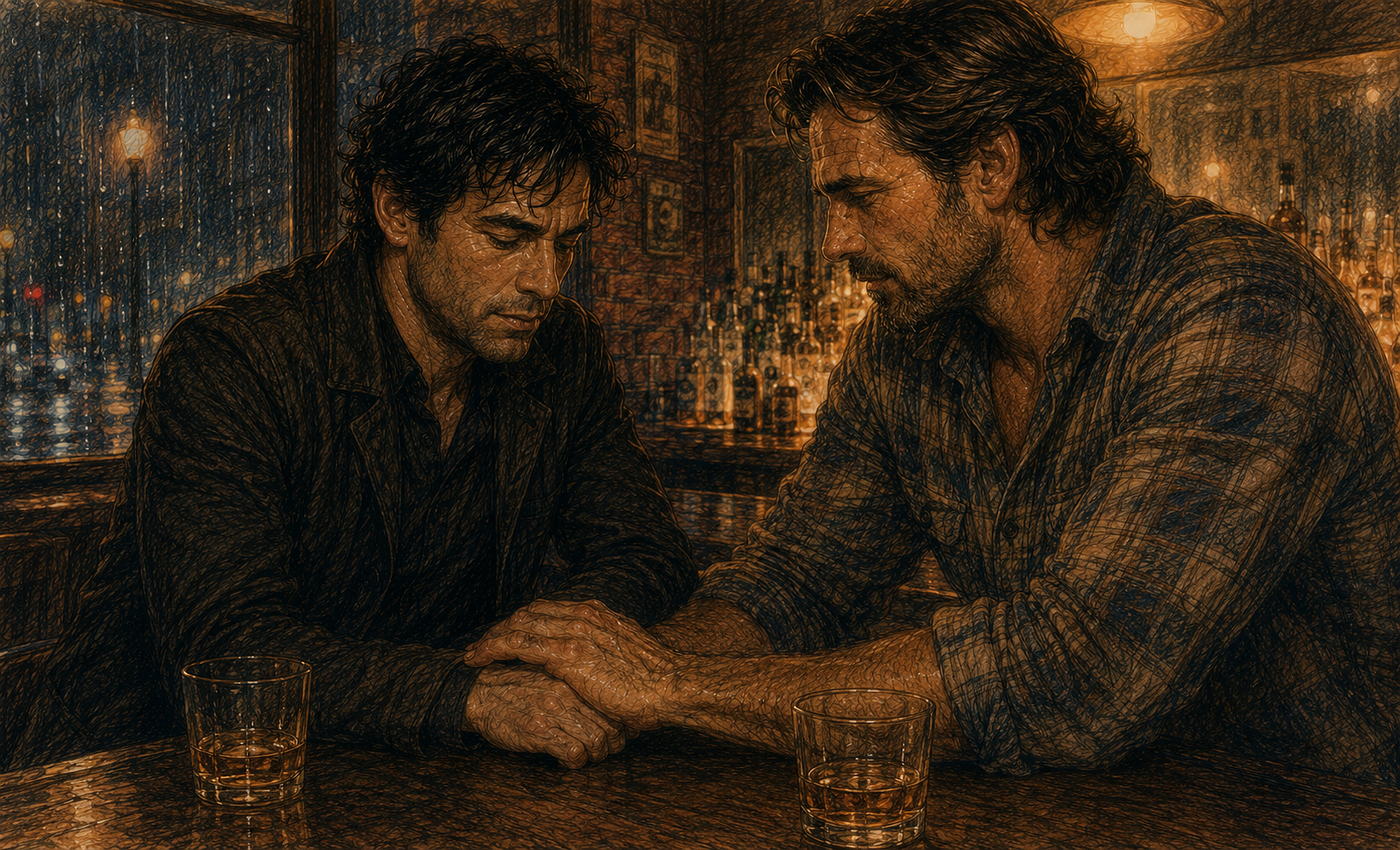
The walk-up is three flights. The storm is almost here. And Eli Rowan — who writes the moment a man surrenders better than anyone — is about to find out whether he can stay inside his own. Part 2 is the storm, the scar, and the morning after. Subscribe for the rest, and for the whole Working Men collection.
[Subscribe to read Part 2 →]
Thanks for reading! If you’re enjoying these stories: 👏 Clap for the article 📝 Leave a comment ✍️ Highlight something you liked ✌️ Follow me for upcoming articles. All of these actions help these stories reach new readers.
메타데이터
- post_id
- cdd644cce605
- slug
- before-the-thunder-breaks-part-1-cdd644cce605
- url
- https://medium.com/@nofadetoblack/before-the-thunder-breaks-part-1-cdd644cce605
- canonical_url
- https://medium.com/@nofadetoblack/before-the-thunder-breaks-part-1-cdd644cce605
- author_url
- https://medium.com/@nofadetoblack
- status
- ok
- fetched_at
- 2026-06-18 07:02:39