BRC-2.0 and the Rise of proBTC: Building Liquidity for Bitcoin DeFi
Introduction: Activating Bitcoin DeFi
BRC-2.0 and the Rise of proBTC: Building Liquidity for Bitcoin DeFi
Introduction: Activating Bitcoin DeFi
The launch of CatSwap, the first AMM operating on BRC-2.0, signals a turning point: Bitcoin-native tokens can now trade on a Uniswap-style DEX, secured by Bitcoin’s proof-of-work.
At the heart of this transformation is proBTC, a wrapped version of Bitcoin that serves as the liquidity backbone for DeFi in the BRC-2.0 ecosystem. Though Best in Slot was the first to adopt proBTC as their wrapper, proBTC is not created or backed by them.
This raises critical questions: how does proBTC function, how decentralized is it in reality, and how does it compare to Ethereum’s WBTC? Let’s explore.
[embed]
Why Bitcoin Needs proBTC under BRC-2.0
Bitcoin’s UTXO model offers unmatched security and finality, but it lacks native support for smart contract logic. Protocols like BRC-20 and now BRC-2.0 allow tokenization of assets (ORDI, SATS, etc.), but they cannot directly interact with raw BTC.
That’s where wrapped assets become essential. Just as Ethereum uses WETH to enable ETH to participate in smart contracts, Bitcoin DeFi now uses proBTC to bring BTC into a programmable domain. Without wrapping, BTC’s over $1T of liquidity could never flow into AMMs, borrowing/lending, or composable DeFi primitives.
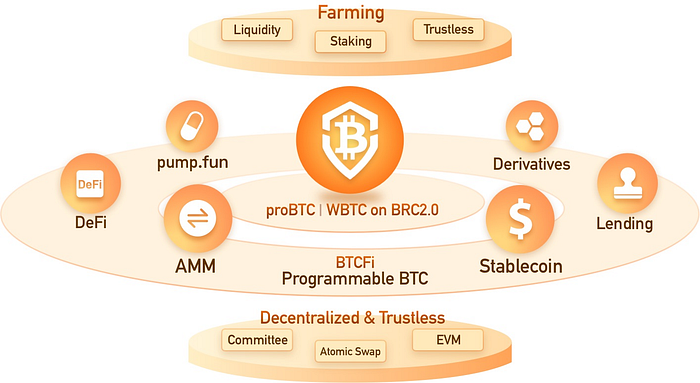
How proBTC Works: Bitcoin’s Wrapped Liquidity Backbone
According to its whitepaper, proBTC (not issued by Best in Slot) is the first decentralized wrapped BTC for BRC-2.0. It’s pegged 1:1 with native BTC and uses advanced cryptography to minimize trust.
How it works:
- Wrapping: Users send BTC to a TSS (Threshold Signature Scheme) address. A committee of nodes, using distributed key shards, mints an equivalent amount of proBTC on BRC-2.0.
- Unwrapping: Users burn proBTC → committee signs a BTC transaction → native BTC is released back.
- Security: Keys are split across many nodes (via DKG & MPC). No single node holds the full private key. Nodes must stake collateral and face slashing penalties for misbehavior.
- UX: proBTC looks and acts like any other BRC-2.0 token, so it can plug into AMMs, lending protocols, and stablecoins.
In short: proBTC turns BTC into a programmable asset inside BRC-2.0.
Is proBTC Really Decentralized? Strengths & Risks
✅ Strengths
- No single custodian → private key is never whole, only shards exist.
- MPC signatures are indistinguishable from normal Bitcoin signatures.
- Slashing incentives discourage bad behavior.
- Rotating node committees reduce long-term collusion risk.
⚠️ Risks
- Still relies on committees → trust is distributed, not eliminated.
- Governance challenges: who selects/rotates nodes?
- Economic security tied to collateral, not pure Bitcoin consensus.
- Wrapping/unwrapping latency (confirmations + MPC coordination).
So while proBTC is more decentralized than WBTC, it’s not fully trustless.

proBTC vs WBTC

proBTC is built for BRC-2.0 → faster adoption. WBTC could arrive later, but it would require extra bridges and complexity.
Why CatSwap Chose proBTC
CatSwap needed a BTC-backed asset to serve as the base pair in its pools. proBTC is the obvious first choice:
- Compatible with BRC-2.0 contracts.
- Marketed as “decentralized wrapped BTC.”
- Avoids the friction of bringing WBTC across chains.
This makes proBTC the default liquidity backbone for early Bitcoin DeFi apps.
What to Watch Next
- TVL growth: How much BTC actually wraps into proBTC?
- Node governance: Who runs the committee — and how decentralized is it in practice?
- Audits: Formal code reviews and penetration testing are critical.
- WBTC integration: Will bridges emerge to connect WBTC liquidity, or will proBTC dominate natively?
The answers to these questions will define the security and adoption curve of BRC-2.0 DeFi.
My Take as a Builder: A Necessary First Step
I’ve spent years building on Bitcoin via Stacks and Ordinals. Wrappers have never been my favorite model — they always introduce some trust.
But here’s the reality: without wrapping, Bitcoin liquidity cannot enter DeFi. proBTC is the best attempt so far to do this in a decentralized way.
If BRC-2.0 succeeds, it won’t be because purists accept wrappers. It will be because users and builders embrace programmability, and liquidity follows.
A new Bitcoin Era
CatSwap + proBTC mark the beginning of a new era: Bitcoin with AMMs, stablecoins, lending, and DeFi apps — secured by proof-of-work, powered by wrapped liquidity.
It’s not perfect. It’s not trustless. But it’s real, and it’s live.
The question now is: will wrapped trust be enough to fuel the next wave of Bitcoin adoption?
Do you think Bitcoin DeFi will thrive with wrapped trust models like proBTC — or should we aim for fully native programmability? Let me know.
메타데이터
- post_id
- cdfb621b1eef
- slug
- brc-2-0-and-the-rise-of-probtc-building-liquidity-for-bitcoin-defi-cdfb621b1eef
- url
- https://coinsbench.com/brc-2-0-and-the-rise-of-probtc-building-liquidity-for-bitcoin-defi-cdfb621b1eef
- canonical_url
- https://coinsbench.com/brc-2-0-and-the-rise-of-probtc-building-liquidity-for-bitcoin-defi-cdfb621b1eef
- author_url
- https://medium.com/@moonsat
- status
- ok
- fetched_at
- 2026-06-09 15:37:30