What Are RFID Tags? A Practical Guide for Industrial Applications
Many companies begin an RFID project by asking a simple question: what is an RFID tag?
What Are RFID Tags? A Practical Guide for Industrial Applications
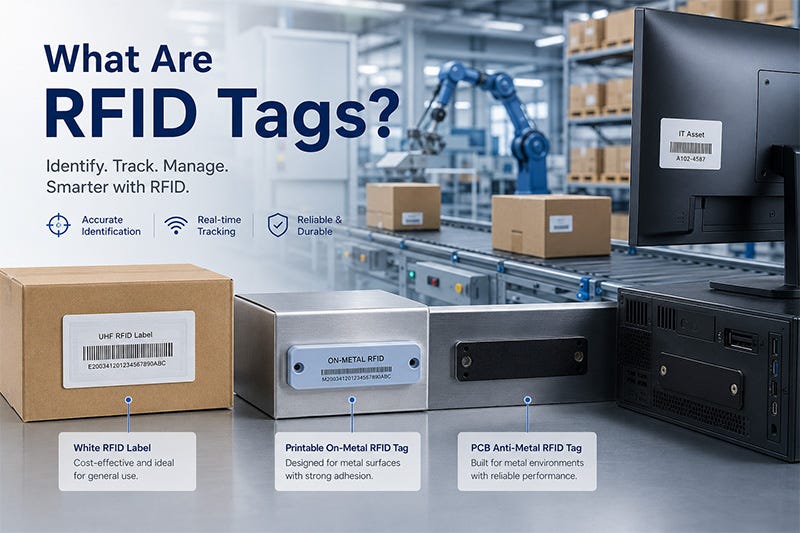
UHF RFID tags used in warehouse and industrial asset management
Many companies begin an RFID project by asking a simple question: what is an RFID tag?
The basic answer is easy. An RFID tag is an electronic identification device that stores data and communicates with an RFID reader through radio frequency signals. In a real industrial project, however, the answer is more practical. An RFID tag is the physical identity of an asset, carton, pallet, tool, medical device, production carrier, or component.
If the wrong tag is selected, even a good RFID reader and antenna may not deliver stable reading results. This is why RFID tag selection should not only be based on price or advertised read distance. It should also consider the surface material, installation method, reader power, antenna placement, tag orientation, interference, and testing conditions.
Infowise RFID works with UHF RFID hardware for industrial data capture applications, including RFID fixed readers, RFID handheld readers, RFID modules, RFID antennas, and RFID tags. From an engineering perspective, the tag is one of the most important parts of the system.
What Is an RFID Tag?
An RFID tag is usually made of a chip, antenna, and outer material or housing.
The chip stores identification data, such as EPC memory and TID information. The antenna receives and transmits radio frequency signals. The outer material protects the tag and determines where it can be installed.
In industrial applications, RFID tags are commonly attached to:
- Warehouse cartons
- Pallets
- IT assets
- Metal equipment
- Medical devices
- Production tools
- Automotive components
- Library items
- Logistics packages
A complete RFID system usually includes RFID tags, RFID readers, RFID antennas, software middleware, and a third-party management system. Infowise RFID provides RFID hardware products and data capture devices that can support API or SDK integration with ERP, WMS, MES, or asset management systems through project integration.
How RFID Tags Work

How RFID tags communicate with RFID readers and antennas
RFID tags communicate with readers through radio frequency signals.
The RFID reader sends RF energy through the antenna. When the tag enters the reading field, it receives the signal. For passive RFID tags, the tag does not have a battery. It uses the energy from the reader antenna to activate the chip and send stored data back to the reader.
This is why passive RFID tags are widely used in warehouse, logistics, asset, and production applications. They are generally smaller, easier to deploy, and more cost-effective than active tags.
Active RFID tags have their own battery and can support longer-distance transmission, but they are usually larger, more expensive, and require battery maintenance. For many industrial identification projects, passive UHF RFID tags are the more practical starting point.
Main Types of RFID Tags
RFID tags can be classified by power source, frequency, material, and installation environment.
Passive RFID tags are powered by the reader signal. They are often used for inventory, logistics, asset management, and production line tracking.
Active RFID tags contain batteries and are used when longer range or special monitoring is required.
UHF RFID tags are widely used in industrial and logistics projects because they can support longer reading distances and multi-tag reading. Common UHF working frequency options include 865–868 MHz and 902–928 MHz, depending on regional requirements.
RFID labels are usually printable adhesive tags. They are suitable for cartons, packaging, documents, warehouse goods, and non-metal assets.
Anti-metal RFID tags are designed for metal surfaces. Metal can detune or block standard RFID labels, so anti-metal tags use special structures or materials to improve reading stability on metal equipment.
RFID Tags for Industrial Environments

Anti-metal RFID tag deployment for metal asset tracking
In industrial environments, the installation surface is often more important than the tag type name.
A standard RFID label may work well on paper cartons or plastic boxes. The same label may perform poorly when attached directly to a metal cabinet, metal tool, server, or automotive component. In this case, an anti-metal RFID tag or printable on-metal RFID label is usually required.
Liquid can also affect RFID performance. Items containing water, chemicals, or liquid products may reduce read stability. Tag placement and antenna direction should be tested before bulk deployment.
Reader power and antenna placement also matter. Increasing reader power is not always the correct solution. If the antenna angle is wrong, if the tag orientation is inconsistent, or if metal reflection creates blind spots, the system may still have missed reads.
This is why practical RFID deployment usually requires sample testing in the real environment.
How to Choose the Right RFID Tag

RFID tag selection guide for industrial applications
A useful RFID tag selection process should begin with the application environment.
First, check the surface. Is the tag being attached to paper, plastic, glass, metal, fabric, or painted equipment?
Second, check the required read distance. A datasheet value is only a reference. Actual performance depends on reader power, antenna gain, installation angle, tag direction, and surrounding interference.
Third, confirm the frequency. UHF RFID tags may support 865–868 MHz or 902–928 MHz depending on the country or region.
Fourth, confirm chip and memory requirements. Many industrial UHF RFID tags use EPC memory and TID memory for identification. If more user memory is required, this should be confirmed before ordering.
Fifth, check the environment. Temperature, dust, water, oil, impact, cleaning process, and outdoor exposure may all affect tag selection.
Finally, test the tag with the actual reader, antenna, installation position, and workflow.
Example RFID Tag Options from Infowise RFID
Infowise RFID provides several UHF RFID tag options for different industrial applications.
The GZY-P9525 UHF RFID PCB tag is designed for industrial asset and equipment identification. Its listed model information includes GZY-P9522, size 95 mm × 25 mm × T3 mm, FR4 PCB material, black color, EPC Class1 Gen2 and ISO 18000–6C protocol, and working frequency options of 865–868 MHz and 902–928 MHz customized. Chip options include NXP Ucode 8 and Ucode 9. The reference read distance is 0.1–10.5 m depending on reader performance. It supports adhesive or embedded installation and has an IP68 rating. Typical applications include IT asset management, production line management, medical equipment management, and fixed asset management.
The GZY-R7030 UHF RFID printable label is suitable for metal surface applications. It has a size of 70 × 30 × 1.25 mm and uses PET, aluminum foil, and foam materials. It supports EPC Class1 Gen2 and ISO 18000–6C, with 865–868 MHz and 902–928 MHz customized frequency options. Chip options include NXP Ucode 8, Ucode 9, and Impinj M730 customized. The reference read distance is 1–7 m on metal surfaces depending on reader performance. Applications include IT asset management, warehouse management, medical laboratory equipment, and automotive component tracking.
The GZY-4418 UHF RFID label is a compact RFID label for asset, library, logistics, and warehouse management. Its size is 44 × 18 × 0.34 mm. It uses coated paper or PET material and supports EPC Class1 Gen2 and ISO 18000–6C. The reference read distance is 1–4.5 m depending on reader performance. It has an IP65 rating and supports optional logo printing, serial number printing, and encoding.
Final Engineering Note
RFID tag selection is not just a purchasing decision. It is a deployment decision.
The right tag should match the asset material, reading distance, antenna position, reader power, frequency region, installation method, and operating environment. Before large-scale deployment, sample testing is strongly recommended.
For industrial RFID projects, stable performance usually comes from matching the right RFID tag, RFID reader, RFID antenna, and installation method together.
Infowise RFID provides UHF RFID readers, RFID antennas, RFID tags, Android RFID handhelds, RFID modules, and industrial terminals for RFID data capture applications. The hardware can support API and SDK integration for connection with third-party systems through project integration.
메타데이터
- post_id
- ce01d70f2c66
- slug
- what-are-rfid-tags-a-practical-guide-for-industrial-applications-ce01d70f2c66
- url
- https://medium.com/@Infowise-rfid/what-are-rfid-tags-a-practical-guide-for-industrial-applications-ce01d70f2c66
- canonical_url
- https://medium.com/@Infowise-rfid/what-are-rfid-tags-a-practical-guide-for-industrial-applications-ce01d70f2c66
- author_url
- https://medium.com/@Infowise-rfid
- status
- ok
- fetched_at
- 2026-06-21 07:44:09