The Boys Who Claimed They Captured a Palm-Sized UFO in Japan (1972) — Kera Incident (Part 5/6)
Mystery Japan Presents: The Unexplained Japan Files Case File #001 — The Kera Incident (Part 5)
The Boys Who Claimed They Captured a Palm-Sized UFO in Japan (1972) — Kera Incident (Part 5/10)
Mystery Japan Presents: The Unexplained Japan Files Case File #001 — The Kera Incident (Part 5)

A palm-sized “UFO” vanishes — and the boys’ story should have ended in a quiet rice field. Instead, it reached two comet hunters, then a late-night TV director, and began spreading across Japan. Part 5 follows the exact pivot point: the moment a local rumor becomes a national case file.
Previously (Part 4): The boys kept catching the palm-sized object — only to lose it again — until it finally vanished for good. Read Part 4 here:
1. Tsutomu Seki and Koichi Ike — The Two Men Who Carried the Kera Incident “Outside”
After the palm-sized UFO vanished for the last time, the boys’ story seemed to hit a dead end.
Adults didn’t believe them. Going to the police might only invite laughter. For all anyone knew, the incident was destined to remain a strange episode confined to the rice fields of Kera.
But not long after, the situation shifted.
Word of the Kera Incident reached two well-known comet hunters of the era: Tsutomu Seki and Koichi Ike. Their involvement marked a turning point. What was on the verge of being dismissed as “kids’ mischief” began to be treated as something worth documenting — something that could travel beyond the village and into the wider public record.
In Part 5, we follow that pivot: the moment the Kera story begins to spread nationwide. We start with Seki.
Seki, a Kochi-born astronomer, was widely recognized for his discoveries of comets and asteroids. In his own writings, he also notes that he independently investigated and evaluated reports of unidentified flying objects (UFOs) in and around Kochi.

Tsutomu Seki
In his 1973 book Seeking Unknown Stars, the Kera Incident appears in a consolidated account under the heading “A Flying Saucer That Fell in Kera Village.”

Seki, Tsutomu. (May 1973). Seeking Unknown Stars. Sankeishobo.
This is the first time the boys’ closed, private experience connects to an “outside” record. From this moment on, the Kera Incident begins to change shape.
2. The Day They Called Seki’s Radio Show — The Boys’ First Contact
The boys decided to call Tsutomu Seki’s radio program.
According to Seki, in 1972 he appeared on a midday show on Kochi Broadcasting. By coincidence, one of the nine boys was a regular listener. Maybe this man will actually hear us out, they thought.
They chose Sadao Fujiwara to call in on everyone’s behalf. The timing matters: it was roughly ten days after the day they “lost sight of” the palm-sized UFO for the last time. If that final disappearance was on September 22, 1972, then the call may have come around Saturday, September 30 (the date is an estimate).
The producer’s message
Sadao’s timing, however, was unlucky. When he called, Seki himself was on air.
A female staff member — described as the producer — answered the phone and passed Seki a handwritten message. The memo summarized the boys’ account roughly as follows:
- Near the end of summer vacation, in the rice fields of the Kera area, they had picked up something like a “flying saucer?” shaped like a hat.
- About 20 centimeters in diameter.
- It sometimes glowed in the evening.
- It would occasionally jump up into the air.
- Since September, they had caught it many times and tried to show it to a teacher at school, but it would slip away before they realized it.
- What, exactly, was it?
Seki later wrote that even after reading the memo, he couldn’t immediately make sense of what he was looking at. But the staff told him something else: several middle-school boys were gathered at Sadao’s house, waiting by the phone for a call back.
Seki calls Koichi Ike
As soon as Seki left the station, he contacted Koichi Ike, a fellow observer living in Tosa City, and asked him to look into it.

Koichi Ike
Ike had a strong interest in UFO reports as well, and Seki seems to have thought of him first as someone who would take the matter seriously. That same evening, Ike headed to Kera and listened to the boys’ story directly.
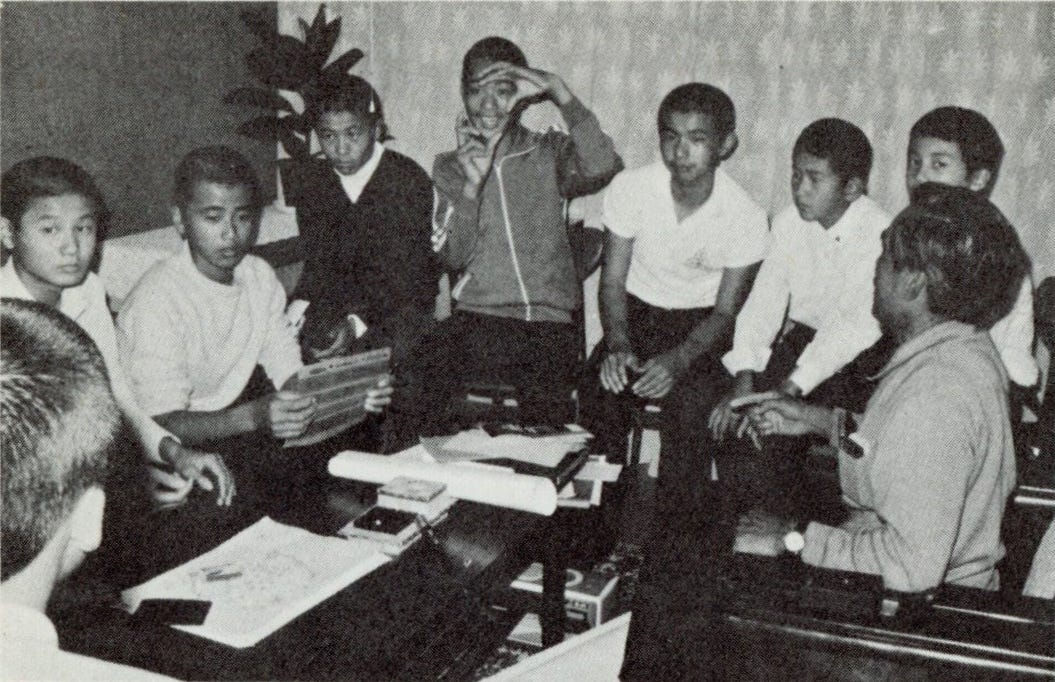
Students from Kera Junior High describe the appearance of the “saucer,” referring to various documents and materials (Koichi Ike, far right).
Ike’s face when he returned
By nightfall, everything changed.
Seki had nearly put the day out of his mind — until Ike returned from the interviews looking unmistakably pale. It has been reported that as Ike listened to the boys, he felt a chill run down his spine.
This didn’t sound like someone enjoying a spooky story. If anything, it reads more like a reaction to something immediate — something uncomfortably close.
And this is the key point: in the Kera Incident, Ike became the first adult to sit down and truly listen to the boys — at a moment when their account was still being brushed aside as “kids’ mischief.”
3. Seki’s Starting Point Was Doubt — And the Hardest Detail Was the “Glow”
Seki began by assuming it wasn’t extraordinary
As Koichi Ike continued interviewing the witnesses, materials began to accumulate on Tsutomu Seki’s side: recorded testimonies from the boys and photographs from the scene.
Ike, who already had a strong interest in UFO reports, went to Kera, listened carefully, and tried — within the limits of what was possible — to check details against reality.
Seki’s starting point was different.
In his own account, he describes a more skeptical approach: begin with ordinary explanations and eliminate them one by one. His first suspicion was simple — a prank.
He imagined a scenario like this: someone tosses a large object — something like an oversized ashtray — into the rice fields at night, then claims it “flew” just to shock a friend. Making an object appear as if it had fallen from the sky, Seki thought, wasn’t necessarily impossible under the right conditions.
And yet, he also wrote that the Kera Incident contained several elements that were difficult to dismiss as mere mischief or suggestion.
The biggest problem was that it lit up
The first point Seki singled out was the claim that the object emitted light.
The boys who said they saw — and even captured — the object in the rice fields at night repeatedly described it as glowing. According to their testimonies, the light was blue, or a slightly yellowish blue. More importantly, it wasn’t constant: it blinked at regular intervals.
They even said they used that light as a guide — walking through the paddies, tracking it, and eventually catching it.
What makes this detail more troubling is the possibility that the glow wasn’t witnessed only by the boys.
One account says that when Toshiaki Kuzuoka brought the object home in his backpack, his mother, Aiko Kuzuoka, noticed something inside flickering like a firefly.
That’s harder to file away as “just kids talking.”
This, precisely, is why Seki treated the Kera Incident as something to be examined — rather than something to be waved off.
4. Seki’s Nighttime Field Check — When “Light” in the Rice Fields Can Fool You
Seki went to Kera at night
One night in mid-October, Tsutomu Seki traveled to the Kera site himself.
What had the boys actually seen? If there was room for misperception, he reasoned, the clues might still be embedded in the landscape — especially after dark.
That night, however, the boys were away on a school trip. With no witnesses to guide him, Seki walked the alleged sighting area alone, tracing the paths through the rice-field ridges.
Why there was no one out there
One detail in Seki’s account stands out: how quiet the place was at night.
He notes that the fields around the sighting area were locally associated with stories of Shibaten — a river-dwelling yokai, often compared to a kappa, used in Kochi and Tokushima as a reason to avoid certain roads after dark.

Shibaten is a yokai from Kochi and Tokushima — often described as kappa-like — resembling a small, child-sized figure (about one meter tall) covered in shaggy hair. It is said to appear along riverbanks and embankments.
In practical terms, the folklore matched what he observed. Seki wrote that even after walking the narrow paths for about thirty minutes, he didn’t pass a single person.
A landscape with no one around at night can make an event feel more isolated — and, perhaps, easier to misinterpret in the moment.
The site offered plenty of “raw material” for misreading light
What Seki came away with was not a sense that something “suspicious” was lying in the fields, but that the conditions for optical confusion were unusually strong.
For one thing, a thin layer of leftover water in the paddies could catch distant city lights — neon glow — making patches of the field appear faintly blue or reddish. In a dark rice field, even that would stand out.
More significant, he focused on a golf driving range located partway through the area. Multiple powerful lamps mounted high above the fencing illuminated the surroundings intensely.
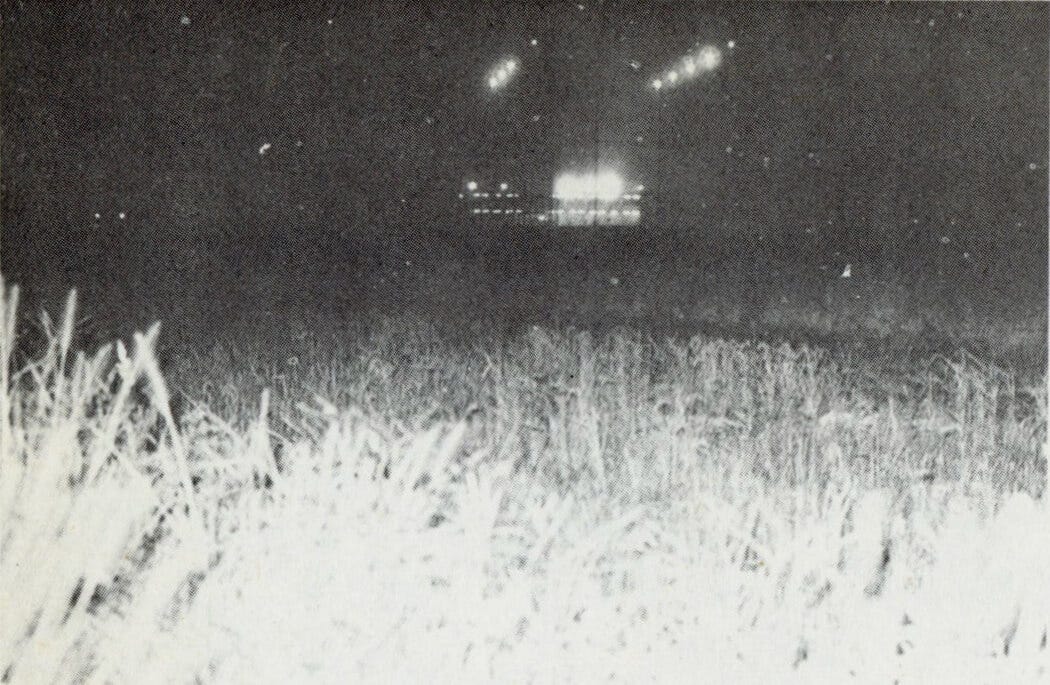
Nighttime view of the fields in Kera. Tsutomu Seki described this image as “a field in Kera Village where a mysterious saucer was reportedly seen several times.” Powerful floodlights from a distant golf driving range are visible in the background.
Under those lights, dew-wet grass could reflect strongly enough that the ground sometimes looked strangely bright. It was also harvest season, with farm tools scattered around — objects that, at a distance and in low light, could easily distort into the wrong shapes. Against strong backlight and glare, even a tool’s shadow might read as “something standing there.”
Seki’s provisional take: floodlights and moving shadows
Seki reported that he found no decisive physical evidence during his walk. Still, he offered a working hypothesis: the driving range’s intense lighting may have been the core ingredient behind at least some of the sightings.
From evening into night, birds move across the sky. Their shifting silhouettes — or momentary reflections — caught in those lights could have appeared, at a glance, like a “flying object,” he suggested.
Of course, this alone doesn’t account for everything the boys described — objects that “vanish,” “reappear,” or “slip out of a bag.” But at minimum, Seki believed he had confirmed something important on-site: the environment contained multiple conditions under which light could look strange, misleading, and alive.
That, in essence, is the backbone of his field report.
5. Interviews with the Boys and Their Parents — The Pattern on the Underside: “Waves and Plovers”
Seki meets the boys — and their families
After his nighttime walk-through of the site, Tsutomu Seki paid a visit to the home of Isamu Fujiwara, the father of Sadao Fujiwara.
There, Seki was finally able to speak directly with the nine middle-school boys said to have captured the “palm-sized UFO,” as well as with their parents. He asked them to recount the sequence of events from the beginning and then worked through the details point by point.
What stayed with him most was the boys’ demeanor. Rather than joking or trying to inflate the story, they seemed to be making a serious effort to describe what they believed had happened. Seki also noted that they were generally good students — and didn’t strike him as the type to casually invent a tale like this.
And above all, it was the sheer number of sketches — and the intensity with which they had drawn them — that gradually softened his guard.
The underside design: “waves and plovers”
One detail, in particular, caught Seki’s attention: a raised pattern on the object’s underside.
The motif appeared again and again in the boys’ drawings. It looked like a combination of wave crests and chidori — plovers — an arrangement reminiscent of traditional Japanese decorative designs.
Seki wrote that the moment he saw it, he felt a flash of recognition, as if he had encountered it somewhere before. He even describes a brief, involuntary image passing through his mind — something like a coastline with pine trees.
It wasn’t proof. Not yet. But the implication seemed clear to him:
If we can identify this pattern, we might get closer to what this thing actually was.
Somewhere around here, the Kera Incident begins to take on sharper edges — no longer just an odd village story, but something that, at least for Seki, warranted methodical attention.
Ike goes further: “There are no contradictions.”
Koichi Ike, meanwhile, reached a more assertive conclusion.
After repeated interviews, Ike stated that he found no major inconsistencies in the boys’ accounts. In his view, this wasn’t a story being assembled on the fly — it sounded like something they had genuinely experienced.
With that conviction, Ike published an article in an astronomy-related magazine arguing, in essence, that the object the boys captured was highly likely to have been a UFO.
At that point, the boys’ experience crossed a threshold: it began moving out of local rumor and family conversation — and into the realm of external record.
It was the first step in how the Kera Incident came to be known nationwide.
6. Onto National Television — 11PM and Junichi Yaoi
The Kera Incident crosses into TV
If Koichi Ike’s article helped push the case into an “outside” written record, the next force that carried it nationwide was television.
In time, Ike’s piece reportedly caught the attention of TV producers. Junichi Yaoi, then a director on Nippon TV’s late-night program 11PM, learned of the Kera Incident and began pursuing it as a story.

Junichi Yaoi
Hosted by Kyosen Ohashi, 11PM occasionally ran UFO and paranormal-themed specials a few times a year under the Monday slot often referred to as “Monday Eleven.”

Kyosen Ohashi
7. From 11PM to Thursday Special — When a Rumor Becomes a Program Segment
Yaoi went on to produce numerous documentary-style segments on UFOs and other unexplained phenomena across shows such as 11PM and Thursday Special, eventually earning nicknames like “the mystery director” or “the UFO director.”
He took an interest in the Kera Incident and decided to develop it as a television segment. In that process, three of the boys — Hiroshi Mori, Sadao Fujiwara, and Toshiaki Kuzuoka — were reportedly invited to a studio in Tokyo.
Yaoi continued interviewing people connected to the case, and the Kera Incident was ultimately introduced in a nationally broadcast UFO special on Thursday Special, aired on October 10, 1974.
This was the moment the story crossed a line: from local talk into a formal TV “case.”
8. “No Meaningful Discrepancies” — Yaoi’s Assessment, and Next Time: The Skeptical Lens
After completing his reporting, Yaoi is said to have offered an assessment along these lines:
Across the accounts of the nine boys, there were no conspicuous contradictions — and after weighing the available photos along with testimony from adults, he felt compelled to treat the boys’ experience as something that could not be dismissed out of hand.
Of course, television is not a courtroom, and it doesn’t get to deliver final verdicts.
But this was still a transformation. For the first time, the Kera Incident shifted from “a rumor in one area” into a story known across Japan.
And that’s not the end. Once something becomes nationally visible, the next phase is almost inevitable: a split between those who accept it — and those who doubt it.
Next time, we revisit the Kera Incident from the skeptical side.
Next (Part 6): The skeptical case — re-examining the Kera Incident from the “doubt” side.
References
- Yaoi, Junichi. (June 2006). Junichi Yaoi’s UFO Encyclopedia (矢追純一のUFO大全). Lyonsha. pp. 254–256.
- Seki, Tsutomu. (May 1973). Seeking Unknown Stars (未知の星を求めて). Sankeishobo. pp. 187–194.
- Yaoi, Junichi. (July 1978). Japan’s UFO Hotspots (全国UFO目撃多発地帯). Futabasha. pp. 272–277.
Author Profile
Haruto Rein, Ph.D. (羅院春人) Former quantum physicist turned independent writer and researcher. He writes Mystery Japan, a case-file series on Japan’s recorded anomalies — built from reports, documents, and testimony, with facts separated from inference and conclusions left to the reader. He also authored ToEST (Shinto philosophy in dialogue) and writes the Shinto Girl series on consciousness and “Spiritual Science.”
© 2025 Shinto Girl Project. Written by Haruto Rein, Ph.D. (羅院春人). All rights reserved. Unauthorized reproduction or distribution is prohibited.
메타데이터
- post_id
- ce1e3c6beaae
- slug
- the-boys-who-claimed-they-captured-a-palm-sized-ufo-in-japan-1972-kera-incident-part-5-6-ce1e3c6beaae
- url
- https://medium.otakupapa.net/the-boys-who-claimed-they-captured-a-palm-sized-ufo-in-japan-1972-kera-incident-part-5-6-ce1e3c6beaae
- canonical_url
- https://medium.otakupapa.net/the-boys-who-claimed-they-captured-a-palm-sized-ufo-in-japan-1972-kera-incident-part-5-6-ce1e3c6beaae
- author_url
- https://medium.com/@wotakupapa
- status
- ok
- fetched_at
- 2026-06-12 07:40:50