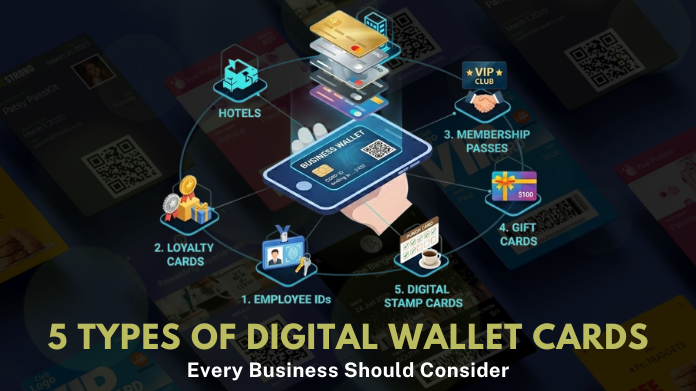
5 Types of Digital Wallet Cards Every Business Should Consider
Physical wallets are fading out. Customers today expect to tap, scan, or click — and businesses that haven’t adapted are already falling…
5 Types of Digital Wallet Cards Every Business Should Consider
Physical wallets are fading out. Customers today expect to tap, scan, or click — and businesses that haven’t adapted are already falling behind.
Digital wallet cards aren’t just about contactless payments. They cover loyalty programs, gift cards, memberships, business networking, and employee spending — all living inside the apps people already use every day. Understanding the different types helps you pick the ones that actually serve your business goals.
Here are the five worth knowing.
1. Loyalty and Rewards Cards
A digital loyalty card on someone’s phone is worth far more than a punch card in their pocket. It doesn’t get lost, forgotten, or thrown away.
When a customer adds your loyalty card to Apple Wallet or Google Wallet, you can send them a push notification when they’re near your store, alert them when they’re close to a free reward, or update their points the moment they make a purchase. No app download required. No paper. Just instant, relevant communication at exactly the right moment.
For any business where repeat customers are the goal — retail, restaurants, salons, coffee shops — this is one of the simplest and most effective ways to stay top of mind between visits.
2. Digital Gift Cards
Gift cards are already one of the highest-margin products a business can offer. Going digital makes them even better.
A digital gift card lives in a customer’s wallet app, ready to be used instantly. There’s nothing to lose, nothing to ship, and no delay between purchase and delivery. That makes them a perfect fit for last-minute gifting, which is when most gift cards actually get bought.
The other underrated benefit is customer acquisition. When someone sends your digital gift card to a friend, that friend shows up to your store or site with money already committed to spending there. That’s a warm introduction you didn’t have to pay for with ads.
3. Digital Business Cards
This one is still being overlooked by most companies, which means there’s a real opportunity for those who move on it now.
A digital business card stored in Apple Wallet or Google Wallet lets your team share contact details via a QR code, NFC tap, or a simple link. No printing, no running out at events, and no outdated information floating around after a team member changes roles or phone numbers. You update it once and every card reflects the change automatically.
For sales teams and client-facing roles, the bigger win is CRM integration. Many platforms now connect directly to tools like HubSpot or Salesforce, so every card tap becomes a lead automatically logged in your pipeline. A conversation at a trade show turns into a follow-up sequence without anyone manually entering a single detail.
4. Membership and Access Cards
If your business runs on memberships — gyms, co-working spaces, clubs, subscription services, healthcare clinics — a digital membership card solves problems you didn’t even know your customers were quietly frustrated by.
Check-in becomes faster. The card is always on their phone, always up to date, and the barcode or QR code can refresh automatically to prevent sharing or fraud. You can push notifications about upcoming renewals, exclusive member events, or tier upgrades without sending a separate email that gets buried.
The big advantage here is visibility. A physical card sits in a drawer. A digital membership card surfaces every time the customer opens their wallet. Their membership feels active and valuable, not forgotten — which directly reduces cancellations.
5. Prepaid and Virtual Payment Cards
This one serves two very different purposes depending on how you use it, and both are worth considering.
Internally, prepaid digital cards solve the expense management headache for businesses with employees, contractors, or field teams. Instead of reimbursement processes and paper receipts, you load funds onto a card that lives in the employee’s wallet. Spending is tracked in real time, limits can be set per person or per category, and the finance team has full visibility without chasing anyone down.
On the customer side, prepaid cards work well for promotional credits, incentive programs, and refunds. Instead of mailing a check or waiting on a bank transfer, you can instantly put money back into a customer’s wallet. It’s faster, more satisfying, and keeps the value connected to your brand rather than disappearing into their bank account.
Using More Than One
These card types work even better in combination. A retail brand can run a loyalty card and a gift card program side by side. A fitness studio can pair a membership card with loyalty rewards for class attendance. A B2B company can equip its sales team with digital business cards while using virtual prepaid cards for vendor payments.
The businesses getting the most out of digital wallets aren’t treating them as a single-purpose payment tool. They’re using them as a connected layer across customer experience, internal operations, and marketing — and that’s where the real advantage starts to show.
If you haven’t mapped out which of these card types fits your business model, now is a good time to start.
메타데이터
- post_id
- ce1e6fdaeffb
- slug
- 5-types-of-digital-wallet-cards-every-business-should-consider-ce1e6fdaeffb
- url
- https://medium.com/@thewalletgroup/5-types-of-digital-wallet-cards-every-business-should-consider-ce1e6fdaeffb
- canonical_url
- https://medium.com/@thewalletgroup/5-types-of-digital-wallet-cards-every-business-should-consider-ce1e6fdaeffb
- author_url
- https://medium.com/@thewalletgroup
- status
- ok
- fetched_at
- 2026-06-09 15:37:30