KLEIN BOTTLE
A curved surface looping through itself, like a bottle whose neck bends backwards and merges into its own body. But the Klein bottle is not…
KLEIN BOTTLE
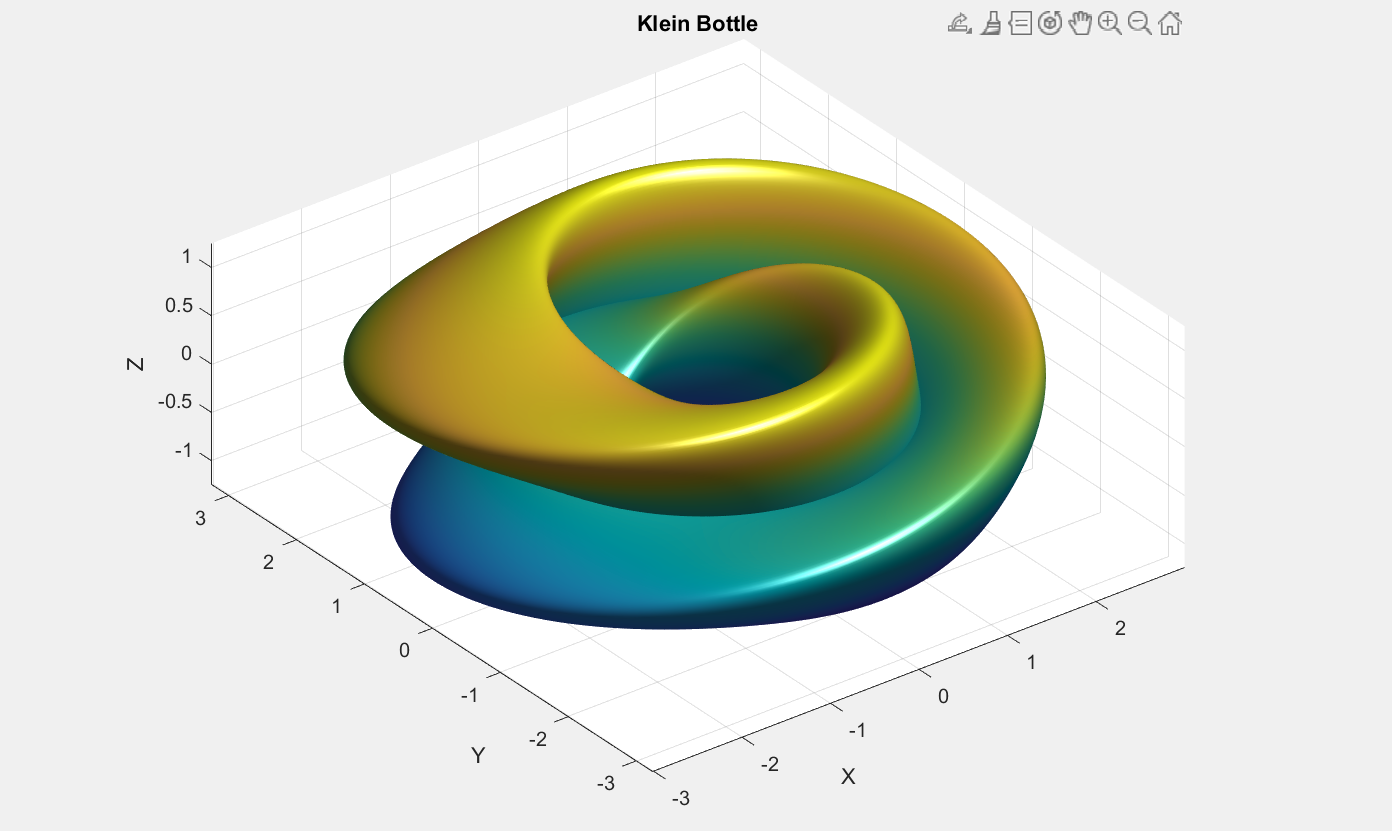
A three-dimensional visualisation of a Klein bottle. The self-intersection occurs because the surface is projected into ordinary 3D space.

A curved surface looping through itself, like a bottle whose neck bends backwards and merges into its own body. But the Klein bottle is not merely a strange geometric construction. It is one of topology’s most famous examples of a non-orientable surface, a structure that fundamentally breaks our ordinary understanding of space, boundaries, and dimensionality.
To understand why the Klein bottle is extraordinary, it helps to begin with a simpler object: the Möbius strip. A Möbius strip is created by taking a rectangular strip of paper, introducing a half-twist, and joining the ends. The result is a surface with only one side and one continuous edge. If an ant were to walk along the surface, it would eventually return to its starting point, having traversed both “sides” without ever crossing an edge.
The Klein bottle extends this idea further.
Imagine taking two Möbius strips and joining their boundaries together. The resulting surface has no edge at all, yet it still retains non-orientability. In simple terms, the Klein bottle has:
v no distinct inside or outside,
v no boundary,
v and no globally consistent orientation.
This makes it fundamentally different from ordinary three-dimensional objects like spheres or cylinders.
Mathematically, the Klein bottle is classified as a closed non-orientable two-dimensional manifold. “Two-dimensional” here does not mean flat; it means that locally, every small region behaves like a 2D surface. “Closed” means it has no edge or boundary. “Non-orientable” means that directional consistency breaks down across the surface.
One way to visualise this is through surface normals. On most surfaces, you can define a vector perpendicular to the surface at every point and move it continuously without contradiction. On a Klein bottle, this becomes impossible. If a normal vector is transported continuously around certain paths, it returns reversed. Orientation itself fails to remain consistent.
This strange property is deeply connected to topology, the branch of mathematics that deals with continuity and connectivity. In topology, objects are studied under transformations such as stretching, bending, and twisting, as long as tearing or glueing does not occur. A sphere and a cube are topologically equivalent because one can be continuously deformed into the other. The Klein bottle, however, occupies a far stranger category because its topology cannot be embedded in ordinary three-dimensional Euclidean space without self-intersection.
This point is crucial.
The familiar Klein bottle models shown in textbooks or glass sculptures are not true Klein bottles in the strict mathematical sense. They are three-dimensional projections of a four-dimensional object. The self-intersection visible in these models is not actually part of the topology; it is merely a consequence of forcing the surface into three dimensions. In four spatial dimensions, the Klein bottle can exist smoothly without intersecting itself.
This relationship with higher dimensions makes the Klein bottle especially important in geometry and theoretical physics. Many physical theories already rely on mathematics involving dimensions beyond the three we directly perceive. In string theory, for example, extra dimensions are compactified into complex topological spaces. While the Klein bottle itself is not a physical model of spacetime, non-orientable manifolds appear naturally in advanced theoretical frameworks.
In fact, the Klein bottle has a direct connection to string theory through what physicists call the “Klein bottle amplitude.” In certain formulations of closed string theory, Klein bottle topologies emerge when considering unoriented strings; strings whose orientation can reverse during propagation. The topology influences how strings interact and contributes to calculations involving quantum consistency conditions.
The Klein bottle also appears in algebraic topology through concepts such as homotopy groups, fundamental groups, and covering spaces. Its fundamental group is non-commutative, reflecting the unusual behaviour of loops traced along the surface. Unlike a sphere, where loops can often shrink continuously to a point, loops on the Klein bottle exhibit more complicated topological structure.

Wireframe representation showing the continuous topology of the Klein bottle.
A common parametrisation of the Klein bottle in three-dimensional space is:
x = (r + cos(u/2) sin(v) − sin(u/2) sin(2v)) cos(u) y = (r + cos(u/2) sin(v) − sin(u/2) sin(2v)) sin(u) z = sin(u/2) sin(v) + cos(u/2) sin(2v)
where u and v range from 0 to 2π.
These equations generate the familiar self-intersecting visualisation used in computer graphics and mathematical modelling software. The parameterisation encodes the twisting and reconnection responsible for the bottle’s topology.
Beyond pure mathematics, the Klein bottle has inspired real scientific and engineering research.
In condensed matter physics, researchers study systems whose electronic properties depend strongly on topology rather than geometry alone. Certain quantum systems exhibit topological phases where global structure determines conductivity and particle behaviour. Non-orientable geometries analogous to Klein bottles have been explored theoretically in these contexts because they alter boundary conditions and wave propagation in unusual ways.
In nanotechnology and molecular chemistry, scientists have attempted to synthesise molecular structures exhibiting Klein-bottle-like topology. Some cyclic molecular chains can twist and reconnect in non-trivial configurations resembling non-orientable surfaces. These topological arrangements can influence molecular stability, chirality, and electronic transport properties.
Engineering applications also emerge in materials science and metamaterials. Metamaterials are engineered structures whose internal geometry determines properties such as acoustic response, electromagnetic propagation, or mechanical deformation. Introducing topological twists into these systems can create wave behaviours not possible in ordinary materials. Researchers have investigated non-orientable architectures inspired by Möbius and Klein geometries for vibration control, flexible electronics, and photonic systems.

Color gradients help visualize continuity and parameter flow across the surface.
Even computational geometry encounters unique challenges with the Klein bottle. Since the surface lack consistent orientation, rendering it accurately in computer graphics requires careful handling of normal vectors, shading algorithms, and surface mapping techniques. Non-orientable surfaces also serve as valuable test cases in topology-aware mesh generation and geometric modelling.
What makes the Klein bottle remarkable is that it reveals how deeply human intuition depends on the dimensional limits of ordinary experience. We instinctively divide space into inside and outside, front and back, left and right. The Klein bottle demonstrates that these distinctions are not universally fundamental. They emerge from the geometry of the spaces we inhabit.
메타데이터
- post_id
- ce27e695b02a
- slug
- klein-bottle-ce27e695b02a
- url
- https://medium.com/@sebeedhavarghese/klein-bottle-ce27e695b02a
- canonical_url
- https://medium.com/@sebeedhavarghese/klein-bottle-ce27e695b02a
- author_url
- https://medium.com/@sebeedhavarghese
- status
- ok
- fetched_at
- 2026-06-09 15:37:30