America500: The Freshwater Corridor
By 2276, America’s future may not be written in the sky. It may be written on water.
America500: The Freshwater Corridor
By 2276, America’s future may not be written in the sky. It may be written on water.
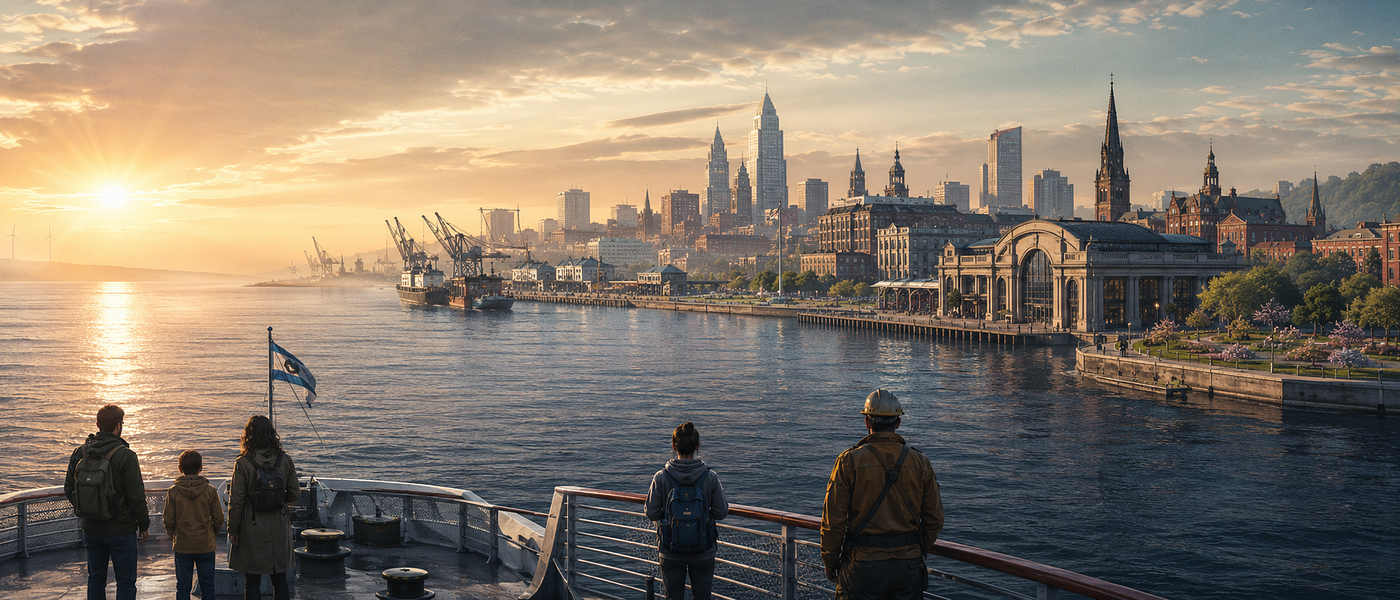
The future is a foreign country. They may still call it America. They may not still call it the United States.
That question belongs to the larger speculation of America500: what kind of country might stand here in 2276, two and a half centuries after our semiquincentennial, five hundred years after the Declaration, after generations of invention, exhaustion, migration, argument, repentance, and renewal? The point here is not to predict gadgets or electoral maps, but to ask what future Americans might inherit from us, what they might discard, and what they might finally learn to see clearly.
In that future, the answer may not begin with artificial intelligence, space settlement, or the next dazzling form of entertainment. It may begin with something older, plainer, and more absolute: Where people can live, what they can drink, how they navigate, which cities recover, or which coasts retreat.
And which regions discover that what once seemed ordinary has become strategic.
By 2276, America’s future may not have been written in the sky at all. It may have been written on water.
The Inland Sea
The old geography, mocked or ignored for decades, returned with authority. The Great Lakes, once treated as the damp attic of American industry, became the inland sea of a continental republic. Cleveland, Detroit, Buffalo, Toledo, Erie, Milwaukee, Chicago, Duluth, Toronto, Hamilton, Kingston, and Montreal formed what later school curriculum called the Freshwater Corridor. The phrase “Rust Belt” survived only as a period term, like “Northwest Territory” or “Silicon Valley.” It belonged to a century that mistook decline for destiny.
As a native Clevelander, I remember once writing in a notebook that the Great Lakes would someday re-emerge as one of the decisive regions of American life. At the time, it may have sounded like local sentiment, the private compensation of someone from a city accustomed to being explained in the past tense. Clevelanders know that tone well: the national habit of referring to the place as if its real life were already over, as if the important thing had happened somewhere else, as if the lake itself were a backdrop to decline rather than the beginning of another argument.
But by America500, water had made such old jokes look…provincial. The continent had grown hotter, thirstier, more mobile, and more wary of its own earlier arrogance. The Great Lakes did not become important because they were nostalgic. They became important because they were fresh, navigable, inland, defensible, and surrounded by cities that already knew how to show up for work. And endure.
Indeed, the Great Lakes cities had already endured one cycle of American forgetting. They had known industrial confidence, labor pride, ethnic neighborhood life, civic swagger, pollution, collapse, depopulation, ridicule, reinvention, and stubborn continuance. Their churches, schools, mills, rail yards, bridges, union halls, warehouses, clinics, ballparks, and waterfronts carried the marks of a country that had built things with its hands and then, for a while, grew embarrassed by the people who knew how to do so.
By 2276, that embarrassment had faded. Competence had become beautiful again.
The St. Lawrence Gate
The St. Lawrence mattered as much as the lakes themselves. Without it, the Great Lakes risk being imagined as a vast inland basin, mighty but enclosed. With it, they become an inland civilization with an oceanic mouth. Montreal becomes the eastern gate of the Freshwater Corridor, the point at which the freshwater continent opens toward the Atlantic.
By America500, Montreal is no mere terminus. It is a threshold. Bilingual, old, Catholic in its bones even when altered by centuries of secular habit and immigrant renewal, it stands where North America turns from lake to river, from river to tide, from inland memory to the wider world. Goods, families, students, pilgrims, civic delegations, medical vessels, musicians, and school groups move through corridors once discussed mainly in the language of freight tonnage and industrial logistics.
A Cleveland family in 2276 might say, “We’re taking the water to Montreal,” the way a family in 2026 might say it is flying to New York. The difference is that the journey has recovered the character of passage. There are meals, study rooms, clinics, chapels, quiet decks, cargo below, families above, the lake dark and immense beyond the glass. The route itself teaches geography. Cleveland to Buffalo. The Niagara frontier. The Welland passage. Lake Ontario. Kingston. The St. Lawrence Seaway. Montreal. The old names return not as trivia, but as stages in a civilizational act of movement.
This is not nostalgia for steamships or an antiquarian fondness for locks and canals. It is the recognition that transportation shapes the soul of a place. The automobile gave Americans freedom and isolation. The airplane gave speed and disembodiment. The commute gave routine and exhaustion. Water travel gives something else: sequence, weather, dependence, delay, conversation, and arrival.
By 2276, a slower mode of movement does not necessarily mean an inferior one. Speed remains useful. Emergency medicine, diplomacy, security, and long-distance travel still demand it. But speed, by now, had lost its glamour. A civilization that has spent centuries accelerating everything eventually learns that not all acceleration is freedom.
After the Commute
One of the foregone rituals of twentieth-century adulthood was the daily movement of millions of people from homes to offices and back again, as if the body itself had to be presented each morning to prove economic seriousness. The work-from-home revolution of the early digital age broke that spell, crudely at first. It arrived through laptop screens, spare bedrooms, kitchen tables, network connectivity, and the uneasy discovery that much office life had been theatrical.
At first, the change felt like a disruption, then a perk, then a culture war, then a scheduling problem. But over time, the consequences deepened. If work did not always require commuting, then cities, schools, roads, offices, and time itself could be rearranged. The early digital age did not know what it had broken — it only knew that the old pattern no longer commanded the same foregone conclusion.
Thus, by 2276, work was no longer necessary for survival in quite the same way. That does not mean work disappeared. A world without work would not be humane; it would likely be deranging. John Paul II, writing in 1981 as the dignity of labor carried particular force for his native Poland, insisted that work is “for man” and not man “for work.” It was a distinction that survived workplace and workforce revolutions. Work remained because human beings still needed discipline, craft, obligation, service, and the dignity of being useful. People repaired ports, tended farms, taught children, maintained water systems, built vessels, cared for the sick, restored wetlands, studied law, sang in churches, kept archives, designed tools, cooked for neighborhoods, and watched over machines that could do almost everything — except become morally responsible for themselves.
Labor became less the price of bread than a form of sanity. A republic that had weakened the tyranny of economic necessity still had to answer a deeper question: what do people do when they no longer have to struggle merely to remain alive? The answer, in the healthier places, was not leisure as permanent distraction — but service to others, stewardship, and the cultivation of personal growth.
Water helped shape that lifestyle. Ferry terminals became civic places again: part market, part school, part station, part town square. Lake vessels carried freight and people together. Some routes were swift; others were deliberately slow. In the old commute, travel had often been time stolen from life. In the Freshwater Corridor, travel became life given form.
The difference is not only practical but also anthropological. The old commute assumed that the person existed in service to the workplace; the new passage assumed that movement could serve the person, the family, the region, and the common good.
Ferries, Ports, and Passage
Imagine the ferry terminal at Cleveland in 2276. Not an airport, though it has the efficiency of one when needed. Not a nostalgic pier, though it honors the older lakefront. It is a public room facing water: stone, glass, timber, steel, gardens, ticket halls, freight bays, quiet study rooms, customs stations, a chapel and clinic, and weather boards. Children learn to read the lake before they learn to cross it. Travelers know the difference between Erie in summer, Erie in storm, Erie in ice, and Erie under the long gray lid of a November or a February.
A student boards for Buffalo, carrying a small bag and a work assignment at a water institute. A grandmother takes the slow vessel to Montreal because she prefers the old route and knows the chapel usher by name. A group of apprentices travels to Detroit to study port mechanics. A family from Toledo heads east for a feast-day festival in a restored parish neighborhood near the St. Lawrence, the children moving easily between English, Spanish, French, and the liturgical scraps of Latin their great-grandparents once thought had vanished. A cargo hold below them carries medical equipment, grain, machine parts, preserved food, tools, textiles, and something as ordinary and vital as replacement valves for a water plant.
The corridor moves because it must. It also moves because movement has become part of its culture. The lakes are no longer passive space between cities. They are the roads, squares, classrooms, and commons of an inland civilization.
This is where the Freshwater Corridor differs from older fantasies of technological escape. It requires human beings become more attentive to where they are. The Great Lakes are not screens to be refreshed away. It has moods, risks, depths, wrecks, and their own natural laws. They cannot be conquered by branding, but are crossed with respect.
That respect reshapes the cities themselves. Waterfronts that once alternated between industrial utility, dereliction, and attempted luxury redevelopment become central again. Ports are not hidden but are vital, a place where beauty and usefulness have been reconciled.
The Lake Erie Underworld
Beneath the water, the region has its own underworld. Lake Erie always had one.
Long before America500, miners descended beneath Cleveland and Fairport Harbor into ancient salt beds left by vanished seas, drilling and blasting road salt from caverns far below the lake. The fact still feels unbelievable even when one knows it to be true: an inland sea above, a prehistoric sea below, white mineral corridors under black water, laboring men extracting winter’s antidote from the memory of a vanished ocean.
Those mines do not become simple public tunnels in the future.But they enter the mythology of the Freshwater Corridor because they reveal what the region always possessed: not merely surface geography, but depth. The Great Lakes were never only blue space on a map. They were memory, burial, and hidden labor.
By 2276, the old salt mines stand as reminders that water is never just water. It has prehistory beneath it, politics around it, chemistry within it, and even claims upon it. The future of the Great Lakes is not one impossible tunnel from Toledo to Montreal, but a necklace of practical passages.
America in 2276 moves in layers. Ferries cross the open lake. Passenger vessels follow old commercial paths. Freight moves below deck and sometimes below ground. The restored lakefront cities learn to treat water not as scenery, border, dumping ground, or industrial convenience, but as the organizing fact of common life.
There is almost a canticle quality to it — Fiat Homo, “Let there be man.” The corridor survives in fragments before it returns as a system: old maps, port plans, salt mines, shipyards, waterworks, and industrial know-how, much of it dismissed in one century as obsolete and recovered in another as wisdom. In Walter M. Miller Jr.’s A Canticle for Leibowitz, the monks preserve the Memorabilia without always understanding what they have guarded. The Freshwater Corridor suggests a less catastrophic version of the same problem. Civilizations do not survive merely by possessing records — they survive by remembering how to read them.
Water and the Coasts
The rise of the Freshwater Corridor does not mean the coasts vanish. America remains a coastal nation, a river nation, an agricultural nation, a desert nation, a mountain nation, a border nation. But by 2276, the coasts have learned humility in ways the inland lakes learned earlier.
Desalination becomes ordinary along many coastlines. It helps cities survive. It allows regions to endure dry years, failed snowpacks, saltwater intrusion, and population pressure. But the oceans never become an infinite faucet, a spigot to be freely used at random. Desalination requires energy, engineering, maintenance, brine management, political stability…and funding. The great lesson that was discovered is not that water can be manufactured by a pull of a lever, but that water itself has become one of civilization’s organizing facts again.
While the coasts learn to drink from the sea, the interior learns to move, once again, along rivers and lakes. Perhaps that was the greatest connection to the country’s past: the country was discovered largely by boat. And so it is again.
The United States and the Water Map
This lesson reaches back to the larger question of America500: whether future citizens still call the country the United States, and whether the phrase still describes reality.
The Freshwater Corridor does not erase the United States — it tests it. In many ways it charts its own course. A country may indulge ideological fantasy on a cable panel or social media feed, but the engineers of the 23rd century realized something from those of the early 19th: you cannot run a lock system that way.
Perhaps that is why the water map becomes one of the places where union is relearned: the daily habit of recognizing that one city’s negligence becomes another city’s poison, one port’s collapse becomes another region’s shortage, one jurisdiction’s vanity becomes another family’s danger.
By 2276, future Americans may have argued fiercely over whether “the United States” remains the right name for a country transformed by federations, compacts, cross-border regions, and continental systems. Some may have preferred simply “America,” broader, warmer, just plain easier. But at some point, the old name was consciously chosen. The land was identified not merely as America, nor as a continental empire, nor as a loose geography of convenience, but as the United States.
The Freshwater Corridor gives that name a renewed argument. States remain distinct because places are distinct. They are united because water makes isolation foolish.
The Moral Geography of Water
Water is practical before it is symbolic. For Christians, water is also baptism — not decorative symbolism, but the matter through which the old life is buried and a new one begins. A civilization reorganized around water would know, at minimum, that water exposes what must be purified and what must be preserved.
This is why the Freshwater Corridor matters to America500. It is not merely a prediction that Cleveland, Detroit, Buffalo, Milwaukee, Chicago, Toronto, and Montreal become more important. It is a way of imagining a chastened country. A country less impressed by spectacle. A country that remembers skill. A country that treats water as precious. A country that no longer believes every problem can be solved by fleeing elsewhere.
The Great Lakes were always there while the country chased other forms of prestige. They watched industries rise, rivers burn, factories close, neighborhoods empty, children leave, and children return. They received our waste and carried our ships. They froze, thawed, flooded, glittered, threatened, and waited.
By 2276, perhaps Americans finally learned to see them for the greatness they had always carried in their name.
메타데이터
- post_id
- ce2ee62838a3
- slug
- america500-the-freshwater-corridor-ce2ee62838a3
- url
- https://medium.com/@jamesfday/america500-the-freshwater-corridor-ce2ee62838a3
- canonical_url
- https://medium.com/@jamesfday/america500-the-freshwater-corridor-ce2ee62838a3
- author_url
- https://medium.com/@jamesfday
- status
- ok
- fetched_at
- 2026-06-09 15:37:30