Keep Your Frontend Safe When Everyone’s Adding Code
How runtime governance stops bad services before they break your app
Keep Your Frontend Safe When Everyone’s Adding Code
How runtime governance stops bad services before they break your app
“Rethinking the Client: A New *Era of Modular, Performant Frontends” | **Part 13***
Every application begins simply. Sometimes it’s just a proof of concept or a minimum viable product created to get something launched. Over time, requirements evolve, features accumulate, and the scope broadens. Even in rare enterprise “greenfield” projects, there’s always pressure to deliver. Processes and protocols often fail to keep pace with the system’s increasing complexity. New teams are formed, new hires join, and key engineers leave or are reassigned. The lifecycle of an enterprise application is rarely straightforward.
Many years ago, I worked on a large frontend project where the team grew from fewer than ten people to over a hundred within just a few months. Back then, micro frontends weren't called that yet, but the architecture was very similar. Multiple teams were responsible for different sub-applications: some owned backend services, while others managed the eventing layer. The system operated in a critical environment, dispatching thousands of events each session. Each sub-application handled only a subset of these events, but among them were a few that were stateful and high-stakes, controlling vital aspects of the experience.
In the early days, the project's simplicity made strict runtime governance seem unnecessary. However, once multiple sub-applications began subscribing to the same critical events, often modifying or flattening them, the flaws became apparent. A minor feature in one team’s sub-application accidentally changed a payload that another team’s module depended on. There was no enforced contract to guarantee the event’s structure, no policy to restrict who could subscribe, and no structured observability to track the impact.
What followed was a production incident that spread throughout the entire system. The cause of the failure was not dramatic; it was the lack of runtime guardrails that made it so harmful. Debugging took days. We compiled logs from multiple teams, attempted to manually reconstruct event flows, and debated whether the change was intentional or accidental. In the end, the problem could have been entirely prevented if the runtime had validated payloads, enforced ownership rules, and logged every binding in a traceable way within minutes, not days.
That moment taught me the hard truth: governance can't be added later. If the runtime is the platform, it must be the one place that validates, isolates, and monitors every interaction. Without it, each new service could be a point of failure. With it, the platform becomes a safeguard, catching issues before they turn into incidents and giving teams the confidence to scale without fear.
Why Governance Belongs in the Runtime
In a modular frontend built with CSMA, the runtime is more than just a loader. It is the dynamic environment where services communicate, exchange messages, and shape the user experience in real time. Without governance at this level, the platform becomes a trust-based system that relies on every team consistently doing the right thing. That is not a safe assumption at scale.
Relying only on design-time standards, documentation, or code review creates gaps. Even the best-written guidelines cannot address runtime realities like dynamic service loading, late-bound event subscriptions, or third-party integrations. These are situations where architectural rules need to be enforced by code that executes, not just by pages in a wiki.
Governance in the runtime does three critical things:
- Enforces boundaries in real time, preventing services from bypassing agreed-upon contracts or injecting unvalidated data into shared flows.
- Observes interactions as they happen so incidents can be diagnosed quickly, with clear lineage from cause to effect.
- Protects the platform from cascading failures by isolating faults, applying fallbacks, and controlling access to sensitive extension points.

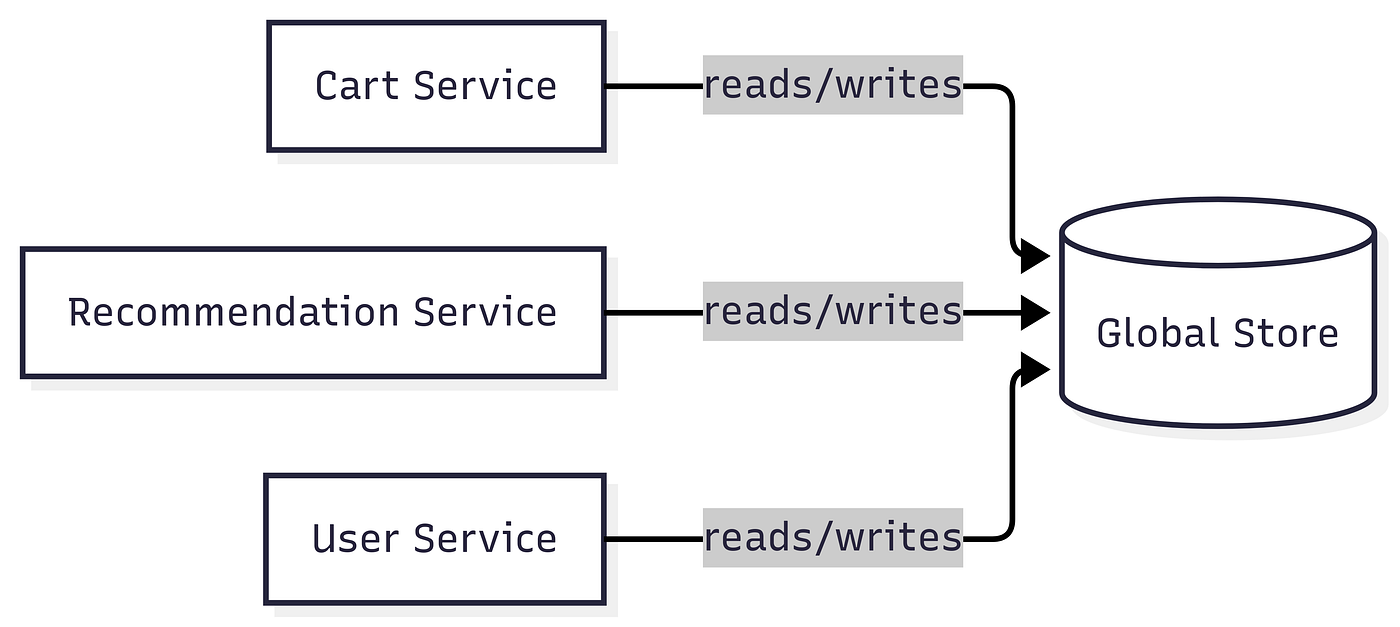
Caption: All service interactions pass through the runtime’s governance layer before they can impact the user experience, ensuring consistent enforcement and control.
The need for runtime governance often becomes clear only after a major incident occurs. By that point, retrofitting it into the platform is much more costly. In CSMA, the runtime is built from the ground up to serve both as the execution host and the enforcement layer. This means every interaction between services is mediated, validated, and logged before it can affect the user experience.
Contracts as the First Line of Defense
In CSMA, contracts are more than documentation. They are enforceable agreements that define how a service behaves, what data it consumes and produces, and where it is allowed to operate. At runtime, these contracts are validated before any service is allowed to bind to the platform.
A contract typically includes:
- An interface definition that describes the methods, events, and data formats the service supports.
- Capability descriptor that declares version, owner, required scopes, and stability status.
- Operational metadata includes performance budgets, privacy flags, and dependencies.
By combining these elements, the runtime can make informed decisions:
- Reject a service that declares one version but tries to use an incompatible API.
- Prevent a module marked as beta from attaching to a production-only extension point.
- Block services from consuming sensitive events unless they have the required scopes

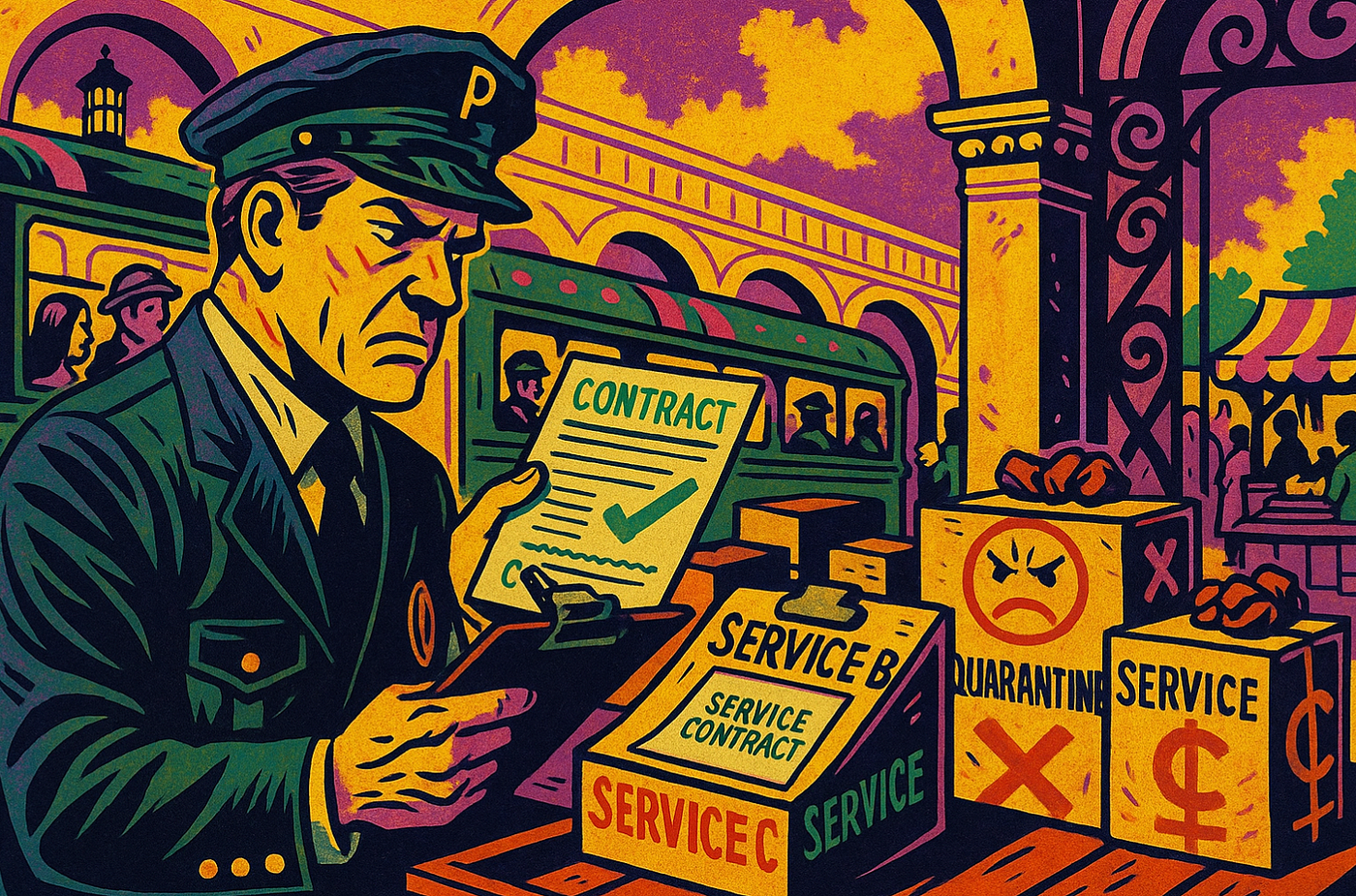
Diagram: The contract gate validates a service before it can bind to the runtime, blocking any module that does not meet the agreed schema or capability requirements.
This approach eliminates ambiguity. Instead of relying on each team to interpret requirements, the runtime becomes the single source of truth for what is valid and what is not. When a service violates its contract, it is stopped before it can affect other modules. In a checkout flow, a pricing service might declare a contract specifying its input payload (SKU and region) and output payload (amount and currency). If a service tries to return anything outside this schema, the runtime rejects the message and logs a clear error. This prevents corrupted data from reaching the payment process and reduces the risk of silent failures that are difficult to debug. Contracts are not just a safety feature; they are the foundation for scaling. As more services are added, the risk of accidental interference increases. A validated contract system ensures that every new module can join the platform without creating uncertainty about its behavior.
A short JSON Schema contract example, along with a validation snippet, will make the idea real. Example:
{
  "$schema": "https://json-schema.org/draft/2020-12/schema",
  "title": "PricingServiceOutput",
  "type": "object",
  "properties": {
    "amount": { "type": "number" },
    "currency": { "type": "string", "pattern": "^[A-Z]{3}$" }
  },
  "required": ["amount", "currency"]
And a small validation snippet in JavaScript:
import Ajv from "ajv";
const ajv = new Ajv();
const validate = ajv.compile(schema);
if (!validate(outputPayload)) {
  throw new Error("Contract violation: " + ajv.errorsText(validate.errors));
}
Shows exactly how a runtime might reject a service payload that violates the schema.
Guarded Extension Points
In a CSMA environment, not every part of the runtime should be open for any service to connect. Extension points serve as controlled gateways, and securing them is one of the most effective ways to prevent accidental or malicious disruptions.
A guarded extension point has three main characteristics:
- Explicit declaration: The runtime defines each extension point by name, scope, and purpose. Nothing can bind to it without registering through the runtime.
- Required interface: Each extension point specifies the contract a service must implement to attach. This includes method signatures, event payload schemas, and error handling expectations.
- Capability profile: The runtime applies rules to decide which services are allowed. For example, some extension points might only accept stateless services, others might allow stateful modules but require them to run in isolated workers.
- Guarding extension points serves two purposes. It protects high-value or high-risk flows such as authentication, payments, or checkout logic from being modified by unauthorized services. It also ensures that when a service plugs in, it does so with full compatibility, following the rules defined for that specific area of the application.
Example:
runtime.registerExtensionPoint({
  name: "checkout/pricing-strategy",
  contract: "PricingStrategy@^2",
  requiredScopes: ["pricing:write"]
});
A “shipping-quote-provider” extension point could be configured to only allow services that implement and that have the scope. Any service failing those checks is rejected instantly, with the runtime producing a clear validation error. Without guarded extension points, the runtime would have no control over who injects code where. With them, the platform maintains both flexibility for independent teams and safety for shared, critical paths.
Fault Isolation by Default
In a composable frontend, a misbehaving service should never be able to bring down the entire user experience. Fault isolation makes sure that when a service fails, its impact is contained, recovery is quick, and the rest of the application keeps running.
In CSMA, fault isolation is achieved through several key techniques:
- Execution boundariesServices that perform CPU-intensive tasks, integrate with third parties, or manage critical flows can be run in worker threads or other isolated environments. This helps prevent them from blocking the main UI thread or interfering with unrelated services.
- Timeouts and circuit breakers The runtime automatically enforces maximum execution times for service calls. If a service fails to respond in time, the call is aborted and a fallback is triggered. Circuit breakers prevent repeated calls to a failing service, avoiding cascading performance issues.
- Fail-safe degradation Instead of leaving a blank space or a broken UI, the runtime can revert to cached data, minimal UI placeholders, or safe default behaviors. This maintains the overall flow, even if the degraded experience has fewer features.
- Error containment and logging Any error thrown by a service is caught and handled within its boundary. The runtime logs the fault with enough detail to trace it back to the specific service and operation, without exposing sensitive data or leaking errors into unrelated parts of the app.

Diagram: Fault isolation ensures that a failing service is contained and replaced with a fallback without disrupting the rest of the application.
Imagine a product recommendation service that begins taking too long to respond because of a slowdown in a third-party API. In CSMA, this service might run in a worker with a two-second timeout. If it fails, the runtime switches to cached recommendations and logs the event for later review. The rest of the application, checkout, browsing, and search, remain unaffected. Fault isolation turns potential platform-wide incidents into minor, recoverable glitches. Instead of rushing to find the root cause during a production crisis, teams can focus on fixing the isolated service without disrupting users.
Example:
const worker = new Worker("recommendations.js");
const timeout = setTimeout(() => {
  worker.terminate();
  useFallbackRecommendations();
}, 2000);
worker.onmessage = (event) => {
  clearTimeout(timeout);
  renderRecommendations(event.data);
};
Policy That Runs, Not Rests
Written governance policies are only as effective as their enforcement. In a distributed frontend environment, a runtime that actively evaluates and enforces policies is much more effective than static documentation or process checklists. In CSMA, policies are embedded directly into the runtime so they execute automatically at the appropriate times: when services are loaded, when they subscribe to events, when they publish messages, or when they bind to extension points. This eliminates dependence on human vigilance and guarantees consistent application of rules across teams.
Common runtime-enforced policies include:
- Ownership requirement: A service must declare a responsible team or owner. No owner, no deployment.
- Stability gates: Services marked as beta can only run in certain environments or behind feature flags.
- Scope checks: Only services with the correct permissions can bind to sensitive flows like checkout or authentication.
- Privacy and compliance rules: Services tagged as handling personal data cannot publish to untrusted channels or store data in insecure contexts.
Example:
runtime.addPolicy((service) => {
  if (service.stability === "beta" && runtime.env === "production") {
    throw new Error(`Service ${service.name} cannot run in production`);
  }
  if (!service.scopes.includes("checkout:write")) {
    throw new Error(`Service ${service.name} missing required scope`);
  }
});
If a service tries to subscribe to an extension point without the correct scope, the runtime rejects the binding immediately and logs the violation. There is no need for a code review to identify the issue, and the rule is enforced consistently across all environments. Executable policies create a safer, more predictable runtime. They make governance proactive instead of reactive, preventing problems before they occur rather than fixing them after deployment. This also enhances the developer experience by enabling teams to understand the rules through direct feedback from the platform, rather than relying on tribal knowledge or outdated documentation.
Structured Observability
Observability in CSMA is not just about collecting logs. It is about structuring information so that every event, service action, and interaction can be traced, understood, and acted upon. Without structured observability, debugging becomes guesswork, and performance issues turn into long investigations instead of quick fixes.
A runtime with structured observability should capture:
- Service lineage: Which services were loaded, in what order, and what extension points they attached to.
- Contract adherence: Whether a service passed validation, what schema version it used, and any mismatches detected.
- Performance metrics: Latency, memory use, and error rates per extension point and service.
- Fallback activations: When a service fails, the runtime triggers a backup flow.
Example:
runtime.on("contractViolation", (details) => {
  console.log(JSON.stringify({
    timestamp: new Date().toISOString(),
    service: details.serviceName,
    event: details.eventName,
    error: details.errorMessage
  }));
});
The goal is to provide clear, searchable trails. For example, if a checkout flow suddenly slows down, the runtime should reveal which services were active during the slowdown, whether any of them triggered a fallback, and how long each call took. This enables quick identification of the cause, rather than spending hours. Structured observability also helps enforce governance indirectly. By making all activity visible and traceable, it discourages risky behavior. Teams know that any deviation from expected behavior will be recorded and surfaced, making it easier to hold services accountable. When observability is integrated into the runtime, it ceases to be a separate concern. Instead, it becomes part of the platform's operation, ensuring consistent visibility across all teams and services.
Core Mechanisms of a Governed Runtime
Bringing runtime governance to life in CSMA involves combining multiple mechanisms that work together to enforce rules, contain faults, and provide visibility. Each of these mechanisms has a specific role, but they are most effective when integrated into a single, cohesive runtime model.
1. Contract Gate Validates the service’s interface and capability descriptor before it is allowed to load.
- Ensures version compatibility using declared semver ranges.
- Confirms ownership, stability status, and required scopes.
- Rejects services that do not match their declared schema.
2. Message Guard Checks the structure and validity of every event or message that a service publishes or subscribes to.
- Uses schema validation to prevent malformed data from propagating.
- Quarantines non-conforming messages with full logging.
- Supports optional sampling to reduce performance overhead in high-throughput paths.
3. Execution Sandbox Runs services in isolated contexts to protect the main UI and other services.
- Enforces CPU and memory limits.
- Applies timeouts to prevent blocking behavior.
- Restricts access to unsafe operations, such as DOM manipulation from untrusted modules.
4. Policy Engine Applies organizational rules automatically at load time, bind time, and message time.
- Evaluates stability, environment, scope, and compliance requirements.
- Allows domain-specific rules to be added without changing service code.
- Makes governance decisions part of the platform’s runtime behavior.
5. Observability Hooks Inject trace and metric collection into every significant runtime action.
- Tracks service lifecycle events and binding activities.
- Logs contract validation results and policy decisions.
- Captures performance and fault isolation events for real-time dashboards.

Diagram: The governed runtime layers multiple mechanisms for validation, message guarding, sandboxing, policy enforcement, and observability, to create a robust safety net for all services.
When these mechanisms work together, the runtime serves as both the foundation and the protector of the platform. Each service interaction is verified, every failure is contained, and all changes are transparent.
Case Study: The Rogue Promotions Module
Imagine a retail platform operating on CSMA where multiple teams manage different parts of the customer experience. One team is responsible for a “Promotions” service that shows discounts during checkout. The module is designed to be lightweight and non-critical, functioning as a pluggable extension within the checkout flow. One day, a developer pushes an update that unintentionally alters the payload of a critical event before passing it downstream. The change is subtle: it adds an extra discount field in the wrong format. In a runtime without strict governance, this would go unnoticed, causing the payment processor to reject certain transactions and potentially leading to lost revenue.
In a governed CSMA runtime, several mechanisms step in:
- Contract Gate: At load time, the runtime detects that the Promotions service’s declared output schema does not match the current contract. The mismatch is flagged immediately.
- Message Guard: Even if the service loads, the malformed event is caught before it reaches the pricing engine. The message is quarantined, and a fallback promotion handler is triggered instead.
- Execution Sandbox: The Promotions service is running in its own isolated thread. When the message is blocked, it does not affect the rest of the checkout logic.
- Policy Engine: Since the service is tagged as “beta” in production, it is restricted from modifying critical pricing events altogether.
- Observability Hooks: The incident is logged with full trace data showing the service ID, the event name, the payload mismatch, and the time of failure. The operations team can pinpoint the problem within minutes.
The outcome is a contained incident. The user still sees a valid checkout total, the payment succeeds, and the issue is fixed in the Promotions module without any downtime. The governance model prevents what could have been a large-scale revenue-impacting situation outage.
Rollout Checklist
Implementing runtime governance in a CSMA-based platform doesn't have to be a huge single effort. Teams can start small, target the highest-risk areas, and gradually expand governance over time. The following phased checklist helps introduce governance smoothly without disrupting ongoing development.
Phase 1: Establish the foundation
- Inventory all services and extension points in the current runtime.
- Identify the most critical flows, such as authentication, payments, or order submission.
- Define and document contracts for these flows first.
Phase 2: Add validation at load time
- Implement a Contract Gate that runs when services are loaded.
- Require service metadata including owner, version, stability, and scopes.
- Reject or quarantine services that fail validation.
Phase 3: Introduce guarded extension points
- Declare extension points explicitly in the runtime.
- Apply capability profiles so only eligible services can bind.
- Focus first on high-value or sensitive integration points.
Phase 4: Enforce runtime policy
- Embed a Policy Engine that runs during service binding and message exchange.
- Add at least one rule for ownership, one for stability, and one for scope permissions.
Phase 5: Add structured observability
- Implement Observability Hooks for service lifecycle, contract validation, and policy enforcement events.
- Ensure every rejected or quarantined action produces a clear, searchable log.
Phase 6: Introduce fault isolation measures
- Run critical or unstable services in sandboxes or worker threads.
- Apply timeouts and fallbacks for external or CPU-heavy operations.
Starting with the most sensitive paths means the first governance rules will already deliver real protection. Over time, the platform can expand these mechanisms to cover all services, creating a fully governed runtime without requiring a disruptive rewrite.
What This Does Not Cover (and the Road Ahead)
Runtime governance is only one aspect of building a robust CSMA platform. While it safeguards the system against bad bindings, malformed messages, and unsafe service behaviors, it does not cover every operational or architectural issue.
This post has focused on the enforcement layer inside the runtime. It has not covered:
- Thread scheduling and worker orchestration: How the runtime prioritizes and balances workloads across main and background execution contexts.
- Advanced developer tooling: How service discovery, contract exploration, and live testing can be integrated into a developer portal.
- Cross-runtime interoperability: How governance adapts when services are deployed across web, mobile, and embedded runtimes simultaneously.
- Automated dependency management: How the runtime updates shared libraries or core APIs while maintaining compatibility guarantees.
These areas are important and closely connected. For example, a governed runtime becomes even more valuable when combined with intelligent scheduling that keeps high-priority tasks responsive, or when linked to a developer portal that makes extension points easy to find but safe to use. In the next part of the series, we will shift from enforcement to orchestration. We will examine how CSMA manages concurrency, schedules service execution, and balances work across different threads and workers without blocking the UI. This will connect the safety we've discussed here to the performance and scalability required in real-world applications.
Takeaways
- Governance in CSMA is not an optional extra. It must live in the runtime so that rules are enforced consistently across all services.
- Contracts form the first layer of protection, preventing incompatible or unsafe services from binding to the platform.
- Guarded extension points give the runtime control over where and how services can integrate, protecting critical flows from unauthorized changes.
- Fault isolation ensures that failures are contained, keeping the rest of the application responsive and functional.
- Executable policies turn governance from documentation into action, providing direct, real-time feedback to developers.
- Structured observability makes it possible to trace every interaction, speeding up debugging and encouraging safe patterns.
- A governed runtime combines validation, isolation, policy enforcement, and observability into one cohesive safety net that scales with the application.
Coming Up Next
In Part 14, we will shift focus from runtime governance to runtime orchestration. We will examine how CSMA schedules service execution, handles concurrency, and distributes workloads among main threads, workers, and background tasks. Additionally, we will discuss maintaining high responsiveness for high-priority operations while preventing lower-priority tasks from being starved, as well as designing scalable concurrency controls that grow with increasing service counts and interaction complexity. If you've ever wondered how to keep a modular, event-driven frontend responsive under heavy load, Part 14 will introduce you to the key strategies to achieve this.

(Monday)
Stay tuned.
🤔 Wait, Isn’t This Just Micro Frontends?
Not quite.

Micro frontends focus on splitting up the UI, allowing different teams to own and manage various parts of the visual interface, which are often deployed separately.
**Client-side Microservices Architecture (CSMA) is different: it’s not about the UI at all. It’s about breaking up business logic components, such as state management, calculations, workflows, and side effects, into independent, testable services** that run inside the client app.
Think of it as giving your frontend the same internal structure and discipline as a backend system, without turning your components into dumping grounds for logic.
You can use CSMA with or without micro frontends. They solve different problems, and they complement each other well.
🧱 Found this helpful?
If this post helped clarify how to think about modular frontend logic, give it a 👏 or share it with someone buried under spaghetti code.
📚 Following the series? This article is part of the ongoing series: Client-side Microservices: Rethinking Frontend Architecture
Each post breaks down how to bring structure, scalability, and sanity to modern frontend development, one small service at a time.
메타데이터
- post_id
- ce421db9453a
- slug
- keep-your-frontend-safe-when-everyones-adding-code-ce421db9453a
- url
- https://medium.com/rethinking-the-client-a-new-era-of-modular/keep-your-frontend-safe-when-everyones-adding-code-ce421db9453a
- canonical_url
- https://medium.com/rethinking-the-client-a-new-era-of-modular/keep-your-frontend-safe-when-everyones-adding-code-ce421db9453a
- author_url
- https://medium.com/@enricopiovesan
- status
- ok
- fetched_at
- 2026-07-18 07:36:35