Cheats All the Way Down: From Banks to Bacteria, Deception is Rife
How to recognise fraud and dishonesty in the oldest game in town
Cheats All the Way Down: From Banks to Bacteria, Deception is Rife
How to recognise fraud and dishonesty in the oldest game in town
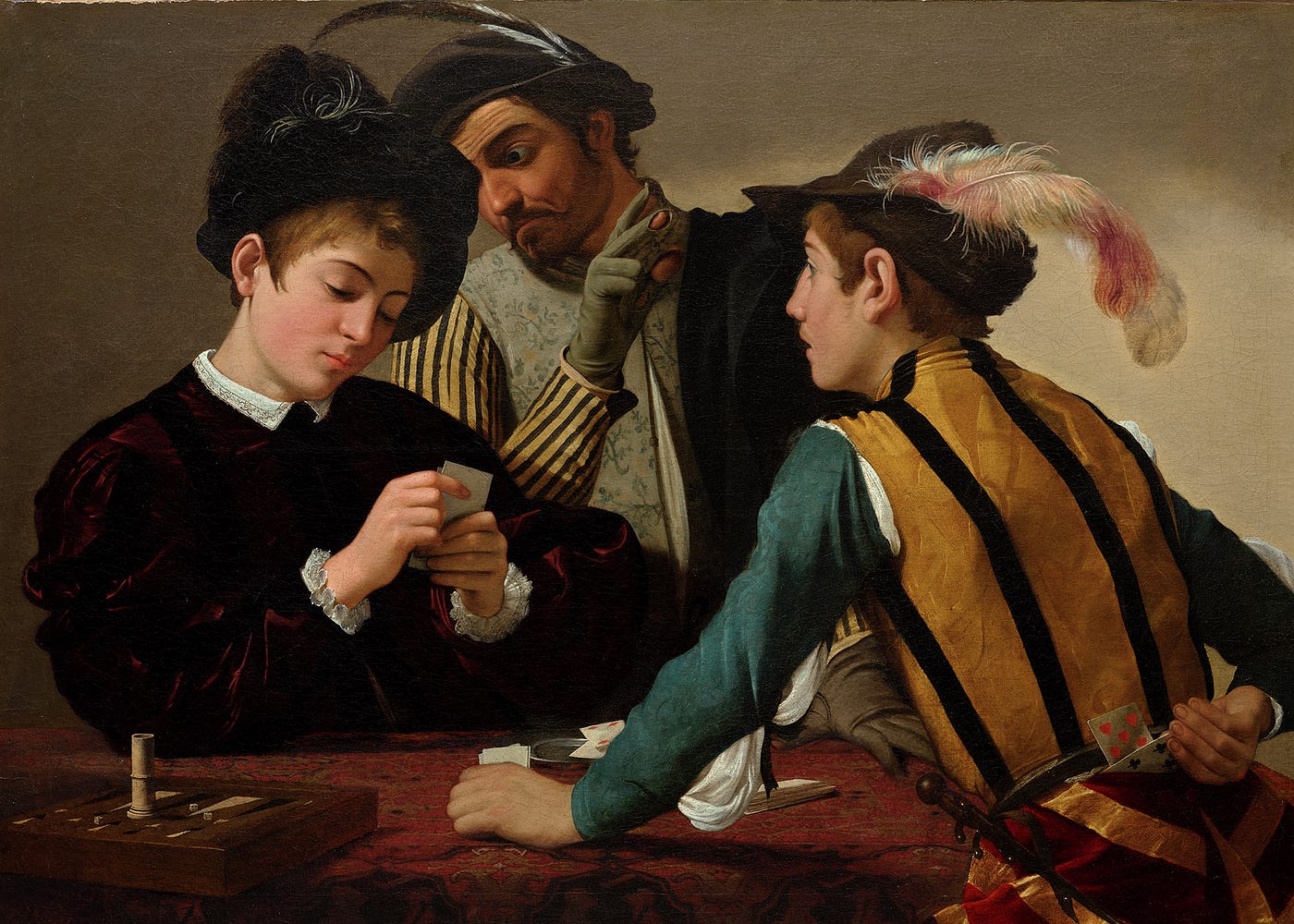
Caravaggio — The Cardsharps (1596–97) Source: Kimbell Art Museum
You know that feeling, the sinking pit in your stomach when you know you’ve just been had? Annoying isn’t it. As the cost of living is biting many of us at the moment, it makes deceptive practices even more salient: small businesses are scratching to survive, with shrinking profits and rising costs, while consumers’ arms grow shorter and their pockets grow longer.
Internet scams are a new, clear and present danger, with the media frequently running stories on who’s been had, how and when. But the why is the important question.
Why do we deceive each other?
There is a broad range of psychological theories of deception, which variously describe it as an anomaly, with truth as the default state; as hard to detect because lying and cheating stem from the same mental processes; and as cognitively costly, making it much easier to default to the truth.
However, one pair of intrepid researchers bundled many of the leading theories into the General Theory of Deception to better understand how people fabricate and choose lies and develop better ways to detect and prevent deception. (1) They identify 99 verbal and non verbal ways people deceive, yielding a multitude of possible deception strategies, organised into a ‘Five Forces’ model.
The model explains that the decision to lie, tell the truth, or refuse to answer depends on five factors. Benefit refers to what a person gains from lying, telling the truth, or refusing to answer, such as avoiding punishment, gaining an advantage, or protecting themselves and others. Punishment refers to the perceived consequences of being caught out, legally or socially. Risk is the estimated likelihood of detection, and Execution Cost is the effort required to maintain the deception. Lastly, Dissonance is the internal conflict associated with deception, including guilt, shame, and violations of personal or social norms
The theory suggests that when a person is asked to answer truthfully, a series of decision rules based on the ‘Five Forces’ play out in the person’s mind. Memory recalls both true and potentially untrue answers, truth coming to mind first, but rehearsed lies also quickly; however, truth is the default response. The person quickly evaluates the costs and benefits of the truth — no benefit; tell the truth, or a potential benefit; consider deceptive alternatives. Options from the five factors are evaluated in the mind, and options with the highest utility are chosen.
For example, you are pulled over by the police and asked, “Did you use any drugs or drink alcohol tonight?” Your memory recalls the giant joint you just rolled, and truth, non-answering, or deception are quickly evaluated. Not answering is not an option; it will attract more attention, and telling the truth is fraught with peril, so deception is chosen. Each possible answer is weighed using the five forces, and the one with the best balance of benefit and the lowest risk/cost is chosen. “I was on my way home from a church prayer meeting officer.” The theory and model suggest that most people tell the truth, but consider lying when it seems advantageous, their choices depending on a rapid, dynamic evaluation of multiple factors.
We can also apply this framework in reverse to analyse others’ deceptive behaviour. For example, you suspect that a person is lying or being deceptive. What might be the possible benefit of them lying, the payoff or reward? Is it to avoid being punished or shamed, or to gain something? What punishment might they face if caught? Is it merely social shame or prison time? What sort of risk are they taking, and what sort of execution cost is there to maintain that lie? Does the lie break down over time, or do the facts change, leading to dissonance in that person and subtle tells of conflict or shame? Useful tools worth remembering if you suspect foul play.
Nevertheless, are humans unique in our ability to lie, cheat, and deceive effectively?
Cheating Amoebas and Lying Lemurs
Humans, it would seem, are far from alone in the deception game; it’s a game as old as time itself and is present in the simplest organisms. Take bacteria, for example, simple single-celled prokaryotes; bacteria emit molecules into their environment to signal other bacteria to vary things like gene expression, virulence, metabolism, and biofilm formation. [2] Other forms of bacteria mimic the chemical messengers to their own advantage, deception at its most basic level.
Viruses can also fool their host into believing they are harmless, suppressing immune response and interfering with immune system communication. Indeed, any multicellular organism operates a fine balance of cheating, cooperation and conflict, with parallels to how human societies function. [3] Groups of cells cooperate through encoded genetic rules for the division of labour and the sharing and transport of resources. Cheaters are ‘punished’ to maintain harmony but sometimes escape, the consequences often leading to cancers.
The animal kingdom also evolved through an evolutionary arms race, not only of tooth and claw but of deception and mimicry: disguise to gain food or avoid becoming someone else’s food.

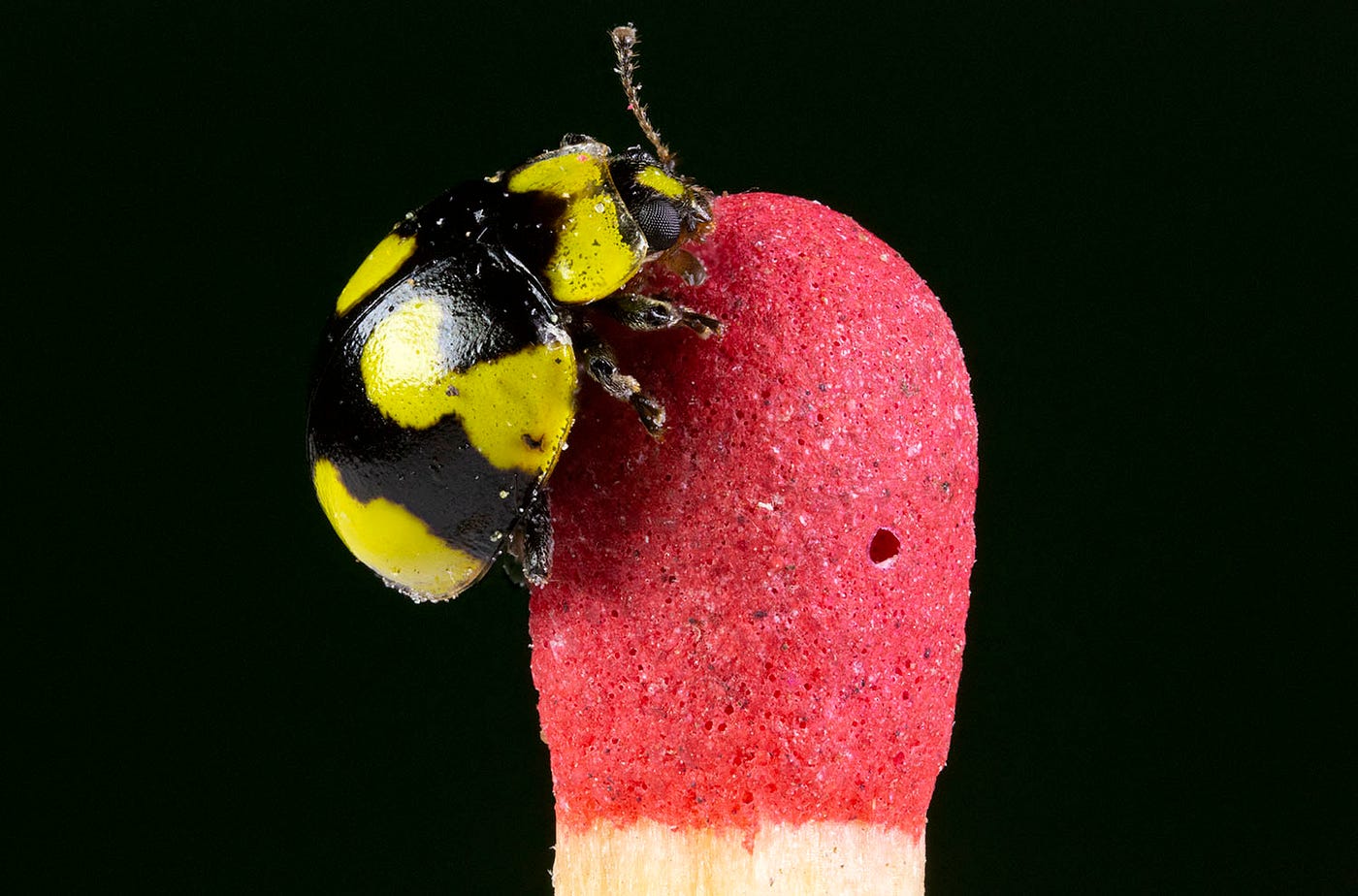
Blister beetle larvae waiting to hitch a ride on a bee Photo by Brenda Black, iNaturalist
Alcon Blue Butterfly Caterpillars are cared for and adopted by ants by mimicking the smell and sounds of ant larvae. Blister Beetle Larvae emit a scent and pretend to be female bees, fooling male bees into carrying them to the nest, where they snack on the bees’ eggs. Colourful orchid mantises resemble an orchid flower to camouflage their appearance to attack prey, and Portia Jumping Spiders mimic other spiders’ courtship signals to invite them on a fateful lunch date. [4]

Snake caterpillar: Photo by Finca Agroturística Dos Ríos, iNaturalist
Other insects use deception as a defence, like the amazing snake caterpillars of Costa Rica, which, when threatened, look like a viper. Or the owl butterfly, whose wing spots resemble an owl’s eyes, scaring off potential predators. Virginia opossums will feign death when threatened, hence the term ‘playing possum,’ and non-venomous snakes imitate their toxic cousins’ patterns and colours.
Primates are experts at social deception. Chimpanzees often send a false flag by pretending to look in the opposite direction of food rewards, waiting until the interloper is gone before snaffling the prize. Chimps are also deceptive in the mating game, females secretly signalling to low-dominance males while the top chimp is around, stealing off into the bushes for a romantic interlude in his absence. [5,6] Baboons have been observed feigning being attacked, so others chase off the accused, the victim then stealing the others’ food, and vervet monkeys give off fake ‘leopard alarm calls’ to their advantage. [7] However, akin to the boy who cried wolf, other monkeys soon wise up to these antics and ignore fake calls.

The culprit! photo by the author
Primates also engage in bargaining and blackmail like behaviours. Robert Sapolsky described how low-ranking baboons threatened by the alpha male grab a nearby youngster and hold it hostage as a defence; the alpha is most likely the father. [8] However, this backfired spectacularly when a usurped male grabbed a nearby youngster to prevent attack by the new alpha before it dawned on him: it was his own kid.
Whilst travelling around India, my wife was blackmailed by a monkey at a well-known temple. The cheeky primate leapt on her back and stole her glasses and then sat on a perch, taunting her. I knew it was a shakedown, and soon a ‘saviour’ turned up and suggested that, for a small fee, he could get the glasses back. Rupees exchanged and the monkey, miraculously, returned the glasses: scammed by two primates!
Many bird species act deceptively when ‘caching’ their food. The birds hide food here and there in various spots for later, but also ‘pretend’ to cache food while others are watching, hiding the real treat in their absence. Dogs are known to ‘fake cache’ food like bones and other stinky treats and will put their tail between their legs when fearful. Why? Not to signal fear, but to cover their anus, where scent glands release pheromones related to fear. Perhaps that’s where the term ‘cover your arse’ comes from?

Georges de La Tour 1620 — The Cheat with the Ace of Clubs Source
Which brings us to humans and our deceptions, which evolutionary psychology would describe as adaptive strategies. In an evolutionary arms race based more on words and actions than on tooth and claw, we have evolved lies and deception, along with the means to detect them, as beneficial social strategies.
Deceptively Human
‘A baker’s dozen’ is thought to have originated in medieval England, where harsh penalties were imposed for selling underweight loaves of bread. This made it better to err on the side of caution by offering 13 loaves for the price of a dozen. The perceived benefits of lying, the negative consequences of punishment, and the gains of an extra penny, weighed against the consequences.
Increased social competition also creates an environment ripe for deception, a means of gaining an advantage when competition is stiff. In our travels, I have often noticed the difference between wealthy developed countries and developing countries with large disparities between wealth and poverty. Travelling through one such country many years back, we were constantly bombarded with sophisticated deceptions to gain our trust and then our wallets. A long history of tourism, wealth inequality and intense social competition creates a perfect storm for deception as a means of survival.
Surprisingly, gossip is also an effective tool at curtailing deception, lies and scammers. Gossiping affects a person’s social standing or reputation, as tongue-wagging spreads information about an individual’s actions and behaviours, trustworthiness or reliability. It is also bi-directional. With an increase in group size and, hitherto, gossipers, access to information about others’ reputations encourages cheaters and gossipers to modify their own behaviours. Knowing that you are being watched, judged, and talked about, pressures individuals to conform to social norms. [9]
Robin Dunbar has a fascinating theory about how gossip evolved. He suggested that as human group sizes grew, allogrooming, a time and labour-intensive form of social bonding behaviour, also seen in primates, became impossible, which led to the evolution of language. (10) Language then supplanted allogrooming as the method of social bonding, freeing up time for other pursuits, hunting, gathering and gathering information on each other; gossip. Aside from the obvious benefits of social bonding, Dunbar suggests that discussing hypothetical situations, gaining insights, policing free riders, self-advertising, promotion, and deception all offer advantages through language and gossip.
You can read more about the theory of gossip here if interested.
Indeed, some suggest gossip and reputation are fundamental to either sustaining or breaking cooperation in human societies. Lies and deception destroy cooperation by affecting reputations. [9]

Francesca da Rimini: William Dyce (1806–1864) National Galleries of Scotland Source
However, there is one area of human deception that stands out prominently: Sex.
The Sexual Deception Arms Race
According to evolutionary psychology theories, the human sexual arms race developed means by which each sex finds competing strategies to seek a suitable mate and outsmart the competition.
David Buss and colleagues describe how, in attempting to outsmart the competition and gain access to sex, some men may resort to a variety of deceptive behaviours, primarily through faking wealth, competence and status. [11] Faking wealth may involve an expensive car, fake designer clothing and jewellery, and lying about career status masks competence. Commitment deception may take the form of deceiving women about their feelings or commitment to exploit women’s evolved preferences for those qualities.
Women may also employ deceptive tactics, competing for desirable men with status, wealth and willingness to commit. This might take the form of direct and indirect tactics like enhancing appearance through seductive clothing, make-up, and fillers or implants, signalling youth and fertility. Intrasexual competition tactics may involve shaming others socially, excluding them, or derogating rivals based on their appearance or reputation to reduce competition. [11,12]
These deceptive behaviours are inextricably tied to a key concept, parental investment. In short-term mating opportunities, a man’s investment may be just one night, but a woman’s could be 9 months or more; it’s wise to be careful about who you choose. [12]
Differences are also observed when sex is the key deception. When men are led on, deceived into believing sex is forthcoming, then withheld, they are significantly more emotionally upset than women, both in short- and long-term relationships. Men likely evolved a greater desire for sexual variety and a higher motivation for short-term mating opportunities, which, when misdirected, interfere with inherent mating strategies, leading to anger or frustration. [11]
However, in long-term relationships, where a significant investment of time, resources and mutual trust exists, deception produces different responses in men and women. [11]
Research reveals that women tend to be more negatively affected than men when deceived about a male partner’s resources or status, finding he works in a bank, not as an executive but as a janitor, with a pay packet to match. This reflects women’s evolved preferences for resourceful, high-status mates, men who can provide resources to raise a family. [11]
Men, however, are also more distressed by a partner’s sexual infidelity than women, particularly in long-term relationships, suggesting that paternity uncertainty evolved defences to guard against actions leading to cuckoldry. High parental investment costs when the child is not yours.
On the other hand, women tend to be more sensitive to emotional infidelity rather than sexual infidelity, where the partner forms a strong emotional bond with the girl on the side. This can be interpreted as an evolved form of defence against losing a stable partner’s resources and the effect that may have on her children. [11,12,13]
Beyond the realms of sexual deception and its evolved arms race, another arms race has emerged: the battle to keep the liars, deceivers and scammers from depleting our own resources.
How We Cheat Each Other
Carrying on the cell biology analogy and merging it with the General Theory of Deception (recall the Five Forces?), consider the following.
At the ‘cellular’ level, we might queue for long periods for coffee, often charged extortionate amounts, only to be stung by that impulsive cake purchase. The sugary delicacy looked so inviting despite having no price tag; the taste soured after realising it cost as much as a steak dinner.
The coffee shop owner may weigh up the perceived benefits of charging an outrageous price for cake without revealing it first, balancing the benefits against the costs of the customer not returning. Gossip in the community and shaming on social media represent norm enforcement, emotional costs and dissonance: “Maybe I should not deceive my customers.”
At the level of tissues, we are deceived by patterns of lies told by corporations. Large supermarket chains convince us that lining up to scan your own groceries is what’s best, while being surveilled by sophisticated camera AI systems and manipulated into favouring discounted items.
Supermarket chains reap the profits from deceptive pricing and self-serve checkouts. The consequences of being fined for deceptive practices are very real, as Australian supermarket giant Coles found out recently, when it faced record fines for deceptively claiming price discounts. While corporations are soulless entities, they still face social stigma and enforcement of norms through large-scale gossip and shaming on social media.
On a level akin to specialised organs, banks convince us to hand over our hard-earned money as it’s much safer with them. Meanwhile, we are being deceived into a quagmire of fees, regulations, fines, and charges, whilst banks convince the population that we no longer need branches, staff, or call centres, despite billions in profits.
Specialised deceptive methods by banks can be their undoing, as seen in the collapse of Lehman Brothers, the worldwide bank bailouts, and the collapse of Iceland’s banking system. Recently, HSBC bank was fined $24 million for failing to protect customers from scams. People pretending to be HSBC staff scammed or ‘spoofed’ customers into losing millions of dollars, with slow case handling, weak fraud controls, and growing customer outrage leading the regulator to sue the bank. Social norm reinforcement at its finest.
The complete organism can be a highly deceptive agent, such as multinational ride-share companies that disrupted the taxi business, itself, often using deceptive practices. The industry was largely replaced by something cheaper and more convenient, but even more insidious in its behaviour. Consumerreports.org described that Uber and Lyft, the two most popular ride-share companies in the U.S., often engage in deception and manipulation. Allegedly, both companies charge customers different prices for the exact same ride, often inflating the original price and then offering a ‘fake’ discount. Prices are also adjusted based on ‘personalised pricing’ where AI algorithms determine an individual’s behaviour, gender, socio-economic status and personality profile to apply a price profile.
Nonetheless, multinational rideshare companies are sometimes held to account for violations of social norms. In 2024, Uber was fined around $324 million by the Netherlands’ privacy watchdog. The company failed to protect the privacy of its drivers, sending sensitive information, such as location data, account details, photos, payment details and even medical data without proper security. Chinese rideshare giant Didi was fined a whopping $1.2 billion for violations of China’s cybersecurity and data protection laws in 2022. Further evidence that even global system-level entities can be held accountable for deceptive behaviour.
Finally, at the population level, governments engage in deceptive behaviour en masse through deceptive election campaigns, propaganda, corruption, misallocation of funding, punitive taxation, and pretty much anything else we can blame them for.
However, whole systems can be held to account for deception, manipulation, and the scamming of entire populations.
High unemployment, corruption, inequality, and lack of political freedom brought about the Arab Spring in 2011. Coordinated social media campaigns led to democratic rule in Tunisia, war in Syria and Yemen, and mass protests in Tahrir Square led to the resignation of President Hosni Mubarak. Around the same time, Gaddafi’s brutal regime in Libya collapsed by a combination of domestic rebellion and foreign military intervention. Proof that even the most powerful tyrants, deceivers and manipulators can fall victim to the truth bias we all possess.
Much like the cells that make up an organism, sharing resources and division of labour, it’s up to us to punish the cheaters, to prevent the spread of dangerous cells that often lead to cancer. Call out the cheaters, question why the cake costs the same as a dinner, why the Uber ride costs double what your friend paid, and why the bank charges are so deceptive. Vote for the leader based on their benefits to society, not their looks, weasel words, or charisma, and remember the ‘Five Forces’ model when you suspect the truth has gone awry, or when you are on the verge of creating your own mistruth.
References
- Srour C, Py J. The General Theory of Deception: A disruptive theory of lie production, prevention, and detection. Psychological Review. 2023; 130(5): p. 1289–1309.
- Majumdar S, Pal S. Bacterial intelligence: imitation games, time-sharing, and long-range quantum coherence. Journal of Cell Communication and Signaling. 2017; 11(3): p. 281–284.
- Aktipis A, Maley CC. Cooperation and cheating as innovation: insights from cellular societies. Philosophical Transactions of the Royal Society of London. Series B. Biological Sciences. 2017; 372(1735): p. ,20160421–20160421.
- Stevens M. Cheats and Deceits: How Animals and Plants Exploit and Mislead (1st ed.): Oxford University Press; 2016.
- De Waal FBM. Good natured : the origins of right and wrong in humans and other animals: Harvard University Press; 1996.
- DeWaal F. The Bonobo and the Atheist: W.W. Norton; 2013.
- Semple S, McComb K. Behavioural deception. Trends in Ecology & Evolution (Amsterdam). 1996; 11(10): p. 434–437.
- Sapolsky RM. A Primate’s Memoir: Scribner; 2002.
- Giardini F, Wittek R. Gossip, reputation and sustainable cooperation: Sociological Foundations. In Giardini F, Wittek R. The Oxford Handbook of Gossip and Reputation.: Oxford University Press; 2019.
- Dunbar RIM. Gossip in Evolutionary Perspective. Review of general psychology. 2004; 8(2): p. 100–110.
- Haselton MG, Buss DM, Oubaid V, Angleitner A. Sex, lies, and strategic interference: the psychology of deception between the sexes. Personality & Social Psychology Bulletin. 2005; 31(1): p. 3–23.
- Buss DM. Bad men: the hidden roots of sexual deception harassment & assault : Robinson; 2022.
- Buss DM. Psychological Sex Differences: Origins Through Sexual Selection. The American Psychologist. 1995; 50(3): p. 164–168.
Sources
https://www.abc.net.au/news/2026-05-14/coles-accc-federal-court-judgment/106673800
https://en.wikipedia.org/wiki/Arab_Spring
https://www.inaturalist.org/observations/213086168
https://www.inaturalist.org/observations/366122485
https://www.cbsnews.com/miami/news/walmart-costco-and-other-companies-rethinking-self-checkout/
https://www.theguardian.com/world/2008/oct/10/iceland-banking
https://www.economicsobservatory.com/why-did-lehman-brothers-fail
메타데이터
- post_id
- ce463de37888
- slug
- cheats-all-the-way-down-from-banks-to-bacteria-deception-is-rife-ce463de37888
- url
- https://thequantasticjournal.com/cheats-all-the-way-down-from-banks-to-bacteria-deception-is-rife-ce463de37888
- canonical_url
- https://thequantasticjournal.com/cheats-all-the-way-down-from-banks-to-bacteria-deception-is-rife-ce463de37888
- author_url
- https://medium.com/@roboroos
- status
- ok
- fetched_at
- 2026-06-24 11:06:28